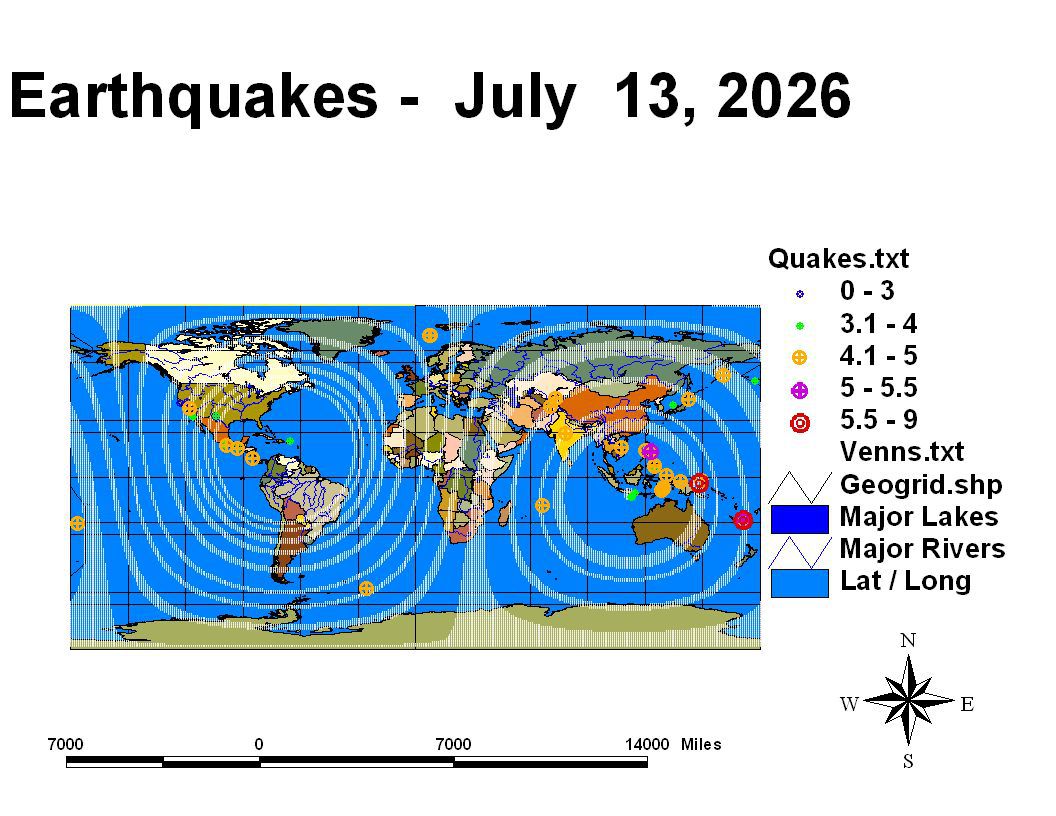

Because this summary is often behind schedule updates to the current date are being added here to make it more relEvAnt to current conditions
July 14, 2026
Notable earthquakes and events:
The new moon will arrive on July 14, 2026 at 09:43 UT. Longitudes at local solar noon are near 39 East while those at local solar midnight are near 141 West longitude. These include Hawaii and areas of eastern Alaska and western Canada and to a lesser extent areas off the coast of Oregon and California while in the east they include Eastern Turkey as well as Ethiopia and areas off southern Africa. These and surrounding areas are the most likely to see tidally enhanced seismicity at this time. A moderate to large earthquake is possible in central or eastern Turkey at this time.
An M 4.3 earthquake occurred today on the eastern boundary of the Garlock
Fault in Central California. NEIC reported it was felt widely throughout the
area of southern and central California with intensity IV in California at Johannesburg and III in West Hollywood, Glendale, Solvang, Bakersfield, Los Angeles, Valencia, Palmdale, California City, Newhall, Santa Clarita, Mojave, Sunland, Lake Arrowhead, Springville, San Bernardino, Visalia, Tehachapi, Glendale, Los Angeles among others.
EMSC reported moderate shaking in California at Mojave, Edwards AFB, Inyokern, Rosamond, Tehachapi, Quartz Hill, Desert View Highlands, Palmdale, Adelanto, Acton, Santa Clarita, San Fernando, North Hills, Burbank, Pine Mountain Club, Glendale, North Hills, Northridge, among others.
The last earthquake of M>=4.3 within about 100 km of today's epicenter
occurred as an M 4.3 on April 18, 2024 about 75 km west of today's epicenter.
The last event of significatly larger magnitude closer than this was an M 4.6
four years ago on July 15, 2022. At the time this summary noted:
"The strongest earthquake in the U.S. or Canada today was an M 4.6 in the Ridgecrest area of Central California. NEIC reported this earthquake of M 4.6 in the California-Nevada border region was felt with intensity II-III in the area(s) of the California-Nevada border region with IV in Ridgecrest and Trona and lesser shaking in Inyokern, Weldon, Lake Isabella, Bodfish, Caliente, East Tulare County, Mojave and Wofford Heights.
This is the strongest earthquake within about 100 km of this epicenter since
an M 4.8 on August 19, 2020 - an aftershock of an M 5.8 on June 24, 2020.
A series of moderate to strong earthquake began in this area of Ridgecrest
in July 4 and 6, 2019 with M 6.4 and M 7.1 among many other moderate associated
shocks. Today's event was likely triggered by high tidal stresses with the
full moon of July 13 " (July 15, 2022)
An earthquake of M 4.1 occurred yesterday at the western edge of the Garlock
Fault and was reported in this summary as:
"A moderate earthquake followed the M 5.5 in the Southern East Pacific Rise
as an M 4.1 north of Los Angeles, California - also at 118.9 West longitude,
similar to the event in the East Pacific Rise. NEIC reported it was felt in Southern
California with III in Lebec and II in Bakersfield, Frazier Park, Fullerton, Maricopa, Canyon Country and Lancaster.
widely with intensity IV in Maricopa, Frazier Park, Lebec, Rosamond and III in Marina del Rey, Bodfish, Arvin, Agoura Hills, Los Angeles, Tujunga, West Hils, Los Angeles, Canoga Park, Thousand Oaks, Bakersfield, Lake Hughes, Newbury Park, Santa Clarita, Malibu, Pasadena, Porterville, Lancaster, Shafter among others in southern and Central California.
An aftershock of M 2.9 occurred later in the day near local solar noon. NEIC reported it was felt
This earthquake in California occurred at the intersection of the Garlock and San Andreas Faults and is
the first such event near this intersection near Frazier Park, California since an M 4.1 on March 12, 2106
and an M 4.2 on January 4, 2015. This is an area where some geophysicists think
a strong earthquake is likely in the short term. The last earthquake of significantly
larger magnitude within about 50 km of today's epicenter was an M 4.7 on September 22, 2005 - an aftershock of
the strongest regional event in the past 35 years - an M 5.1 on April 16, 2005.
Both the Garlock and the San Andreas faults are capable of earthquakes with
M>=7.5. An M 7.5 occurred in July 21, 1952 near Bakersfield, the largest
regional event in recent history but two major earthquakes hit the region
in 1812 with the activity in the New Madrid and Venezuela areas reported
in previous issues of this summary. While the length of the Garlock fault has been active in recent years,
the span of the the San Andreas to the north and south of the Garloc/San
Andreas has not shown much activity and may be locked. In that sense,
today's event may be a significant regional event indicating a change
in seismic pattern with increasing stress in this area. At the time of the M 4.1 on March 12, 2016" (July 13, 2026)
Together, these events at the easternmost and westernmost termina of the
Garlock fault suggest the area is under stress and may delineate a possible
rupture zone of a larger event forthcoming in the area.
Like the M 4.1 to the west of this, this epicenter is at the fifth node
(51.4 degrees) from the Venezuela earthquakes. The Garlock fault is nearly
perpendicular to wave trains from that source and could be strongly
affected by energy from that area because of that geometry.
O: 13JUL2026 16:40:55 35.3N 117.8W MB=4.3 NEIC CENTRAL CALIFORNIA
O: 13JUL2026 16:40:54 35.3N 117.8W MW=4.2 EMSC SOUTHERN CALIFORNIA
O: 13JUL2026 17:01:11 35.3N 117.8W ML=2.4 EMSC SOUTHERN CALIFORNIA
O: 13JUL2026 18:29:13 35.3N 117.8W ML=2.6 EMSC SOUTHERN CALIFORNIA
O: 13JUL2026 18:54:19 35.3N 117.8W ML=2.5 EMSC SOUTHERN CALIFORNIA
O: 13JUL2026 19:11:16 35.3N 117.8W ML=2.0 EMSC SOUTHERN CALIFORNIA
O: 13JUL2026 22:49:16 35.3N 117.8W ML=2.2 EMSC SOUTHERN CALIFORNIA
O: 14JUL2026 05:44:51 35.3N 117.8W ML=2.6 EMSC SOUTHERN CALIFORNIA
An M 6.3 occurred today in the area southeast of the Loyalty Islands. It was
not reported felt in this remote area. This continues strong seismicity
in the area which has been ongoing for several days. The last earthquake
in the Loyalty Islands within about 200 km of today's epicenter with M>=6.3
occurred as an M 7.1 on May 20, 2023 - an aftershock of an M 7.7 on May 19, 2023.
At the time this summary noted:
"A major to great earthquake occurred today in the region of New Caledonia and the Loyalty Islands.
NEIC reported this earthquake was felt with intensity II-III in New Caledonia at We Iles, Noumea, Paita, Norfold Island, Suva, Fiji and Sydney, New South Wasles, Australia.
This earthquake occurred at the peak of an M2.3 solar flare but was probably
triggered by an M8.0 flare which maximized within a couple of minutes of local
solar noon at the epicenter an hour earlier. Solar Flare Effects (SFE) on seismicity is most
prominent at local solar noon when the epicenter is directly beneath the sun. The
...
Today's activity in the Loyalty Islands was likely promoted by strong tidal stresses
associated with the new moon as noted in this summary ... " (May 19, 2023)
Like the events of May 19 and 20, 2023 today's activity in the Loyalty Islands
also coincided with the new moon of July 14, 2026 (see above) and may have
been promoted by tidal stresses with that alignment.
This epicenter is at the third node (120 degrees) from Venezuela and may
have been promoted by energy from that source.
O: 13JUL2026 14:45:49 22.8S 171.5E MB=6.3 NEIC SOUTHEAST OF LOYALTY ISLANDS
O: 13JUL2026 07:59:35 22.8S 171.6E MB=4.9 NEIC SOUTHEAST OF LOYALTY ISLANDS
O: 13JUL2026 06:45:31 22.7S 171.6E MB=5.0 EMSC SOUTHEAST OF LOYALTY ISLANDS
O: 13JUL2026 07:59:36 22.7S 171.5E mb=4.9 EMSC SOUTHEAST OF LOYALTY ISLANDS
O: 13JUL2026 14:45:52 22.7S 171.5E Mw=6.3 EMSC SOUTHEAST OF LOYALTY ISLANDS
O: 14JUL2026 01:27:40 22.7S 171.3E mb=4.9 EMSC SOUTHEAST OF LOYALTY ISLANDS
O: 13JUL2026 16:31:35 22.8S 171.5E mb=5.1 EMSC SOUTHEAST OF LOYALTY ISLANDS
O: 13JUL2026 17:15:34 22.8S 171.5E mb=4.5 EMSC SOUTHEAST OF LOYALTY ISLANDS
O: 13JUL2026 17:21:05 22.8S 171.5E mb=4.7 EMSC SOUTHEAST OF LOYALTY ISLANDS
O: 13JUL2026 17:24:11 22.8S 171.6E mb=4.5 EMSC SOUTHEAST OF LOYALTY ISLANDS
O: 13JUL2026 15:14:40 22.9S 171.5E mb=4.7 EMSC SOUTHEAST OF LOYALTY ISLANDS
O: 13JUL2026 21:03:42 23.0S 171.4E Mw=5.0 EMSC SOUTHEAST OF LOYALTY ISLANDS
O: 13JUL2026 19:48:32 23.1S 171.5E mb=4.8 EMSC SOUTHEAST OF LOYALTY ISLANDS
The strongest earthquake in the world today was an M 6.4 in Papua New Guinea.
NEIC reported it may have been felt lightly near Lorengau, Papua New Guinea.
The last earthquake in New Guinea within about 200 km of today's
epicenter which had M>=6.4 was an M 6.4 on July 25, 2016. At the time
this summary noted:
"The strongest earthquake of the day was an M 6.4 in the Admiralty Islands
near New Ireland. This is the strongest earthquake in the earth in at least
three weeks. The last event within about 250 km of this epicenter of M>=6.4
occurred more than 10 years ago on November 5, 2005 also with M 6.4. No earthquakes
of larger size have occurred in this region in at least 25 years, however events
of M 6.4 occurred on July 25, 2003 and on March 4, 1992. ... The Admiralty
Islands are located within about 10 degrees of the geomagnetic equator." (July 25, 2016)
This earthquake may have been promoted by effects from a moderate geomagnetic
storm as discussed in the previous issue of this summary:
"A moderate geomagnetic storm with Kp reaching 4.67 between 13:00 and 15:00 UT
occurred on July 12. At high latitudes Kp at this time was 7. This is the first
time kp at any latitude has reached 7 in the past month, although a similar reading
on Planetary K-index was obtained at about 03:00 UT on July 4. Longitudes which
may see triggered enhanced seismicity due to this storm include the South
Sandwich Islands which were near local solar noon and areas near New Guinea
which were near local solar midnight at the time of this storm commencement.
The new moon (see above) will tend to reinforce triggering in these areas
in the next several days and a moderately strong to strong earthquake is
considered likely near these regions in the next two days." (July 13, 2026)
The epicenter in New Guinea is at 143 degrees from Venezuela and was
likely promoted by energy from that source.
O: 13JUL2026 08:53:27 3.2S 148.5E MB=6.4 NEIC PAPUA NEW GUINEA
O: 13JUL2026 08:53:26 3.2S 148.5E MB=6.4 EMSC BISMARCK SEA
The earthquake in the Bismarck Sea (see above) was followed 3.3 minutes later
by an M 3.8 in the area south of Java, Indonesia and later by an M 4.0. This region has been
active at magnitude range lower than this since the M 7.5 hit in Venezuela
but these are the strongest event near the exact antipode in Java to date.
Stronger regional seismicity is possible due to antipodal effects from Venezuela.
O: 13JUL2026 08:56:43 10.6S 112.7E MB=3.8 EMSC SOUTH OF JAVA, INDONESIA
O: 13JUL2026 15:19:16 10.6S 113.6E ML=4.0 EMSC SOUTH OF JAVA, INDONESIA
O: 13JUL2026 08:56:43 10.7S 112.7E ML=3.8 EMSC SOUTH OF JAVA, INDONESIA
NEIC reported an earthquake of M 5.0 in Chiapas, Mexico was felt with intensity up to II-III in the area(s) of Chiapas, Mexico in Guatemal City at Chinautla, Retalhuleu, Villa Nueva and in San JKuan la Laguna, and Panajachel, Solola, Olintepeque, Quezaltenango and in Villahermosa, Tabasco, Mexico.
EMSC reported strong shaking in Guatemala at San Bernardino, San Antonio Aguas Calientes, Villa Nueva, Mixco, and in Tapachula, Mexico.
O: 14JUL2026 01:19:59 14.8N 92.3W MB=5.0 NEIC CHIAPAS, MEXICO
O: 14JUL2026 01:20:00 14.7N 92.3W MW=5.0 EMSC CHIAPAS, MEXICO
O: 14JUL2026 02:12:56 14.5N 92.4W ML=4.2 EMSC OFFSHORE CHIAPAS, MEXICO
NEIC reported an earthquake of M 2.8 off the coast of Northern California was felt with intensity up to II-III in the area(s) of off the coast of Northern California in Eureka.
O: 13JUL2026 18:44:28 40.5N 124.5W MB=2.8 NEIC OFFSHORE NORTHERN CALIFORNIA
NEIC reported an earthquake of M 3.0 in Nevada was felt with intensity up to II-III in the area(s) of Nevada in Silver Springs and Fallon.
O: 13JUL2026 09:46:03 39.3N 119.0W MB=3.0 NEIC NEVADA
SEISMIC EFFECTS OF TROPICAL CYCLONES
Some seismicity may be affected by weather due to wind, tidal surge and air pressure systems effects of the continental mass compared with adjoining plate masses. During the tropical storm season in the Northern Hemisphere we keep an eye on tropical storms which may affect seismicity according to our models. Currently the following tropical storms appear to have potential to affect seismicity in the coming week:
No Tropical cyclones are currently active
A tropical cyclone may be forming south of Guerrero, Mexico. This system is currently
at 12N 101W and moving to the west with winds up to 33 kts. No immediate
effects on regional seismicity are expected with this storm at this time.
SOLAR FLARES
Following is the listing of C- M- or X-class flares from SWPC for the date
of July 13, 2026. These listings are published daily in this summary and at SWPC.
The main line gives details of flares. Subsequent lines identify some earthquakes
which are at or after the time of the flare and could have been affected by
immediate Solar Flare Effects (SFE). Some earthquakes occur at longitudes
which were at local solar noon or local solar midnight when a flare occurred and may also have
been affected by SFE. These are not identified here.
SOLAR FLARES
Flare # START MAX END CLASS DATE Flux (Jm-2)
-------------------------------------------------------------------------
7640 1733 1747 1800 C1.4 (July 13, 2026) 2.0E-03
Mindanao M 5.0 17:44 UT
South Sandwich Is. M 4.9 17:45 UT
Sea of Japan M 4.0 17:58 UT
7650 1815 1822 1833 C1.3 (July 13, 2026) 1.4E-03
Southern California M 2.6 18:29 UT
*indicates modified reading from NOAA GOES Graph
GEOMAGNETIC FIELD: active July 14 unsettled July 15-16. Solar M-flare chance: 25% X-class: 5% proton storm: 1%
A moderate geomagnetic storm with Hp30 (Kp) reaching 4.0 occurred late on
UT July 13 between 23:30 and 00:00 on July 14, 2026.
AP Indicies: global: 9, high: 10, mid-latitude: 8, time of max k: 22:00-24:00 UT; Max k: 3 Global Kp 3.67 2100-2400, July 13; Sunspot Number: 59; Radio Flux: 103
July 13, 2026
Notable earthquakes and events:
The new moon will arrive on July 14, 2026 at 09:43 UT. Longitudes at local solar noon are near 39 East while those at local solar midnight are near 141 West longitude. These include Hawaii and areas of eastern Alaska and western Canada and to a lesser extent areas off the coast of Oregon and California while in the east they include Eastern Turkey as well as Ethiopia and areas off southern Africa. These and surrounding areas are the most likely to see tidally enhanced seismicity at this time. A moderate to large earthquake is possible in central or eastern Turkey at this time.
A moderate geomagnetic storm with Kp reaching 4.67 between 13:00 and 15:00 UT
occurred on July 12. At high latitudes Kp at this time was 7. This is the first
time kp at any latitude has reached 7 in the past month, although a similar reading
on Planetary K-index was obtained at about 03:00 UT on July 4. Longitudes which
may see triggered enhanced seismicity due to this storm include the South
Sandwich Islands which were near local solar noon and areas near New Guinea
which were near local solar midnight at the time of this storm commencement.
The new moon (see above) will tend to reinforce triggering in these areas
in the next several days and a moderately strong to strong earthquake is
considered likely near these regions in the next two days.
The first M-class solar flare in the past five days occurred today with
M1.1 peaking about 08:00 UT. Areas which were near local solar midnight
at the time of this flare were near 120 West longitude and included
Western California, Oregon and the Southeast Pacific Ridge. These
areas showed immediate SFE effects from this flare including an M 5.5 in
the Southeast Pacific and an M 4.1 north of Los Angeles, California and
an M 3.8 off the coast of Oregon.
The event in the Southern East Pacific Rise was discussed in the previous
issur of this summary as:
"The strongest earthquake in the world yesterday (July 11) was an M 6.4 in the South Sandwich
Islands of the southern Atlantic region. It was not reported felt in this
remote area. A tsunami was neither expected nor observed with this earthquake. The last earthquake of M>=6.4 in the South Sandwich Islands was
an M 7.1 on August 22, 2021 (see previous issue of this summary).
The second strongest earthquake in the world today occurred directly west
of the M 6.4 in the South Sandwich Island (see above) in the Southern East
Pacific Rise where an M 5.5 was recorded. At M 5.5 this is the strongest
earthquake in the Southern East Pacific Rise within about 200 km of this
epicenter in at least 35 years. The strongest earthquake within about 300
km of today's earthquake in the past 35 years was an M 6.6 on May 20, 2026
about 300 km east of today's epicenter. Today's event may have been promoted
by stress redistribution in the area from that quake which was discussed
at the time in this summary as:
"A strong M 6.6 earthquake hit the South East Pacific Rise today at 122 West
longitude. This event was not reported felt in this remote area and
a tsunami is unlikely. EMSC shows an aftershock of M 5.2 about 53 minutes
after the mainshock. The mainshock is the strongest recorded within
about 300 km of this epicenter since an M 6.6 on August 6, 2001 nearly
25 years ago.
This epicenter is at 122 West longitude, a longitude which was particularly stressed
during the new moon of May 16 as reported in previous issues of this summary:
"The new moon will arrive on May 16, 2026 at 20:01 UT. Longitudes which are at local solar noon at this time are near 120W and those at local solar midnight near 60E. In the west these include western North America (including California, Oregon and Washington) and portions of the East Pacific Rise and in the east portions of the central Indian Ocean and Central Asia near Hindu Kush, Iran, Pakistan and Afghanistan among others. These areas are most likely to see tidal triggering in the next week. A large earthquake is possible in this time and tidal triggering is not limited to these regions but is most likely near local solar noon or local solar midnight." (May 14-28, 2026)
This epicenter is also nearly antipodal to a highly unusual pair of earthquakes
that struck on May 5 in the Ural Mountains of Russia. ..." (May 20, 2026)
Today's event in the Southern East Pacific Rise occurred within minutes of
local solar midnight and may have been promoted by tidal and/or geomagnetic
stresses which maximize near this hour.
This earthquake appears to have been promoted by SFE from an M-class solar
flare. The quake occurred within minutes of local solar midnight near the
peak of an M1.1 solar flare (#7440), the first M-class solar flare since July 9 (M1.1 #6940).
Only two other M-class flares have been listed by SWPC in the past 10 days.
Preliminary data on this flare from SWPC follow.
Flare # START MAX END CLASS DATE Flux (Jm-2)
-------------------------------------------------------------------------
7440 0717 0811 0842 M1.1 (July 12, 2026) 3.3E-02
Southern East Pacific Rise M 5.5 07:29 UT
Southern California M 4.1 10:38 UT
Central California M 2.4 08:02 UT
Fiji M 4.1 08:45 UT
Siberia M 4.4 08:03 UT
Kamchatka M 4.3 08:52 UT
A strong excursion in the geomagnetic field intensity at GOES satellites
was also recorded by both GOES 18 and 19 magnetometers. This began about 06:45 UT
to about 07:15 UT." (July 12, 2026)
This epicenter is at 144 degrees from the North Geomagnetic pole and may
have been promoted by energy from that source.
O: 12JUL2026 07:29:24 54.5S 118.9W MB=5.5 NEIC SOUTHERN EAST PACIFIC RISE
O: 12JUL2026 07:29:23 54.6S 119.0W MB=5.5 EMSC SOUTHERN EAST PACIFIC RISE
A moderate earthquake followed the M 5.5 in the Southern East Pacific Rise
as an M 4.1 north of Los Angeles, California - also at 118.9 West longitude,
similar to the event in the East Pacific Rise. NEIC reported it was felt in Southern
California with III in Lebec and II in Bakersfield, Frazier Park, Fullerton, Maricopa, Canyon Country and Lancaster.
widely with intensity IV in Maricopa, Frazier Park, Lebec, Rosamond and III in Marina del Rey, Bodfish, Arvin, Agoura Hills, Los Angeles, Tujunga, West Hils, Los Angeles, Canoga Park, Thousand Oaks, Bakersfield, Lake Hughes, Newbury Park, Santa Clarita, Malibu, Pasadena, Porterville, Lancaster, Shafter among others in southern and Central California.
An aftershock of M 2.9 occurred later in the day near local solar noon. NEIC reported it was felt
This earthquake in California occurred at the intersection of the Garlock and San Andreas Faults and is
the first such event near this intersection near Frazier Park, California since an M 4.1 on March 12, 2106
and an M 4.2 on January 4, 2015. This is an area where some geophysicists think
a strong earthquake is likely in the short term. The last earthquake of significantly
larger magnitude within about 50 km of today's epicenter was an M 4.7 on September 22, 2005 - an aftershock of
the strongest regional event in the past 35 years - an M 5.1 on April 16, 2005.
Both the Garlock and the San Andreas faults are capable of earthquakes with
M>=7.5. An M 7.5 occurred in July 21, 1952 near Bakersfield, the largest
regional event in recent history but two major earthquakes hit the region
in 1812 with the activity in the New Madrid and Venezuela areas reported
in previous issues of this summary. While the length of the Garlock fault has been active in recent years,
the span of the the San Andreas to the north and south of the Garloc/San
Andreas has not shown much activity and may be locked. In that sense,
today's event may be a significant regional event indicating a change
in seismic pattern with increasing stress in this area. At the time of the M 4.1 on March 12, 2016 this summary noted:
"The strongest earthquake in California today was an M 4.1 near Ojai, California.
NEIC reported maximum intensity V and noted it was felt with intensity II-III
in Santa Paula, Ojai, Fillmore, Oak View, Somis, Ventura, Moorpark, Camarillo
and other areas of Southwestern California. This was part of a series of events
which may have been tidally promoted. The initial events in the series - an M 3.3
and an M 2.3 occurred within about 30 minutes of local solar midnight, a prime
time for tidal triggering of seismicity. The event of M 4.1 is the strongest
to hit within about 50 km of this epicenter since an M 4.1 on May 8, 2009. The
last of larger magnitude in the region was an M 4.3 on July 24, 2004." (March 12, 2016)
This epicenter is at the seventh node (51.4 degrees) from recent major
earthquakes in Venezuela and was probably promoted by energy from those sources.
It is also at the fourth node (90 degrees) from the M 5.5 in the South East Pacific
Rise several hours earlier (see above).
O: 12JUL2026 10:38:04 34.8N 118.9W MB=4.1 NEIC SOUTHERN CALIFORNIA
O: 12JUL2026 10:38:04 34.8N 118.9W MW=4.1 EMSC CENTRAL CALIFORNIA
O: 12JUL2026 13:01:33 34.8N 118.9W ML=2.2 EMSC CENTRAL CALIFORNIA
O: 12JUL2026 17:53:11 34.8N 118.9W ML=2.8 EMSC CENTRAL CALIFORNIA
O: 12JUL2026 22:37:38 34.8N 118.9W ML=2.1 EMSC CENTRAL CALIFORNIA
O: 12JUL2026 17:53:11 34.8N 118.9W MB=2.9 NEIC SOUTHERN CALIFORNIA
NEIC reported an earthquake of M 4.2 in Southern Alaska was felt with intensity up to II-III in the area(s) of Southern Alaska in Girdwood, Kenai, Anchorage, Willow, Cooper Landing, Homer, Chugiak, Eagle River and Soldotna.
The second M 4.2 was reported with intensity III in Alaska at Girdwood, Kasilof, Anchorage, and II in Anchor Point, Homer and Ninilchik.
O: 12JUL2026 06:00:44 59.7N 153.0W MB=4.2 NEIC SOUTHERN ALASKA
O: 12JUL2026 22:11:06 59.7N 152.5W ML=4.2 EMSC SOUTHERN ALASKA
O: 12JUL2026 22:11:06 59.7N 152.5W MB=4.2 NEIC SOUTHERN ALASKA
NEIC reported an earthquake of M 3.0 in Northern California was felt with intensity up to II-III in the area(s) of Northern California in Fortuna and Eureka.
O: 13JUL2026 06:14:17 40.5N 124.3W MB=3.0 NEIC NORTHERN CALIFORNIA
O: 13JUL2026 06:14:17 40.5N 124.3W MD=3.0 EMSC NORTHERN CALIFORNIA
NEIC reported an earthquake of M 5.4 in Luzon, Philippines was felt with intensity up to II-III in the area(s) of Luzon, Philippines in Bicol with V in Claveria; III in Tabaco, Sagpon and II in Marupit.
O: 13JUL2026 00:54:02 12.8N 123.0E MB=5.4 NEIC LUZON, PHILIPPINES
O: 13JUL2026 00:54:03 12.8N 123.0E MW=5.4 EMSC MASBATE REGION, PHILIPPINES
NEIC reported an earthquake of M 3.6 in Southern Texas was felt with intensity up to II-III in the area(s) of Southern Texas in San Antonio.
This earthquake occurred near local solar noon and may have been promoted
by tidal and/or geomagnetic stresses which maximize near this hour.
The last earthquake in southern Texas within about 200 km of today's epicenter
with M>=3.6 was an M 3.6 on January 31, 2025 - an aftershock of an M 4.5 on January 30, 2025. The
only other event in the area in the past 15 years of significantly larger magnitude
than that of today was an M 4.7 on February 17, 2024. At the time of the M 4.5 in January,
2025 this summary noted:
"A moderate M 4.5 earthquake occurred in the Falls City, Southern Texas region today. NEIC reported this earthquake was felt with maximum intensity V in Southern Texas at Gillett, Bastrop; IV in Ecleto, Falls City, Hobson, Karnes City, Kenedy, Poth, Runge, Stockdale, San Antonio; III in Whitney, Richmond, Devine, Jourdanton, Kerrville, Pleasanton, Adkins, Cibolo, Converse, Floresville, La Vernia, Marion, New Braunfels, Nixon, Saint Hedwig, Schertz, Seguin, Smiley, Sutherland Springs, Yorktown, San Antonio, Burnet, Del Valle, Elgin, Leander, Manor, Round Rock Austin and as far as 200 km from the epicenter.
It may have been promoted by the new moon which arrived today
...
This earthquake follows a series of minor to moderate quakes in the area over the past several years and has been
covered in this summary. Two earthquakes of M>=4.5 have hit this area within about
200 km of this epicenter in the past 35 years - an M 4.8 on October 20, 2011 and an M 4.7 on February 7, 2024. When the M 4.4 and 4.7 hit the area on
February 17, 2024, this summary noted:
"The strongest earthquake in the U.S. or Canada today was an M 4.7 in southern Texas. This event was reported by NEIC to have been felt with intensity up to VI in Falls City, Texas.
Aftershocks of M 3.7 and 3.3 followed and were felt in the same area. EMSC reported
the mainshocks were felt as far as San Antonio where beds shook and people were awakened. It followed
a series of foreshocks including an M 4.4 twelve minutes earlier which was felt with intensity
up to V in Falls City, Texas. An M 3.9 foreshock was also felt with intensity up to
V in the Falls City area of Texas. Today's activity occurred within minutes
of local solar midnight and may have been promoted by strong tidal stresses
which maximize near this hour. An X2.3 solar flare occurred on February 16, 2024
when this epicenter was at local solar midnight. This flare may have helped
trigger this unusually large earthquake.
...
Today's activity follows an M 3.9 in the same area of Texas which occurred on February 12, 2024 and
was noted in this summary at the time as:
"An earthquake of M 3.8-3.9 also shook southern Texas today. NEIC reported it was felt with intensity up to IV in the Falls City, Texas area.
The only earthquake within about 100 km of this epicenter of M>3.9 in the
past 35 years were events of M 4.8 on October 20, 2011 and M 4.3 on April 9, 1993.
An M 3.3 hit the same area on February 9, 2024. At the time this summary noted:
"A light earthquake of M 3.3 also occurred in Southern Texas today.
NEIC reported this earthquake of M 3.3 in Southern Texas was felt with intensity up to IV in the area(s) of Southern Texas in Falls City.
Light earthquakes in this region began in late 2020. The largest earthquakes
in the region in recent years were of M 3.9-4.0 on October 9, 2023 and September 14, 2023.
Recent events in the area suggest triggering at this level in this area
is likely at this time." (February 9, 17, 2024)
On October 20, 2011 when this series began in earnest this summary noted:
"The unusual earthquake in southern Texas was the strongest in that region
in recorded history. The only event of M>=4 in the area since 1990 was an
M 4.3 on April 9, 1993. There is no record of any earthquake in this area
off south-central Texas of M>4 since events were first recorded in the area
nearly 200 years ago. It may be due to oil extraction in the area but
this is simply speculation. This is one of the strongest earthquakes ever
recorded in Texas...."( January 30, 2025)
O: 12JUL2026 20:52:20 28.6N 99.1W MB=3.6 NEIC SOUTHERN TEXAS
O: 12JUL2026 20:11:25 28.6N 99.1W ML=2.4 EMSC SOUTHERN TEXAS
O: 12JUL2026 20:52:20 28.6N 99.1W ML=3.5 EMSC SOUTHERN TEXAS
O: 13JUL2026 06:09:35 28.8N 99.0W ML=2.1 EMSC SOUTHERN TEXAS
O: 12JUL2026 11:24:51 28.9N 99.0W ML=2.1 EMSC SOUTHERN TEXAS
O: 13JUL2026 01:44:54 28.9N 99.0W ML=2.6 EMSC SOUTHERN TEXAS
NEIC reported an earthquake of M 3.8 off the coast of Oregon was felt with intensity up to II-III in the area(s) of off the coast of Oregon near Bandon.
This epicenter is at the sixth node (60 degrees) from Venezuela and may have
been promoted by energy from that source.
O: 12JUL2026 17:49:02 43.4N 127.2W MB=3.8 NEIC OFF COAST OF OREGON
O: 12JUL2026 17:49:02 43.4N 127.3W MB=3.8 EMSC OFF COAST OF OREGON
NEIC reported an earthquake of M 4.6-4.8 in South Island, New Zealand was felt with intensity up to II-III in the area(s) of South Island, New Zealand in Woodend Canterbury.
GeoNet reported the following data for this earthquake:
This epicenter is near the third node (120 degrees) from Venezuela and may
have been promoted by energy from that source.
O: 12JUL2026 16:31:07 42.6S 173.5E MS=4.8 GEONET Felt with light intensity in the area of Hammer Springs, New Zealand and in southern North Island. Of 333 felt reports 152 reports of weak and 145 of light intensity with 33 of moderate shaking and 2 with strong 0 with severe and 1 with extreme intensity came from the area.
O: 12JUL2026 16:31:08 42.5S 173.5E MB=4.6 NEIC SOUTH ISLAND, NEW ZEALAND
O: 12JUL2026 16:31:08 42.6S 173.5E MB=4.6 EMSC SOUTH ISLAND OF NEW ZEALAND
NEIC reported an earthquake of M 4.6 in the South Sandwich Islands may have been felt with intensity up to II-III in the area(s) of the South Sandwich Islands.
This epicenter is near the fifth node (72 degrees) from Venezuela and may
have been promoted by energy from that source.
O: 12JUL2026 15:15:57 55.6S 27.3W MB=4.6 NEIC SOUTH SANDWICH ISLANDS
O: 12JUL2026 15:15:57 55.6S 27.3W MB=4.6 EMSC SOUTH SANDWICH ISLANDS REGION
NEIC reported an earthquake of M 5.3 in Sulawesi, Indonesia was felt with intensity up to II-III in the area(s) of Sulawesi, Indonesia in Manado.
O: 12JUL2026 10:05:38 0.2N 122.4E mb=4.7 EMSC MINAHASA, SULAWESI, INDONESIA
O: 12JUL2026 13:46:37 1.2N 121.4E MB=5.3 EMSC MINAHASA, SULAWESI, INDONESIA
O: 12JUL2026 13:46:37 1.2N 121.4E MB=5.3 NEIC SULAWESI, INDONESIA
NEIC reported an earthquake of M 5.1 in Sumbawa, Indonesia was felt with intensity up to II-III in the area(s) of Sumbawa, Indonesia in Timur at Waingapu with IV and III in Ruteng.
This epicenter is near the antipode of recent major earthquakes in Venezuela
and may have been promoted by antipodal energy concentration from that source.
Similar elevated activity near the antipode of Venezuela is currently
occurring near Krakatora and south of Java and is expected to continue
with additional moderate earthquakes in this region.
O: 12JUL2026 13:20:25 9.6S 119.3E MB=5.1 NEIC SUMBAWA, INDONESIA
O: 12JUL2026 13:20:21 9.7S 119.3E MB=5.1 EMSC SUMBA REGION, INDONESIA
NEIC reported an earthquake of M 3.0 in Nevada was felt with intensity up to II-III in the area(s) of Nevada near Las Vegas.
O: 12JUL2026 12:36:02 36.7N 115.7W MB=3.0 NEIC NEVADA
NEIC reported an earthquake of M 3.3 in Hawaii was felt with intensity up to II-III in the area(s) of Hawaii in Pahoa.
This epicenter is south of Hawaii and is at the sub-solar latitude for today.
It may have been promoted by sub-solar stresses as it occurred near local
solar midnight.
O: 12JUL2026 11:43:49 18.8N 155.1W MB=3.3 NEIC HAWAII
NEIC reported an earthquake of M 4.5 in the Fox Islands, Aleutians, Alaska was felt with intensity up to II-III in the area(s) of the Fox Islands, Aleutians, Alaska with III in Unalaska, Alaska.
O: 12JUL2026 11:23:48 53.6N 166.7W MB=4.5 NEIC FOX ISLANDS
EMSC reported an earthquake of M 4.8 in Russia-Mongolia border was felt with intensity up to IV in the area(s) of Russia-Mongolia border in Russia at Shamanka, Angarsk, Markova, Irkutsk, and Dzerzhinsk.
This epicenter is near the third node (120 degrees) from Venezuela and may
have been promoted by energy from that source.
O: 13JUL2026 02:18:40 51.6N 102.0E MB=4.8 EMSC RUSSIA-MONGOLIA BORDER
EMSC reported an earthquake of M 4.3 in Meghalaya, India was felt with intensity up to IV in the area(s) of Meghalaya, India at Guwahati.
This event occurred within minutes of local solar noon near the sub-solar
latitude today and may have been promoted by tidal and/or geomagnetic
stresses with the new moon of July 14, 2026 (see above).
O: 12JUL2026 06:30:39 25.6N 90.6E MB=4.3 EMSC MEGHALAYA, INDIA REGION
SEISMIC EFFECTS OF TROPICAL CYCLONES
Some seismicity may be affected by weather due to wind, tidal surge and air pressure systems effects of the continental mass compared with adjoining plate masses. During the tropical storm season in the Northern Hemisphere we keep an eye on tropical storms which may affect seismicity according to our models. Currently the following tropical storms appear to have potential to affect seismicity in the coming week:
No Tropical cyclones are currently active
A tropical cyclone may be forming in the north Pacific. This system is currently
at 11N 136E and moving to the WNW with lines up to 28 kts. No immediate
effects on regional seismicity are expected with this storm at this time.
SOLAR FLARES
Following is the listing of C- M- or X-class flares from SWPC for the date
of July 12, 2026. These listings are published daily in this summary and at SWPC.
The main line gives details of flares. Subsequent lines identify some earthquakes
which are at or after the time of the flare and could have been affected by
immediate Solar Flare Effects (SFE). Some earthquakes occur at longitudes
which were at local solar noon or local solar midnight when a flare occurred and may also have
been affected by SFE. These are not identified here.
SOLAR FLARES
Flare # START MAX END CLASS DATE Flux (Jm-2)
-------------------------------------------------------------------------
7390 0015 0057 0260 C5.9 (July 12, 2026) 1.5E-02 *
Kamchatka M 4.4 00:20 UT
Guerrero M 4.0 00:36 UT
Talaud M 4.9 00:43 UT
7440 0717 0811 0842 M1.1 (July 12, 2026) 3.3E-02
Southern East Pacific Rise M 5.5 07:29 UT
Southern California M 4.1 10:38 UT
Central California M 2.4 08:02 UT
Fiji M 4.1 08:45 UT
Siberia M 4.4 08:03 UT
Kamchatka M 4.3 08:52 UT
7510 1346 1358 1406 C2.6 (July 12, 2026) 2.1E-03
Minahasa, Sulawesi M 5.3 13:46 UT
7520 1523 1532 1536 C1.0 (July 12, 2026) 8.7E-04
7550 1536 1540 1543 C1.0 (July 12, 2026) 5.5E-04
7560 1952 1959 2010 B8.9 (July 12, 2026) 9.3E-04
Oacaca M 3.9, 3.9 19:55 UT 20:01 UT
Southern Texas M 2.4 20:11 UT
*indicates modified reading from NOAA GOES Graph
GEOMAGNETIC FIELD: unsettled July 13 quiet July 14-15. Solar M-flare chance: 25% X-class: 5% proton storm: 1%
AP Indicies: global: 18, high: 40, mid-latitude: 16, time of max k: 09:00-12:00 UT; Max k: 7 Global Kp 4.67 1100-1200, July 12; Sunspot Number: 70; Radio Flux: 107
July 12, 2026
Notable earthquakes and events:
The new moon will arrive on July 14, 2026 at 09:43 UT. Longitudes at local solar noon are near 39 East while those at local solar midnight are near 141 West longitude. These include Hawaii and areas of eastern Alaska and western Canada and to a lesser extent areas off the coast of Oregon and California while in the east they include Eastern Turkey as well as Ethiopia and areas off southern Africa. These and surrounding areas are the most likely to see tidally enhanced seismicity at this time. A moderate to large earthquake is possible in central or eastern Turkey at this time.
The strongest earthquake in the world today was an M 6.4 in the South Sandwich
Islands of the southern Atlantic region. It was not reported felt in this
remote area. A tsunami was neither expected nor observed with this earthquake. The last earthquake of M>=6.4 in the South Sandwich Islands was
an M 7.1 on August 22, 2021. At the time this summary noted:
"The strongest earthquake in the world today was an M 7.0-7.1 in the South Sandwich
Island, the strongest aftershock to date of the August 12, 2021 M 8.1 and is
approximately the size of the earthquake in Haiti of August 14 (M 7.2).
It was accompanied by a strong series of earthquakes including an M 5.8.
Tidal stresses (see above) were near their maximum in the South Sandwich Islands
today with the full moon and probably helped enhance this activity." (August 22, 2021)
Today's earthquake in the South Sandwich Islands follows a series of moderate
to strong earthquakes which began in early July. This series was discussed
in the previous issue of this summary as:
"The strongest earthquake of the day in the world was an M 5.4 in the South Sandwich
Islands area of the South Atlantic. This area has seen seismic enhancement since
the full moon of June 29, 2026 including an M 4.9 several hours before today's
event. It had been near local solar midnight when that full moon was finalized
and was expected (by this summary) to see subsequent seismic enhancement
at this time as:
"The full moon arrived on June 29, 2026 at 23:57 UT. Longitudes which are at local solar midnight at this time are located at about 0 East while those at local solar noon are near 180 West/East. In the east these include most of western Europe, England and Iceland and the south Mid-Atlantic Ridge and the South Sandwich Islands while in the west areas of the western Aleutians, Alaska, Hawaii, Tonga/Fiji/Kermadec Islands, New Zealand to the Balleny Islands and portions of the Pacific-Antarctic Ridge are included. These are the most likely areas to see significant tidal triggering with this full moon. Other areas may also see tidal promotion in the next week especially at times of large solar flares and near local solar midnight and solar noon. The likelihood of a strong associated earthquake with this full moon are moderate to high." (June 28 to July 2, 2026)
Further activity in the South Sandwich Islands is expected at this time. This
includes the possibility of a strong regional earthquake in the next several
days. The area was strong influenced by the strong geomagnetic storm of the
past several days as noted in this summary in previous issues:
"A series of earthquakes occurred at various epicenters in the South Sandwich
Islands and southwest of Africa with moderate intensity. These were all
oceanic events and were not felt in the epicentral area. This area was
near local solar noon at the time of the full moon of June 29, 2026
and had been expected to see enhanced seismicity at this time in the
seismic forecast in this summary .. " (July 3, 2026, July 11, 2026)
This epicenter is at 145 degrees from the landfall position of Typhoon Bavi
today and at the fifth node (72 degrees) from Venezuela and may have been promoted
by constructive interference of energy from those sources.
O: 11JUL2026 10:26:44 55.6S 28.9W MB=6.4 NEIC SOUTH SANDWICH ISLANDS REGION
O: 11JUL2026 06:52:27 59.6S 26.4W MB=5.4 NEIC SOUTH SANDWICH ISLANDS REGION
The second strongest earthquake in the world today occurred directly west
of the M 6.4 in the South Sandwich Island (see above) in the Southern East
Pacific Rise where an M 5.5 was recorded. At M 6.4 this is the strongest
earthquake in the Southern East Pacific Rise within about 200 km of this
epicenter in at least 35 years. The strongest earthquake within about 300
km of today's earthquake in the past 35 years was an M 6.6 on May 20, 2026
about 300 km east of today's epicenter. Today's event may have been promoted
by stress redistribution in the area from that quake which was discussed
at the time in this summary as:
"A strong M 6.6 earthquake hit the South East Pacific Rise today at 122 West
longitude. This event was not reported felt in this remote area and
a tsunami is unlikely. EMSC shows an aftershock of M 5.2 about 53 minutes
after the mainshock. The mainshock is the strongest recorded within
about 300 km of this epicenter since an M 6.6 on August 6, 2001 nearly
25 years ago.
This epicenter is at 122 West longitude, a longitude which was particularly stressed
during the new moon of May 16 as reported in previous issues of this summary:
"The new moon will arrive on May 16, 2026 at 20:01 UT. Longitudes which are at local solar noon at this time are near 120W and those at local solar midnight near 60E. In the west these include western North America (including California, Oregon and Washington) and portions of the East Pacific Rise and in the east portions of the central Indian Ocean and Central Asia near Hindu Kush, Iran, Pakistan and Afghanistan among others. These areas are most likely to see tidal triggering in the next week. A large earthquake is possible in this time and tidal triggering is not limited to these regions but is most likely near local solar noon or local solar midnight." (May 14-28, 2026)
This epicenter is also nearly antipodal to a highly unusual pair of earthquakes
that struck on May 5 in the Ural Mountains of Russia. ..." (May 20, 2026)
Today's event in the Southern East Pacific Rise occurred within minutes of
local solar midnight and may have been promoted by tidal and/or geomagnetic
stresses which maximize near this hour.
This earthquake appears to have been promoted by SFE from an M-class solar
flare. The quake occurred within minutes of local solar midnight near the
peak of an M1.1 solar flare, the first M-class solar flare since July 9 (M1.1 #6940).
Only two other M-class flares have been listed by SWPC in the past five days.
Preliminary data on this flare from SWPC follow.
Flare # START MAX END CLASS DATE Flux (Jm-2)
-------------------------------------------------------------------------
XXXX 0717 0811 0842 M1.1 (July 12, 2026) 3.3E-02
A strong excursion in the geomagnetic field intensity at GOES satellites
was also recorded by both GOES 18 and 19 magnetometers. This began about 06:45 UT
to about 07:15 UT.
O: 12JUL2026 07:29:24 54.5S 118.9W MB=5.5 NEIC SOUTHERN EAST PACIFIC RISE
O: 12JUL2026 07:29:23 54.6S 119.0W MB=5.5 NEIC SOUTHERN EAST PACIFIC RISE
NEIC reported an earthquake of M 4.2 in Southern Alaska was felt with intensity up to II-III in the area(s) of Southern Alaska in Girdwood, Kenai, Anchorage, Willow, Cooper Landing, Homer, Chugiak, Eagle River and Soldotna.
O: 12JUL2026 06:00:44 59.7N 153.0W MB=4.2 NEIC SOUTHERN ALASKA
NEIC reported an earthquake of M 2.7 in Northern California was felt with intensity up to II-III in the area(s) of Northern California at Fortuna.
O: 12JUL2026 03:35:05 40.5N 124.3W MB=2.7 NEIC NORTHERN CALIFORNIA
NEIC reported an earthquake of M 4.9 in Molucca, Indonesia was felt with intensity up to II-III in the area(s) of Molucca, Indonesia in Manado, Sulawesi.
O: 12JUL2026 00:43:30 3.7N 127.0W MB=4.9 NEIC MOLUCCA, INDONESIA
NEIC reported an earthquake of M 3.6 in Central Alaska was felt with intensity up to II-III in the area(s) of Central Alaska near Petersville.
O: 11JUL2026 16:00:56 63.1N 150.4W MB=3.6 NEIC CENTRAL ALASKA
NEIC reported an earthquake of M 5.4 in Mindanao, Philippines was felt with intensity up to II-III in the area(s) of Mindanao, Philippines with IV in San Jose, III in Buayan, Tingacan and II in Manado, Sulawesi, Indonesia.
O: 11JUL2026 10:51:12 5.0N 125.5E MB=5.4 NEIC MINDANAO, PHILIPPINES
EMSC reported an earthquake of M 4.5 in the Bay of Bengal was felt with intensity up to IV in the area(s) of the Bay of Bengal in India at Yarada and Visakhapatnam.
This earthquake was nearly sub-solar and may have been promoted by sub-solar
effects on this date.
This epicenter is at 142 degrees from Venezuela and may have been promoted
by energy from that source.
O: 11JUL2026 23:35:45 16.5N 84.5E MB=4.5 EMSC BAY OF BENGAL
SEISMIC EFFECTS OF TROPICAL CYCLONES
Some seismicity may be affected by weather due to wind, tidal surge and air pressure systems effects of the continental mass compared with adjoining plate masses. During the tropical storm season in the Northern Hemisphere we keep an eye on tropical storms which may affect seismicity according to our models. Currently the following tropical storms appear to have potential to affect seismicity in the coming week:
SUPER TYPHOON BAVI (09W)
---- ------- ---------- -------- ----- ------ ------- ---------------
STYP BAVI 2026-07-12 00:00 UT 28.7N 120.4E 75 kts West of Ryukyu Islands, Japan
Super Typhoon Bavi (TD 09W) continued today as it made landfall in the Japanese Ryukyu Islands with winds up to 75 kts. It is expected to track to the northwest over the day and to dissipate in the next day. The antipode of today's location of Bavi is near 28S 60W over eastern Brazil and is not likely to see enhanced seismicity at this time as it is generally a seismic quiet zone.
SOLAR FLARES
Following is the listing of C- M- or X-class flares from SWPC for the date
of July 11, 2026. These listings are published daily in this summary and at SWPC.
The main line gives details of flares. Subsequent lines identify some earthquakes
which are at or after the time of the flare and could have been affected by
immediate Solar Flare Effects (SFE). Some earthquakes occur at longitudes
which were at local solar noon or local solar midnight when a flare occurred and may also have
been affected by SFE. These are not identified here.
SOLAR FLARES
Flare # START MAX END CLASS DATE Flux (Jm-2)
-------------------------------------------------------------------------
XXXX 0717 0811 0842 M1.1 (July 12, 2026) 3.3E-02
XXXX 0015 0045 0260 C6.0 (July 12, 2026) 6.3E-03
7250 0332 0337 0343 C1.1 (July 11, 2026) 6.1E-04
Antofagasta M 2.7 03:31 UT
7350 2002 2013 2030 C1.0 (July 11, 2026) 1.7E-03
Antofagasta M 4.0 20:25 UT
*indicates modified reading from NOAA GOES Graph
GEOMAGNETIC FIELD: minor storms July 12 unsettled July 13 quiet July 14. Solar M-flare chance: 25% X-class: 5% proton storm: 1%
AP Indicies: global: 7, high: 7, mid-latitude: 9, time of max k: 05:00-08:00 UT; Max k: 3 Global Kp 2.33 0000-0600, July 11; Sunspot Number: 82; Radio Flux: 112
July 11, 2026
Notable earthquakes and events:
The new moon will arrive on July 14, 2026 at 09:43 UT. Longitudes at local solar noon are near 39 East while those at local solar midnight are near 141 West longitude. These include Hawaii and areas of eastern Alaska and western Canada and to a lesser extent areas off the coast of Oregon and California while in the east they include Eastern Turkey as well as Ethiopia and areas off southern Africa. These and surrounding areas are the most likely to see tidally enhanced seismicity at this time. A moderate to large earthquake is possible in central or eastern Turkey at this time.
The strongest earthquake of the day in the world was an M 5.4 in the South Sandwich
Islands area of the South Atlantic. This area has seen seismic enhancement since
the full moon of June 29, 2026 including an M 4.9 several hours before today's
event. It had been near local solar midnight when that full moon was finalized
and was expected (by this summary) to see subsequent seismic enhancement
at this time as:
"The full moon arrived on June 29, 2026 at 23:57 UT. Longitudes which are at local solar midnight at this time are located at about 0 East while those at local solar noon are near 180 West/East. In the east these include most of western Europe, England and Iceland and the south Mid-Atlantic Ridge and the South Sandwich Islands while in the west areas of the western Aleutians, Alaska, Hawaii, Tonga/Fiji/Kermadec Islands, New Zealand to the Balleny Islands and portions of the Pacific-Antarctic Ridge are included. These are the most likely areas to see significant tidal triggering with this full moon. Other areas may also see tidal promotion in the next week especially at times of large solar flares and near local solar midnight and solar noon. The likelihood of a strong associated earthquake with this full moon are moderate to high." (June 28 to July 2, 2026)
Further activity in the South Sandwich Islands is expected at this time. This
includes the possibility of a strong regional earthquake in the next several
days. The area was strong influenced by the strong geomagnetic storm of the
past several days as noted in this summary in previous issues:
"A series of earthquakes occurred at various epicenters in the South Sandwich
Islands and southwest of Africa with moderate intensity. These were all
oceanic events and were not felt in the epicentral area. This area was
near local solar noon at the time of the full moon of June 29, 2026
and had been expected to see enhanced seismicity at this time in the
seismic forecast in this summary .. " (July 3, 2026)
An unusually large M 4.9 earthquake was widely felt near Grebocice, Poland today.
NEIC reported it was felt with intensity IV in Dolnoslaskie, Poland at Lubin and Polkowice.
EMSC reported long and intense shaking in Poland at Rudna, Lubin, Polkowice, Scinawa, Osiek, Glogow, Szlichtyngowa, Jemielno, Kunice, and Strzelin.
This event could be related to the upcoming new moon of July 14 as it is near the
longitude of maximum tidal stress with that event (see above). The last earthquake
in Poland within about 200 km of this epicenter with M>=4.9 occurred with M 5.0
on July 20, 2018 and prior to that an M 5.0 on December 30, 2010. These are
likely related to regional mining in the area but are not mine collapses.
When the M 5.0 on July 20, 2018 occurred this summary noted:
"An M 4.5-5.0 in Poland was reported felt near Europe's largest copper mine near Polkowice, Poland with strong intensity,
perhaps a rockburst or collapse. It was also reported felt in Lubin, Poland
and woke many. The last earthquake in Poland within about 300 km of this epicenter
with M>=5 occurred on December 30, 2010 (M 5.0) nearly eight years ago. The only
quake of significantly larger magnitude in this area since 1990 was an M 5.4 on December 31, 1999. As this occurred within about an hour of the turn of the millenium, it is possible it was artifically promoted as part of a millenium celebration." (July 20, 2018)
This epicenter is at 103 degrees from Antofagasta, Chile and near that distance
from Mindanao and Sulawesi and may have been promoted by energy from those
sources.
O: 11JUL2026 06:11:59 51.5N 16.2E MB=4.9 NEIC POLAND
O: 11JUL2026 06:11:59 51.5N 16.2E MB=4.8 EMSC POLAND
The strongest earthquake in the U.S. or Canada today was a moderate M 4.4 in the
Covelo area of northern California. NEIC reported it was widely felt with intensity IV in Covelo, Eureka and Branscomb, California III in Santa Rosa, Dos Rios, Laytonveille, Westport and II in Morgan Hill, Magalia, Red Bluff, Myers Flat, Mendocino, Willits, Ukiah, Potter Valley, San Mateo, Littleriver, Fort Bragg and Yuba City.
EMSC reported it may have been lightly felt in Cottonwood and Fort Bragg.
The mainshock was preceded by several light foreshocks including an M 3.8 which
occurred near local solar noon and may have been promoted by tidal and/or
geomagnetic stresses which maximize near this hour. That foreshock was reported
by NEIC to have been felt with intensity III in Covelo and II in Denair, California.
This is the strongest earthquake within the state of California (not including
offshore events) within about 100 km of this epicenter since an M 5.6 about 100 km
south of today's epicenter on June 24, 2026. The last event of M>4.4 prior
to that earthquake last month occured as an M 4.6 on May 17, 1995. When
a similar M 4.3-4.4 hit the area nearly exactly 14 years ago on July 8, 2012, this summary noted:
"NEIC reported that this earthquake of M 4.3 in Northern California was felt with intensity () in California at:
(3) Albion, (2) Branscomb, (2) Calistoga, (3) Caspar, (2) Clearlake Oaks, (3) Comptche, (4) Fort Bragg, (3) Fremont, (1) Gualala, (2) Kelseyville, (2) Laytonville, (2) Leggett,
(3) Littleriver, (2) Manchester, (2) McKinleyville, (3) Mendocino, (2) Petrolia, (2) Philo, (2) Point Arena, (2) Potter Valley, (2) Selma, (3) Westport,
(3) Whitethorn and (2) Willits. The epicenter was about 140 miles north of
San Francisco near Fort Bragg in Mendocino Caounty. No damage
was reported with this earthquake. This is the strongest earthquake to
hit in this region of Northern California in the past four years. The
last earthquake of similar or larger size hit this region on April 18, 2007.
There have been three other events of similar or larger magnitude in the
area in the past 22 years, on April 17, 2000 (M 4.5); December 7, 2001 (M 4.3)
and December 14, 2001 (M 4.4)." (July 9, 2012)
This epicenter is at 103 degrees from Mindanao and at the fourth node (90 degrees)
from Typhoon Bavi and may have been promoted by energy from those sources.
O: 11JUL2026 01:14:37 39.9N 123.2W MB=4.4 NEIC NORTHERN CALIFORNIA
O: 11JUL2026 05:15:26 39.9N 123.2W MD=2.1 EMSC NORTHERN CALIFORNIA
O: 10JUL2026 22:33:18 39.9N 123.2W MD=2.7 EMSC NORTHERN CALIFORNIA
O: 10JUL2026 22:53:12 39.9N 123.2W MD=2.5 EMSC NORTHERN CALIFORNIA
O: 11JUL2026 01:14:37 39.9N 123.2W Mw=4.4 EMSC NORTHERN CALIFORNIA
O: 10JUL2026 22:05:08 39.9N 123.2W MW=3.5 EMSC NORTHERN CALIFORNIA
O: 10JUL2026 22:05:08 39.9N 123.2W MB=3.8 NEIC NORTHERN CALIFORNIA
NEIC reported an earthquake of M 5.1 in Central Peru was felt with intensity up to II-III in the area(s) of Central Peru in Lima at San Luis with IV and Santa Maria with III and with II in Huaraz, Ancash.
This epicenter is on the geomagnetic equator and at 103 degrees from the North
and South Geomagnetic poles and may have been promoted by energy from those sources.
O: 11JUL2026 07:58:27 10.9S 79.0W MB=5.1 NEIC CENTRAL PERU
NEIC reported an earthquake of M 2.7 in Northern California was felt with intensity up to II-III in the area(s) of Northern California in Kelseyville, Napa and San Rafael.
O: 11JUL2026 03:29:17 38.8N 122.8W MB=2.7 NEIC NORTHERN CALIFORNIA
NEIC reported an earthquake of M 2.6 in Oregon was felt with intensity up to II-III in the area(s) of Oregon in Neotsu and Lincoln City.
O: 10JUL2026 20:24:39 45.0N 123.8W MB=2.6 NEIC OREGON
NEIC reported an earthquake of M 3.1 in Hawaii was felt with intensity up to II-III in the area(s) of Hawaii with III in Kealakekua, Dailua Kona and II in Captain Cook Holualoa.
O: 10JUL2026 19:25:11 19.4N 155.9W MB=3.1 NEIC HAWAII
EMSC reported an earthquake of M 4.2 in Yemen was felt with intensity up to IV in the area(s) of Yemen in Ash Shaykh 'Uthman.
O: 11JUL2026 05:19:22 13.1N 44.9E MB=4.2 NEIC YEMEN
SEISMIC EFFECTS OF TROPICAL CYCLONES
Some seismicity may be affected by weather due to wind, tidal surge and air pressure systems effects of the continental mass compared with adjoining plate masses. During the tropical storm season in the Northern Hemisphere we keep an eye on tropical storms which may affect seismicity according to our models. Currently the following tropical storms appear to have potential to affect seismicity in the coming week:
SUPER TYPHOON BAVI (09W)
---- ------- ---------- -------- ----- ------ ------- ---------------
STYP BAVI 2026-07-11 00:00 UT 26.9N 124.9E 80 kts Ryukyu Islands, Japan
Super Typhoon Bavi (TD 09W) continued today as it made landfall in the Japanese Ryukyu Islands with winds up to 80 kts. It is expected to track to the northwest over the several days. It os expected to make landfall in the Ryukyu Islands, Japan around July 11 where a moderate to strong earthquake may occur near that time. The antipode of today's location of Bavi is near 24S 58W over eastern Brazil and is not likely to see enhanced seismicity at this time as it is generally a seismic quiet zone.
SOLAR FLARES
Following is the listing of C- M- or X-class flares from SWPC for the date
of July 10, 2026. These listings are published daily in this summary and at SWPC.
The main line gives details of flares. Subsequent lines identify some earthquakes
which are at or after the time of the flare and could have been affected by
immediate Solar Flare Effects (SFE). Some earthquakes occur at longitudes
which were at local solar noon or local solar midnight when a flare occurred and may also have
been affected by SFE. These are not identified here.
SOLAR FLARES
Flare # START MAX END CLASS DATE Flux (Jm-2)
-------------------------------------------------------------------------
7170 1433 1459 1520 C6.0 (July 10, 2026) 1.1E-02
Venezuela M? 14:54 UT
Yemen M 3.4 15:14 UT
*indicates modified reading from NOAA GOES Graph
GEOMAGNETIC FIELD: active July 11 minor storms July 12 unsettled July 13. Solar M-flare chance: 30% X-class: 5% proton storm: 1%
AP Indicies: global: 12, high: 21, mid-latitude: 12, time of max k: 09:00-12:00 UT; Max k: 5 Global Kp 3.67 0600-0900, July 10; Sunspot Number: 62; Radio Flux: 107
July 10, 2026
Notable earthquakes and events:
A moderate earthquake of M 4.5 occurred west of Hawaii today. NEIC reported it was
felt throughout the island of Hawaii with intensity III and reported from Captain Cook, Mountain View, Kailua Kona, Kealakekua, Holualoa, Naalehu, Pepeekeo, Kailua, with II in Paauilo, Lahaina, Honokaa, Pahala, Hawaii National Park, Kamuela, Kurtistown, Laupahoehoe, Kula and Kapaau among others.
EMSC reported it was felt in Hawaii at Hawaiian Ocean View, Honaunau-Napoopoo and Kalaoa.
This is the largest non-volcanic earthquake within about 100 km of this epicenter
in Hawaii since an M 4.6 on June 3, 2026. That event was at sub-solar conditions
with the sun overhead at noon at 19.5 north latitude on that date.
The epicenter of today's event at 19.2 north latitude is also at the sub-solar latitude
for July 9-10 and was likely triggered by those sub-solar conditions. In a
previous issue of this summary sub-solar activity in Hawaii had been reviewed as:
"NEIC reported an earthquake of M 3.3 in Hawaii was felt with intensity up to II-III in the area(s) of Hawaii in Pahala, Naalehu, Waikoloa, Holualoa, Hawaii National Park, Volcano, Pepeekeo.
EMSC reported sudden shaking in Hawaiian Ocean View. Like the earthquakes
in the Virgin Islands and Maharshtra, India (see above) this event in Hawaii
is at today's sub-solar latitude (19.2 degrees north) and was probably
promoted by strong tidal and/or geomagnetic stresses which maximize
in vertical directions under these circumstances.
Hawaii is no stranger to sub-solar tectonic earthquakes in early July. For example
one of the strongest earthquake in Hawaii in recent years occurred on July 5, 2021
with M 5.2 and was also exactly sub-solar at 20.2 north latitude. earthquakes
of M>=3.5 have hit in Hawaii at sub-solar latitudes early July in each of
the past 10 years with the exception of 2025 indicating this is a powerful
triggering circumstance for earthquakes in Hawaii." (July 8-9, 2026)
Other seismic regions nearing sub-solar conditions in the next several days
include Guerrero and central Mexico and northern Philippines among others.
Moderate seismic enhancement in these areas is possible at this time due
to sub-solar stresses.
NEIC lists a second earthquake in Hawaii occurring one second before the M 4.5 but about 100 km
east of that epicenter. This event of M 3.4 could be confused with effects
from the M 4.5 a second later. NEIC reported it was felt with intensity II-III
in Naalehu, Captain Cook, Kamuela.
O: 10JUL2026 06:17:25 19.2N 156.4W ML=4.5 NEIC HAWAII
O: 10JUL2026 06:17:24 19.3N 155.4W ML=3.4 NEIC HAWAII
It was a relatively quiet day in global seismicity. Two of the largest earthquakes
of the day occurred in the Loyalty Islands with M 4.7 and M 4.5. These occurred
near local solar noon but were not reported felt in this remote area near
New Caledonia in the southwest Pacific area. These may have been promoted
by a strong excursion in the geomagnetic field recorded as beginning
around 02:40 UT on the GOES-19 magnetometer. An arcjet maneuver was required
to stabilize the orbit of GOES 19 - this occurred at 03:00 UT and ended
at 04:38 UT on July 10, 2026 when normal operations resumed.
This summary has previously discussed a number of similar simultaneous
geomagnetic excursions and earthquakes in previous issues. This appear
to be the latest such "coincidence".
O: 10JUL2026 02:41:56 21.9S 170.3E ML=4.7 NEIC LOYALTY ISLANDS
O: 10JUL2026 02:34:54 22.3S 170.0E ML=4.5 NEIC LOYALTY ISLANDS
A second spike in the geomagnetic field occurred later in the UT day of July 10
with the peak occurred at the GOES-18 magnetometer at 07:30 UT. This was
accompanied by an M 4.1 in the area of Iran north of the conflict zone near
the Strait of Hormuz also at 07:30 UT. This is within minutes of local
solar noon at the Iranian epicenter. Spikes of this type - as noted earlier in this
summary - could be caused by an electromagnetc pulse. Under certain circumstances
this could be useful in hostilities. Other hypotheses for this coincidence are possible however.
O: 10JUL2026 07:29:55 27.9N 57.6E ML=4.1 NEIC IRAN
NEIC reported an earthquake of M 5.0 in northern Mindanao and Leyte, Philippines was felt with intensity up to II-III in the area(s) of northern Mindanao, Philippines in Dapa Caraga.
EMSC reported light shaking in the Philippines at Wright and Baras.
This earthquake occurred near local solar midnight and was the second largest in
the world in the past 24 hours. It may have been promoted by energy from
tidal or geomagnetic stresses.
O: 09JUL2026 16:46:49 10.8N 125.2E ML=5.0 NEIC LEYTE, PHILIPPINES
NEIC reported an earthquake of M 3.5 in Central California was felt with intensity up to II-III in the area(s) of Central California with III in Big Sur, Castroville, Soquel, Capitola, Salinas, Hollister, Pacific Grove and II in Monterey, Pebble Beach, Soledad, Felton, Gonzales, Santa Cruz, gilroy, Pleasanton, Paicines, Watsonville, Seaside, Marina, Carmel, Morgan Hill, Scotts Valley, Aptos, King City, and Ben Lomond.
EMSC reported moderate shaking in California at Ridgemark, Chualar, Hollister, Marina, Del Rey Oaks, Pacific Grove, Old Fig Garden, Fresno.
The last earthquake of M>=3.5 within about 50 km of this epicenter occurred as an M 3.6
on May 17, 2026 and prior to that an M 3.5 on December 21, 2025.
O: 09JUL2026 14:49:17 36.6N 121.3W ML=3.5 NEIC CENTRAL CALIFORNIA
NEIC reported an earthquake of M 5.1 in Western Honshu, Japan was felt with intensity up to II-III in the area(s) of Shikoku, Japan in Kobe, Kyoto, Katsuura, Chiba, Osaka and Ako, Hyogo.
O: 09JUL2026 12:58:57 33.3N 135.0E ML=5.1 NEIC SHIKOKU, JAPAN
EMSC reported an earthquake of M 4.0 in Kazakhstan was felt with intensity up to IV in the area(s) of Kazakhstan in Zhabagly, Taraz, and in Tashkent, Uzbekistan.
O: 09JUL2026 19:59:33 42.4N 70.9E ML=4.0 EMSC CENTRAL KAZAKHSTAN
SEISMIC EFFECTS OF TROPICAL CYCLONES
Some seismicity may be affected by weather due to wind, tidal surge and air pressure systems effects of the continental mass compared with adjoining plate masses. During the tropical storm season in the Northern Hemisphere we keep an eye on tropical storms which may affect seismicity according to our models. Currently the following tropical storms appear to have potential to affect seismicity in the coming week:
SUPER TYPHOON BAVI (09W)
---- ------- ---------- -------- ----- ------ ------- ---------------
STYP BAVI 2026-07-10 00:00 UT 21.9N 126.9E 90 kts East of Taiwan
Super Typhoon Bavi (TD 09W) continued today east of Taiwan with winds up to 90 kts. It is expected to track to the northwest over the several days. It os expected to make landfall in the Ryukyu Islands, Japan and Taiwan around July 10-11 where a moderate to strong earthquake may occur near that time. The antipode of today's location of Bavi is near 22S 54W over eastern Brazil and is not likely to see enhanced seismicity at this time as it is generally a seismic quiet zone.
SOLAR FLARES
Following is the listing of C- M- or X-class flares from SWPC for the date
of July 9, 2026. These listings are published daily in this summary and at SWPC.
The main line gives details of flares. Subsequent lines identify some earthquakes
which are at or after the time of the flare and could have been affected by
immediate Solar Flare Effects (SFE). Some earthquakes occur at longitudes
which were at local solar noon or local solar midnight when a flare occurred and may also have
been affected by SFE. These are not identified here.
SOLAR FLARES
Flare # START MAX END CLASS DATE Flux (Jm-2)
-------------------------------------------------------------------------
6940 0217 0227 0229 M1.1 (July 9, 2026) 3.1E-03
Hawaii M 2.4 02:20 UT
6990 0651 0713 0735 C2.7 (July 9, 2026) 5.3E-03
Nevada M 2.9, 3.3 06:54 UT 06:59 UT
North Is. New Zealand M 3.0 06:51 UT
*indicates modified reading from NOAA GOES Graph
GEOMAGNETIC FIELD: active July 10-11 quiet July 12. Solar M-flare chance: 40% X-class: 10% proton storm: 1%
AP Indicies: global: 16, high: 23, mid-latitude: 15, time of max k: 09:00-12:00 UT; Max k: 6 Global Kp 3.67 2000-2400, July 9; Sunspot Number: 77; Radio Flux: 110
July 9, 2026
Notable earthquakes and events:
A moderate geomagnetic storm may have begun around 10:00 UT on July 9. GFZ gives the Hp30 index
for this reaching 4.66 at 10:30-11:00 UT. This could enhance seismicity in western
Europe but only slightly.
NEIC reported an earthquake of M 3.4 in Nevada was felt with intensity up to II-III in the area(s) of Nevada in Bullhead City, Arizona.
O: 09JUL2026 06:59:06 36.7N 116.3W ML=3.4 NEIC NEVADA
O: 08JUL2026 23:36:16 36.7N 116.3W ML=2.5 EMSC NEVADA
O: 09JUL2026 06:54:18 36.7N 116.3W ML=2.9 EMSC NEVADA
O: 09JUL2026 06:59:06 36.7N 116.3W ML=3.3 EMSC NEVADA
NEIC reported an earthquake of M 5.0 in Sichuan, China was felt with intensity up to II-III in the area(s) of Sichuan, China in Nanchong.
O: 08JUL2026 23:44:13 28.5N 104.7E ML=5.0 NEIC SICHUAN, CHINA
O: 08JUL2026 23:44:13 28.5N 104.7E MW=5.0 EMSC EASTERN SICHUAN, CHINA
O: 09JUL2026 04:25:56 28.5N 104.7E ML=3.2 EMSC EASTERN SICHUAN, CHINA
NEIC reported an unusual earthquake of M 4.4 in Angola may have been felt with intensity up to II-III in the area(s) of may have been Licapa, Angola.
This is the strongest earthquake in Angola within about 200 km of this epicenter
since an M 4.6 on August 6, 1999 and an M 4.8 on February 20, 1993. The
last such event within about 300 km of this epicenter was an M 4.8 on August
4, 2020. Today's earthquake occurred within minutes of local solar midnight
and may have been promoted by tidal and/or geomagnetic stresses which
maximize near this hour.
This epicenter is at 103 degrees from Mindanao and the north geomagnetic pole and at the fourth node (90 degrees) from
Venezuela and the south geomagnetic pole and may have been promoted by energy from those sources.
O: 08JUL2026 23:27:05 7.6S 21.9E ML=4.4 NEIC ANGOLA
NEIC reported an earthquake of M 3.9 in Puerto Rico was felt with intensity up to II-III in the area(s) of Puerto Rico in Ensenada, Saban Grande, Lajas, Guaynabo, Cabo Rojo, Guayanilla and Hormigueros.
EMSC reported moderate shaking in Puerto Rico at Palomas, Yauco, San German, Utuado, and Cabo Rojo.
This is a near sub-solar earthquake which occurred near local solar noon. This
last earthquake of M>=3.9 in southern Puerto Rico with significantly
larger magnitude than M 3.9 was an M 5.1 on February 19, 2026. Recent sub-solar
earthquakes in early July have occurred as an M 4.5 (July 10, 2022); 4.5 (July 18, 2021); 5.3 (July 3, 2020);
It was likely promoted by tidal and/or geomagnetic stresses which maximize near this hour.
A series of sub-solar earthquakes occurred in the past two days including
events in Central India, Virgin Islands and Hawaii (see previous issue of
this summary for more details).
This epicenter is at 141 degrees from Typhoon Bavi and may have been
promoted by energy from that source.
O: 08JUL2026 20:07:31 18.0N 66.8W ML=3.9 NEIC PUERTO RICO
O: 08JUL2026 20:07:31 18.0N 66.8W ML=3.9 EMSC PUERTO RICO
O: 08JUL2026 10:05:29 18.8N 67.5W MD=3.1 EMSC PUERTO RICO REGION
Another series of earthquakes today which were at the sub-solar latitude
occurred in Maharashtra, India. The largest of these ocured within about 5 seconds of the
M 3.9 in Puerto Rico (see aboe) - compare 20:07:25 UT for the India event
with 20:07:31 UT for the event in Puerto Rico. EMSC reported moderate shaking from events
of M 4.1 and M 4.2 was felt in India at Hingoli, Nanded, Pathri, Basmat, Kalamnuri, Latur, Bijapur, Gulbarga Basavakalyan.
The sub-solar latitude on July 8 is 19.2 North latitude. The larger of these events occurred at 19.2N near local solar midnight,
another good example of sub-solar triggering of seismicity.
The last earthquake in Maharashtra, India with M>=4.2 occurred as an
M 4.5 on April 11, 2026 and before that two years ago on July 10, 2024. There
were no earthquakes of M>=4.2 within 200 km of this epicenter between 2001 and 2023.
Readers may note that the event in July, 2024 was also a sub-solar earthquake similar
to that that occurred today. At the time this summary noted:
"NEIC reported this earthquake of M 4.5 in India was felt with intensity up to V in the area(s) of India in Basmat.
EMSC reported moderate shaking in Idia at Mahaveer Society, Nanded, Hingoli. " (July 10, 2024)
This epicenter is at the fifth node (72 degrees) from the North Geomagnetic Pole; the sixth node
(60 degrees) from Honshu, Japan and the seventh node (51 degrees) from Typhoon
Bavi and may have been promoted by energy from those sources.
O: 08JUL2026 20:07:25 19.2N 76.9E MW=4.2 EMSC MAHARASHTRA, INDIA
O: 08JUL2026 21:53:10 19.5N 77.1E MW=4.1 EMSC MAHARASHTRA, INDIA
O: 08JUL2026 20:07:25 19.2N 77.0E MB=4.2 EMSC MAHARASHTRA, INDIA
O: 08JUL2026 20:45:09 19.6N 77.2E ML=3.6 EMSC MAHARASHTRA, INDIA
O: 08JUL2026 20:47:43 19.6N 77.2E ML=3.9 EMSC MAHARASHTRA, INDIA
O: 08JUL2026 21:53:10 19.6N 77.2E ML=4.1 EMSC MAHARASHTRA, INDIA
NEIC reported an earthquake of M 2.9 in Lake Michigan north of Chicago, Illinois was felt with intensity up to II-III in the area(s) of Lake Michigan north of Chicago, Illinois with IV in Illinois at Harwood Heights; III in Riverside, Palos Heights, Loves Park, Park Ridge, Addison, Chicago, Berwyn and Shorewood and in South Haven, and Spring Lake, Michigan; Ossian, Indiana, Milwaukee and Edgerton, Wisconsin, and Hillsboro, Missouri and as far as 100 km from the epicenter.
This earthquake occurred near local solar noon and may have been promoted by
tidal and/or geomagnetic stresses which maximize near this hour.
The last earthquake near Chicago with M>=2.9 occurred on July 15, 2024 with M 3.4 but
the last within about 100 km of today's event was an M 2.9 on March 25, 2015.
At the time this summary noted:
"The most unusual earthquake in the U.S. was associated with the strong tornadic storm
which earlier hit areas of eastern and central Oklahoma. As it moved into
Illinois and earthquake of M 2.9 was felt lightly west of Chicago. This earthquake
was reported by NEIC to have been lightly felt in Indiana at Highland and Hammond; in
Milwaukee, Beloit and Madison and in Illinois at Anna, Belleville, Champaign, Machesney Park, Rockford, South Beloit, Roscoe, Rockton, Rock Falls, Rochelle, Poplar Grove, Durand, Dixon, Davis Junction, Caledonia, Belvidere, Chicago, Yorkville, Waterman, North Aurora, Aurora, Orland Park, New Lenox, Lemont, Oak Park, Schaumburg, Hoffman Estates, Carol Stream, Wheaton, West Chicago, Union, South Elgin, Saint Charles, Schaumburg, Hoffman Estates, Lake in the Hills, Marengo, Lombard, Huntley, Hampshire, Glendale Heights, Gilberts, Genoa, Geneva, Elgin, Elburn, Dundee, Dekalb, Carpentersville, Bartlett, Algonquin, Woodstock, Wonder Lake, Waukegan, Wauconda, Palatine, Round Lake, Palatine, Northbrook, Vernon Hills, Mundelein, McHenry, Livertyville, Lake Zurich, Lake Villa, Island Lake, Ingleside, Highland Park, Gumee, Fox River Grove, Fox Lake, Deerfield, Crystal Lake, Cary, Barrington, Rolling Meadows, Elk Grove Village and Arlington Heights, Illionis.
The earthquake was accompanied by a loud earthquake noise. It is the strongest
in the area since an M 3.1 on November 4, 2013 and and M 3.8 on February 10, 2010
which had an epicenter near Elgin. There were no immediate reports of damage
or casualties from this light earthquake but it was widely heard and felt.
This is the strongest true earthquake within 150 km of this epicenter since the
M 3.8 on February 10, 2010. Other light earthquakes have hit the region of Illinois
in the past 25 years on December 17, 1990 (M 3.2); September 2, 1999 (M 3.5) and June 28, 2004 (M 4.2)." (March 25, 2015)
Today's epicenter is at the 10th node (36 degrees) from Venezuela
and may have been promoted by energy from that source.
O: 08JUL2026 19:38:43 42.2N 87.5W MW=2.9 NEIC LAKE MICHIGAN, ILLINOIS
NEIC reported an earthquake of M 5.5 in the Balleny Islands was not felt in this remote area.
This epicenter is antipodal to recent extensive seismic and volanic activity
in Iceland and the Reykjanes Ridge south of Iceland (see previous issue
of this summary for details).
This epicenter is at 120.0 degrees from Venezuela (the third node) and may have been
promoted by energy from that source.
O: 08JUL2026 19:07:10 61.8S 154.9E MW=5.5 NEIC BALLENY ISLANDS REGION
The strongest earthquake in the world today was an M 5.8 in the Loyalty Islands south of Vanuatu.
NEIC reported was possibly felt in Isangel, Vanuatu.
This epicenter is at the seventh node from the north Geomagnetic Pole (106 degrees)
and at 51 degrees from the South Geomagnetic Pole, Mindanao, Sulawesi and Typhoon Bavi
and may have been promoted by constructive interference of energy from those sources.
This earthquake in the Loyalty Islands may have been promoted by SFE associated
with solar flare 6740 as it occurred near the peak output of that C2.1 flare.
Data on this flare from SWPC follow.
Flare # START MAX END CLASS DATE Flux (Jm-2)
-------------------------------------------------------------------------
6740 0940 0955 1001 C2.1 (July 8, 2026) 1.9E-03
Loyalty Is. M 5.8 09:50 UT
This epicenter is at the seventh node (52 degrees) from Typhoon Bavi and from Mindanao
and Sulawesi and may have been promoted by energy from those sources.
O: 08JUL2026 09:50:23 20.3S 168.8E MW=5.8 NEIC LOYALTY ISLANDS
O: 08JUL2026 09:50:27 20.3S 168.7E MW=5.8 EMSC LOYALTY ISLANDS
O: 08JUL2026 11:42:50 20.2S 168.9E Mw=5.2 EMSC LOYALTY ISLANDS
EMSC reported an earthquake of M 4.6 in Luzon, Philippines was felt with intensity up to IV in the area(s) of Luzon, Philippines in Baguio and Tuding.
O: 09JUL2026 06:33:45 16.4N 120.5E MW=4.6 EMSC LUZON, PHILIPPINES
EMSC reported an earthquake of M 4.5 in Tajikistan was felt with intensity up to IV in the area(s) of Tajikistan in Osh, Kyrgyzstan.
This epicenter is at the third node (120 degrees) from Venezuela and at the
seventh node (52 degrees) from Typhoon Bavi and may have been promoted by energy from those sources.
O: 09JUL2026 01:15:06 38.1N 74.1E MW=4.5 EMSC TAJIKISTAN
SEISMIC EFFECTS OF TROPICAL CYCLONES
Some seismicity may be affected by weather due to wind, tidal surge and air pressure systems effects of the continental mass compared with adjoining plate masses. During the tropical storm season in the Northern Hemisphere we keep an eye on tropical storms which may affect seismicity according to our models. Currently the following tropical storms appear to have potential to affect seismicity in the coming week:
SUPER TYPHOON BAVI (09W)
---- ------- ---------- -------- ----- ------ ------- ---------------
STYP BAVI 2026-07-09 00:00 UT 18.7N 129.0E 135 kts East of Northern Philippines
Super Typhoon Bavi (TD 09W) continued today east of northern Philippines with winds up to 135 kts. It is expected to track to the northwest over the next week. It os expected to make landfall in the Ryukyu Islands, Japan and Taiwan around July 10-11 where a moderate to strong earthquake may occur near that time. The antipode of today's location of Bavi is near 19S 51W over eastern Brazil and is not likely to see enhanced seismicity at this time as it is generally a seismic quiet zone.
SOLAR FLARES
Following is the listing of C- M- or X-class flares from SWPC for the date
of July 8, 2026. These listings are published daily in this summary and at SWPC.
The main line gives details of flares. Subsequent lines identify some earthquakes
which are at or after the time of the flare and could have been affected by
immediate Solar Flare Effects (SFE). Some earthquakes occur at longitudes
which were at local solar noon or local solar midnight when a flare occurred and may also have
been affected by SFE. These are not identified here.
SOLAR FLARES
Flare # START MAX END CLASS DATE Flux (Jm-2)
-------------------------------------------------------------------------
6640 0732 0741 0745 C1.2 (July 8, 2026) 8.0E-04
Honshu M 4.7 07:35 UT
6740 0940 0955 1001 C2.1 (July 8, 2026) 1.9E-03
Loyalty Is. M 5.8 09:50 UT
6750 1031 1042 1059 C1.0 (July 8, 2026) 1.7E-03
6760 1120 1125 1128 C1.0 (July 8, 2026) 5.1E-04
New Britain M 5.0 11:23 UT
Loyalty Is. M 5.2 11:42 UT
6820 1749 1756 1801 M1.5 (July 8, 2026) 6.3E-03
*indicates modified reading from NOAA GOES Graph
GEOMAGNETIC FIELD: active July 9-11. Solar M-flare chance: 40% X-class: 10% proton storm: 1%
AP Indicies: global: 12, high: 31, mid-latitude: 11, time of max k: 06:00-08:00 UT; Max k: 6 Global Kp 3.33 0600-0900, July 8; Sunspot Number: 81; Radio Flux: 116
July 8, 2026
Notable earthquakes and events:
The quiet conditions in global seismicity which accompanied the recent strong
geomagnetic storm ended today with a number of moderate to moderately large
earthquakes around the world - many of which were felt. The Hp30 index from GFZ
did not exceed 4 today.
A strong instantaneous excursion occurred today as recorded on the GOES-18 and GOES 19
satellite magnetometers. This occurred at 19:45 UT. An arcjet maneuver was
performed and satellite orbit of GOES 18 resumed normal operations by 07:20 UT.
As reported in previous issues of this summary, this excursion in the
measured geomagnetic field (perhaps an electromagnetic pulse) was accompanied
by a simultaneous earthquake of M 5.3, the largest in the world within hours
of this time in the area of Sunda Strait, Indonesia (also at 19:45 UT). Various
hypotheses may be presented explaining to some extent, the simultaneity
of these two phenomena. Readers will recall recent earthquakes of M 6.0-6.1
in the Gulf of California and then in the Ryukyu Islands, Japan also occurred
within a minute of a significant arcjet and geomagnetic excursion (see previous
summaries for details). The earthquake today in Sunda Strait occurred near local
solar midnight and was followed 10 minutes later by an M 4.6 in Kyrgyzstan within
minutes of local solar midnight.
NEIC reported the M 5.3 in Sunda Strait, Indonesia was felt near Labaun, Indonesia in the epicentral area.
EMSC reported moderate shaking in Indonesia at Biha and Serpong.
This epicenter is near the antipode of Venezuela and at the sixth node (60 degrees)
from the South Geomagnetic pole and Honshu, Japan and may have been promoted
by energy from those sources.
O: 07JUL2026 19:44:53 6.6S 105.1E MW=5.3 NEIC SUNDA STRAIT, INDONESIA
EMSC reported the earthquake Kyrgyzstan was felt in Uzbekistan at Yangiyer and Qirgiziston and in Kazakhstan at Almaty.
O: 07JUL2026 19:54:41 41.2N 72.6E MW=4.6 NEIC KYRGYZSTAN
A strong decrease in the geomagnetic field intensity at the GOES satellites
was also recorded starting at 18:10 UT on July 7, 2026. This geomagnetic fluctuation
was accompanied by an M 5.3 in Costa Rica and an M 4.5 in the Andreanof Islands,
Alaska at 18:12 UT and M 18:08 UT respectively. Costa Rica was within minutes
of local solar noon at the time of the earthquake there and it may have
been promoted by electromagnetic changes such as these.
EMSC reported the earthquake in Costa Rica was felt with moderate to strong intensity
in Santiago, Paquera, Carrillos, Alajuela, La Asuncion, San Felipe, Santo Domingo, Mercedes, Calle Blancos, Guadalupe, Tilaran, Curridabat, San Isdro and possibly in Manaca Norte, Panama.
O: 07JUL2026 18:11:32 9.7N 84.7W MW=5.3 NEIC COSTA RICA
O: 07JUL2026 18:07:41 52.5N 176.2W MW=4.5 NEIC ANDREANOF ISLANDS, ALASKA
The earthquake in Costa Rica followed several unusual earthquakes near local
solar noon including an M 4.7-4.9 in the Virgin Islands and an M 4.9 in the Drake Passage
about half an hour before the event in Costa Rica. The earthquake in the
Virgin Islands is the strongest event in the Virgin Islands since an M 4.9 on March 31, 2026.
At the time this summary noted:
"A moderate earthquake of M 5.0 was accompanied by a series of moderate foreshocks
and aftershocks north of Anguilla in the Virgin Islands today. While moderate
earthquakes in the Virgin Islands are not uncommon, this is an unusual earthquake.
The last earthquake within about 100 km of this epicenter with M>=5.0 was recorded
by NEIC as occurring on on June 1, 2009 also with M 5.0. as an aftershock of
an M 5.6 on March 2, 2006. At the time this summary noted:
"A moderately strong earthquake ocurred today in the region of the Leeward
and Virgin Islands on the northeast border between the Atlantic and
Caribbean tectonic plates. Data on the NEIC website indicates the earthquake
was felt with intensity III in Puerto Rico at Naguabo and Guaynabo and
at Saint Thomas, Virgin Islands. It was also felt in the Virgin Islands
at St. John and in Puerto Rico wat Carolina and generally within about
250 km of the epicenter. This is the strongest earthquake located in
the Leeward Islands (16-22N 60-70W) in nearly three years - since an M 5.7
occurred on June 30, 2003. ..." (March 2, 2006)
Today's event follows a series of moderate earthquakes in the area including
an M 5.2 on March 19, 2026 about 150 km southeast of today's epicenter. This
summary has followed this over the past week as further activity in the
Virgin Islands was expected at this time due to its antipodal location
with respect to TC Narelle. Fore example on March 29, it was noted:
"The series of light ot moderate earthquakes continued today in Puerto Rico and
the Virgin Islands with maximum of M 4.2 in the area of Saint Martin and the Bottom, Bonaire, Sainte Eustatius and Saba, Leeward Islands.
This is the strongest earthquake in this area since an M 4.4 on August 4, 2025.
The last event of significantly larger magnitude in the area was an M 5.0 on April 19, 2014. At
the time this summary noted:
"A pair of moderate earthquakes also hit the Caribbean today. The largest of these
was in the Leeward Islands (M 5.0-5.3) while an M 3.9-4.3 also occurred north
of this in the Virgin Islands. This area is still unstable and near a major
earthquake and these may be signs of this instability. Forecast 79446 had
expected both these events within about 50 km of the epicenters to occur
around April 19. The M 5.0 in the Leeward Islands near Anguilla is the strongest
in that area in nearly a year - since an M 5.3 on April 30, 2013.
Local News reported the earthquake of M 5.0 in the Leeward Islands was felt with moderate intensity in St. Kitts and Nevis about 50 km from the epicenter.
No damages or casualties were reported. NEIC reported this earthquake occurred in the Saint Martin Region, Leeward Islands with intensity II-III in
the Netherlands Antilles at Philippsburg and in the Netherlands Antilles at Simpson Bay and OPhillipsburg and
with intensity II in Maunabo, Puerto Rico." (April 20, 2014, March 31, 2026)
Today's epicenter in the Virgin Islands was exactly sub-solar (sub-solar latitude
on July 7 is 19.5 North latitude) on this date and occurred within an hour
or local solar noon marking it as an excellent example of a triggered
sub-solar earthquake.
This epicenter is at 141 degrees from Typhoon Bavi; and at the fifth node (72 degrees)
from the north geomagnetic pole and may have been promoted by energy from those sources.
O: 07JUL2026 17:25:36 19.5N 64.6W MW=4.7 NEIC VIRGIN ISLANDS
O: 07JUL2026 08:02:11 19.5N 64.3W MD=3.8 EMSC VIRGIN ISLANDS REGION
O: 07JUL2026 17:25:36 19.6N 64.6W mb=4.7 EMSC VIRGIN ISLANDS REGION
O: 08JUL2026 01:07:04 18.9N 64.6W MD=3.7 EMSC VIRGIN ISLANDS REGION
O: 07JUL2026 17:39:56 57.3S 66.9W MW=4.9 NEIC DRAKE PASSAGE
O: 07JUL2026 17:39:56 57.4S 66.9W MB=4.9 EMSC DRAKE PASSAGE
Another series of earthquakes today which were at the sub-solar latitude
occurred in Maharashtra, India. The sub-solar latitude on July 8 is 19.2
North latitude. The larger of these events occurred at 19.2N near local solar midnight,
another good example of sub-solar triggering of seismicity.
The last earthquake in Maharshtra, India with M>=4.2 occurred as an
M 4.5 on April 11, 2026 and before that two years ago on July 10, 2024. There
were no earthquakes of M>=4.2 within 200 km of this epicenter between 2001 and 2023.
Readers may note that the event in July, 2024 was also a sub-solar earthquake similar
to that that occurred today. At the time this summary noted:
"NEIC reported this earthquake of M 4.5 in India was felt with intensity up to V in the area(s) of India in Basmat.
EMSC reported moderate shaking in Idia at Mahaveer Society, Nanded, Hingoli. " (July 10, 2024)
This epicenter is at the fifth node (72 degrees) from the North Geomagnetic Pole; the sixth node
(60 degrees) from Honshu, Japan and the seventh node (51 degrees) from Typhoon
Bavi and may have been promoted by energy from those sources.
O: 08JUL2026 20:07:25 19.2N 76.9E MW=4.2 EMSC MAHARSHTRA, INDIA
O: 08JUL2026 21:53:10 19.5N 77.1E MW=4.1 EMSC MAHARSHTRA, INDIA
NEIC reported an earthquake of M 3.3 in Hawaii was felt with intensity up to II-III in the area(s) of Hawaii in Pahala, Naalehu, Waikoloa, Holualoa, Hawaii National Park, Volcano, Pepeekeo.
EMSC reported sudden shaking in Hawaiian Ocean View. Like the earthquakes
in the Virgin Islands and Maharshtra, India (see above) this event in Hawaii
is at today's sub-solar latitude (19.2 degrees north) and was probably
promoted by strong tidal and/or geomagnetic stresses which maximize
in vertical directions under these circumstances.
Hawaii is no stranger to sub-solar tectonic earthquakes in early July. For example
one of the strongest earthquake in Hawaii in recent years occurred on July 5, 2021
with M 5.2 and was also exactly sub-solar at 20.2 north latitude. earthquakes
of M>=3.5 have hit in Hawaii at sub-solar latitudes early July in each of
the past 10 years with the exception of 2025 indicating this is a powerful
triggering circumstance for earthquakes in Hawaii.
O: 08JUL2026 07:16:25 19.1N 155.4W MW=3.3 NEIC HAWAII
O: 08JUL2026 07:16:24 19.2N 155.4W ML=3.5 EMSC ISLAND OF HAWAII, HAWAII
NEIC reported an earthquake of M 4.7 in Central Peru was felt with intensity up to II-III in the area(s) of Central Peru near Santa Rosa.
O: 08JUL2026 05:00:32 10.7S 74.8W MW=4.7 NEIC CENTRAL PERU
NEIC reported an earthquake of M 4.4 in Crete, Greece was felt with intensity up to II-III in the area(s) of Crete, Greece in Ayia Marina, Platanos and Holimvari, Hania and in Ierapetra.
EMSC reported moderate shaking with a loud earthquake noise in Crete at Platanos, Kissamos, Kolympari, Tavronitis, Palaiochora, Maleme, Gerani, Agia Marina, Daratsos, Chania.
This event occurred within minutes of local solar midnight and may have been
promoted by tidal and/or geomagnetic stresses which maximize near this hour.
This epicenter is at 103 degrees from Antofagasta, Chile and may have been
promoted by energy from that source.
O: 07JUL2026 22:18:03 35.3N 23.4E MW=4.4 NEIC CRETE, GREECE
O: 07JUL2026 22:18:03 35.5N 23.5E MB=4.4 EMSC CRETE, GREECE
NEIC reported an earthquake of M 5.1 in Sichuan, China was felt with intensity up to II-III in the area(s) of Sichuan, China in Huayang and Chengdu.
EMSC reported strong shaking in Yanjing, China. Reports from China indicate
that these earthquakes in a series are causing minor damage and forcing
people to flee from their homes for fear of collapsing structures. The last
earthquake in northern Sichuan, China within about 200 km of today's events
with M>=5.1 occurred as a series starting with an M 5.8 on June 17, 2019.
At the time this summary noted:
"The strongest earthquake of the day was an M 5.8 in Southern Sichuan, China. NEIC reported intensity up to VI in Sichuan at Xunchang and Yibin and II-III in Luzhou, Leshan, Sichuan and in Chongqing at Chongqing and Beibei. Also felt in Zunyi, Guzhou and in Guiyang, China.
Two aftershocks of M 5.2 were felt. NEIC reported intensity II-III in Sichuan at Chengdu and in Chongqing, China.
At least 12 were killed in this earthquake which also injured more than 135 people.
A hotel and up to 73 houses collapsed in the earthquake. A hospital in Changning County was also damaged. Most of the deaths
were caused bu the structural collapse. Nearly 5000 were evacuated. Sections of highway
were closed or covered by landslides. The event occurred near local solar
midnight, a prime time for tidal triggering with the full moon which arrived today." (June 17, 2019)
Today's activity in Sichuan, China follows a pair of earthquakes of M 5.0 each
about 300 km north of today's epicenter which occurred on July 5, 2026.
At the time this summary noted:
"NEIC reported a series of earthquakes of M 5.0, 5.0, 4.6 in Sichuan, China was felt with intensity up to II-III in the area(s) of Sichuan, China in Jiancheng, Chengdu and Huayang." (July 5, 2026)
This epicenter is at 141 degrees from Venezuela; at the 12th node (30 degrees)
from Mindanao and the sixth node from the North Geomagnetic Pole and may have been promoted by energy from those sources,
O: 07JUL2026 22:22:13 28.7N 104.8E MB=4.6 EMSC EASTERN SICHUAN, CHINA
O: 07JUL2026 20:01:28 28.5N 104.7E ML=3.8 EMSC EASTERN SICHUAN, CHINA
O: 07JUL2026 22:12:30 28.6N 104.7E Mw=5.1 EMSC EASTERN SICHUAN, CHINA
O: 08JUL2026 02:08:49 28.6N 104.7E Mw=5.1 EMSC EASTERN SICHUAN, CHINA
O: 07JUL2026 22:12:29 28.6N 104.8E MW=5.1 NEIC SICHUAN, CHINA
O: 08JUL2026 02:08:49 28.6N 104.7E MW=5.1 NEIC SICHUAN, CHINA
NEIC reported an earthquake of M 3.6 in Northern California was felt with intensity up to II-III in the area(s) of Northern California in with IV in Angwin, III in Calistoga, San Jose, Santa Rosa, Rohnert Park, Aptos, Sonoma, Sn Rafael, Suisun City, Ukiah, Windsor, Hidden Valley Lake, Nice, Oakland, Fairfield, Penngrove, San Francisco and Glenbrook, Nevada. Deer Park, Angwin, Saint Helena, Pope Valley and Napa.
NEIC reported an aftershock of M 2.6 in Northern California was felt with intensity up to II-III in the area(s) of Northern California in Deer Park, Angwin, Saint Helena, Pope Valley and Napa.
These earthquakes occurred near local solar noon and may have been promoted
by tidal and/or geomagnetic stresses which maximize near this hour.
This epicenter is at the fourth node (90 degrees) from Typhoon Bavi; the seventh node
(51 degrees) from the north geomagnetic pole and 103 degrees from Mindanao
and may have been promoted by energy from those sources.
O: 07JUL2026 21:33:10 38.6N 122.4W MW=2.6 NEIC NORTHERN CALIFORNIA
O: 07JUL2026 21:33:10 38.6N 122.5W MD=2.4 EMSC NORTHERN CALIFORNIA
O: 07JUL2026 21:30:02 38.6N 122.4W MW=3.6 NEIC NORTHERN CALIFORNIA
O: 07JUL2026 21:30:02 38.6N 122.5W MW=3.4 EMSC NORTHERN CALIFORNIA
NEIC reported an earthquake of M 4.9 in North Island, New Zealand was felt with intensity up to II-III in the area(s) of North Island, New Zealand in Gisborne and Whakatane Bay of Plenty.
GEONET reported the following data for this event:
O: 07JUL2026 20:33:16 37.1S 177.5E MB=5.8 GEONET 1024 people reported feeling this earthquake with 614 at weak intensity and 359 with light shaking and 47 with moderate intensity 4 with strong, 0 with severe and 0 with extreme intensity.
This epicenter is at the fifth node (72 degrees) from Typhoon Bavi and at the 10th node (36 degrees) from the South Geomagnetic Pole and may
have been promoted by constructive interference of energy from those sources.
O: 07JUL2026 20:33:15 37.2S 177.4E MW=4.9 NEIC NORTH ISLAND, NEW ZEALAND
O: 07JUL2026 20:33:15 37.2S 177.4E MW=5.0 EMSC OFF E. COAST OF N. ISLAND, N.Z
NEIC reported an earthquake of M 4.2 in Sumatra, Indonesia was felt with intensity up to II-III in the area(s) of Northern Sumatra, Indonesia in Binjai.
This epicenter is at the fifth node (72 degrees) from the South Geomagnetic Pole
and at the 10th node (36 degrees) from Typhoon Bavi and may have been
promoted by constructive interference of energy from those source.
O: 07JUL2026 15:36:07 3.0N 97.5E MW=4.2 NEIC SUMATRA, INDONESIA
O: 07JUL2026 15:36:07 2.9N 97.6E MB=4.2 EMSC NORTHERN SUMATRA, INDONESIA
NEIC reported an earthquake of M 4.5 in northeastern Venezuela was felt with intensity up to II-III in the area(s) of northeastern Venezuela near Yagyaraparo.
EMSC reported light shaking in Venezuela at Maturin and Carupano.
O: 07JUL2026 08:41:37 10.7N 62.6W MW=4.5 NEIC SUCRE, VENEZUELA
O: 07JUL2026 08:41:38 10.8N 62.7W MB=4.5 EMSC OFFSHORE SUCRE, VENEZUELA
NEIC reported a swarm of earthquakes of M 4.5-5.4 in the Reykjanes Ridge area of the north Atlantic.
This is a remote area south of Iceland and these events were not reported
felt. It is likely that these earthquakes are associated with volcanic
activity in this area of the Northern Mid-Atlantic Ridge promoted by
the geomagnetic storm of the past two days. They may also have been
promoted by tidal stresses with the full moon which was maximized
near this longitude. The last earthquake within about 250 km of this
epicenter in the Reykjanes Ridge with M>=5.3 occurred as an M 5.5 and M 5.9
on March 10, 2019 - the only such events since July, 2006 nearly 20 years ago.
At the time of the March, 2019 event this summary noted:
"A series of moderate to moderately strong earthquakes occurred today in the northern
Northern Mid-Atlantic Ridge in the Reykjanes area. The strongest of these was an
M 5.8 preceded by events of M 5.2 and 5.3. These events were not reported felt
in this remote area and were probably associated with volcanism on the Reykjanes Ridge.
The M 5.8 is the strongest earthquake within about 200 km of this epicenter
since an M 5.9 on September 10, 2017. No other such events have hit the area in the past 30 years." (March 10, 2019)
Like today's activity in the Reykjanes Ridge, the activity in March, 2019
followed a day after a strong geomagnetic storm. At the time this summary noted:
"The geomagnetic field saw active conditions today. The AP level was 24.
High latitude geomagnetic field saw minor storm conditions with AP at 36.
This is the strongest global geomagnetic storm since AP reached 35 on November 5, 2018.
At high latitudes A reached 40 on February 1. This storm is likely to promote
moderate to strong seismicity along the geomagnetic equator and to a lesser extent at high latitudes.
The storm reached maximum levels early on March 1 with KP 5 globally and KP 6 at high latitudes and would most likely
affect seismicity in the Caribbean and western south America where a moderate
to strong earthquake could occur in the next several days. The earthquake
of M 7.0 in Peru today on the geomagnetic equator occurred at the peak of this storm." (March 1-6, 2019)
When a similar swarm occurred 23 years ago on July 9, 2003 this summary
noted the relation to a strong geomagnetic storm as:
"The geomagnetic field was strongly disturbed levels today. A strong geomagnetic
storm began at about 03:00 UT on July 11 and has continued throughout the
day and through the first half of July 12 intensifying on the morning of
July 12. A global and regional seismic watch is being called on this basis" (July 9, 2003)
This activity is nearly antipodal to the South Geomagnetic Pole and at 34 degrees
from the north geomagnetic pole and may have been promoted by energy from those
sources associated with the recent geomagnetic storm.
O: 07JUL2026 08:30:56 59.5N 30.4W ML=5.0 NEIC REYKJANES RIDGE
NEIC reported an earthquake of M 4.7 in Svalbard and Jan Mayen was felt with intensity up to II-III in the area(s) of Svalbard and Jan Mayen near Olonkinbyen.
This series began with an M 3.5 at exactly local solar midnight and may
have been promoted by tidal and/or geomagnetic stresses which maximize near
this hour.
This epicenter is at 102-103 degrees from Sulawesi and Antofagasta, Chile
and at the fifth node (72 degrees) from Venezuela and my have been
promoted by energy from those sources.
O: 08JUL2026 00:22:31 71.9N 6.8W ML=3.5 NEIC JAN MAYEN ISLAND REGION
O: 08JUL2026 04:21:46 71.1N 7.1W MW=4.7 NEIC SVALBARD AND JAN MAYEN
O: 08JUL2026 04:32:57 71.1N 7.3W ML=3.3 EMSC JAN MAYEN ISLAND REGION
O: 08JUL2026 04:21:46 71.2N 7.2W mb=4.7 EMSC JAN MAYEN ISLAND REGION
O: 08JUL2026 07:32:58 71.3N 7.6W ML=2.1 EMSC JAN MAYEN ISLAND REGION
O: 08JUL2026 00:22:31 71.0N 6.8W ML=3.5 EMSC JAN MAYEN ISLAND REGION
EMSC reported an earthquake of M 4.7 in Tajikistan was felt with intensity up to IV in the area(s) of Tajikistan in Kazakshatan at Asyqata.
This earthquake may have been promoted by a C1.8 solar flare which was
in progress when it occurred. Data of this flare from SWPC follow:
Flare # START MAX END CLASS DATE Flux (Jm-2)
-------------------------------------------------------------------------
6480 2240 2249 2253 C1.8 (July 7, 2026) 1.0E-03
Tajikistan M 4.9 22:42 UT
This epicenter is at the sixth node from Mindanao and Sulawesi and 51.4 degrees
(Node 7) from the North Geomagnetic Pole and may have been promoted by energy from those sources.
O: 07JUL2026 22:42:37 39.1N 71.6E ML=4.9 EMSC TAJIKISTAN
SEISMIC EFFECTS OF TROPICAL CYCLONES
Some seismicity may be affected by weather due to wind, tidal surge and air pressure systems effects of the continental mass compared with adjoining plate masses. During the tropical storm season in the Northern Hemisphere we keep an eye on tropical storms which may affect seismicity according to our models. Currently the following tropical storms appear to have potential to affect seismicity in the coming week:
SUPER TYPHOON BAVI (09W)
---- ------- ---------- -------- ----- ------ ------- ---------------
STYP BAVI 2026-07-08 00:00 UT 17.6N 130.8E 140 kts West of Guam
Super Typhoon Bavi (TD 09W) continued today west of Guam with winds up to 140 kts. It is expected to track to the northwest over the next week. Seismicity in Guam and the Caroline and Mariana Islands is sensitive to strong Typhoons. A moderate to large earthquake in this area could accompany Bavi as it moves to the west. The antipode of today's location of Bavi is near 18S 50W over eastern Brazil and is not likely to see enhanced seismicity at this time as it is generally a seismic quiet zone.
SOLAR FLARES
Following is the listing of C- M- or X-class flares from SWPC for the date
of July 7, 2026. These listings are published daily in this summary and at SWPC.
The main line gives details of flares. Subsequent lines identify some earthquakes
which are at or after the time of the flare and could have been affected by
immediate Solar Flare Effects (SFE). Some earthquakes occur at longitudes
which were at local solar noon or local solar midnight when a flare occurred and may also have
been affected by SFE. These are not identified here.
SOLAR FLARES
Flare # START MAX END CLASS DATE Flux (Jm-2)
-------------------------------------------------------------------------
6380 0332 0340 0346 C1.8 (July 7, 2026) 1.5E-03
6410 1202 1212 1217 C1.6 (July 7, 2026) 1.4E-03
6430 1409 1419 1422 M4.0 (July 7, 2026) 1.0E-02
Talaud M 4.5 14:21 UT
6480 2240 2249 2253 C1.8 (July 7, 2026) 1.0E-03
Tajikistan M 4.9 22:42 UT
*indicates modified reading from NOAA GOES Graph
GEOMAGNETIC FIELD: quiet July 8 active July 9-10. Solar M-flare chance: 45% X-class: 10% proton storm: 1%
AP Indicies: global: 4, high: 3, mid-latitude: 4, time of max k: 16:00-18:00 UT; Max k: 2 Global Kp 2.00 2200-2400, July 7; Sunspot Number: 50; Radio Flux: 110
July 7, 2026
Notable earthquakes and events:
Conditions in the ionosphere of the earth returned to background today after
two days of a G3 geomagnetic storm. Proton and electron flux at satellite
altitudes were slightly above normal with electron flux exceeding the
alert level throughout much of the day. This level of activity following
the geomagnetic storm suggests that a return to active seismic conditions
is due in the next two days. Earthquakes today in the Drake Passage (at 60S
latitude - M 5.8) and a swarm in the Reykjanes Ridge (at 60N latitude) in the
northern Atlantic were probably promoted by the geomagnetic storm as geomagnetic
effects from such storms often concentrate at high latitudes near the
geomagnetic poles. The swarm in the Reykjanes Ridge began at the peak of that storm and continued
at active levels today. GOES magnetometers showed no unusual activity throughout
July 6, 2026. A minor arcjet correction to the GOES-19 satellite around 03:30 UT
does not seem to be related to a strong spike in geomagnetic field readings.
The Hp30 index from GFZ and the Kp index from NOAA did not exceed 3 throughout
the day. There were no M- or X- class solar flares listed by SWPC. The only
significant oceanic storm active at this time is Super-Typhoon Bavi - a storm
northwest of Guam at this time. Seismicity in the region of Guam, the Caroline
Islands and the Mariana Islands could still be enhanced with this storm
in the region. No strong earthquakes were recorded today but several oceanic
events in the Indian and Atlantic Oceans could be of interest to readers of this summary.
NEIC reported a swarm of earthquakes of M 4.5-5.4 in the Reykjanes Ridge area of the north Atlantic.
This is a remote area south of Iceland and these events were not reported
felt. It is likely that these earthquakes are associated with volcanic
activity in this area of the Northern Mid-Atlantic Ridge promoted by
the geomagnetic storm of the past two days. They may also have been
promoted by tidal stresses with the full moon which was maximized
near this longitude. The last earthquake within about 250 km of this
epicenter in the Reykjanes Ridge with M>=5.3 occurred as an M 5.5 and M 5.9
on March 10, 2019 - the only such events since July, 2006 nearly 20 years ago.
At the time of the March, 2019 event this summary noted:
"A series of moderate to moderately strong earthquakes occurred today in the northern
Northern Mid-Atlantic Ridge in the Reykjanes area. The strongest of these was an
M 5.8 preceded by events of M 5.2 and 5.3. These events were not reported felt
in this remote area and were probably associated with volcanism on the Reykjanes Ridge.
The M 5.8 is the strongest earthquake within about 200 km of this epicenter
since an M 5.9 on September 10, 2017. No other such events have hit the area in the past 30 years." (March 10, 2019)
Like today's activity in the Reykjanes Ridge, the activity in March, 2019
followed a day after a strong geomagnetic storm. At the time this summary noted:
"The geomagnetic field saw active conditions today. The AP level was 24.
High latitude geomagnetic field saw minor storm conditions with AP at 36.
This is the strongest global geomagnetic storm since AP reached 35 on November 5, 2018.
At high latitudes A reached 40 on February 1. This storm is likely to promote
moderate to strong seismicity along the geomagnetic equator and to a lesser extent at high latitudes.
The storm reached maximum levels early on March 1 with KP 5 globally and KP 6 at high latitudes and would most likely
affect seismicity in the Caribbean and western south America where a moderate
to strong earthquake could occur in the next several days. The earthquake
of M 7.0 in Peru today on the geomagnetic equator occurred at the peak of this storm." (March 1-6, 2019)
When a similar swarm occurred 23 years ago on July 9, 2003 this summary
noted the relation to a strong geomagnetic storm as:
"The geomagnetic field was strongely disturbed levels today. A strong geomagnetic
storm began at about 03:00 UT on July 11 and has continued throughout the
day and through the first half of July 12 intensifying on the morning of
July 12. A global and regional seismic watch is being called on this basis" (July 9, 2003)
This activity is nearly antipodal to the South Geomagnetic Pole and at 34 degrees
from the north geomagnetic pole and may have been promoted by energy from those
sources associated with the recent geomagnetic storm.
O: 07JUL2026 08:30:56 59.5N 30.4W ML=5.0 NEIC REYKJANES RIDGE
O: 07JUL2026 05:55:40 59.5N 30.3W ML=5.3 NEIC REYKJANES RIDGE
O: 07JUL2026 05:00:43 59.5N 30.3W ML=5.0 NEIC REYKJANES RIDGE
O: 07JUL2026 04:56:02 59.4N 30.2W ML=4.4 NEIC REYKJANES RIDGE
The strongest earthquake of the day in the world was an M 5.8 in the Drake
Passage near Ushuaia, Argentina. NEIC reported it may have been felt with intensity
up to IV in the epicentral area. It is likely that this event in the
Drake Passage is related to the subsequent events in the Reykhanes Ridge
as they are separated by exactly 120.0 degrees (node 3) at nearly equal distances
from the equator. The last earthquake of M>=5.8 within about 200 km of today's
event in the Drake Passage occurred as an M 7.4 and M 6.4 aftershocks on May 2, 2025 and prior to that as a
pair of evnts on October 29, 2018 of M 6.3 and M 5.8. At the time of the May, 2025
event this summary remarked on the coincidence of this event with a strong
geomagnetic storm as:
"A severe geomagnetic storm occurred today with maximum high latitude KP reaching
7 around 12:00-14:00 UT. The high latitude A for the day was 68. This is
the strongest geomagnetic storm at high latitudes since A reach 113 on January 1, 2025.
The sudden commencement storms of this type can trigger seismic activity
centered at nodal distances from the South and North Geomagnetic poles where
charged particles interact with the ionosphere and earth. So it should not be
surprising to frequent readers of this summary that a magnitude M 7.4 earthquake
occurred at the high latitude of 55S at the height of this geomagnetic storm
at a distance of 60.0 degrees (node 6) from the South Geomagnetic Pole.
The major earthquake of M 7.4 today in the Drake Passage south of South America
was followed by a series of moderate aftershocks. This earthquake was reported by
NEIC to have been felt with intensity up to V in Ushuaia Tierra del Fuego, Argentina and II in Rio Gallegos, Santa Crus, Argentina and in Chile at Punta Arenas, Magellanes and Quilpue, Valparaiso.
An aftershock of M 6.4 was felt in the same area.
reported felt in this remote epicentral area. A tsunami was possible but
only record of a regional tsunami was recorded at Vernadsky, Antarctica at 65S 64W with maximum height 0,14m or 0.4 ft.
This earthquake occurred near local solar noon and may have been promoted by a strong geomagnetic storm which reach KP
7 about the time of this event. This epicenter is located at 60 degrees
from the South Geomagnetic Pole and could have been affected by storm
particles affecting that pole. It is also at 144 degrees from the M 7.7
in Myanmar of March 28 and may have been promoted by energy from that source.
The only earthquake of M>=7 in recorded history within about 500 km of this
epicenter was an M 7.0 on June 15, 1970. Today's earthquake is therefore
a major significant event being the largest ever recorded in this region." (May 2, 2025)
Today's epicenter in the Drake Passage is located at the sixth node (60 degrees)
from the South Geomagnetic Pole and at 149 degrees from the North Geomagnetic
Pole and may have been promoted by energy associated with the recent geomagnetic storm from those sources.
O: 07JUL2026 01:26:45 57.3S 66.8W ML=5.8 NEIC DRAKE PASSAGE
NEIC reported an earthquake of M 2.5 in Oklahoma was felt with intensity up to II-III in the area(s) of Oklahoma in Prague.
O: 07JUL2026 00:35:06 35.5N 96.7W ML=2.5 NEIC OKLAHOMA
NEIC reported an earthquake of M 4.9 in Mauritius was felt with intensity up to II-III in the area(s) of Mauritius near Port Mathurin.
This epicenter is located at 108 degrees from the North Geomagnetic Pole
and may have been promoted by energy from that source.
O: 06JUL2026 20:25:12 18.3S 64.8E ML=4.9 NEIC MAURITIUS
NEIC reported an earthquake of M 4.9 in the southwest Indian Ridge was not felt in this remote area.
This epicenter is at 103 degrees from Super-typhoon Bavi and may have
been promoted by energy from that source.
O: 06JUL2026 16:50:10 38.4S 48.1E ML=4.9 NEIC SOUTHWEST INDIAN RIDGE
NEIC reported an earthquake of M 5.1 in Valparaiso, Chile was felt with intensity up to II-III in the area(s) of Valparaiso, Chile with IV in Valparaiso at Quillota and III in Vina del Mar, Calera, Villa Alemana, Santiago, Puento Alto, Paine, Lampa, Buin and Penaflor.
EMSC reported moderate to strong shaking in Quintero, Vina del Mar, Hacienda La Calera, Quillota, Valparaiso, Quilpue, Villa Alemana, Llaillay, Lo Prado, Santiago, Providencia, Puente Alto, and in Las Heras, Argentina.
This epicenter is at 144 degrees from Super-Typhoon Bavi and may have
been promoted by energy from that source.
O: 06JUL2026 16:15:51 32.5S 71.8W ML=5.1 NEIC VALPARAISO, CHILE
O: 06JUL2026 16:18:10 32.6S 71.7W ML=4.8 NEIC VALPARAISO, CHILE
NEIC reported an earthquake of M 3.2 in the Channel Islands south of Los Angeles, California was felt with intensity up to II-III in the area(s) of the Channel Islands south of Los Angeles, California in Los Angeles, Fullerton, Santa Monica, Avalon, Irvine, Redondo Beach, Long Beach.
O: 06JUL2026 12:48:02 33.4N 118.3W ML=3.2 NEIC CHANNEL ISLANDS, CALIFORNIA
NEIC reported an earthquake of M 4.6 in northern Honshu, Japan was felt with intensity up to II-III in the area(s) of northern Honshu, Japan in Misawa, Aomori.
O: 06JUL2026 11:29:36 40.4N 141.8E ML=4.6 NEIC OFF EASTERN JAPAN
NEIC reported earthquakes of M 3.8 and M 3.8 in Southern Colorado were felt with intensity up to II-III in the area(s) of Southern Colorado in Trinidad, Kim and Weston and in Raton, New Mexico.
O: 06JUL2026 09:31:40 36.9N 104.8W ML=3.8 NEIC SOUTHERN COLORADO
O: 06JUL2026 09:21:54 36.8N 104.8W ML=3.8 NEIC SOUTHERN COLORADO
NEIC reported earthquakes of M 5.8 and M 5.4 in Mindanao, Philippines were felt with intensity up to II-III in the area(s) of Mindanao, Philippines in Silway, Katangawan, Manado, Padada, Buayan.
O: 06JUL2026 08:41:38 4.9N 125.1E ML=5.4 NEIC MINDANAO, PHILIPPINES
O: 06JUL2026 08:11:11 5.0N 125.4E ML=5.8 NEIC MINDANAO, PHILIPPINES
NEIC reported an earthquake of M 3.4 in Northern Chile was felt with intensity up to II-III in the area(s) of Tarapaca, Chile in Iquique.
O: 06JUL2026 07:29:50 19.7S 70.2W ML=3.4 NEIC TARAPACA, CHILE
EMSC reported earthquakes of M 4.2 and M 3.9 in Bio-Bio, Chile were felt with intensity up to IV in the area(s) of Bio-Bio, Chile at Coronel, Concepcion.
This epicenter is at 144 degrees from Super Typhoon Bavi and Mindanao and
may have been promoted by constructive energy interference from those sources.
O: 06JUL2026 12:43:14 37.0S 73.6W ML=4.2 EMSC BIO-BIO, CHILE
O: 06JUL2026 12:58:14 37.0S 73.6W ML=3.9 EMSC BIO-BIO, CHILE
SEISMIC EFFECTS OF TROPICAL CYCLONES
Some seismicity may be affected by weather due to wind, tidal surge and air pressure systems effects of the continental mass compared with adjoining plate masses. During the tropical storm season in the Northern Hemisphere we keep an eye on tropical storms which may affect seismicity according to our models. Currently the following tropical storms appear to have potential to affect seismicity in the coming week:
SUPER TYPHOON BAVI (09W)
---- ------- ---------- -------- ----- ------ ------- ---------------
STYP BAVI 2026-07-07 00:00 UT 16.5N 138.4E 150 kts Guam
Super Typhoon Bavi (TD 09W) continued today west of Guam with winds up to 150 kts. It is expected to track to the northwest over the next week. Seismicity in Guam and the Caroline and Mariana Islands is sensitive to strong Typhoons. A moderate to large earthquake in this area could accompany Bavi as it moves to the west. The antipode of today's location of Bavi is near 16S 42W near eastern Brazil and is not likely to see enhanced seismicity at this time as it is generally a seismic quiet zone.
SOLAR FLARES
Following is the listing of C- M- or X-class flares from SWPC for the date
of July 6, 2026. These listings are published daily in this summary and at SWPC.
The main line gives details of flares. Subsequent lines identify some earthquakes
which are at or after the time of the flare and could have been affected by
immediate Solar Flare Effects (SFE). Some earthquakes occur at longitudes
which were at local solar noon or local solar midnight when a flare occurred and may also have
been affected by SFE. These are not identified here.
SOLAR FLARES
Flare # START MAX END CLASS DATE Flux (Jm-2)
-------------------------------------------------------------------------
6230 0034 0044 0049 C5.9 (July 6, 2026) 3.9E-03
Oaxaca M 4/0 00:45 UT
6250 0157 0221 0234 C9.6 (July 6, 2026) 1.6E-02
Fiji M 4.4 02:21 UT
N of New Zealand M 4.0 02:23 UT
Costa Rica M 4.7 02:37 UT
6270 0455 0511 0530 C6.1 (July 6, 2026) 1.1E-02
Southern Alaska M 4.0 05:36 UT
6290 0639 0748 0916 C7.2 (July 6, 2026) 4.9E-02
6340 1825 1840 1853 C3.8 (July 6, 2026) 6.2E-03
Sulawesi M 4.4 18:47 UT
*indicates modified reading from NOAA GOES Graph
GEOMAGNETIC FIELD: quiet July 7-8 active July 9. Solar M-flare chance: 55% X-class: 10% proton storm: 5%
AP Indicies: global: 7, high: 10, mid-latitude: 6, time of max k: 13:00-16:00 UT; Max k: 4 Global Kp 2.67 0000-0300, July 6; Sunspot Number: 85; Radio Flux: 125
July 6, 2026
Notable earthquakes and events:
The geomagnetic storm of July 4 sputtered to an end today. Enhanced global
seismicity is expected to begin in the next two days. Super-Typhoon Bavi
is making landfall near Guam today and could enhance regional seismicity
in the area of the southern Mariana Islands in the next several days
as it passes through the region. Although global seismicity was quiet
today the area of Tonga and Fiji and the IDL continued to see enhanced
seismicity and it did on July 4. This may have been promoted by the X1.1
solar flare late on July 4.
The strongest earthquake of the day was an M 5.8 in the Fiji Islands. It was not reported
felt in this epicentral area but NEIC reported possible shaking near Levuka, Fiji.
O: 05JUL2026 14:22:26 20.0S 179.0W ML=5.8 NEIC FIJI ISLANDS REGION
NEIC reported earthquakes of M 5.8 and M 5.4 in Mindanao, Philippines were felt with intensity up to II-III in the area(s) of Mindanao, Philippines in Silway, Katangawan, Manado, Padada, Buayan.
O: 06JUL2026 08:41:38 4.9N 125.1E ML=5.4 NEIC MINDANAO, PHILIPPINES
O: 06JUL2026 08:11:11 5.0N 125.4E ML=5.8 NEIC MINDANAO, PHILIPPINES
NEIC reported an earthquake of M 4.0 in Southern Alaska was felt with intensity up to II-III in the area(s) of Southern Alaska in Clam Gulch, Honer, Anchor Point, Anchorage, Kenai and Ninilchik.
O: 06JUL2026 05:36:22 60.0N 152.5W ML=4.0 NEIC SOUTHERN ALASKA
NEIC reported an earthquake of M 3.5 in New Mexico was felt with intensity up to II-III in the area(s) of New Mexico at Tierra Amarilla.
O: 05JUL2026 16:37:28 36.7N 106.8W ML=3.5 NEIC NEW MEXICO
NEIC reported a series of earthquakes of M 5.0, 5.0, 4.6 in Sichuan, China was felt with intensity up to II-III in the area(s) of Sichuan, China in Jiancheng, Chengdu and Huayang.
O: 05JUL2026 15:30:13 31.6N 104.1E ML=5.0 NEIC SICHUAN, CHINA
O: 05JUL2026 15:20:13 31.6N 104.1E ML=4.6 NEIC SICHUAN, CHINA
O: 05JUL2026 15:03:27 31.5N 104.1E ML=5.0 NEIC SICHUAN, CHINA
NEIC reported earthquakes of M 3.2 and M 3.0 in Central California were felt with intensity up to II-III in the area(s) of Central California in San Juan Bautista, Hollister, Aromas, Salinas, Watsonville, Salinas, San Francisco, Monterey, Gilroy and Mill Valley.
O: 05JUL2026 14:45:06 36.9N 121.6W ML=3.2 NEIC CENTRAL CALIFORNIA
O: 05JUL2026 14:04:47 36.9N 121.4W ML=3.0 NEIC CENTRAL CALIFORNIA
SEISMIC EFFECTS OF TROPICAL CYCLONES
Some seismicity may be affected by weather due to wind, tidal surge and air pressure systems effects of the continental mass compared with adjoining plate masses. During the tropical storm season in the Northern Hemisphere we keep an eye on tropical storms which may affect seismicity according to our models. Currently the following tropical storms appear to have potential to affect seismicity in the coming week:
SUPER TYPHOON BAVI (09W)
---- ------- ---------- -------- ----- ------ ------- ---------------
STYP BAVI 2026-07-06 00:00 UT 14.9N 144.0E 175 kts Guam
Super Typhoon Bavi (TD 09W) continued today north of Guam with winds up to 175 kts. It is expected to track to the northwest over the next week passing over Guam as a major typhoon with winds up to 180 kts on or about July 4-5, 2026. Major damage is possible in Guam at that time. Seismicity in Guam is sensitive to strong Typhoons. It is likely that a moderate to large earthquake near Guam will accompany the landfall of Bavi in Guam within several days. The antipode of today's location of Bavi is near 15S 36W near the mid-Atlantic ridge at 12S 30W where some enhanced seismicity is possible at this time.
SOLAR FLARES
Following is the listing of C- M- or X-class flares from SWPC for the date
of July 5, 2026. These listings are published daily in this summary and at SWPC.
The main line gives details of flares. Subsequent lines identify some earthquakes
which are at or after the time of the flare and could have been affected by
immediate Solar Flare Effects (SFE). Some earthquakes occur at longitudes
which were at local solar noon or local solar midnight when a flare occurred and may also have
been affected by SFE. These are not identified here.
SOLAR FLARES
Flare # START MAX END CLASS DATE Flux (Jm-2)
-------------------------------------------------------------------------
5750 0024 0031 0036 M1.3 (July 5, 2026) 6.7E-03
5760 0109 0121 0130 C8.3 (July 5, 2026) 8.1E-03
5780 0316 0324 0332 C4.1 (July 5, 2026) 3.8E-03
5790 0419 0432 0439 M1.3 (July 5, 2026) 1.0E-02
5800 0441 0447 0452 M1.0 (July 5, 2026) 7.0E-03
5830 0521 0539 0549 M2.7 (July 5, 2026) 3.0E-02
Greenland Sea M 4.5 05:51 UT
5840 0610 0619 0624 C7.8 (July 5, 2026) 5.9E-03
5870 0711 0715 0717 C7.7 (July 5, 2026) 2.4E-03
5880 0721 0726 0731 C9.9 (July 5, 2026) 4.6E-03
5900 0820 0826 0831 C4.2 (July 5, 2026) 2.6E-03
Oaxaca M 4.0 08:20 UT
5920 0849 0859 0904 C5.7 (July 5, 2026) 4.4E-03
5980 1042 1053 1056 C5.2 (July 5, 2026) 6.4E-03
6000 1056 1100 1102 M1.4 (July 5, 2026) 4.8E-03
6010 1104 1110 1130 M1.0 (July 5, 2026) 1.9E-02
6020 1153 1201 1208 C9.5 (July 5, 2026) 6.8E-03
Coquimbo, M 4.5 11:57 UT
6030 1252 1258 1311 C8.1 (July 5, 2026) 7.4E-03
6060 1417 1423 1428 C4.1 (July 5, 2026) 3.7E-03
Fiji M 5.8 14:22 UT
Coquimbo, M 5.0 14:22 UT
6080 1505 1520 1533 C6.9 (July 5, 2026) 9.6E-03
Kuril Is. M 4.5 15:06 UT
Sichuan M 5.0 15:04 UT M 4.6 15:20 UT M 5.0 15:30 UT
6110 1641 1645 1648 M1.4 (July 5, 2026) 7.2E-03
New Mexico M 3.4 16:38 UT
Molucca M 4.0 16:39 UT
6120 1735 1740 1750 C5.0 (July 5, 2026) 4.7E-03
6130 1751 1757 1802 M5.3 (July 5, 2026) 2.1E-02
6150 1856 1907 1911 M1.4 (July 5, 2026) 9.1E-03
New Guinea M 4.6 19:10 UT
Taiwan M 4.3 19:11 UT
6180 2007 2017 2023 C7.3 (July 5, 2026) 5.8E-03
New Guinea M 2.9 20:07 UT M 4.2 20:26 UT
Oaxaca M 4.0 20:15 UT
6200 2114 2122 2138 M1.0 (July 5, 2026) 1.2E-02
6220 2138 2142 2146 C9.5 (July 5, 2026) 5.0E-03
Oaxaca M 3.5 21:37 UT
*indicates modified reading from NOAA GOES Graph
GEOMAGNETIC FIELD: active July 6 quiet July 7-8. Solar M-flare chance: 75% X-class: 20% proton storm: 20%
AP Indicies: global: 17, high: 31, mid-latitude: 19, time of max k: 10:00-13:00 UT; Max k: 6 Global Kp 4.00 1000-1300, July 5; Sunspot Number: 116; Radio Flux: 139
July 5, 2026
Notable earthquakes and events:
A strong geomagnetic storm hit early on the UT morning of July 4. At this writing the kp value
reached 7.33 during the hours from 03:00-06:00 UT. This is a G2-G3 storm
and is capable of disrupting global communications. Strong geomagnetic storms tend to suppress global seismicity except at the onset of
the storm. This dampening of seismicity is probably due to the disruptive
effect of the storm on ionospheric ring currents which induce telluric currents
in areas beneath them in the earth. When the storm subsides and these
electric currents resume, seicmicity can increase considerably. Storms such as this can also bring
enhanced seismicity at the onset or in areas near local solar noon at the
sudden commencement. The planetary A-index reached 7.33 (Ho30 at 8+) around
03:00-06:00 UT. The last time the plantary A index was 75 or higher was March 22, 2026 when
it reached 75 but the last with higher a-index occurred on January 20 when
the A-index as a massive 143 (G5 geomagnetic storm). A proton storm at energy levels >= 10MeV was reported at GOES-18 starting about 19:30 UT
on July 3 and continued into July 5. A strong enhancement of the geomagnetic
field strength at both GOES 18 and 19 satellites occurred starting about 04:30
on July 4. The sudden commencement of this geomagnetic storm appears to have
occurred about 00:00 on July 4. longitudes at local solar noon at this hour
include Tonga/Fiji/New Zealand and the central Aleutians in the north. These
area the most likely longitudes to see seismic enhancement with this storm.
But a sudden decline in field strength occurred starting about 01:30 and lasted
through 02:15 UT on both satellite magnetometers on July 4, 2026. The storm reached maximum
planetary Kp levels of 8 (Hp30, GFZ) at 05:00-05:30 UT after reaching 6.33
at 02:00-02:30 UT.
A strong X1.3 (#5640) solar flare began about 20:25 and peaked at 20:41 UT on July 4.
This flare was accompanied by a M 4.8 in Southern Peru near local solar noon
an event that was probably triggered by SFE from this flare as the epicenter
of this earthquake lies on the geomagnetic equator where SFE could be
concentrated. Previous X1.0-X1.1 flares have occurred recently on June 30, (X1.1 #3630)
and June 2, 2026 (X1.0 #7290). Data for today's flare from SWPC follow.
Flare # START MAX END CLASS DATE Flux (Jm-2)
-------------------------------------------------------------------------
5640 2025 2041 2047 X1.3 (July 4, 2026) 5.0E-02 *
Southern Peru M 4.7 20:25 UT
A strong enhancement in the geomagnetic field strength was measured by GOES 18 and 19
magnetometers beginning around 19:00 and peaking around 20:15 UT on July 4, 2026
This followed a strong excursion of the field strength from about 13:00 UT to 17:45 UT
on July 4.
The earthquake in southern Peru is also antipodal with in about 100 km to
the landfall position of Tropical Storm Maysak which occurred yesterday.
At the time this summary had expected the event in Peru as:
"TS MAYSAK 2026-07-03 00:00 UT 17.6N 109.7E 45 kts Southeast Asia
TS Maysak (TD 10W) continued today and made landfall off Vietnam with winds up to 45 kts. It is expected to track to the northwest over the next several days with winds up to 50 kts on or about July 4, 2026 making landfall near Hanoi, Vietnam. Some coastal damage is possible in Vietnam at that time. It is possible that a moderate earthquake near Laos or Vietnam or Sichuan, China will accompany landfall within several days. The antipode of today's location of Maysak is near 18S 71W in southern Peru where moderately enhanced seismic activity is possible at this time." (July 3, 2026)
O: 04JUL2026 20:24:48 16.7S 73.6W ML=4.7 NEIC SOUTHERN PERU
An earlier M 4.4 in Tarapaca, Chile today occurred with the passage of TS Maysak
over the antipode as noted in the previous issues of this summary:
"TS MAYSAK 2026-07-04 00:00 UT 20.6N 107.8E 55 kts Southeast Asia
TS Maysak (TD 10W) continued today and made landfall off Vietnam with winds up to 55 kts. It is expected to track to the northwest over the next several days with winds up to 55 kts on or about July 4, 2026 making landfall near Hanoi, Vietnam. Some coastal damage is possible in Vietnam at that time. It is possible that a moderate earthquake near Laos or Vietnam or Sichuan, China will accompany landfall within several days. The antipode of today's location of Maysak is near 20S 72W in southern Peru and northern Chile near Tarapaca where moderately enhanced seismic activity is possible at this time." (July 4, 2026)
EMSC reported this earthquake was felt lightly in Iquique, Chile.
O: 06JUL2026 07:29:49 19.7S 70.2W ML=3.6 EMSC TARAPACA, CHILE
A strong eruption of Mt. Etna occurred with the onset of the geomagnetic
storm and may have been promoted by it. INGV in their latest ETNA bulletin
indicated this eruption began at 05:45 UT and intensified with an eruptive cloud around 06:45 UT.
This eruption may have been triggered by SFE associated with flare
5290 (C9.5) which began a minute before the eruption began.
Flare # START MAX END CLASS DATE Flux (Jm-2)
-------------------------------------------------------------------------
5290 0544 0552 0559 C9.5 (July 4, 2026) 8.4E-03
Tonga M 4.3 05:46 UT
Etna eruption 05:45 UT
NEIC reported an earthquake of M 3.2 in Southern Alaska was felt with intensity up to II-III in the area(s) of Southern Alaska in Anchorage.
O: 05JUL2026 04:00:31 61.4N 150.3W ML=3.2 NEIC SOUTHERN ALASKA
NEIC reported an earthquake of M 4.5 in Mariana Islands was felt with intensity up to II-III in the area(s) of Mariana Islands in the Pagan Region.
This event may have been promoted by the Super Typhoon Bavi which is south
of this epicenter at the time of this event as noted in this summary:
"Super Typhoon Bavi (TD 09W) continued today north of Guam with winds up to 175 kts. It is expected to track to the northwest over the next week passing over Guam as a major typhoon with winds up to 180 kts on or about July 4-5, 2026. Major damage is possible in Guam at that time. Seismicity in Guam is sensitive to strong Typhoons. It is likely that a moderate to large earthquake near Guam will accompany the landfall of Bavi in Guam within several days. The antipode of today's location of Bavi is near 14S 30W near the mid-Atlantic ridge at 12S 30W where some enhanced seismicity is possible at this time." (July 5, 2026)
O: 04JUL2026 22:12:53 18.9N 145.8E ML=4.5 NEIC NORTHERN MARIANA ISLANDS
EMSC reported earthquakes of M 5.0 and M 5.0 in Coquimbo, Chile were felt with intensity up to IV in the area(s) of Coquimbo, Chile in La Serena, Coquimbo, Vicuna, Copiapo.
O: 05JUL2026 15:53:34 29.2S 71.9W ML=5.0 EMSC COQUIMBO, CHILE
O: 05JUL2026 14:42:05 29.3S 71.9W ML=5.0 EMSC COQUIMBO, CHILE
SEISMIC EFFECTS OF TROPICAL CYCLONES
Some seismicity may be affected by weather due to wind, tidal surge and air pressure systems effects of the continental mass compared with adjoining plate masses. During the tropical storm season in the Northern Hemisphere we keep an eye on tropical storms which may affect seismicity according to our models. Currently the following tropical storms appear to have potential to affect seismicity in the coming week:
TROPICAL STORM MAYSAK (DEPRESSION 10W)
---- ------- ---------- -------- ----- ------ ------- ---------------
TS MAYSAK 2026-07-05 00:00 UT 20.6N 109.0E 55 kts Southeast Asia
TS Maysak (TD 10W) continued today and made landfall off Vietnam with winds up to 55 kts. It is expected to track to the northwest over the next several days with winds up to 55 kts on or about July 5, 2026 making landfall near Hanoi, Vietnam. Some coastal damage is possible in Vietnam at that time. It is possible that a moderate earthquake near Laos or Vietnam or Sichuan, China will accompany landfall within several days. The antipode of today's location of Maysak is near 20S 71W in southern Peru and northern Chile near Tarapaca where moderately enhanced seismic activity is possible at this time.
SUPER TYPHOON BAVI (09W)
---- ------- ---------- -------- ----- ------ ------- ---------------
STYP BAVI 2026-07-05 00:00 UT 13.5N 147.8E 175 kts East of Guam
Super Typhoon Bavi (TD 09W) continued today north of Guam with winds up to 175 kts. It is expected to track to the northwest over the next week passing over Guam as a major typhoon with winds up to 180 kts on or about July 4-5, 2026. Major damage is possible in Guam at that time. Seismicity in Guam is sensitive to strong Typhoons. It is likely that a moderate to large earthquake near Guam will accompany the landfall of Bavi in Guam within several days. The antipode of today's location of Bavi is near 14S 30W near the mid-Atlantic ridge at 12S 30W where some enhanced seismicity is possible at this time.
SOLAR FLARES
Following is the listing of C- M- or X-class flares from SWPC for the date
of July 4, 2026. These listings are published daily in this summary and at SWPC.
The main line gives details of flares. Subsequent lines identify some earthquakes
which are at or after the time of the flare and could have been affected by
immediate Solar Flare Effects (SFE). Some earthquakes occur at longitudes
which were at local solar noon or local solar midnight when a flare occurred and may also have
been affected by SFE. These are not identified here.
SOLAR FLARES
Flare # START MAX END CLASS DATE Flux (Jm-2)
-------------------------------------------------------------------------
5150 0013 0023 0032 M2.3 (July 4, 2026) 1.8E-02
5190 0059 0113 0121 M2.1 (July 4, 2026) 2.0E-02
5200 0152 0201 0208 M1.2 (July 4, 2026) 1.1E-02
5240 0321 0332 0340 M3.7 (July 4, 2026) 2.6E-02
5250 0341 0342 0343 M4.0 (July 4, 2026) 6.9E-03
5280 0504 0515 0522 M1.3 (July 4, 2026) 1.1E-02
Izu Is. M 4.8 05:04 UT
5290 0540 0552 0559 C9.5 (July 4, 2026) 8.4E-03 *
Tonga M 4.3 05:46 UT
Etna eruption 05:40 UT
5300 0612 0620 0635 C7.4 (July 4, 2026) 1.0E-02
5330 0726 0742 0748 C5.3 (July 4, 2026) 6.9E-03
Azores M 3.9 07:35 UT
New Guinea M 5.1 07:50 UT
5380 0748 0807 0814 M1.8 (July 4, 2026) 1.7E-02
New Guinea M 5.1 07:50 UT
5390 0841 0852 0856 M1.0 (July 4, 2026) 7.3E-03
Mindanao M 4.9 08:53 UT
New Guinea M 5.1 08:55 UT
Halmahera M 5.0 09:02 UT
5450 1104 1112 1119 M3.2 (July 4, 2026) 2.1E-02
5510 1341 1351 1358 M3.2 (July 4, 2026) 2.1E-02
5520 1426 1430 1435 C8.3 (July 4, 2026) 6.0E-03
5740 1435 1438 1441 C8.5 (July 4, 2026) 3.9E-03
5540 1526 1534 1550 C8.0 (July 4, 2026) 1.1E-02
Reykjanes Ridge M 4.4 15:16 UT
Sicily, Italy M 3.8 15:46 UT
Washington M 2.3 15:39 UT
5560 1602 1606 1611 M1.1 (July 4, 2026) 5.4E-03
Coast of Central America M 4.6 16:07 UT
5580 1656 1702 1704 C7.5 (July 4, 2026) 3.6E-03
Izu Is. M 4.6 16:57 UT M 4.7 17:03 UT
Etha, Italy M 2.7 16:53 UT
5610 1836 1848 1903 M1.9 (July 4, 2026) 2.1E-02
Tarapaca M 4.4 18L38 UT
5620 1923 1936 1940 M1.5 (July 4, 2026) 1.1E-02
5640 2025 2041 2047 X1.3 (July 4, 2026) 5.0E-02 *
Southern Peru M 4.7 20:25 UT
5690 2216 2224 2229 M1.1 (July 4, 2026) 8.5E-03
Fiji M 4.5 22:26 UT
North Is. N.Z, M 4.3 22:29 UT
5710 2332 2341 2344 C9.3 (July 4, 2026) 5.5E-03
5720 2346 2348 2353 M1.0 (July 4, 2026) 4.3E-03
South of Fiji M 4.5 23:51 UT
*indicates modified reading from NOAA GOES Graph
GEOMAGNETIC FIELD: minor storms July 5 active July 6 quiet July 7. Solar M-flare chance: 70% X-class: 20% proton storm: 20%
AP Indicies: global: 75, high: 53, mid-latitude: 40, time of max k: 13:00-18:00 UT; Max k: 6 Global Kp 7.33 0300-0600, July 4; Sunspot Number: 97; Radio Flux: 161
July 4, 2026
Notable earthquakes and events:
A strong geomagnetic storm hit early on the UT morning of July 4. At this writing the kp value
reached 7.33 during the hours from 03:00-06:00 UT. This is a G2-G3 storm
and is capable of disrupting global communications. It could also bring
enhanced seismicity at the onset or in areas near local solar noon at the
sudden commencement.
A proton storm at energy levels >= 10MeV was reported at GOES-18 starting about 19:30 UT
on July 3 and continued into July 4. A strong enhancement of the geomagnetic
field strength at both GOES 18 and 19 satellites occurred starting about 04:30
on July 4. This is probably the sudden commencement of this geomagnetic storm.
But a sudden decline in field strength occurred starting about 01:30 and lasting
through 02:15 UT on both satellite magnetometers. The storm reached maximum
planetary Kp levels of 8 (Hp30, GFZ) at 05:00-05:30 UT after reaching 6.33
at 02:00-02:30 UT.
Otherwise it was a relatively quiet day in global seismicity. No earthquakes
of M>=5.5 were recorded and no unusual or damaging earthquakes occurred today.
NEIC reported an earthquake of M 3.8 in Southeastern Alaska was felt with intensity up to II-III in the area(s) of Southeastern Alaska near Port Alexander.
O: 04JUL2026 03:12:36 56.0N 135.6W ML=3.8 NEIC SOUTHEASTERN ALASKA
NEIC reported an earthquake of M 5.0 in Coquimbo, Chile was felt with intensity up to II-III in the area(s) of Coquimbo, Chile in La Serena.
EMSC reported moderate to strong shaking in Chile at Monte Patria, Illapel, Salamanca, Coquimbo, La Serena, Vicuna, Santiago, Copiapo.
O: 04JUL2026 03:09:33 30.9S 71.5W ML=5.0 NEIC COQUIMBO, CHILE
NEIC reported an earthquake of M 2.5 in Northern California was felt with intensity up to II-III in the area(s) of Northern California near Anderson Springs.
O: 04JUL2026 02:23:40 38.8N 122.7W ML=2.5 NEIC NORTHERN CALIFORNIA
NEIC reported an earthquake of M 5.2 in Mindanao, Philippines was felt with intensity up to II-III in the area(s) of Mindanao, Philippines with IV in Katangawan and II-III in Padada, Buayan.
O: 04JUL2026 02:21:23 5.4N 125.1E ML=5.2 NEIC MINDANAO, PHILIPPINES
NEIC reported an earthquake of M 4.8 in Sumbawa, Indonesia was felt with intensity up to II-III in the area(s) of Sumbawa, Indonesia near Tambolaka, Sumba, Indonesia.
O: 03JUL2026 17:14:52 9.5S 119.4E ML=3.8 NEIC SUMBAWA, INDONESIA
NEIC reported an earthquake of M 4.5 in Guadeloupe was felt with intensity up to II-III in the area(s) of Guadeloupe in Gingerland Saint George, Saint Kitts and Nevis.
O: 03JUL2026 14:45:25 16.6N 59.6W ML=4.5 NEIC GUADELOUPE
EMSC reported an earthquake of M 2.5 in Southern California was felt with intensity up to IV in the area(s) of Southern California in Ramona.
O: 04JUL2026 05:42:09 33.3N 116.3W ML=2.5 EMSC SOUTHERN CALIFORNIA
EMSC reported an earthquake of M 4.4 in Kazakhstan was felt with intensity up to IV in the area(s) of Kazakhstan in Taraz.
O: 03JUL2026 23:40:55 43.5N 71.7E ML=4.4 EMSC CENTRAL KAZAKHSTAN
SEISMIC EFFECTS OF TROPICAL CYCLONES
Some seismicity may be affected by weather due to wind, tidal surge and air pressure systems effects of the continental mass compared with adjoining plate masses. During the tropical storm season in the Northern Hemisphere we keep an eye on tropical storms which may affect seismicity according to our models. Currently the following tropical storms appear to have potential to affect seismicity in the coming week:
TROPICAL STORM MAYSAK (DEPRESSION 10W)
---- ------- ---------- -------- ----- ------ ------- ---------------
TS MAYSAK 2026-07-04 00:00 UT 20.6N 107.8E 55 kts Southeast Asia
TS Maysak (TD 10W) continued today and made landfall off Vietnam with winds up to 55 kts. It is expected to track to the northwest over the next several days with winds up to 55 kts on or about July 4, 2026 making landfall near Hanoi, Vietnam. Some coastal damage is possible in Vietnam at that time. It is possible that a moderate earthquake near Laos or Vietnam or Sichuan, China will accompany landfall within several days. The antipode of today's location of Maysak is near 20S 72W in southern Peru and northern Chile near Tarapaca where moderately enhanced seismic activity is possible at this time.
SUPER TYPHOON BAVI (09W)
---- ------- ---------- -------- ----- ------ ------- ---------------
STYP BAVI 2026-07-04 00:00 UT 12.5N 150.8E 176 kts East of Guam
Super Typhoon Bavi (TD 09W) continued today east of Guam with winds up to 175 kts. It is expected to track to the northwest over the next week passing over Guam as a major typhoon with winds up to 180 kts on or about July 4-5, 2026. Major damage is possible in Guam at that time. Seismicity in Guam is sensitive to strong Typhoons. It is likely that a moderate to large earthquake near Guam will accompany the landfall of Bavi within several days. The antipode of today's location of Bavi is near 12S 26W near the mid-Atlantic ridge at 12S 30W where some enhanced seismicity is possible at this time.
SOLAR FLARES
Following is the listing of C- M- or X-class flares from SWPC for the date
of July 3, 2026. These listings are published daily in this summary and at SWPC.
The main line gives details of flares. Subsequent lines identify some earthquakes
which are at or after the time of the flare and could have been affected by
immediate Solar Flare Effects (SFE). Some earthquakes occur at longitudes
which were at local solar noon or local solar midnight when a flare occurred and may also have
been affected by SFE. These are not identified here.
SOLAR FLARES
Flare # START MAX END CLASS DATE Flux (Jm-2)
-------------------------------------------------------------------------
4590 0041 0047 0050 C4.3 (July 3, 2026) 2.2E-03
Andreanof Is. M 4.2 00:48 UT
4630 0221 0235 0241 C4.1 (July 3, 2026) 4.7E-03
Halmahera M 6.2 02:31 UT
4670 0241 0248 0251 C4.3 (July 3, 2026) 2.9E-03
Hawaii M 3.3 02:42 UT
4720 0857 0951 1017 C9.2 (July 3, 2026) 3.3E-02
Macquarie Is. M 4.6 09:16 UT
Kyrgyzstan M 4.4 09:35 UT
Mindanao M 4.9, M 4.9 10:08 10:17 UT
4850 1303 1313 1316 M1.4 (July 3, 2026) 7.0E-03
4870 1426 1433 1435 C6.3 (July 3, 2026) 4.1E-03
Andreanof Is. M 3.8 14:35 UT
4890 1456 1501 1509 C5.8 (July 3, 2026) 4.7E-03
4920 1632 1651 1711 C6.5 (July 3, 2026) 1.4E-02
4930 1731 1736 1741 C6.3 (July 3, 2026) 4.0E-03
5010 1749 1811 1832 M6.7 (July 3, 2026) 9.9E-02
5030 1857 1859 1903 M6.3 (July 3, 2026) 2.3E-02
Banda Sea M 4.3 19:00 UT
Mindanao M 4.8 19:09 UT
5080 1959 2008 2019 M1.5 (July 3, 2026) 1.7E-02
Switzerland M 3.3 20:03 UT
Nevada M 2.4 20:03 UT
5100 2227 2235 2240 C8.4 (July 3, 2026) 5.7E-03
5130 2350 //// 0005 M2.0 (July 3, 2026) 1.0E-02
Fiji M 4.5 00:00 UT
*indicates modified reading from NOAA GOES Graph
GEOMAGNETIC FIELD: major storms July 4 minor storms July 5 active July 6. Solar M-flare chance: 70% X-class: 20% proton storm: 20%
AP Indicies: global: 10, high: 8, mid-latitude: 11, time of max k: 22:00-24:00 UT; Max k: 4 Global Kp 3.67 2200-2400, July 3; Sunspot Number: 112; Radio Flux: 187
July 3, 2026
Notable earthquakes and events:
A strong excursion (geomagnetic field strengthening) in the geomagnetic field was registered by the GOES 19 magnetometer
beginning about 03:50 UT and peaking around 04:00 UT on July 3, 2026. An arcjet maneuver was
performed to reposition the satellite and normal operations resumed by 05:15 UT.
Longitudes which were at local solar noon at this time are near 125 East and
include Halmahera, Taiwan and Minahassa and Mindanao. A geomagnetic excursion
of this strength could help trigger moderately strong to strong seismic
events in these regions. In fact a strong earthquake of M 6.1 occurred in the
Ryukyu Islands northeast of Taiwan at the peak of this geomagnetic event.
The M 6.1 was preceded by a foreshock of M 4.9 near the same epicenter
at the start of this geomagnetic change.
A strong earthquake of M 6.1 was felt in the area of northern Taiwan and the
Southern Ryukyu Islands, Japan today. NEIC reported it was felt in the
Southern Ryukyu Islands with intensity III in Ginowan, Okinawa, Japan.
It was preceded by a foreshock of M 4.9 11.5 minutes earlier and by an M 4.7 earlier in the day. This earthquake
occurred during a strong geomagnetic enhancement registered at GOES 19 magnetometer
(see above). This is the strongest earthquake in the southern Ryukyu Islands
within about 200 km of this epicenter since an M 6.3 on September 18, 2023
at a focus of 183 km but the last event at a shallow focus in this area of
M>=6.1 occurred as a series on April 20, 2007 including events of M 6.1 and M 6.2.
Two tropical cyclones may have helped promote a strong earthquake in this
area at this time. Typhoon Mekkhala passed over this epicenter last week
as the first major typhoon of the season on June 24-26, 2026 as reported in this summary
at the time:
"TYP MEKKHALA 2026-06-25 00:00 UT 23.6N 124.7E 85 kts Ryukyu Islands
TS Mekkhala (TD 07W) continued today in the Ryukyu Islands with winds up to 85 kts. It is expected to track to the northeast over the next day east of the northern Philippines. This storm could help promote enhanced seismicity in the Philippines, Taiwan and the Ryukyu Islands, Japan in the next several days." (June 24-26, 2026)
A regional storm - TS Maysak - is currently active near northern Vietnam
to the southwest of this epicenter in the Ryukyu Islands where it made
landfall today. Stresses associated with this storm may also have helped
promote this earthquake at this time. This was described in this summary as:
"TS MAYSAK 2026-07-03 00:00 UT 17.6N 109.7E 45 kts Southeast Asia
TS Maysak (TD 10W) continued today and made landfall off Vietnam with winds up to 45 kts. It is expected to track to the northwest over the next several days with winds up to 50 kts on or about July 4, 2026 making landfall near Hanoi, Vietnam. Some coastal damage is possible in Vietnam at that time. It is possible that a moderate earthquake near Laos or Vietnam or Sichuan, China will accompany landfall within several days. The antipode of today's location of Maysak is near 18S 71W in southern Peru where moderately enhanced seismic activity is possible at this time." (July 3, 2026)
Today's earthquake at 25 North latitude occurred within minutes of local
solar noon when the sun was directly overhead at noon - a classic sub-solar
earthquake. A similar sub-solar M 6.0 hit the Gulf of California, Mexico
two days ago.
O: 03JUL2026 04:04:48 25.9N 125.9E ML=6.1 NEIC NORTHEAST OF TAIWAN
O: 03JUL2026 03:53:22 26.1N 125.9E ML=4.9 NEIC NORTHEAST OF TAIWAN
O: 02JUL2026 14:44:30 23.7N 122.6E ML=4.7 NEIC NORTHEAST OF TAIWAN
NEIC reported an earthquake of M 5.9 in the Kuril Islands was felt with intensity up to II-III in the area(s) of the Kuril Islands near Severo-Kuril'sk.
O: 03JUL2026 08:22:53 48.3N 154.3E ML=5.9 NEIC KURIL ISLANDS
The strongest earthquake in the world today was an M 6.2 in Halmahera midway
between recent major earthquakes in Mindanao, Philippines and Sulawesi,
Indonesia. Like the later earthquake in the Ryukyu Islands (see above)
this earthquake in Indonesia also occurred near local solar noon and
may have been promoted by tidal and/or geomagnetic energies.
NEIC reported aftershocks of M 4.7 and M 4.6 in Halmahera, Indonesia were felt with intensity up to II-III in the area(s) of Halmahera, Indonesia with II in Manado, Sulawesi.
The M 6.2 is the strongest earthquake in Halmahera within about 150 km of this
epicenter since an M 7.4 about 200 km southwest of today's epicenter on Aril 1, 2026.
O: 03JUL2026 02:31:28 1.8N 127.5E ML=6.2 NEIC HALMAHERA, INDONESIA
O: 03JUL2026 08:11:39 1.7N 127.4E ML=4.7 NEIC HALMAHERA, INDONESIA
O: 03JUL2026 04:17:53 1.7N 127.3E ML=4.6 NEIC HALMAHERA, INDONESIA
NEIC reported an earthquake of M 3.9 in Northern California was felt with intensity up to II-III in the area(s) of Northern California in McCloud and Lakeport with lesser shaking possible in Chico, Orland and El Dorado Hills.
O: 03JUL2026 01:39:10 39.8N 122.7W ML=3.9 NEIC NORTHERN CALIFORNIA
NEIC reported an earthquake of M 4.2 in Costa Rica was felt with intensity up to II-III in the area(s) of Costa Rica in San Rafael, San Jose, Santo Domingo, Heredia, Desemparados, Alajuela and Santa Ana.
EMSC reported it was felt quickly in Costa Rica at Escazu, San Felipe, Alajuela, San Pedro, Florencia, Guacimo, and in Juigalpa, Nicaragua.
O: 03JUL2026 04:18:06 9.8N 84.3W ML=4.2 NEIC COSTA RICA
NEIC reported an earthquake of M 3.2 in Wyoming was felt with intensity up to II-III in the area(s) of Wyoming in Green River.
O: 03JUL2026 02:56:12 41.5N 109.9W ML=3.2 NEIC WYOMING
NEIC reported an earthquake of M 4.2 in the Andreanof Islands, Alaska was felt with intensity up to II-III in the area(s) of the Andreanof Islands, Alaska with IV near Adak.
This earthquake occurred near local solar noon and may have been promoted
by tidal and/or geomagnetic stresses. A strong C-class flare occurred
minutes before when this epicenter was at exactly local solar noon. SFE
from this flare may have helped trigger this event in the Aleutians.
O: 03JUL2026 00:48:59 51.4N 178.4W ML=4.2 NEIC ANDREANOF ISLANDS, ALASKA
NEIC reported an earthquake of M 4.3 in Mindanao, Philippines was felt with intensity up to II-III in the area(s) of Mindanao, Philippines in Buayan.
O: 02JUL2026 18:13:24 5.6N 125.0E ML=4.3 NEIC MINDANAO, PHILIPPINES
NEIC reported an earthquake of M 4.7 in Eastern Honshu, Japan was felt with intensity up to II-III in the area(s) of Eastern Honshu, Japan at Utsunomiya, Tochigi.
EMSC reported an M 5.1 later off the coast of Honshu was felt lightly in Ojima and Urayasu, Japan.
O: 02JUL2026 11:48:28 37.2N 138.4E ML=4.7 NEIC EASTERN HONSHU, JAPAN
O: 03JUL2026 01:44:51 38.8N 142.2E ML=5.1 NEIC NEAR EAST COAST OF HONSHU, JAPAN
NEIC reported an earthquake of M 5.2 in the Dodecanese Islands, Greece was felt with intensity up to II-III in the area(s) of the Dodecanese Islands, Greece in Karpathos, Falirakion, Ialisos, Lardos, Soroni and Afantou.
EMSC reported it was felt with moderate intensity in Greece at Karpathos, Gennadi, Lardos, Afantou, Dhamatria, Kremasti, Faliraki, Ialysos, Rodos, and in Turkey in Icmeler, Marmaris, Dalaman, Dalyan, Gocek, Ortaca, FethiyeMilas, Soke, Aydin, Alanya, Denizli.
O: 02JUL2026 11:06:21 35.3N 27.3E ML=5.2 NEIC DODECANESE ISLANDS, GREECE
SEISMIC EFFECTS OF TROPICAL CYCLONES
Some seismicity may be affected by weather due to wind, tidal surge and air pressure systems effects of the continental mass compared with adjoining plate masses. During the tropical storm season in the Northern Hemisphere we keep an eye on tropical storms which may affect seismicity according to our models. Currently the following tropical storms appear to have potential to affect seismicity in the coming week:
TROPICAL STORM DOUGLAS (04E)
---- ------- ---------- -------- ----- ------ ------- ---------------
TS DOUGLAS 2026-07-03 00:00 UT 19.1N 128.1W 45 kts Pacific West of Mexico
TS Douglas (14E) continued today west of Baja California, Mexico in the north Pacific Ocean with winds up to 45 kts. It is expected to track to the northwest over the next several days with winds up to 45 kts but is not expected to significantly affect regional seismicity at this time. The antipode of today's location of TS Douglas is near 19S 52E in the South Indian Ocean and is not a seismic area.
TROPICAL STORM MAYSAK (DEPRESSION 10W)
---- ------- ---------- -------- ----- ------ ------- ---------------
TS MAYSAK 2026-07-03 00:00 UT 17.6N 109.7E 45 kts Southeast Asia
TS Maysak (TD 10W) continued today and made landfall off Vietnam with winds up to 45 kts. It is expected to track to the northwest over the next several days with winds up to 50 kts on or about July 4, 2026 making landfall near Hanoi, Vietnam. Some coastal damage is possible in Vietnam at that time. It is possible that a moderate earthquake near Laos or Vietnam or Sichuan, China will accompany landfall within several days. The antipode of today's location of Maysak is near 18S 71W in southern Peru where moderately enhanced seismic activity is possible at this time.
TYPHOON BAVI (09W)
---- ------- ---------- -------- ----- ------ ------- ---------------
TYP BAVI 2026-07-03 00:00 UT 12.9N 154.2E 130 kts East of Guam
Typhoon Bavi (TD 09W) continued today east of Guam with winds up to 130 kts. It is expected to track to the northwest over the next week passing over Guam as a major typhoon with winds up to 180 kts on or about July 4-5, 2026. Major damage is possible in Guam at that time. Seismicity in Guam is sensitive to strong Typhoons. It is likely that a moderate to large earthquake near Guam will accompany the landfall of Bavi within several days. The antipode of today's location of Bavi is near 12S 26W near the mid-Atlantic ridge where some enhanced seismicity is possible at this time.
SOLAR FLARES
Following is the listing of C- M- or X-class flares from SWPC for the date
of July 2, 2026. These listings are published daily in this summary and at SWPC.
The main line gives details of flares. Subsequent lines identify some earthquakes
which are at or after the time of the flare and could have been affected by
immediate Solar Flare Effects (SFE). Some earthquakes occur at longitudes
which were at local solar noon or local solar midnight when a flare occurred and may also have
been affected by SFE. These are not identified here.
SOLAR FLARES
Flare # START MAX END CLASS DATE Flux (Jm-2)
-------------------------------------------------------------------------
4230 0137 0156 0204 M4.2 (July 2, 2026) 3.5E-02
Central Peru M 4.8 01:39 UT
4260 0407 0415 0422 C8.6 (July 2, 2026) 6.8E-03
Virgin Is. M 4.0 04:18 UT
4270 0455 0501 0506 C8.5 (July 2, 2026) 4.5E-03
South Sandwich Is. M 5.2 05:14 UT
4300 0602 0609 0613 C5.6 (July 2, 2026) 3.0E-03
4310 0714 0722 0725 C6.3 (July 2, 2026) 3.9E-03
4360 1021 1026 1028 M2.8 (July 2, 2026) 7.1E-03
Dodecanese Is. M 5.2 11:06 UT
4530 2303 2312 2316 M1.2 (July 2, 2026) 6.8E-03
*indicates modified reading from NOAA GOES Graph
GEOMAGNETIC FIELD: major storms July 3-4 minor storms July 5. Solar M-flare chance: 70% X-class: 20% proton storm: 20%
AP Indicies: global: 4, high: 2, mid-latitude: 4, time of max k: 09:00-16:00 UT; Max k: 2 Global Kp 2.00 0000-0200, July 2; Sunspot Number: 101; Radio Flux: 203
July 2, 2026
Notable earthquakes and events:
A strong and sudden increase in the geomagnetic file occurred at both GOES 18 and 19
Satellites on July 1 peaking at about 20:00 UT. Longitudes where seismic
enhancement could be seen following this geomagnetic excursion are near
120 West (at local solar noon) and include areas of Washington, Oregon and California in western U.S. This followed a similar but
less intense spike which peaked at about 15:00 UT on July 1. Kp levels were
quiet throughout the day.
NEIC reported an earthquake of M 3.8 in Washington State (US) was felt with intensity up to II-III in the area(s) of Washington State (US) with IV in Edmonds and III in Freeland, Langley, Seattle, Kirkland, Camano, Concrete, Stanwood, Oak Harbor, and in general within about 100 km of the epicenter. It was also eported felt lightly in mount angel, Oregon, and in British Columbia at Sooke, Walnut Grove, Abbotsford, Chilliwack, Vancouver, Victoria, among others.
EMSC reported moderate shaking in Washington State at Oak Harbor, Camano, La Conner, Stanwood, Cathan, Shaker Church, Sisco Heights, Everett, Friday Harbor, Lynnwood, Ferndale, and in Canata at Victoria, Richmond.
An aftershock of M 2.3 was also reported by EMSC to have been felt in Anacortes, Washington.
The last earthquake with M>=3.8 within about 200 km of this epicenter in Washington
occurred more tha a year ago as an M 3.9 on March 6, 2025 and an M 4.5 on March 3, 2025.
At the time this summary noted:
"A moderate M 4.5 shook regions of northwestern Washington State and southern British Columbia. NEIC reported maximum intensity from this earthquake near Orcas Island, Washington at Eastsound, Friday Harbor, Lopez Island, Olga, Woodinville, Renton, Fox Island, Tacoma and in British Columbia at Cumberland and Sidney. Intensity III was felt in Portland, Eugene and Springfield, Oregon and in most areas of northwestern Washington including at Seattle and Bellingham, with
similar shaking in British Columbia in Duncan, Cowichan Valley, Vancouver, Victoria among many other communities.
Lesser shaking of intensity II was reported from Idaho, northern California, and as far as about 400 km from the epicenter.
A series of light aftershocks followed the mainshock. A foreshock of M 1.3 occurred three minutes before the mainshock.
No tsunami was observed nor expected.
...
"NEIC reported a light M 3.3 was felt in the region of Snoqualmie, Washington today. NEIC reported intensity III was felt in Snoqualmie, North Bend, Lynnwood, Gold Bar, Sultan, Washington and in Lake Cowichan, British Columbia, Canada and in Astoria, Oregon. Lesser shaking was
felt in Washington at Bothell, Carnation, Duvall, Fall City, Issaquah, Redmond, Renton and Seattle among others.
A foreshock today of M 2.8 in Washington State was reported felt with intensity II-III at Gold Bar, Bremerton, Issaquah, Seattle, Bremerton, Hansville, Port Orchard, Tacoma, Belfair, Hoodsport, Maple Valley, ?North Bend, Seattle and in Vicoria British Columbia, Canada." (February 27, 2025)
The last earthquake of M>=3.0 prior to this was an M 3.4 on February 22, 2025 and
an M 4.8 about 300 km northwest of this on February 21, 2025. At the time this
summary noted:
"A moderate earthquake of M 4.8 shook the area of northeastern Washington State and Southeastern British Columbia east of Vancouver B.C today. NEIC reported maximum shaking of intensity V in Sechelt, British Columbia, Canada and IV in B.C. at Cwichan Valley, Duncan, Gibsons, Lake Cowichan, Lions Bay, Nanaimo, Powell River, Squamist and in Washing at Maple Falls, Vancouver, Ellensburg, Maple Fall and Greenbank. Intensity III was felt in Washington State at Arlington, Concrete, Eastsound, Everson, Friday Habor, Point Robers, Lynden, Port Angeles, Vancouver among others and in British Columbia, Canada at Abbotsford, Campbell River, Chemainus, Ladysmith, Parksville, Pemberton, Vancouver, Victoria, Walnut Grove, Whistler, White Rock among others with lesser shaking as far as Seattle, Everett, Bellingham, and as far as Rufus, Oregon.
This is the strongest earthquake within about 200 km of this epicenter to occur
since an M 4.9 on December 30, 2015. At the time this summary noted:
"The most widely felt earthquake of the day was the M 4.9 in the Vancouver Island
region on the Puget Sound west of Seattle, Washington. While reported as far as New
Mexico and Indiana perceptible shaking from this event was probably limited to
an area about 200 km from the epicenter. NEIC reported intensity II-III in communities
throughout British Columbia and northwestern Washington State. More intense shaking
of intensity IV was reported in Washington at Friday Harbor, La Conner, Lopez Island, Lummi Island, Lynden, Point Roberts, Sumas, Forks, Sekiu, Olympia, Aberdeen, and in British Columbia at Sidney, Abbotsford, Aldergrove, Cowichan Valley, Cumberland, Duncan, Fort Langley, Lillooet, Lions Vay, North Cowichan, Sooke, Vancouver, Victoria, Walnut Grove and White Rock. No major damage or injuries were reported with this earthquake.
The Vancouver quake hit within an hour of local solar midnight and was probably
promoted by high tidal stresses which maximize at this time. The last earthquake
within about 150 km of this epicenter with M>=4.8 occurred on June 10, 2001 with M 5.0.
This was probably an aftershock of the M 6.8 earthquake near Olympia of February 28, 2001. " (December 30, 2015, February 21, 2025)
... This continued elevated regional seismicity in the area
of Washington and British Columbia of the past several days." (February 22, 2025)
These Earthquakes in Washington State are located at the fourth node (90 degrees) degrees from the M 7.4 in Vanuatu of December 17, 2024 and was likely promoted by energy from that source." (March 3, 2025)
Today's earthquake in Washington is at the sixth node (60 degrees) from Venezuela
and at 100 degrees from Mindanao and may have been promoted by energy from
those epicenters.
O: 02JUL2026 06:35:47 48.3N 122.6W ML=3.8 NEIC WASHINGTON STATE
O: 02JUL2026 06:48:56 48.3N 122.6W ML=2.3 EMSC PUGET SOUND REGION, WASHINGTON
A series of earthquakes occurred at various epicenters in the South Sandwich
Islands and southwest of Africa with moderate intensity. These were all
oceanic events and were not felt in the epicentral area. This area was
near local solar noon at the time of the full moon of June 29, 2026
and had been expected to see enhanced seismicity at this time in the
seismic forecast in this summary as:
"The full moon arrived on June 29, 2026 at 23:57 UT. Longitudes which are at local solar midnight at this time are located at about 0 East while those at local solar noon are near 180 West/East. In the east these include most of western Europe, England and Iceland and the south Mid-Atlantic Ridge and the South Sandwich Islands while in the west areas of the western Aleutians, Alaska, Hawaii, Tonga/Fiji/Kermadec Islands, New Zealand to the Balleny Islands and portions of the Pacific-Antarctic Ridge are included. These are the most likely areas to see significant tidal triggering with this full moon. Other areas may also see tidal promotion in the next week especially at times of large solar flares and near local solar midnight and solar noon. The likelihood of a strong associated earthquake with this full moon are moderate to high." (June 28 to July 2, 2026)
Today's activity in the South Atlantic began when the area was near local
solar midnight and may have been promoted by tidal and/or geomagnetic
effects which maximize near this hour.
O: 02JUL2026 05:23:17 61.0S 23.5W ML=5.3 NEIC SOUTH SANDWICH ISLANDS REGION
O: 02JUL2026 05:14:00 57.9S 8.5W ML=5.2 NEIC EAST OF SOUTH SANDWICH ISLANDS REGION
O: 02JUL2026 02:57:42 58.4S 26.6W ML=5.2 NEIC SOUTH SANDWICH ISLANDS REGION
O: 02JUL2026 02:17:58 59.5S 26.2W ML=4.9 NEIC SOUTH SANDWICH ISLANDS REGION
The other area - at the International Date Line (180 East/West longitude) also
saw a series of moderately large earthquakes today in the Tonga/Fiji area.
These included some of the largest earthquakes in the world today.
One of these - an M 5.7 in Tonga occurred near local solar noon and was felt
with intensity II in Tualele, Northwest Upolu, Samoa.
O: 02JUL2026 01:13:55 21.2S 178.8W ML=4.7 NEIC FIJI REGION
O: 01JUL2026 21:13:40 16.9S 174.8W ML=5.7 NEIC TONGA REGION
O: 01JUL2026 10:42:43 20.1S 178.7E ML=5.6 NEIC FIJI
O: 01JUL2026 17:28:36 23.8S 179.9W ML=4.5 NEIC SOUTH OF FIJI REGION
The strongest earthquake of the day in the world was an M 6.0 in northern
Honshu, Japan. NEIC reported it was felt with intensity IV in Aomori at Hachinohe, Misawa and III in Hokkaido, Akita and Miyagi, Japan.
This is an aftershock of the M 6.9 in the region which followed the
events in Venezuela on June 24, 2026.
O: 01JUL2026 12:08:29 40.1N 142,4E ML=6.0 NEIC NORTHERN HONSH?U, JAPAN
NEIC reported an earthquake of M 3.4 in Southern California was felt with intensity up to II-III in the area(s) of Southern California in La Quinta, Palm Desert, Thermal, Ramona, Palm Springs, Rancho Mirage, Idyllwild, El Cajon.
O: 02JUL2026 06:17:26 33.2N 116.1W ML=3.4 NEIC SOUTHERN CALIFORNIA
NEIC reported an earthquake of M 4.8 in Southern Peru was felt with intensity up to II-III in the area(s) of Central Peru in Cusco.
O: 02JUL2026 01:39:27 14.0S 72.9W ML=4.8 NEIC SOUTHERN PERU
NEIC reported an earthquake of M 4.4 in Maule, Chile was felt with intensity up to II-III in the area(s) of Maule, Chile in Concepcion, Bio-Bio.
EMSC reported moderate shaking in Bio-Bio, Chile in Tome, Concepcion, Coronel,
Chillan, Lota, Cabrero, San Carlos, Coihueco.
This epicenter is at 145 degrees from Mindanao and may have been promoted by
energy from that source. It is also at the eighth node (45 degrees) from
Venezuela.
O: 01JUL2026 19:52:02 36.5S 72.9W ML=4.4 NEIC MAULE, CHILE
NEIC reported an earthquake of M 5.5 in Hindu Kush, Afghanistan was felt with intensity up to II-III in the area(s) of Hindu Kush, Afghanistan in Tajikistan and Pakistan.
EMSC reported moderate ahsking in Dangam, Kabul, Afghanistan and in Timargar, Bat Khela, Peshawar, Attock City, Abbottabad, Islamabad, Rawalpindi, in India at Baramula, Sopur, Srinagar, in Uzbekistan at Samarkand, Tashkent, Salor, in Kazakhstan at Shymkent, Almaty, Talas, Kyrgyzstan, Lahore, Pakistan, and in Tajikistan at Dushanbe Almaty, ,
O: 01JUL2026 17:57:02 36.6N 70.4E ML=5.5 NEIC HINDU KUSH, AFGHANISTAN
NEIC reported an earthquake of M 4.4 in Costa Rica was felt with intensity up to II-III in the area(s) of Costa Rica in Golfito, Puntarenas.
O: 01JUL2026 13:41:16 8.7N 83.6W ML=4.4 NEIC COSTA RICA
EMSC reported an earthquake of M 4.2 in Greece was felt with intensity up to IV in the area(s) of Greece in Larisa, Rizrio, Trikala, Sellades and in Gostivar North Macedonia, and possible in Galatina, Italy.
O: 01JUL2026 09:54:14 39.1N 22.3E ML=4.2 EMSC GREECE
SEISMIC EFFECTS OF TROPICAL CYCLONES
Some seismicity may be affected by weather due to wind, tidal surge and air pressure systems effects of the continental mass compared with adjoining plate masses. During the tropical storm season in the Northern Hemisphere we keep an eye on tropical storms which may affect seismicity according to our models. Currently the following tropical storms appear to have potential to affect seismicity in the coming week:
TROPICAL STORM DOUGLAS (04E)
---- ------- ---------- -------- ----- ------ ------- ---------------
TS DOUGLAS 2026-07-01 00:00 UT 17.6N 127.6W 45 kts Pacific West of Mexico
TS Douglas (14E) continued today west of Baja California, Mexico in the north Pacific Ocean with winds up to 45 kts. It is expected to track to the northwest over the next several days with winds up to 45 kts but is not expected to significantly affect regional seismicity at this time. The antipode of today's location of TS Douglas is near 16S 53E in the South Indian Ocean and is not a seismic area.
TROPICAL DEPRESSION 10W
---- ------- ---------- -------- ----- ------ ------- ---------------
TD 10W 2026-07-02 00:00 UT 17.6N 111.0E 45 kts Southeast Asia
TD 10W formed today off Vietnam with winds up to 45 kts. It is expected to track to the northwest over the next several days with winds up to 50 kts on or about July 4, 2026. Some coastal damage is possible in Vietnam at that time. It is possible that a moderate earthquake near Laos or Vietnam will accompany land fall within several days. The antipode of today's location of TD 10W is near 16S 68W in Bolivia where moderately enhanced seismic activity is possible at this time.
TYPHOON BAVI (09W)
---- ------- ---------- -------- ----- ------ ------- ---------------
TYP BAVI 2026-07-02 00:00 UT 12.6N 156.6E 85 kts East of Guam
Typhoon Bavi (TD 09W) formed today east of Guam with winds up to 80 kts. It is expected to track to the northwest over the next week passing over Guam as a major typhoon with winds up to 140 kts on or about July 4-5, 2026. Major damage is possible in Guam at that time. Seismicity in Guam is sensitive to strong Typhoons. It is likely that a moderate to large earthquake near Guam will accompany the landfall of Bavi within several days, landfall of Typhoon Bavi. The antipode of today's location of Bavi is near 12S 24W near the mid-Atlantic ridge where some enhanced seismicity is possible at this time.
SOLAR FLARES
Following is the listing of C- M- or X-class flares from SWPC for the date
of July 1, 2026. These listings are published daily in this summary and at SWPC.
The main line gives details of flares. Subsequent lines identify some earthquakes
which are at or after the time of the flare and could have been affected by
immediate Solar Flare Effects (SFE). Some earthquakes occur at longitudes
which were at local solar noon or local solar midnight when a flare occurred and may also have
been affected by SFE. These are not identified here.
SOLAR FLARES
Flare # START MAX END CLASS DATE Flux (Jm-2)
-------------------------------------------------------------------------
3760 0441 0456 0517 C7.6 (July 1, 2026) 1.3E-02
3770 0619 0627 0630 M1.1 (July 1, 2026) 4.7E-03
Loyalty Is. M 4.9 06:23 UT
South of Java M 4.0 06:30 UT
3790 0637 0643 0647 M1.0 (July 1, 2026) 5.0E-03
South of Java M 2.6 06:40 UT
3810 0728 0735 0738 M1.5 (July 1, 2026) 5.1E-03
3820 0807 0817 0820 M2.5 (July 1, 2026) 7.8E-03
3830 0845 0854 0927 C4.3 (July 1, 2026) 9.3E-03
Rat Is. M 4.2 09:01 UT
Sulawesi M 4.4 09:21 UT
3850 1004 1008 1011 M1.3 (July 1, 2026) 4.0E-03
Gulf of California M 4.1 10:14 UT
3950 1422 1431 1436 M1.1 (July 1, 2026) 7.9E-03
3970 1439 1454 1512 M2.6 (July 1, 2026) 4.2E-02
Honshu M 4.2 14:52 UT
South of Java M 3.6 15:09 UT
4020 1705 1712 1715 C8.2 (July 1, 2026) 3.3E-03
4120 1844 1943 1955 M3.5 (July 1, 2026) 6.4E-02
Bio-Bio Chile M 4.4 19:52 UT
4160 2015 2022 2028 M1.8 (July 1, 2026) 1.1E-02
Coquimbo M 4.0 20:15 UT
4180 2257 2309 2313 M8.5 (July 1, 2026) 3.7E-02
4210 2349 0002 0016 M1.1 (July 1, 2026) 1.4E-02
*indicates modified reading from NOAA GOES Graph
GEOMAGNETIC FIELD: active July 2 major storms July 3 minor storms July 4. Solar M-flare chance: 70% X-class: 20% proton storm: 20%
AP Indicies: global: 14, high: 11, mid-latitude: 15, time of max k: 00:00-06:00 UT; Max k: 4 Global Kp 4.67 0000-0200, July 1; Sunspot Number: 146; Radio Flux: 201
July 1, 2026
Notable earthquakes and events:
An X1.1 class solar flare (#3630) occurred late on June 30 UT. This flare is the first
X-class solar flare since and X1.1 on June 3, 2026 and is associated with
the same sunspot group as that flare. The last flares of significantly larger
energy were an X2.5 and X2.4 on April 24, 2026 (#8000 and 8100). This flare began
with a smaller precursor flare of C9.1 at 19:45 UT. A strong decrease in the electron
flux at GOES satellites occurred about 19:45 UT. At the same time a strong enhancement
of the geomagnetic field at GOES 18 was recorded afer a sharp decline in the
minutes before. This excursion in the field intensity caused GOES 18 orbital
changes which were corrected for by an arcject maneuver near 20:00 UT
and the system resumed normal operations by 21:07 UT. The Hp30 index from GFZ
shows a moderate geomagnetic storm beginning about 16:30 UT and a second about
12:00 UT of Kp5+ on June 30. A strong earthquake
of M 6.0 occurred in the Gulf of California at 19:45 UT near local solar noon at the
time of these flares and geomagnetic changes. This epicenter in Mexico was at the sub-solar latitude
(24 degrees) and was an obvious example of a sub-solar earthquake. This
summary has proposed in previous issues that sub-solar earthquakes are most
likely related to tidal and geomagnetic effects as the vertical tides
are maximized in these locations at this time. An M5.8 flare preceded the X-class
event beginning at 12:37 UT. This was accompanied by a strong enhancement
of electron flux at GOES satellites. The only flares of larger energy levels
in the month of June, 2026 occurred as an M 6.8 on June 21 (#1290) and several
associated with the X-class flare on June 3, 2026 of M9.3 and M7.7. Today's
flares combined with the stresses associated with the full moon of June 29
will likely lead to enhanced seismicity in longitudes near 180 degrees W and E and near
0 degrees W and E. These include areas of Tonga/Fiji and the South Sandwich
Islands among others as noted in the full moon seismic forecast in this
and previous issues of this summary.
"The full moon arrived on June 29, 2026 at 23:57 UT. Longitudes which are at local solar midnight at this time are located at about 0 East while those at local solar noon are near 180 West/East. In the east these include most of western Europe, England and Iceland and the south Mid-Atlantic Ridge and the South Sandwich Islands while in the west areas of the western Aleutians, Alaska, Hawaii, Tonga/Fiji/Kermadec Islands, New Zealand to the Balleny Islands and portions of the Pacific-Antarctic Ridge are included. These are the most likely areas to see significant tidal triggering with this full moon. Other areas may also see tidal promotion in the next week especially at times of large solar flares and near local solar midnight and solar noon. The likelihood of a strong associated earthquake with this full moon are moderate to high." (June 28 to July 1, 2026)
A strong M 6.0 and aftershocks up to M 5.3 occurred today in the Gulf of California.
NEIC reported intensity IV in Sinaloa, Mexico at Los Mochis and II-III in Guasave, Culiacan and La Palma.
The last earthquake within about 200 km of this epicenter in the Gulf of
California with M>=6 occurred as an M 6.4 on June 18, 2023 (also a sub-solar event)
and an M 6.6 on September 13, 2014. Similar sub-solar events hit the area on June 22, 1991 and
June 30, 1995, 31 years ago to the date. After the M 5.4 on June 18, 2023
this summary noted:
The strongest earthquake in the world today was an M 6.4 in the southern Gulf of California and Southern Baja California, Mexico. NEIC reported this earthquake was felt with intensity II-III in Baja California, Mexico in Los Cabos, Cabo San Lucas, Todos Santos, La Paz, Mazatlan, Concordia, Bucerias, Nayit, Tlalnepantla and Mexico City.
This earthquakes series began within minutes of local solar noon and was
probably promoted by strong tidal stresses associated with today's new moon.
The last earthquake in the Gulf of California within about 250 km of today's
series with M>=6.4 was an M 6.6 on September 13, 2015. Two other events have
hit this area in the past 35 years - an M 6.7 on October 21, 2010 and M 6.4 on October 3, 2002.
Changes in the seismicity of the area had been addressed in the previous
issue of this summary as:
"The aftershock swarm off the coast of Baja California following the M 6.2 in this
area of November 22, 2022 has ceased suddenly after seven months of nearly
continuous seismicity above the M>=3 level in the area. This sudden ceasing
of this seismicity is very anomalous. This whole series has been anomalous
as previously noted in this summary. It will be interesting to see whether
this aftershock activity returns after a period of inactivity.
Seismicity about 200 km to the east of this in the northern Gulf of California,
however, has increased in recent days. This, combined with a continuing
seismic enhancement in the Gulf of California about 400 km southeast of
this suggests that a stronger earthquake is likely approaching in that area." (June 18, 2023)
The M 6.7 on October 21, 2010 occurred with the full moon and at the time of the M 6.6 on September 13, 2015 occurred with the new moon this summary noted:
"A strong earthquake of M 6.6 (NEIC, EMSC) - M 6.7 (UNAM) hit the Gulf of California today. Only two similar
quakes have hit the area in the past 25 years - both of M 6.6-6.7.
A series of factors including new moon tidal stresses" (September 13, 2015, June 18, 2023)
Today's earthquakes in the Gulf of California occurred while major changes
in the geomagnetic and solar flux fields were occurring (see above) and
was probably promoted by these geomagnetic changes.
This epicenter in the Gulf of California is at the third node (120 degrees)
from Mindanao and at the ninth node (40 degrees) from Venezuela
and was probably promoted by constructive energy interference from those
sources.
O: 30JUN2026 19:45:41 24.8N 108.8W ML=6.0 EMSC GULF OF CALIFORNIA
O: 30JUN2026 19:45:40 24.8N 108.9W ML=6.0 NEIC GULF OF CALIFORNIA
O: 30JUN2026 21:01:34 24.7N 109.0W ML=5.3 NEIC GULF OF CALIFORNIA
NEIC reported an earthquake of M 3.4 in Hawaii was felt with intensity up to II-III in the area(s) of Hawaii in Naalehu, Pahala, Laupahoehoe, Honokaa, Papaikou, Honomu, Volcano, Pepeekeo, Hilo and Pahoa.
O: 01JUL2026 05:06:40 19.2N 155.5W ML=3.4 NEIC HAWAII
NEIC reported an earthquake of M 2.6 in Ontario, Canada was felt with intensity up to II-III in the area(s) of Ontario, Canada in Parry Sound.
O: 01JUL2026 04:41:03 45.8N 80.7W ML=2.6 NEIC SOUTHERN ONTARIO, CANADA
NEIC reported an earthquake of M 4.4 in Argentina was felt with intensity up to II-III in the area(s) of Argentina in Cordoba at Cordoba, Villa Carlos Paz and Alta Gracia.
EMSC reported moderate to strong shaking in Argentina at Cruz del Eje, Villa de Soto, Villa Allende, Villa Carlos Paz, Cordoba, Monte Cristo, Mina Clavero.
O: 01JUL2026 04:34:13 30.7S 64.4W ML=4.4 NEIC ARGENTINA
NEIC reported an earthquake of M 5.3 in China was felt with intensity up to VII in the area(s) of China near Dunhuang.
O: 30JUN2026 23:33:54 37.8N 95.3E ML=5.3 NEIC CHINA
NEIC reported an earthquake of M 4.9 in Mindanao, Philippines was felt with intensity up to II-III in the area(s) of Mindanao, Philippines in Buayan.
O: 30JUN2026 21:34:53 5.6N 125.3E ML=4.9 NEIC MINDANAO, PHILIPPINES
NEIC reported an earthquake of M 4.7 in Micronesia may have been felt with intensity up to II-III in the area(s) of Micronesia.
O: 30JUN2026 21:49:19 4.8N 146.4E ML=4.7 NEIC MICRONESIA
NEIC reported an earthquake of M 4.8 in Northern Honshu, Japan was felt with intensity up to II-III in the area(s) of Northern Honshu, Japan in Misawa, Aomori and Sendai, Miyagi.
O: 30JUN2026 14:02:23 40.1N 142.4E ML=4.8 NEIC NORTHERN HONSHU, JAPAN
EMSC reported an earthquake of M 5.0 in Central Peru was felt with intensity up to IV in the area(s) of Central Peru in San Fernando.
O: 01JUL2026 02:00:38 8.8S 74.9W ML=5.0 EMSC CENTRAL PERU
EMSC reported an earthquake of M 4.4 in Myanmar was felt with intensity up to IV in the area(s) of Myanmar in Sarupathar, India.
O: 30JUN2026 17:12:19 25.3N 96.6E ML=4.4 EMSC MYANMAR
SEISMIC EFFECTS OF TROPICAL CYCLONES
Some seismicity may be affected by weather due to wind, tidal surge and air pressure systems effects of the continental mass compared with adjoining plate masses. During the tropical storm season in the Northern Hemisphere we keep an eye on tropical storms which may affect seismicity according to our models. Currently the following tropical storms appear to have potential to affect seismicity in the coming week:
TROPICAL STORM DOUGLAS (04E)
---- ------- ---------- -------- ----- ------ ------- ---------------
TS DOUGLAS 2026-07-01 00:00 UT 16.6N 126.6W 45 kts Pacific West of Mexico
TS Douglas (14E) formed today west of Baja California, Mexico in the north Pacific Ocean with winds up to 45 kts. It is expected to track to the northwest over the next several days with winds up to 45 kts but is not expected to significantly affect regional seismicity at this time. The antipode of today's location of TS Douglas is near 16S 53E in the South Indian Ocean and is not a seismic area.
TROPICAL DEPRESSION 10W
---- ------- ---------- -------- ----- ------ ------- ---------------
TD 10W 2026-07-01 00:00 UT 16.6N 112.0E 40 kts Southeast Asia
TD 10W formed today off Vietnam with winds up to 40 kts. It is expected to track to the northwest over the next several days with winds up to 50 kts on or about July 4, 2026. Some coastal damage is possible in Vietnam at that time. It is possible that a moderate earthquake near Laos or Vietnam will accompany land fall within several days. The antipode of today's location of TD 10W is near 16S 68W in Bolivia where moderately enhanced seismic activity is possible at this time.
TYPHOON BAVI (09W)
---- ------- ---------- -------- ----- ------ ------- ---------------
TYP BAVI 2026-07-01 00:00 UT 12.6N 158.6E 80 kts East of Guam
Typhoon Bavi (TD 09W) formed today east of Guam with winds up to 80 kts. It is expected to track to the northwest over the next week passing over Guam as a major typhoon with winds up to 140 kts on or about July 4-5, 2026. Major damage is possible in Guam at that time. Seismicity in Guam is sensitive to strong Typhoons. It is likely that a moderate to large earthquake near Guam will accompany the landfall of Bavi within several days, landfall of Typhoon Bavi. The antipode of today's location of Bavi is near 12S 24W near the mid-Atlantic ridge where some enhanced seismicity is possible at this time.
SOLAR FLARES
Following is the listing of C- M- or X-class flares from SWPC for the date
of June 30, 2026. These listings are published daily in this summary and at SWPC.
The main line gives details of flares. Subsequent lines identify some earthquakes
which are at or after the time of the flare and could have been affected by
immediate Solar Flare Effects (SFE). Some earthquakes occur at longitudes
which were at local solar noon or local solar midnight when a flare occurred and may also have
been affected by SFE. These are not identified here.
SOLAR FLARES
Flare # START MAX END CLASS DATE Flux (Jm-2)
-------------------------------------------------------------------------
3310 0039 0116 0136 M1.3 (June 30, 2026) 2.9E-02
Kuril Is. M 4.4 00:46 UT
Virgin Is M 3.9 01:03 UT
3320 0311 0319 0332 C3.2 (June 30, 2026) 3.8E-03
3350 0617 0633 0652 C3.8 (June 30, 2026) 6.7E-03
3380 0911 0920 0932 C2.8 (June 30, 2026) 3.8E-03
3470 0932 0936 0938 C3.3 (June 30, 2026) 1.5E-03
3420 1220 1234 1237 C4.3 (June 30, 2026) 4.3E-03
El Salvador M 3.9 12:35 UT
3500 1237 1257 1323 M5.8 (June 30, 2026) 1.1E-01
Ryukyu Is. M 4.6 12:39 UT
3570 1623 1626 1634 C3.2 (June 30, 2026) 2.2E-03
3590 1639 1647 1653 C5.7 (June 30, 2026) 4.0E-03
Sulawesi M 4.0 16:52 UT 17:05 M 4.4.
3600 1714 1726 1731 C5.0 (June 30, 2026) 3.5E-03
Myanmar M 4.4 17:12 UT
3610 1831 1848 1900 C4.9 (June 30, 2026) 6.5E-03
Java M 2.9 18:28 UT
Talaud M 4.6 18:24 UT
3620 1945 1958 2035 C9.1 (June 30, 2026) 5.6E-03 *
Gulf of California M 6.0 19:46 UT M 4.5 20:29 UT
Sulawesi M 4.3 19:53 UT
3630 2034 2050 2100 X1.1 (June 30, 2026) 8.9E-02
Java M 2.6 20:35 UT
Gulf of California M 3.9 20:36 UT M 4.1 20:52 UT M 5.3 21:01 UT
3700 2306 2318 2326 C5.1 (June 30, 2026) 5.2E-03
Maule, Chile M 3.4 23:06 UT
Southern California M 2.2 23:09 UT
*indicates modified reading from NOAA GOES Graph
GEOMAGNETIC FIELD: active July 1-2 major storms July 3. Solar M-flare chance: 65% X-class: 15% proton storm: 15%
AP Indicies: global: 17, high: 13, mid-latitude: 17, time of max k: 18:00-22:00 UT; Max k: 4 Global Kp 4.67 2000-2200, June 30; Sunspot Number: 139; Radio Flux: 203
June 30, 2026
Notable earthquakes and events:
The full moon arrived on June 29, 2026 at 23:57 UT. Longitudes which are at local solar midnight at this time are located at about 0 East while those at local solar noon are near 180 West/East. In the east these include most of western Europe, England and Iceland while in the west areas of the western Aleutians, Alaska, Hawaii, Tonga/Fiji/Kermadec Islands, New Zealand to the Balleny Islands and portions of the Pacific-Antarctic Ridge are included. These are the most likely areas to see significant tidal triggering with this full moon. Other areas may also see tidal promotion in the next week especially at times of large solar flares and near local solar midnight and solar noon. The likelihood of a strong associated earthquake with this full moon are moderate to high.
A moderately strong earthquake of M 5.5 occurred off the coast of Oregon today.
NEIC reported it was felt with intensity III in Sutherlin, Oregon and II in Oregon
at Seaside, Eugene, Portland, Rockaway Beach, Williams and possibly in San Francisco, California and Friday Harbor, Washington.
The last earthquake of M>=5.5 within about 200 km of today's epicenter was an
M 6.0 on January 16, 2026. At the time this summary noted:
"A strong earthquake of M 6.0 occurred today in the region off the coast of
Oregon. NEIC reported it was felt along the coast of Oregon with intensity IV in
Port Orford; III in Neskowin, Portland, Sherwood, Otis, Siletz, Seal Rock, Lake Oswego and Reedsport.
No tsunami was expected nor observed with this earthquake. The last earthquakes
off the coast of Oregon with M>=6 occurred as an M 6.0 on October 30, 2024 and an M 6.3 on October 29, 2019.
...
The last earthquakes within about 200 km of today's epicenter with M>=6 occurred
with M 6.3 on August 29, 2019 and M 6.2 on August 22, 2018. Only one other such
event has hit the area in the past 15 years - an M 6.0 on April 11, 2012.
At the time of the 2019 event this summary noted:
"This is the strongest earthquake off the coast of Oregon within about 250
km of this epicenter in more than 10 years - since an M 6.3 on January 10, 2008
and prior to that an M 6.3 on January 16, 2003. The only event in the region
with greater magnitude in the past 30 years was an M 6.9 on July 13, 1991." (August 29, 2019)
More recently on September 2, 2024 this summary reviewed recent seismicity in the area as:
"The strongest earthquake in the U.S. or Canada today was an M 4.2 off the coast of Oregon.
NEIC reported this earthquake of M 4.2 off the coast of Oregon was felt with intensity up to II in the area(s) of Oregon in Portland.
This area has been relatively quiet in recent months. The last earthquake
of M>=4.2 occurred on May 4, 2024 with M 4.3. The last of significantly larger
magnitude was an M 5.7 on March 27, 2024...." (January 16, 2026)
Today's event may be related to volcanism in the area off Oregon. The timing
however suggests tidal triggering from the full moon of June 29, 2026 combined
with energy related to the earthquakes in Venezuela of June 24. This epicenter
lies at the sixth node (60 degrees) from the quakes in Venezuela, similar
to an M 5.8 in Iceland yesterday. Far-field triggering at the third and sixth
nodes from Venezuela has been prominent in recent days as discussed
in previous issues of this summary.
O: 29JUN2026 11:35:33 43.4N 127.1W ML=5.5 NEIC OFF THE COAST OF OREGO
O: 29JUN2026 11:35:33 43.4N 127.1W MW=5.5 EMSC OFF COAST OF OREGON
O: 29JUN2026 13:38:54 43.0N 127.6W ML=3.4 EMSC OFF COAST OF OREGON
O: 29JUN2026 12:47:10 43.3N 127.1W mb=3.9 EMSC OFF COAST OF OREGON
An example of the third node triggering from Oregon occurred today in Afghanistan
(following an M 6.1 there reported in the previous issue of this summary).
This event of M 4.5 occurred two minutes before the event off Oregon
and was felt lightly in Kabul, Afghanistan. It occurred at 120 degrees
(node 3) from Venezuela.
The events in Afghanistan and Oregon may have been promoted by SFE
from solar flare 3050 which was in progress when they occurred.
Data on this flare from SWPC follow.
Flare # START MAX END CLASS DATE Flux (Jm-2)
-------------------------------------------------------------------------
3050 1120 1125 1135 C2.2 (June 29, 2026) 1.6E-03 *
Afghanistan M 4.5 11:33 UT
Oregon M 5.5 11:35 UT
O: 29JUN2026 11:33:12 36.6N 70.7W ML=4.5 EMSC HINDU KUSH, AFGHANISTAN
NEIC reported an earthquake of M 4.2 in the North Atlantic off the coast of Nova Scotia and Newfoundland, Canada may have been felt with intensity up to II-III in the area(s) of the North Atlantic off the coast of Nova Scotia and Newfoundland, Canada near Saint Pierre and Miquelon.
This is an unusual earthquake since the last event of M>=4.2 within about
200 km of this epicenter occurred on on June 19, 2022 with M 4.5. Only two other
events of M>=4.2 have occurred in ts area in the past 35 years - an M 4.7 on January 25, 2005
and an M 4.3 on March 17, 1998. At the time of the June, 2022 event this summary
noted:
"An unusual earthquake of M 4.5 occurred today in the North Atlantic Ocean
east of Maine. It was not reported felt in this remote area. NEIC reported this earthquake of M 4.5 in the North Atlantic was felt with intensity II-III in the area(s) of New Brunswick, Canada and Franklin, Maine.
This is the strongest earthquake within about 200 km of this epicenter in the North
Atlantic since an M 4.7 on January 25, 2005, the only such event in
this area in at least 30 years. When the event in January, 2005 occurred
this summary noted it as:
"Two moderate earthquakes of M>=4.5 occurred today at opposite sides of
the North American continent. The most unusual of these was an M 4.7 in
the North Atlantic Ocean in the Laurentian Fan off Nova Scotia. This is
near the Grand Banks epicenter of 1929 which produced one of the most widespread
and damaging tsunamis to hit the eastern U.S. or Canada in historic times.
Today's event is too small to trigger a significant tsunami. No reports of
damage or casualties from this quake have been reported. This earthquake was
located at 102 degrees from the M 6.8 in Honshu, Japan last week - a strong
cusp distance from that event. This is the strongest earthquake located by
NEIC in the area (30-50N 46-66W) in at least five years. It appears to be
the strongest in the region (40-50N 46-60W) to occur in the past 30 years - since
an M 5.2 about 100 km from this epicenter on Oct. 6, 1975." (January 26, 2005, June 19, 2022)
Today's earthquake occurred at the 10th node (36 degrees) from Venezuela and may have
been promoted by energy from that source as well as from tidal stresses
with the full moon which was completed hours before this event (see above).
O: 30JUN2026 05:36:44 44.4N 56.3W ML=4.2 NEIC NORTHERN ATLANTIC
NEIC reported an earthquake of M 2.9 in Missouri was felt with intensity up to II-III in the area(s) of Missouri with II in Hornersville, Williamsville and Poplar Bluff, it may also have been felt lightly in Arkansas and Tennessee.
Similar earthquakes occurred as an M 3.0 on September 6 and an M 2.9 on June 27, 2025
but the last of larger magnitude in this general area of northwestern Missouri
was an M 4.0 on November 18, 2021. At the time this summary noted:
"The largest earthquake felt in the U.S. or Canada today was an M 4.0 in southeastern Missouri. NEIC reported it was felt with maximum intensity V in Missouri at Poplar Bluff, Fairdealing, and Fisk, Holcomg, Clarkton, Neelyville, Oxly with IV in Williamsville, Ellsinore, Grandin, Wappapello, and II-III in Mill Spring, Greenville, and Broseley. It was also felt lightly throughout most of the southern United States as far as New Mexico and Florida with moderate shaking in Mississippi, Arkansas, Kentucky, Tennessee, Indiana, Illinois.
This is the strongest earthquake in Missouri within about 100 km of this epicenter
since an M 4.2 more than 27 years ago on February 5, 1994. The only other event
of M>=4 in the region in the past 30 years of similar magnitude was an M 3.9-4.0
on April 2, 2015 about 150 km southeast of today's epicenter." (November 18, 2021)
Today's epicenter is at the exact same distance (33.04-33.06 degrees) from Venezuela as the
M 3.6 in Indiana yesterday and so these two must be considered a pair related to those Venezuelan shocks. This is near the 11th node and may have been
promoted by energy from that source.
O: 30JUN2026 03:41:27 36.8N 90.6W ML=2.9 NEIC MISSOURI
O: 30JUN2026 03:41:27 36.9N 90.6W MD=2.8 EMSC SOUTHEASTERN MISSOURI
O: 29JUN2026 11:14:28 36.6N 89.6W MD=2.0 EMSC SOUTHEASTERN MISSOURI
The M 3.5-3.6 in Indiana had been discussed in the previous issue of this summary as:
"A light earthquake of M 3.5 hit the region of Indiana and Illinois today. NEIC reported it was felt with intensity up to IV in Indiana, Illinois, Kentucky with IV reported in Indiana at Bichnell, Shelburn, Sullivan, Westfield and Evansville and III in Kentucky at Webster, as well as in Illinois at Martinsville, McLeansboro and in Indiana in Oaktown and Bristow. It was also widely felt in Princeton, Newburgh, Indiana, Mount Carmel, Olney, Lawrenceville, Illinois, and as far as 200 km in Saint Louis, Missouri and Chicago Illinois.
The last earthquake within about 150 km of this epicenter with M>=3.5
occurred as an M 3.5 on September 19, 2017. A moderate earthquake also
hit the area with M 5.2-5.4 on April 18, 2008. At the time this summary noted:
"The strongest earthquake in the U.S. or Canada outside Alaska today was an M 3.8 in Illinois.
This appears to be a delayed eclipse earthquake lying on the path of totality
of the August 21, 2017 solar eclipse. It is similar to an earthquake in Illinois
which occurred with the greate M 8.2 in Mexico on September 8, but, unlike
that event today's occurred before the Mexican quake, not after. NEIC reported
today's earthquake in Illinois was felt with maximum intensity IV in Mount Carmel, Bone Gap, Browns, West Salem, Illinois.
It was also reported felt with lesser intensity through much of Illinois, Indiana
and Missouri up to about 400 km from the epicenter. No damage or casualties
were reported with this earthquake. The earthquake of September 9 was M 3.2.
The last of M>=3.8 within about 150 km of this Illinois epicenter occurred on
April 18, 2008 with M 5.4 with an aftershock of M 4.0 on April 21, 2008." (September 19, 2017)
Today's earthquake occurred near local solar midnight and may have been promoted
by tidal stresses associated with today's full moon (see above).
This epicenter is at the 11th node (32.8 degrees) from the earthquakes of
M 7.2 and M 7.5 of June 24, 2026 in Venezuela and were likely promoted
by energy from that source. It is also at 144 degrees from the South Geomagnetic Pole; at the seventh node (52 degrees) from the North Geomagnetic Pole and
at tht fourth node (90 degrees) from Northern Honshu, Japan." (June 29, 2026)
O: 29JUN2026 07:05:42 38.6N 88.0W ML=3.5 NEIC SOUTHERN INDIANA
NEIC reported an earthquake of M in was felt with intensity up to II-III in the area(s) of
O: 29JUN2026 07:05:42 38.6N 88.0W ML=3.5 NEIC SOUTHERN INDIANA
NEIC reported an earthquake of M 3.1 in Southern Alaska was felt with intensity up to II-III in the area(s) of Southern Alaska with III in Anchorage, and II in Palmer, Chugiak and Eagle River.
O: 29JUN2026 22:39:50 51.7N 148.3W ML=3.1 NEIC SOUTHERN ALASKA
O: 29JUN2026 10:19:31 61.2N 149.6W ML=3.2 EMSC SOUTHERN ALASKA
O: 29JUN2026 22:39:51 61.7N 148.2W ML=3.1 EMSC SOUTHERN ALASKA
NEIC reported an earthquake of M 3.9 in Southern Alaska was felt with intensity up to II-III in the area(s) of Southern Alaska in Kodiak.
O: 29JUN2026 15:29:10 58.5N 152.6W ML=3.9 NEIC SOUTHERN ALASKA
O: 29JUN2026 15:29:10 58.5N 152.6W ML=3.9 EMSC KODIAK ISLAND REGION, ALASKA
Aftershocks continued in northern Venezuela today. Among these NEIC reported an earthquake of M 4.6 in Venezuela was felt with intensity up to II-III in the area(s) of Venezuela in Chaco, Miranda, El Hatillo, San Antonio de los Altos, Petare, El Cafetal and Caracas with IV and III in La Dolorita, Baruta, Carrizal, Caraballeda, Los Teques, Guatire, San Felipe.
O: 29JUN2026 11:01:03 10.8N 66.8W ML=4.6 NEIC NORTHERN VENEZUELA
Among a number of apparently far-field earthquakes from Venezuela in the
past several days (see this and previous issues for details) one stands out.
This was a seemingly inconspicuous event of M 4.2 south of Java, Indonesia.
It was widely felt and was reported by EMSC to have been felt by at least
125 responders. This may be in error however since the BMG website
does not give any details of felt activity with this earthquake.
The location is important however as it lies within about 100 km of
exactly antipodal to the events in Venezuela, the most conspicuous
of a series of events in the past two days in this region of Java.
Readers recall that two epicenters are antipodal if the numerical latitudes
are the same in two different hemispheres (N and S) and the absolute
value of the longitudes in different hemispheres (E and W) is 180 degrees.
In this case the events in Venezuela were at 11N 68W and those for
this event in Java at 11S 112E and readers can confirm antipodality.
This area south of Java is an active seismic zone but the last earthquake
of M>=4.2 in the area within about 100 km of this epicenter occurred
on January 23, 2026 with M 4.5.
This earthquake occurred about one minute before the strongest earthquake
aftershock in Venezuela today (see above).
An earlier event of M 3.7 occurred within minutes of local solar midnight
in Java and was not felt. This is a striking example of antipodality.
The epicenter of this event is at 10.8S 111.8E whereas the M 7.5 in
Venezuela was located at 10.5N 68.5W - a difference from true antipodality
of less than 50 km - within error limits of true antipodal events.
O: 29JUN2026 10:59:59 11.1S 112.8W ML=4.2 EMSC SOUTH OF JAVA, INDONESIA
O: 29JUN2026 10:59:59 11.1S 112.8E ML=4.2 EMSC SOUTH OF JAVA, INDONESIA
O: 29JUN2026 15:13:13 10.7S 109.4E ML=3.8 EMSC SOUTH OF JAVA, INDONESIA
O: 29JUN2026 16:09:57 10.8S 111.8E ML=3.7 EMSC SOUTH OF JAVA, INDONESIA
EMSC reported an earthquake of M 3.6 in the Canary Islands was felt with intensity up to IV in the area(s) of the Canary Islands at Pajara.
O: 30JUN2026 01:31:37 28.2N 15.1W ML=3.6 EMSC CANARY ISLANDS, SPAIN REGION
O: 29JUN2026 07:40:07 30.8N 18.0W ML=3.4 EMSC CANARY ISLANDS, SPAIN REGION
SEISMIC EFFECTS OF TROPICAL CYCLONES
Some seismicity may be affected by weather due to wind, tidal surge and air pressure systems effects of the continental mass compared with adjoining plate masses. During the tropical storm season in the Northern Hemisphere we keep an eye on tropical storms which may affect seismicity according to our models. Currently the following tropical storms appear to have potential to affect seismicity in the coming week:
There are no tropical cyclones currently active
SOLAR FLARES
Following is the listing of C- M- or X-class flares from SWPC for the date
of June 29, 2026. These listings are published daily in this summary and at SWPC.
The main line gives details of flares. Subsequent lines identify some earthquakes
which are at or after the time of the flare and could have been affected by
immediate Solar Flare Effects (SFE). Some earthquakes occur at longitudes
which were at local solar noon or local solar midnight when a flare occurred and may also have
been affected by SFE. These are not identified here.
SOLAR FLARES
Flare # START MAX END CLASS DATE Flux (Jm-2)
-------------------------------------------------------------------------
2870 0032 0041 0049 C5.1 (June 29, 2026) 4.3E-03
2880 0226 0232 0235 C3.1 (June 29, 2026) 1.7E-03
2890 0243 0250 0256 C3.0 (June 29, 2026) 2.1E-03
2900 0307 0317 0322 C4.8 (June 29, 2026) 4.5E-03
Kermadec Is. M 4.9 03:10 UT
2910 0322 0340 0351 C4.1 (June 29, 2026) 7.7E-03
Southern Alaska M 5.3 03:32 UT
2950 0740 0758 0806 C6.5 (June 29, 2026) 1.0E-02
Central America M 5.1 07:38 UT
Kamchatka M 4.6 07:36 UT
2960 0806 0828 0834 C8.1 (June 29, 2026) 1.2E-02
2990 0953 1005 1010 C3.0 (June 29, 2026) 3.0E-03
3050 1120 1125 1132 C2.2 (June 29, 2026) 1.6E-03
Afghanistan M 4.5 11:33 UT
Oregon M 5.5 11:35 UT
3060 1208 1212 1223 C1.9 (June 29, 2026) 1.8E-03
3070 1229 1234 1237 C2.5 (June 29, 2026) 1.2E-03
Xinjiang, China M 4.8 12:33 UT
3150 1721 1730 1732 C3.5 (June 29, 2026) 3.2E-03
3190 1732 1740 1757 C6.1 (June 29, 2026) 8.4E-03
3180 1928 1933 1938 C3.0 (June 29, 2026) 2.0E-03
Kamchatka M 4.6 19:29 UT
3210 1943 1947 1949 C4.4 (June 29, 2026) 1.7E-03
3240 2024 2034 2049 C3.7 (June 29, 2026) 5.2E-03
3240 2056 2100 2103 C5.6 (June 29, 2026) 2.2E-03
3260 2113 2140 2152 M1.4 (June 29, 2026) 2.2E-02
Taiwan M 4.2 21:15 UT
El Salvador M 4.4 21:27 UT
Fiji M 4.6 21:38 UT
3300 2347 2353 2356 C2.8 (June 29, 2026) 1.6E-03
*indicates modified reading from NOAA GOES Graph
GEOMAGNETIC FIELD: minor storms June 30 active July 1-2. Solar M-flare chance: 60% X-class: 10% proton storm: 5%
AP Indicies: global: 3, high: 2, mid-latitude: 4, time of max k: 12:00-16:00 UT; Max k: 2 Global Kp 1.33 1000-1300, June 29; Sunspot Number: 132; Radio Flux: 195
June 29, 2026
Notable earthquakes and events:
The full moon will arrive on June 29, 2026 at 23:57 UT. Longitudes which are at local solar midnight at this time are located at about 0 East while those at local solar noon are near 180 West/East. In the east these include most of western Europe, England and Iceland while in the west areas of the western Aleutians, Alaska, Hawaii, Tonga/Fiji/Kermadec Islands, New Zealand to the Balleny Islands and portions of the Pacific-Antarctic Ridge are included. These are the most likely areas to see significant tidal triggering with this full moon. Other areas may also see tidal promotion in the next week especially at times of large solar flares and near local solar midnight and solar noon. The likelihood of a strong associated earthquake with this full moon are moderate to high.
A light earthquake of M 3.5 hit the region of Indiana and Illinois today. NEIC reported it was felt with intensity up to IV in Indiana, Illinois, Kentucky with IV reported in Indiana at Bichnell, Shelburn, Sullivan, Westfield and Evansville and III in Kentucky at Webster, as well as in Illinois at Martinsville, McLeansboro and in Indiana in Oaktown and Bristow. It was also widely felt in Princeton, Newburgh, Indiana, Mount Carmel, Olney, Lawrenceville, Illinois, and as far as 200 km in Saint Louis, Missouri and Chicago Illinois.
The last earthquake within about 150 km of this epicenter with M>=3.5
occurred as an M 3.5 on September 19, 2017. A moderate earthquake also
hit the area with M 5.2-5.4 on April 18, 2008. At the time this summary noted:
"The strongest earthquake in the U.S. or Canada outside Alaska today was an M 3.8 in Illinois.
This appears to be a delayed eclipse earthquake lying on the path of totality
of the August 21, 2017 solar eclipse. It is similar to an earthquake in Illinois
which occurred with the greate M 8.2 in Mexico on September 8, but, unlike
that event today's occurred before the Mexican quake, not after. NEIC reported
today's earthquake in Illinois was felt with maximum intensity IV in Mount Carmel, Bone Gap, Browns, West Salem, Illinois.
It was also reported felt with lesser intensity through much of Illinois, Indiana
and Missouri up to about 400 km from the epicenter. No damage or casualties
were reported with this earthquake. The earthquake of September 9 was M 3.2.
The last of M>=3.8 within about 150 km of this Illinois epicenter occurred on
April 18, 2008 with M 5.4 with an aftershock of M 4.0 on April 21, 2008." (September 19, 2017)
Today's earthquake occurred near local solar midnight and may have been promoted
by tidal stresses associated with today's full moon (see above).
This epicenter is at the 11th node (32.8 degrees) from the earthquakes of
M 7.2 and M 7.5 of June 24, 2026 in Venezuela and were likely promoted
by energy from that source. It is also at 144 degrees from the South Geomagnetic Pole; at the seventh node (52 degrees) from the North Geomagnetic Pole and
at tht fourth node (90 degrees) from Northern Honshu, Japan.
O: 29JUN2026 07:05:42 38.6N 88.0W ML=3.5 NEIC SOUTHERN INDIANA
The strongest earthquake in the U.S. or Canada today was an M 5.3 in southeastern
Alaska near Cordova. NEIC reported it was felt with intensity III in Alaska at Girdwood, Anchorage, Indian, Eagle River, Palmer, Valdez, Seward and II in Cooper Landing, Chugiak, and Elmendorf AFB among others.
This is the largest earthquake within about 150 km of this epicenter since an M
5.6 on July 25, 2009 and an M 5.3 on August 24, 2004. A similar event of M 5.5
hit this area on March 1, 2000. At the time of the M 5.3 in August, 2004 this summary noted:
"In central Alaska an earthquake of M 5.3 was located early on August 25 (UT) near
Nelchina, Alaska. This earthquake is the strongest in the Denali National
Park area of Alaska (60-65N 143-150W) since the great earthquake of M 8.0-8.5
hit this area on Nov. 3, 2002, and is probably the strongest aftershock to date
of that event (with the exception of an M 6.0 that occurred 20 minutes after
the great earthquake). There has been some foreshock activity in the region
over the past several days.
...
The strongest events in the U.S. or Canada reported today were of M 3.8,
3.7 and 3.5 in the southern Alaska region east of Denali National Park.
These events occurred within about 10 km latitude and 100 km longitude
of forecast 20832 which expected this activity around August 22 with
maximum magnitude up to M 5.5." (August 25, 2004)
This epicenter is at the seventh node from TS Higos (51.4 degrees) and Antofagasta, Chile (103 degrees)
and near the fifth node (72 degrees) from Venezuela and may have been promoted
by energy from those sources as well as today's full moon tidal stresses.
O: 29JUN2026 03:32:39 60.2N 145.9W ML=5.3 NEIC SOUTHEASTERN ALASKA
O: 29JUN2026 03:32:39 60.2N 145.9W MW=5.3 EMSC SOUTHERN ALASKA
O: 29JUN2026 03:37:26 60.2N 145.9W ML=3.0 EMSC SOUTHERN ALASKA
NEIC reported an earthquake of M 5.2 in Mindanao, Philippines was felt with intensity up to II-III in the area(s) of Mindanao, Philippines in Manado, Sulawesi, Indonesia.
O: 29JUN2026 04:23:05 4.5N 125.1E ML=5.2 NEIC MINDANAO, PHILIPPINES
O: 29JUN2026 04:23:06 4.5N 125.2E MB=5.2 EMSC KEPULAUAN SANGIHE, INDONESIA
O: 29JUN2026 04:14:33 4.6N 125.4E mb=4.9 EMSC KEPULAUAN SANGIHE, INDONESIA
O: 28JUN2026 17:57:14 5.6N 125.3E MB=4.5 EMSC MINDANAO, PHILIPPINES
NEIC reported an earthquake of M 3.6 in Central Alaska was felt with intensity up to II-III in the area(s) of Central Alaska near Eagle Village.
O: 29JUN2026 01:36:28 64.8N 140.6W ML=3.6 NEIC EASTERN ALASKA
O: 29JUN2026 01:36:28 64.8N 140.7W ML=3.6 EMSC SOUTHERN YUKON TERRITORY, CANA
NEIC reported an earthquake of M 5.2 in Sichuan, China was felt with intensity up to II-III in the area(s) of Sichuan, China with IV in Xunbhang; III in Chengdu, Huayang and Chongqing and II in Leshan, Zigong.
EMSC reported moderate shaking in China at Zunchang, Yanjing, Lesha, Wenlin, Chengdu.
The last earthquake within about 200 km of this epicenter in Sichuan, China with
M>=5.2 was a similar M 5.2 on January 18m 2026 about 200 km southwest of today's epicenter.
The last event of significantly larger magnitude in this area was an M 5.8
on June 17, 2019. At the time this summary noted:
"The strongest earthquake of the day was an M 5.8 in Southern Sichuan, China. NEIC reported intensity up to VI in Sichuan at Xunchang and Yibin and II-III in Luzhou, Leshan, Sichuan and in Chongqing at Chongqing and Beibei. Also felt in Zunyi, Guzhou and in Guiyang, China.
Two aftershocks of M 5.2 were felt. NEIC reported intensity II-III in Sichuan at Chengdu and in Chongqing, China.
At least 12 were killed in this earthquake which also injured more than 135 people.
A hotel and up to 73 houses collapsed in the earthquake. A hospital in Changning County was also damaged. Most of the deaths
were caused bu the structural collapse. Nearly 5000 were evacuated. Sectionis of highway
were closed or covered by landslides. The event occurred near local solar
midnight, a prime time for tidal triggering with the full moon which arrived today. This epicenter is near the fourth node (90 degrees) from the activity in the
Kermadec Islands and was probably promoted from that source. A highly unusual
earthquake in western Texas at 29N 104W also occurred at the fourth node from
the Kermadec Islands today and was symmetric with the activity in Sichuan.
The only other event of M>=5.9 within about 200 km of this epicenter in Sichuan,
China in the past 30 years occurred August 3, 2014 about 250 km southwest of
today's epicenter." (June 17, 2019)
Like the event in June, 2019 (see above) today's earthquake in Sichuan
occurred with the full moon. This epicenter is located at 141 degrees
from Venezuela and at the 12th node (30 degrees) from Mindanao and Sulawesi and
the sixth node from the north geomagnetic pole and may have been promoted
by energy from those sources.
O: 28JUN2026 16:12:08 28.6N 104.8E ML=5.2 NEIC SICHUAN, CHINA
O: 28JUN2026 16:12:08 28.6N 104.8E MW=5.2 EMSC EASTERN SICHUAN, CHINA
NEIC reported an earthquake of M 5.0 in North Island, New Zealand was felt with intensity up to II-III in the area(s) of North Island, New Zealand with III in Palmerston North, Lower Hutt, Kapiti, Wellington, Foxton Manawatu-Wanganui and II in Porirua.
GeoNet reported this earthquake of M 4.8 in North Island, New Zealand with the following parameters:
O: 28JUN2026 11:04:13 40.4S 174.5E MB=4.8 GEONET Felt with moderate intensity in the area of Southern North Island, New Zealand and northern South Island. 5258 reports of felt events were made of which 3133 reported weak and 1890 light intensity with 221 reports of moderate shaking and 10 with strong and 3 severe and 1 with extreme intensity came from the area.
This epicenter is near the third node (120 degrees) from Venezuela and
may have been promoted by energy from that source.
O: 28JUN2026 11:04:12 40.4S 174.4E ML=5.0 NEIC NORTH ISLAND, NEW ZEALAND
EMSC reported aftershocks continued in Venezuela today. Earthquake of M 4.3 and M 4.5 in Northern Venezuela was felt with intensity up to IV in the area(s) of Northern Venezuela with IV in Venezuela at Valencia and II in El Cafetal, Miranda, El Limon, Aragua, Cagua, San Antonio de los Altos, Baruta, and Los Teques.
The official toll reached more than 1400 deaths associated with the mainshocks
of June 24 but this is still expected to rise considerably as thousands
are still missing under collapsed buildings in Venezuela.
Moderate earthquake at an near the antipode of those events in the area
south of Java, Indonesia continued today with some approaching within
50 km of the exact antipodal latitude and longitude.
These are expected to continue and include a new event of M>=4 in the
next several days.
O: 28JUN2026 09:33:58 10.4N 68.4W ML=4.3 NEIC NORTHERN VENEZUELA
O: 28JUN2026 08:46:09 10.7N 68.3W MB=4.5 EMSC FALCON, VENEZUELA
O: 28JUN2026 09:33:58 10.5N 68.4W mb=4.3 EMSC CARABOBO, VENEZUELA
O: 28JUN2026 08:46:10 10.7N 68.5W ML=4.5 NEIC NORTHERN VENEZUELA
NEIC reported an earthquake of M 4.4 in Colombia was felt with intensity up to II-III in the area(s) of Colombia in Quimbaya, Quindio and Pereira, Risaralda.
EMSC reported moderate shaking in Pereira, Santa Rosa de Cabal, Manizales, Sabaneta, Itagui, Libano, Medellin, Soacha, Bogota, Villavicencio, Pitalito.
O: 28JUN2026 08:39:25 5.1N 76.3W MB=4.4 EMSC COLOMBIA
O: 28JUN2026 08:39:25 5.1N 76.2W ML=4.4 NEIC COLOMBIA
EMSC reported an earthquake of M 4.7 south of Africa was not felt in this remote area.
This epicenter is at 103 degrees from the earthquakes in Venezuela and
was probably promoted by energy from those sources.
O: 28JUN2026 08:34:26 52.7S 27.6E MB=4.7 EMSC SOUTH OF AFRICA
O: 28JUN2026 08:34:26 52.7S 27.6E MB=4.7 EMSC SOUTH OF AFRICA
EMSC reported an earthquake of M 4.4 in Southern Greece was felt with intensity up to IV in the area(s) of Southern Greece in Nafplio, Kalamata, Tripoli, Drapetsona, Moskhaton, Keratsini, Elefsina, Zagrafos, among others.
O: 28JUN2026 22:08:28 37.0N 22.9E MB=4.4 EMSC SOUTHERN GREECE
EMSC reported an earthquake of M 4.6 in Northern Algeria was felt with intensity up to IV in the area(s) of Northern Algeria in Djelfa, Charef.
This epicenter is at the fourth node (90 degrees) from Antofagasta and
may have been promoted by energy from that source.
O: 28JUN2026 18:37:12 34.8N 2.9E MB=4.6 EMSC NORTHERN ALGERIS
EMSC reported an earthquake of M 4.0 in Western Turkey was felt with intensity up to IV in the area(s) of Western Turkey in Yagcilar, Balikesir, Salihli, Manisa, Odemis, Bornova, Edremit, Bayrkli, Izmir, Tire, Menemen, Gorukle, Nilufer, Esenler.
O: 28JUN2026 12:56:13 39.2N 28.1E MB=4.0 EMSC WESTERN TURKEY
EMSC reported an earthquake of M 4.4 in Myanmar was felt with intensity up to IV in the area(s) of Myanmar in Bangldesh at Dhaka and Paltan, and Tungi.
This epicenter was at a sub-solar latitude on June 28 and may have been
promoted by tidal stresses with the full moon of June 29.
O: 28JUN2026 15:53:17 21.6N 92.5E MB=4.4 EMSC MYANMAR-BANGLADESH
SEISMIC EFFECTS OF TROPICAL CYCLONES
Some seismicity may be affected by weather due to wind, tidal surge and air pressure systems effects of the continental mass compared with adjoining plate masses. During the tropical storm season in the Northern Hemisphere we keep an eye on tropical storms which may affect seismicity according to our models. Currently the following tropical storms appear to have potential to affect seismicity in the coming week:
There are no tropical cyclones currently active
SOLAR FLARES
Following is the listing of C- M- or X-class flares from SWPC for the date
of June 28, 2026. These listings are published daily in this summary and at SWPC.
The main line gives details of flares. Subsequent lines identify some earthquakes
which are at or after the time of the flare and could have been affected by
immediate Solar Flare Effects (SFE). Some earthquakes occur at longitudes
which were at local solar noon or local solar midnight when a flare occurred and may also have
been affected by SFE. These are not identified here.
SOLAR FLARES
Flare # START MAX END CLASS DATE Flux (Jm-2)
-------------------------------------------------------------------------
2590 0144 0155 0200 C4.1 (June 28, 2026) 2.8E-03
Southern California M 2.1 01:44 UT
2620 0646 0654 0703 C2.4 (June 28, 2026) 2.4E-03
West of Gibraltar M 4.2 06:59 UT
Vanuatu M 5.2 07:05 UT
2640 0703 0707 0709 C2.2 (June 28, 2026) 1.2E-03
Vanuatu M 5.2 07:05 UT
2720 1501 1509 1515 C2.7 (June 28, 2026) 2.0E-03
2780 2038 2046 2050 C2.8 (June 28, 2026) 2.3E-03
2790 2050 2059 2103 C3.3 (June 28, 2026) 2.7E-03
Guatemala M 4.0 20:55 UT
2800 2117 2144 2155 C9.5 (June 28, 2026) 1.5E-02
Afghanistan M 4.1 21:31 UT
ntofagasta M 4.2 21:53 UT
2810 2155 2159 2205 C8.7 (June 28, 2026) 5.5E-03
Southern Greece M 4.4 22:08 UT
*indicates modified reading from NOAA GOES Graph
GEOMAGNETIC FIELD: minor storms June 30 active July 1 quiet June 29. Solar M-flare chance: 50% X-class: 10% proton storm: 5%
AP Indicies: global: 5, high: 4, mid-latitude: 6, time of max k: 00:00-08:00 UT; Max k: 2 Global Kp 2.00 0000-0600, June 28; Sunspot Number: 131; Radio Flux: 186
June 28, 2026
Notable earthquakes and events:
The full moon will arrive on June 29, 2026 at 23:57 UT. Longitudes which are at local solar midnight at this time are located at about 0 East while those at local solar noon are near 180 West/East. In the east these include most of western Europe, England and Iceland while in the west areas of the western Aleutians, Alaska, Hawaii, Tonga/Fiji/Kermadec Islands, New Zealand to the Balleny Islands and portions of the Pacific-Antarctic Ridge are included. These are the most likely areas to see significant tidal triggering with this full moon. Other areas may also see tidal promotion in the next week especially at times of large solar flares and near local solar midnight and solar noon. The likelihood of a strong associated earthquake with this full moon are moderate to high.
The strongest earthquake today was an M 6.1 in the Hindu Kush area of Afghanistan.
NEIC reported it was felt with intensity IV in Afghanistan at Baghrami, Kabul and in Pakistan at Mingaora. Intensity III was felt in Pakistan at Peshawar, Haripur, Hazro, Punjab, Islamabad, as well as in Dushanbe, Tajikistan and Tashkent, Uzbekistan.
EMSC reported strong to moderate shaking in Pakistan, Afghanistan, Tajikistan, Uzbekistan, India, Kyrgyzstan, Turkmenistan.
The last earthquake in the Hindu Kush area of Afghanistan with M>=6.1 occurred
as an M 6.4 on January 11, 2024. At the time this summary noted:
"The strongest earthquake in the world today was an M 6.4-6.5 in Hindu Kush, Afghanistan. This intermediate focus earthquake (about 210 km depth) was widely felt. NEIC reported intensity up to V in Hindu Kush, Afghanistan at Jurm.
A foreshock of M 4.1 about two hours earlier was also felt with intensity V in Jurm, Afghanistan.
EMSC reported moderate to strong shaking in India, Pakistan, Afghanistan, Uzbekistan and Tajikistan in the communities of Kabul, Dushanbe, Peshawar, Swabi, Denov Tumani, Uzbekistan, Mansehra among others.
There were no immediate reports of serious damage or casualties although walls of a
number of houses in Sooch, Jurm were cracked. This epicenter is at the seventh
node (51.4 degrees) from the M 7.6 in Western Honshu of January 1, 2024 and was
probably promoted by energy from that source ..." (January 11, 2024)
This earthquake is located at the sixth node (60 degrees) from Mindanao and
Sulawesi and at 120 degrees from Venezuela (node 3) and continues
strong far-field triggering at the sixth and third nodes from that event
including a M 5.8 earlier in the day in Iceland near the sixth node (60 degrees).
O: 27JUN2026 13:34:52 36.4N 70.8E ML=6.1 NEIC HINDU KUSH, AFGHANISTAN
An earthquake of M 5.8 also occurred today in the area of Iceland. It was probably
felt in the area but this has not been immediately reported. This is the strongest
earthquake in Iceland within about 200 km of this epicenter since an M 6.2-6.3 on May 29, 2008.
The only other similar events in Iceland in the past 35 years occurred on June
17 and 21, 2000 with M 6.8 and M 6.5. At the time of the May, 2008 events
this summary noted:
"A strong earthquake of M 6.2 hit the region of Iceland today. This is a rare
event joining only four others which have hit the area in the past 50 years of
M>=6.2. Because the earthquake occurred under the main island, it was felt
strongly in Iceland. NEIC reported intensity VI at Laugaras and intensity V at
Seltjarnarnes, Vestmannayjar, Reykholar, Keflavik, Hafnarfjorthur, and Akranes.
Intensity IV was felt at Reykjavik and Kopavogur. Lesser shaking occurred in
Iceland at Mosfellsbar, Borgarnes, Akureyri. Because the earthquake was only 40
km from Reykjavik, the capital of Iceland, it rocked buildings in that city and
caused up to 15 injuries there. Nearer the epicenter at Selfoss, a city
southeast of the capital, 15-30 were injured. Many were panicked in Selfoss and
fled into the streets eventually setting up tents amid the aftershocks.
Evacuations have been proceeding as the earthquake caused a number of
landslides. A series of light aftershocks have been recorded. A number of homes
were damaged and the road between Reykjavik and Selfoss has been closed by quake
damage according to reports through Associated Press." (May 30, 2008)
Today's earthquake in Iceland is at 106 degrees from Mindanao and near the sixth node (60 degrees)
from Venezuela and may have been promoted by energy from those sources.
O: 27JUN2026 18:32:51 64.4N 22.4W ML=5.8 EMSC ICELAND
NEIC reported an earthquake of M 4.4 in Colombia was felt with intensity up to II-III in the area(s) of Colombia in Quimbaya, Quindio and Pereira, Risaralda.
EMSC reported moderate shaking in Pereira, Santa Rosa de Cabal, Manizales, Sabaneta, Itagui, Libano, Medellin, Soacha, Bogota, Villavicencio, Pitalito.
O: 28JUN2026 08:39:25 5.1N 76.2W ML=4.4 NEIC COLOMBIA
NEIC reported an earthquake of M 5.1 South of Sumatra was felt with intensity up to II-III in the area(s) of South of Sumatra in Karawang, Java, Indonesia.
EMSC reported moderate shaking in Biha. This epicenter is antipodal to
the event in Colombia today (see above).
O: 27JUN2026 21:10:26 6.2S 104.6E ML=5.1 NEIC SOUTH OF SUMATRA
NEIC reported an earthquake of M 5.8 in Northern Honshu, Japan was felt with intensity up to II-III in the area(s) of Northern Honshu, Japan with V in Hachinohe, Aomori; IV in Misawa, Morioka, Obihir, Hokkaido and II-III in Miyagi and Shizuoka.
EMSC reported moderate shaking in Japan at Takizawa and Tokyo.
Like the earthquake in Hindu Kush (see above) this epicenter is at the
third node (120 degrees) from Venezuela and may have been promoted by
energy from that source. It is an aftershock of the M 6.9 of June 24, 2026 which
may have been triggered by the SkS seismic wave from the M 7.2 quake
in Venezuela minutes earlier as noted in previous issues of this summary.
The last earthquakes within about 200 km of this epicenter in northern Honshu
with M>=5.8 occurred on June 24, 2026 (M 6.9); and April 20, 2026 (M 7.4).
O: 27JUN2026 20:21:50 40.2N 142.4E ML=5.8 NEIC NORTHERN HONSHU, JAPAN
EMSC reported continuing aftershocks including an earthquake of M 4.8 in Northern Venezuela was felt with intensity up to IV in the area(s) of Northern Venezuela with IV in El Limon, Palo Negro, Caracas, Turmero, Baruta, Valencia and III in Los Teques, San Mateo, Barquisimeto and Chacao.
O: 27JUN2026 19:20:36 10.6N 67.5W ML=4.8 NEIC NORTHERN VENEZUELA
An earthquake of M 5.6 (BKMG) occurred today in the area south of Java, Indonesia.
BMG reported it was felt with intensity III in Pacifan, Wonogiri, Tulungagung, Blitar and II in Kulon Progo, Bantul, Sleman, Yogyakarta, Trenggalek, Malang, Nganjuk, Magetan, Klaten, Ponorogo and Jember, Java, Indonesia.
NEIC reported intensity IV in Yogyakarta, Indonesia at Jetis and III in Yogyakarta and
Wonosari and in Java at Prambanan and Surakarta with lesser shaking in Madiun, and in Yogyakarta at Depok and Kasihan.
EMSC reported strong shaking in Indonesia at Gondang, Sewon, Yogyakarta, and Madiun City.
GOES magnetometers showed strong enhancement of the geomagnetic field
beginning at about 06:30 UT and lasting till about 07:15 UT. This may
have helped promoted this earthquake in Java.
This earthquake south of Java is within about 150 km of being exactly antipodal to the M 7.2 and M 7.5
in Venezuela of June 25, 2026 and was probably promoted by antipodal
seismic waves from that event. In the previous issue of this summary
it had been anticipated as:
"Because of its M 7.5 size the earthquake in Venezuela is likely to trigger
far-field aftershocks. When an M 7.3 earthquake occurred on August 21, 2018
in eastern Venezuela it was followed on September 29, 2018 by an M 7.5 in
the area of Sulawesi, so the antipodal nature of these areas is well established
by previous data. The exact antipode of today's epicenter is at 10S 111E
an area south of Java, Indonesia. This is a seismic region and was showing
a number of minor earthquake associated with solar flares today and could
see a strong or major event in the next several weeks." (June 25, 2026)
Earthquakes of M 5.8 and M 5.7 hit this area of Java on February 5 and January 27, 2026.
At the time this summary noted:
"The strongest earthquake in the world today was an M 5.8 (EMSC) to 6.4 (BMG) in Java, Indonesia. NEIC reported it was felt with maximum intensity V in Java at Jatiroto, Gondanglegi and in Yogyakarta at Pendong, Depok and Sweon with IV in Java at Jaten, Kediri, Magelang, Kanigoro, Surakarta, Mlati, and III in Driyorego, Grogol, and II in Grogol, Tabanan, Bandung, Karawang and Degangan.
EMSC reported strong shaking in Java at Sudimoro, Pacitan, Wonogiri, Karanganyar, Temenggungan, Klampok, Madiun, Bambanglipuro, Pugeran Maguwoharjo, Gampengrego, Yogyakarta, Surakarta, Depok Kasihan Me.ati amonther others where it woke many.
The last earthquake within about 200 km of this epicenter with M>=5.8 occurred
on June 30, 2023 with M 5.8. At the time this summary noted:
"A strong earthquake of M 5.8-6.4 shook the region of Java, Indonesia today.
BMG reported this earthquake of M 6.4 in Java, Indonesia was felt with intensity II-III in the area(s) of Java, Indonesia with VI in Pracimantoro, Wonogiri, Java, Pacitan; V in Wonogiri, Gunungkidul, Kebumen, Purworejo, Mageland, Kulon Progo, Bantul, Gunungkidul, Sleman, Yogyakarta, Pacitan, Ponorogo, Pasuruan, Mojokerto, Bojonegoro, Lombok.
NEIC reported an aftershock of M 4.9 in Bali, Indonesia was felt with intensity II-III in the area(s) of Bali, Indonesia in Kuta.
News sources reported the quake injured at least 10 people while one person died of a heart attack during the quake.
The associated shaking caused minor damage to hundreds of residences, offices and health and school facilites
mainly in Yogyakarta and Central Java. No tsunami was expected or observed with
This earthquake may have been triggered by SFE from flare #6340 which was ending
simultaneously with this earthquake ...
This is the strongest earthquake within about 200 km of this epicenter in
Java since an M 6.1 on January 25, 2014. The last event of M>=6.4
in this area occurred more than 35 years ago." (June 30, 2023)
Today's earthquake occurred within about an hour of local solar midnight and may have
been promoted by geomagnetic effects which maximize near this hour." (February 5, 2026)
Today's earthquake was also near local solar noon and may have been promoted
by tidal and/or geomagnetic stresses.
In addition to being nearly antipodal to the earthquakes in Venezuela this epicenter
is also at the seventh node (52 degrees) from TS Higos and may have been
promoted by energy from those sources (see above for more details).
Two minor earthquakes in the area south of Java were almost exactly antipodal
to the M 7.2 and M 7.5 earthquakes in Venezuela. This area could see continued
enhanced seismicity in the coming days.
O: 27JUN2026 07:47:21 9.0S 111.2E ML=5.6 BMG SOUTH OF JAVA, INDONESIA
O: 27JUN2026 07:47:23 9.0S 111.2E ML=5.2 NEIC SOUTH OF JAVA, INDONESIA
EMSC reported an earthquake of M 4.2 west of Gibraltar was felt with intensity up to IV in the area(s) of west of Gibraltar in Lagoa, Portugal.
The last earthquake within about 150 km of this epicenter west of Gibraltar
with M>=4.2 occurred as an M 4.5 on September 19, 2022. An M 5.4 on August 25, 2024
about 200 km north of today's epicenter was discussed in this summary
at the time as:
"A moderately strong earthquake of M 5.4 was widely felt in Portugal today. It occurred
near the antipode of an earlier M 6.9 in Tonga and may have been related to
antipodal focusing of seismic energy at the antipode of that epicenter. NEIC reported
the earthquake in Portugal was felt with maximum intensity VII in Lisbon, Portugal at Benedita Lisboa e Vale do Tejo and VI in Portugal at Ponte Norte, Sines Alenteho with V in Trafaria Lisboa e Vale do Tejo, Santa Barbara de Nexe, Monte Redondo, Moita, Loures, Castro, Carregado, Bucelas, Bombarral, Arrentela, Alferrarede, Lisbon, and with lesser shaking throughout Portugal and portions of Spain.
EMSC reported a possible minor tsunami with maximum shaking in Portugal near the
towns of Sines, Zambujal de Cima, with a great deal of noise. Euro Weekly News reported no major damage or injuries with this earthquake.
The last earthquake located near Portugal with M>=5.4 occurred more than 35 years ago. The only
comparable event in the past 35 years occurred with M 5.4-5.5 on December 17, 2009 and January 10, 2006." (August 26, 2024)
Today's epicenter is at 103 degrees from Typhoon Mekkhala and TS Higos and
near 60 degrees (node 6) from Venezuela and the third node (120 degrees) from
Mindanao and Sulawesi and was likely promoted by constructive energy interference
from those sources.
O: 28JUN2026 06:59:41 36.7N 9.8W ML=4.2 EMSC WEST OF GIBRALTAR
EMSC reported an earthquake of M 4.7 south of Africa was not felt in this remote area.
This epicenter is at 103 degrees from the earthquakes in Venezuela and
was probably promoted by energy from those sources.
O: 28JUN2026 08:34:26 52.7S 27.6E MB=4.7 EMSC SOUTH OF AFRICA
SEISMIC EFFECTS OF TROPICAL CYCLONES
Some seismicity may be affected by weather due to wind, tidal surge and air pressure systems effects of the continental mass compared with adjoining plate masses. During the tropical storm season in the Northern Hemisphere we keep an eye on tropical storms which may affect seismicity according to our models. Currently the following tropical storms appear to have potential to affect seismicity in the coming week:
There are no tropical cyclones currently active
SOLAR FLARES
Following is the listing of C- M- or X-class flares from SWPC for the date
of June 27, 2026. These listings are published daily in this summary and at SWPC.
The main line gives details of flares. Subsequent lines identify some earthquakes
which are at or after the time of the flare and could have been affected by
immediate Solar Flare Effects (SFE). Some earthquakes occur at longitudes
which were at local solar noon or local solar midnight when a flare occurred and may also have
been affected by SFE. These are not identified here.
SOLAR FLARES
Flare # START MAX END CLASS DATE Flux (Jm-2)
-------------------------------------------------------------------------
2270 0622 0626 0628 C2.3 (June 27, 2026) 1.0E-03
Guatemala M 3.9 06:24 UT
Antofagasta M 4.4 06:36 UT
2300 0648 0654 0717 C2.1 (June 27, 2026) 3.9E-03
2310 0717 0727 0744 C2.2 (June 27, 2026) 3.7E-03
Java M 5.6 07:47 UT
2340 0908 0923 0941 C3.9 (June 27, 2026) 6.8E-03
2370 1046 1053 1055 C3.1 (June 27, 2026) 1.7E-03
Central California M 2.5 10:47 UT
Banda Sea M 5.9 10:37 UT
2390 1214 1221 1226 C2.9 (June 27, 2026) 2.1E-03
Java M 2.6 12:14 UT
Fiji M 4.5 12:35 UT
2430 1509 1516 1525 C1.9 (June 27, 2026) 1.9E-03
2560 2053 2102 2106 C7.4 (June 27, 2026) 6.8E-03
Fiji M 4.1 Fiji 20:59 UT
2580 2106 2111 2113 C7.4 (June 27, 2026) 4.3E-03
Sunda Strait M 5.1 21:10 UT
*indicates modified reading from NOAA GOES Graph
GEOMAGNETIC FIELD: active June 28 and June 30 quiet June 29. Solar M-flare chance: 50% X-class: 10% proton storm: 5%
AP Indicies: global: 7, high: 8, mid-latitude: 8, time of max k: 00:00-08:00 UT; Max k: 3 Global Kp 2.67 0000-0200, June 27; Sunspot Number: 119; Radio Flux: 188
June 27, 2026
Notable earthquakes and events:
At 163 the 10.7 cm Radio Flux was the strongest in the past month. This may contributed
to elevated seismicity in the world today. A proton and electron flux storm
began about 16:30 UT on June 27 and could help promote additional enhanced
seismic activity especially near 65W (local solar noon) and possibly
115E (local solar midnight) in the hours after that. On June 26 the GOES
18 magnetometer showed a strong enhancement in the local magnetic field beginning abouot 20:00 UT
which required an arcjet maneuver at 20:10 UT to correct the position of that satellite.
No significant geomagnetic storms occurred on June 26. The highest Hp30 (Kp) value on June 26
from GFZ was reached with 4.3 around 19:30-20:00 UT.
O: 26JUN2026 20:08:03 5.6N 125.4E ML=4.6 NEIC MINDANAO, PHILIPPINES
O: 26JUN2026 19:56:42 51.0N 159.1E ML=4.5 EMSC KAMCHATKA
An earthquake of M 5.6 (BKMG) occurred today in the area south of Java, Indonesia.
BMG reported it was felt with intensity III in Pacifan, Wonogiri, Tulungagung, Blitar and II in Kulon Progo, Bantul, Sleman, Yogyakarta, Trenggalek, Malang, Nganjuk, Magetan, Klaten, Ponorogo and Jember, Java, Indonesia.
NEIC reported intensity IV in Yogyakarta, Indonesia at Jetis and III in Yogyakarta and
Wonosari and in Java at Prambanan and Surakarta with lesser shaking in Madiun, and in Yogyakarta at Depok and Kasihan.
EMSC reported strong shaking in Indonesia at Gondang, Sewon, Yogyakarta, and Madiun City.
GOES Magnetometers showed strong enhancement of the geomagnetic field
beginning at about 06:30 UT and lasting till about 07:15 UT. This may
have helped promoted this earthquake in Java.
This earthquake south of Java is within about 150 km of being exactly antipodal to the M 7.2 and M 7.5
in Venezuela of June 25, 2026 and was probably promoted by antipodal
seismic waves from that event. In the previous issue of this summary
it had been anticipated as:
"Because of its M 7.5 size the earthquake in Venezuela is likely to trigger
far-field aftershocks. When an M 7.3 earthquake occurred on August 21, 2018
in eastern Venezuela it was followed on September 29, 2018 by an M 7.5 in
the area of Sulawesi, so the antipodal nature of these areas is well established
by previous data. The exact antipode of today's epicenter is at 10S 111E
an area south of Java, Indonesia. This is a seismic region and was showing
a number of minor earthquake associated with solar flares today and could
see a strong or major event in the next several weeks." (June 25, 2026)
Earthquakes of M 5.8 and M 5.7 hit this area of Java on February 5 and January 27, 2026.
At the time this summary noted:
"The strongest earthquake in the world today was an M 5.8 (EMSC) to 6.4 (BMG) in Java, Indonesia. NEIC reported it was felt with maximum intensity V in Java at Jatiroto, Gondanglegi and in Yogyakarta at Pendong, Depok and Sweon with IV in Java at Jaten, Kediri, Magelang, Kanigoro, Surakarta, Mlati, and III in Driyorego, Grogol, and II in Grogol, Tabanan, Bandung, Karawang and Degangan.
EMSC reported strong shaking in Java at Sudimoro, Pacitan, Wonogiri, Karanganyar, Temenggungan, Klampok, Madiun, Bambanglipuro, Pugeran Maguwoharjo, Gampengrego, Yogyakarta, Surakarta, Depok Kasihan Me.ati amonther others where it woke many.
The last earthquake within about 200 km of this epicenter with M>=5.8 occurred
on June 30, 2023 with M 5.8. At the time this summary noted:
"A strong earthquake of M 5.8-6.4 shook the region of Java, Indonesia today.
BMG reported this earthquake of M 6.4 in Java, Indonesia was felt with intensity II-III in the area(s) of Java, Indonesia with VI in Pracimantoro, Wonogiri, Java, Pacitan; V in Wonogiri, Gunungkidul, Kebumen, Purworejo, Mageland, Kulon Progo, Bantul, Gunungkidul, Sleman, Yogyakarta, Pacitan, Ponorogo, Pasuruan, Mojokerto, Bojonegoro, Lombok.
NEIC reported an aftershock of M 4.9 in Bali, Indonesia was felt with intensity II-III in the area(s) of Bali, Indonesia in Kuta.
News sources reported the quake injured at least 10 people while one person died of a heart attack during the quake.
The associated shaking caused minor damage to hundreds of residences, offices and health and school facilites
mainly in Yogyakarta and Central Java. No tsunami was expected or observed with
This earthquake may have been triggered by SFE from flare #6340 which was ending
simultaneously with this earthquake ...
This is the strongest earthquake within about 200 km of this epicenter in
Java since an M 6.1 on January 25, 2014. The last event of M>=6.4
in this area occurred more than 35 years ago." (June 30, 2023)
Today's earthquake occurred within about an hour of local solar midnight and may have
been promoted by geomagnetic effects which maximize near this hour." (February 5, 2026)
Today's earthquake was also near local solar noon and may have been promoted
by tidal and/or geomagnetic stresses.
In addition to being antipodal to the earthquakes in Venezuela this epicenter
is also at the seventh node (52 degrees) from TS Higos and may have been
promoted by energy from those sources (see above for more details).
O: 27JUN2026 07:47:21 9.0S 111.2E ML=5.6 BMG SOUTH OF JAVA, INDONESIA
O: 27JUN2026 07:47:23 9.0S 111.2E ML=5.2 NEIC SOUTH OF JAVA, INDONESIA
With the antipodal (to Venezeula) event of M 5.2-5.6 today south of Java, Indonesia
it is prudent to reexamine the last earthquake in Venezuela of the size
(M 7.5) of the event of June 25. This earthquake occurred on March 26, 1812 and
was associated in time with major earthquakes in New Madrid, Missouri (M 8.1)
and in the Los Angeles, California (December 8, 1812 and December 21, 1812 M 7.0) region of the same year.
What is not often associated with that event in Venezuela was a major
eruption of Tambora Volcano at 9S 118E east of Java in 1815. This is considered
by many geoscientists as the greatest volcanic eruption in modern times.
It released enough gas and particulate matter to darken the earth's skies
for several years after and caused the "year without summer" in 1816 when temperatures
in many areas dropped by significant amounts due to the sky darkening
from that volcanic eruption. This eruption began in 1812 when the "volcano
began to rumble and generated a dark cloud" (Wikipedia and Stothers, 2004, Density of fallen ash after the eruption of Tambora in 1815. Jurnal of Volcanology and Geothermal Research 134 (4), 343-345.
As Tambora is very near the antipode of the
1812 earthquake in Venezuela it is likely this volcanic activity in
Indonesia was promoted by seismic effects from the earthquake in Venezuela.
The last eruption of Tambora occurred on June 20, 2026.
The area of Sumatra and Java east to Sumba in Indonesia is highly volcanic
and many of the greatest recent volcanic eruption have occurred in this
region (including Krakatoa at 6S 105E in the Sunda arc) which experienced
a similar catastrophic eruption sequence from May to October, 1883 also causing global climate and
temperature drops due to the emitted ash cloud. The antipode of Krakatoa
is in Colombia at 6N 75W, another active seismic area. One of the strongest
earthquakes recorded in Colombia was an M 8.0 at 7N 77W on September 7, 1882
months before the eruption at Krakatoa began and very near the antipode
of that volcano. The only other event in Colombia of M>=8 in the historical
catalog was an M 8.2 on June 18, 1826. Krakatoa is currently experience a major period of unrest and
regional geoscientists consider a major eruption is possible at this time
or in the near future.
This brief glimpse into some of the major historical events in Colombia and
Venezuela and subsequent volcanism in the Sunda arc of Venezuela suggests
that the expected seismic regime of that area is likely to see a major
volcanic eruption in the next months as well as the possibility of a
moderately large to large earthquake near the antipode of the Venezuelan
earthquakes. Such an eruption would likely have major consequences in the
near term on global weather and temperatures as seen in 1812-1815 and
in 1882-1883. Mount Merapi in Central Java is an active volcano and is near
the antipode to the Venezuelan earthquakes. Signs of such a pending eruption should be carefully monitored
in coming days.
A moderately strong earthquake occurred today in the area of Tokyo, Japan with
M 5.7. This follows an M 5.8 to the east of this epicenter which was reported
in the last issue of this summary. Today's event occurred near local solar
midnight and was reported by NEIC to have been widely felt in Honshu with intensity V-VI in Shizuoka, Kanagawa, Yamanashi, Tokyo, Japan at Fujisawa, Nirasaki, Ebina, Sagamihara, Kodaira, Hakone, Kofu, Fujiyoshida, Atsugi, Gotemba.
EMSC reported strong shaking in Japan at Hachioji, Zama, Chigasaki, Inagi, Fujisawa, Tokorozawa, Yokohama, Kawasaki, Nishitokyo, Tokyo, Yokosuka, Kawaguchi, Ichikawa-minami, Urayasu, Miyoshi, and as far as 175 km from the epicenter.
The last earthquake within about 150 km of this epicenter in Honshu, Japan
with M>=5.7 occurred on October 7, 2021 with M 5.9. At the time this summary noted:
"The strongest earthquake felt in the world today was an M 5.9 in the region of southeastern Honshu, Japan near Tokyo. NEIC reported it was felt with maximum intensity V in Chiba and Tokyo, Japan at Chiba, Ichihara, Funabashi, Narashino, Yotsukaido, Urayasu, Yachiyo, Ichikawa, Kamagaya, Sakura among others.
As noted, when an M 5.6 hit north of this in northern Honshu Japan, in the previous issue of this summary, this earthquake was probably
promoted by the passage of Typhoon Mindulle east of this several days ago as:
"Super Typhoon Mindulle (TS 20W) continued in the area east of Honshu, Japan today with winds up to 70 kts. This system is moving to the northeast and is currently south of eastern Honshu, Japan. It is expected to track north reaching areas south of Honshu, Japan this week. Major seismic enhancement is possible in the area of Central and eastern Honshu in the next several days as this storm passes to the east." (October 2-3, 2021)
Today's event is the first within about 150 km of Tokyo, Japan with M>=5.9
in more than an year - since an M 5.9 on June 24, 2020. The last event of
larger magnitude in this area was an M 6.2 five years ago on September 23, 2106." (October 7, 2021)
It appears that today's event in Tokyo was also triggered by strong regional
ocean Storms. Typhoon Mekkhala and Tropical Storm Higos merged today
at the same time and location as the M 5.7 quake in Honshu, Japan. Stresses from these storms
had been expected to bring enhanced seismicity to the area as noted in this summary:
"TS HIGOS 2026-06-27 00:00 UT 36.0N 140.0E 55 kts Eastern Honshu, Japan
TS Higos (TD 08W) continued today south of eastern Honshu, Japan with winds up to 55 kts. It is expected to track to the northeast over the next day possibly enhancing seismicity in eastern and northern areas of Honshu, Japan at this time. The antipode is at 35S 40W in the southern Atlantic and is not a seismic area.
and
TYP MEKKHALA 2026-06-27 00:00 UT 35.5N 140.0E 50 kts Southeastern Honshu, Japan
TS Mekkhala (TD 07W) merged today with TS Higos today in the area of southeastern Honshu, Japan near Tokyo with winds up to 50-55 kts. These storms are expected to dissipate today but remnants may track to the northeast over the next day. This storm could help promote enhanced seismicity in the area of Tokyo, and northern areas of eastern Honshu, Japan. The antipode is at 35S 40W in Brazil is not a seismic area." (June 26-27, 2026)
This epicenter is at 51.4 degrees (node 7) from the North Geomagnetic Pole
and may have been promoted by energy from that source.
O: 26JUN2026 13:29:01 35.5N 138.9E ML=5.7 NEIC SOUTHEASTERN HONSHU, JAPAN
NEIC reported an earthquake of M 3.1 in Northern California was felt with intensity up to II-III in the area(s) of Northern California in Clio, Downieville, Sierra City, B lairsden-Graeagle, Portola, Goodyears Bar, Quincy, and II in Susanville, Truckee and Gardnerville, Nevada.
O: 27JUN2026 07:30:48 39.8N 120.7W ML=3.1 NEIC NORTHERN CALIFORNIA
NEIC reported an earthquake of M 4.9 in Southern Alaska was felt with intensity up to II-III in the area(s) of Southern Alaskan with IV in Homer and III in Anchor Point, Seward, Sterling, Soldotna, Clam Gulch, Ninilchik, Kasilof, Anchorage, Cooper Landing and II in Kenai, Girdwood, Wasilla, Moose Pass, Chugiak, Eagle River.
This epicenter is at the fourth node (90 degrees) from Sulawesi and at 105 degrees from
Antofagasta Chile and my have been promoted by energy from those sources.
O: 27JUN2026 01:15:31 60.1N 151.3W ML=4.9 NEIC SOUTHERN ALASKA
NEIC reported an earthquake of M 4.1 in Southern Alaska was felt with intensity up to II-III in the area(s) of Southern Alaskan in Anchorage, Eagle River, Kenai, Moose Pass, Palmer, Seward, Kasilof, Chugiak, Cooper Landing, Elmendorf AFB, Wasilla, Homer, Soldotna, Willow.
EMSC reported moderate shaking in Anchorage, Girdwood and Eagle River, with moderate shaking in Knik-Fairview, Gateway, Lakes, Palmer and Farm Loop.
O: 27JUN2026 05:25:52 61.0N 150.1W ML=4.2 NEIC SOUTHERN ALASKA
NEIC reported continuing aftershocks in the Redwood Valley area of Northern California today with of M 2.5 in Northern California was felt with intensity up to II-III in the area(s) of Northern California in Redwood Valley and Kelseyville.
O: 27JUN2026 04:47:34 39.3N 123.2W ML=2.5 NEIC NORTHERN CALIFORNIA
NEIC reported earthquakes of M 5.4 and M 5.2 in Pakistan was felt with intensity up to II-III in the area(s) of Pakistan with VII in Barkhan.
These epicenters are at the third node (120 degrees) from Venezuela and near the
sixth node (60 degrees) from the North Geomagnetic Pole, Mindanao, Sulawesi, Honshu, and
Tropical Storm Higos and may have been promoted by constructive interference
of energy from those sources.
O: 27JUN2026 03:06:21 30.5N 69.7E ML=5.4 NEIC PAKISTAN
O: 26JUN2026 11:48:47 30.4N 69.6E ML=5.2 NEIC PAKISTAN
NEIC reported an earthquake of M 4.7 in Venezuela was felt with intensity up to II-III in the area(s) of Venezuela with IV in Turmero, and III in Caracas, Los Dos Caminos, Miranda, Palo Negro, Baruta, Valencia, Carrizal, Guarenas, El Cafetal, San Antonio de los Altos.
EMSC reported strong shaking in Venezuela at El Consejo, El Limon, Mariara, Maracay, Puerto Cabello, Turmero, Sant Rita, San Joaquin, among others. It was felt as far as 300 km from the epicenter.
Tolls from the M 7.2 and M 7.5 quakes of June 25 continued to rise. More than
300 have been confirmed dead due to that earthquake with thousands missing
and presumed dead. At least 30 building were completely destroyed and collapsed.
Relief workers will clarify additional details in coming days.
O: 26JUN2026 22:16:11 10.8N 67.6W ML=4.7 NEIC VENEZUELA
Aftershocks in Mindanao Philippiines also continued today. The strongest of these
occurred as an M 6.5, the strongest aftershock of the M 7.8 of June 7, 2026 since
an M 6.5 on June 8, 2026. NEIC reported today's earthquake was felt with intensity VI in souothern Mindanao at San Jose, Kiamba, Klinan; V in Maitum, Conel, Maan, Katangawan, Silway, Buayan, Banga, IV in Padada, Pag-asa. Koronadal, Barra, Davao, and III in Manado, Sulawesi, Indonesia among others.
This event lies on the geomagnetic equator at a position which was exactly
at local solar noon when a strong geomagnetic excursion was recorded on
GOES satellites. This was reported in the previous issue of this summary as:
"A strong excursion in the the strength of the geomagnetic field measured by the GOES-19
magnetometer increasing the measured strength of the field from about 70 nT
at 03:42 UT to 120 nT at 03:48 UT on June 26, 2026. This continued until about
05:09 UT when a sudden drop in the recorded magnetic field occurred. The position
of the satellite was corrected with an arcjet maneuver at about 03:45 UT and
normal recording resumed about 05:20 UT. The GOES-18 magnetometer showed
a similar increase in the magnetic field peaking at about 03:45 UT." (June 26, 2026)
NEIC reported an earthquake of M 4.6 in Mindanao was felt with intensity up to II-III in the area(s) of
This earthquake may have been promoted by a strong geomagnetic change
at the time of the event as recorded on GOES Satellite magnetometers (see above).
O: 26JUN2026 20:08:03 5.6N 125.4E ML=4.6 NEIC MINDANAO, PHILIPPINES
NEIC reported earthquakes of M 2.8 and M 2.8 in Southern California were felt with intensity up to II-III in the area(s) of Southern California with III in Thousand Palms, Rancho Mirage and II in La Quinta, Chula Vista, Palm Desert, Indio and Palm Springs.
O: 26JUN2026 16:36:33 33.9N 116.2W ML=2.8 NEIC SOUTHERN CALIFORNIA
NEIC reported an earthquake of M 5.0 in the Dominican Republic was felt with intensity up to II-III in the area(s) of the Dominican Republic with IV in Puerto Rico at Utuado, III in Anasco, Aguada, San Juan, Guaynabo, Arroyo, and Rincon.
EMSC reported moderate shaking in the Dominican Republic at La Romana, Punta Cana, Salvaleon de Higuey, Otra Banda, Hato Mayo del Rey, Boca Chica, Guerra, Santo Domingo, and in Puerto Rico in Mayaguez among others. It
was reported as far as 300 km from the epicenter.
This earthquake occurred within minutes of local solar noon at a latitude
which was near sub-solar at the time and may have been promoted by tidal
and/or geomagnetic stresses. The last earthquake in the Dominican Republic
within about 200 km of this epicenter with M>=5 occurred as an M 5.7 on August 5, 2025 and
one year ago on June 24, 2025 also with M 5.7. At the time this summary noted:
"An M 5.7 earthquake was widely felt in the areas of the Dominican Republic and Puerto Rico today. NEIC reported maximum intensity IV in Puerto Rico at Adjuntas, Aguada, Auadilla, Cabo Rojo, Utuado and III in Anasco, Arecibo, Camuy, Barceloneta and Castaner.
An M 4.5 aftershock occurred which was felt with loud rumbling in Dominican Republic at Otra Banda and Punta Cana and strongly in Ponce, Puerto Rico (EMSC data).
A foreshock of M 3.9 was felt with intensity IV in Otra Banda Dominican Republic and III in Puerto Rico at Ponce, Cayey, San Juan, Guaynabo, and Carolina.
This event occurred near local solar midnight and may have been promoted by
tidal and/or geomagnetic stresses which maximize near this hour. The epicenter
is near sub-solar at this time of June. This has not been lost to this
audience in the past several days as it was reported:
"Because of its location near the Tropic of Capricorn, Mexico is no stranger to
major earthquakes near the summer solstice when the sun is directly overhead.
Such events occurred in 1897 (M 7.0); 1916 (M 7.1); 1928 (M 8.0) and 1982 (M 7.2)
among others. This relation had been noted in the previous issues of this report as:
"On the first day of summer in the northern hemisphere, the sun reaches its zenith at about 23 degree North latitude
due to the tilt of the earth's axis. Vertical tidal triggering is therefore
maximized near 23 North latitude at this time of year. Seismicity can be
seen to increase at this latitude as well as evidenced by today's India earthquake at 23 North
latitude ... (June 22, 2020, June 19, 2025, June 24, 2025)
This epicenter is at the third node (120 degrees) from Tropical Storm Higos
and may have been promoted by energy from that source.
O: 26JUN2026 16:06:49 17.9N 68.2W ML=5.0 NEIC DOMINICAN REPUBLIC
NEIC reported an earthquake of M 5.2 in Nicaragua was felt with intensity up to II-III in the area(s) of Nicaragua in Casatepe, Diriamba, Managua, Tola Rivas and in Santa Cruz, Costa Rica and Ayutuxtepeque, San Salvador, El Salvador.
EMSC reported moderate to strong shaking in Nicaragua at Ciudad Sandino, Managua, Nagarote, and as far from the epicenter 125 km at Juigalpa.
This epicenter is at 144 degrees from Mindanao and may have been promoted by energy
from that source.
O: 26JUN2026 11:57:25 12.0N 86.5W ML=5.2 NEIC NICARAGUA
SEISMIC EFFECTS OF TROPICAL CYCLONES
Some seismicity may be affected by weather due to wind, tidal surge and air pressure systems effects of the continental mass compared with adjoining plate masses. During the tropical storm season in the Northern Hemisphere we keep an eye on tropical storms which may affect seismicity according to our models. Currently the following tropical storms appear to have potential to affect seismicity in the coming week:
TROPICAL STORM HIGOS (DEPRESSION 08W)
---- ------- ---------- -------- ----- ------ ------- ---------------
TS HIGOS 2026-06-27 00:00 UT 36.0N 140.0E 55 kts Eastern Honshu, Japan
TS Higos (TD 08W) continued today south of eastern Honshu, Japan with winds up to 55 kts. It is expected to track to the northeast over the next day possibly enhancing seismicity in eastern and northern areas of Honshu, Japan at this time. The antipode is at 35S 40W in the southern Atlantic and is not a seismic area.
TYPHOON MEKKHALA (07W)
---- ------- ---------- -------- ----- ------ ------- ---------------
TYP MEKKHALA 2026-06-27 00:00 UT 35.5N 140.0E 50 kts Southeastern Honshu, Japan
TS Mekkhala (TD 07W) merged today with TS Higos today in the area of southeastern Honshu, Japan near Tokyo with winds up to 50-55 kts. These storms are expected to dissipate today but remnants may track to the northeast over the next day. This storm could help promote enhanced seismicity in the area of Tokyo, and northern areas of eastern Honshu, Japan. The antipode is at 35S 40W in Brazil is not a seismic area.
SOLAR FLARES
Following is the listing of C- M- or X-class flares from SWPC for the date
of June 26, 2026. These listings are published daily in this summary and at SWPC.
The main line gives details of flares. Subsequent lines identify some earthquakes
which are at or after the time of the flare and could have been affected by
immediate Solar Flare Effects (SFE). Some earthquakes occur at longitudes
which were at local solar noon or local solar midnight when a flare occurred and may also have
been affected by SFE. These are not identified here.
SOLAR FLARES
Flare # START MAX END CLASS DATE Flux (Jm-2)
-------------------------------------------------------------------------
2100 1223 1248 1304 C5.7 (June 26, 2026) 1.0E-02
2110 1346 1353 1357 C1.7 (June 26, 2026) 1.4E-03
Sulawesi M 5.0 13:47 UT
2170 1357 1404 1409 C3.5 (June 26, 2026) 2.2E-03
Mindanao M 4.3 14:02 UT
2130 1452 1501 1508 C2.0 (June 26, 2026) 1.7E-03
2190 2012 2021 2028 C2.4 (June 26, 2026) 2.1E-03
Mindanao M 4.6 20:08 UT
*indicates modified reading from NOAA GOES Graph
GEOMAGNETIC FIELD: active June 27-28 quiet June 29. Solar M-flare chance: 50% X-class: 10% proton storm: 5%
AP Indicies: global: 11, high: 15, mid-latitude: 13, time of max k: 15:00-18:00 UT; Max k: 4 Global Kp 3.00 1800-2200, June 26; Sunspot Number: 99; Radio Flux: 163
June 26, 2026
Notable earthquakes and events:
The sun was at its most active in the past month. With Radio flux at 10.7 cn of 156 greater
than any in the past 30 days. The sunspot number of 136 today also was the most since June 6 when it reached 139.
A strong excursion in the strength of the geomagnetic field measured by the GOES-19
magnetometer increasing the measured strength of the field from about 70 nT
at 03:42 UT to 120 nT at 03:48 UT on June 26, 2026. This continued until about
05:09 UT when a sudden drop in the recorded magnetic field occurred. The position
of the satellite was corrected with an arcjet maneuver at about 03:45 UT and
normal recording resumed about 05:20 UT. The GOES-18 magnetometer showed
a similar increase in the magnetic field peaking at about 03:45 UT.
The strongest earthquake of the day occurred near Tokyo, Japan with M 5.8.
This event occurred simultaneously with the strong geomagnetic field excursioni
seen on GOES 18 and 19 satellite magnetometers (see above) and may have been
triggered by it. EMSC reported the earthquake was felt with moderate to strong intensity
in Japan at Kamagaya, Ichikawa-minami, Urayasu, Tokyo, Kawasaki, Toda, Yokosuka, Tokorozawa.
NEIC reported intensity IV in Chiba and Saitama and III i nKanagawa, Ibaraki, Tokyo, Shizuoka, Tochigi, Shizuoka Prefectures.
This sequence began with an M 4.1 minutes earlier. That earthquake was
reported by EMSC to have been felt lightly in Urayasu, Chiba. It occurred
within a couple of minutes of local solar noon and was likely triggered
by geomagnetic effects which maximize near this hour. A strong increase in
the electron flux at GOES satellites accompanied these geomagnetic and seismic
events starting about 02:40 UT and maximizing about 03:40 UT. Proton flux
and solar flare activity remained quiet during this time. Anomalous behavior
of the solar wind also appears to have maximized around 03:45 UT along with
a minor increase in the Hp30 index to 3.33.
The last earthquake with M>=5.8 within about 150 km of this epicenter near
Tokyo, Japan was recorded on March 14, 2012 and more recently on May 26, 2023 with M 6.1. At the time this summary noted:
"An M 6.1-6.2 earthquake shook the area of Japan near Tokyo today. NEIC reported it was felt
with maximum intensity VI in Chiba, IV in Ibaraki, Saitama, Kanagawa, Tokyo, with lesser shaking in Gunma, Tochigi, Shizuoka, Miyagi, Niigata, Aichi Prefectures.
JMA reported intensity IV (Japanese scale) throughout much of the area of
southeastern Honshu, Japan. An aftershock of M 4.9 was reported by NEIC to have been felt with intensity III in Chiba and IV in Kochi Prefectures, Japan.
This forced a number of bulet trains to stop
operations temporarily. A series of earthquakes have occurred in this region
of Japan in the past two weeks of M 5.0-5.5 and may have been precursory
to today's event. This included an M 5.2 in Chiba Prefecture of May 11, 2023 which
injured at least five elderly people in Chiba and two others in Kanagawa Prefecture
while doing minor damage to buildings and roofing. At the time this summary noted
in this regard:
"A moderate earthquake of M 5.2 was widely felt in the region of Tokyo, Japan today. NEIC reported maximum intensity V in Chiba and Kanagawa Prefectures with IV in Tokyo, Saitama, and lesser shaking in Ibaraki and Shizuoka Prefectures, Japan.
It caused several injuries to elderly people and minor damage to buildings.
The last earthquake within about 200 km of this epicenter near Tokyo, Japan
with M>=5.2 was an M 5.0 on October 7, 2021. At the time this summary note
in this regard:
"Today's event is the first within about 150 km of Tokyo, Japan with M>=5.9
in more than an year - since an M 5.9 on June 24, 2020. The last event of
larger magnitude in this area was an M 6.2 five years ago on September 23, 2016." (October 7, 2021)
... This activity is located at the seventh node (51.5 degrees) from the major earthquake in Tajikistan of M 7.2 on February 23, 2023
and may have been promoted by energy from that source." (May 11, 2023)
Typhoon Mawar is currently south of this epicenter. Mawar is the strongest
typhoon to hit the region of Guam and the Mariana Islands in more than two
decades and could have influenced the timing of today's earthquake in Japan.
In previous issues this summary had noted in this regard:
"Typhoon Mawar (02W) continued today in the area of west of Guam with winds up to 165 kts. It is expected to track to the northwest reaching Taiwan around May 31 as a typhoon with winds up to 165 kts. It is likely that a moderate to strong earthquake could occur near Guam or Taiwan or Southern Japan with this storm in the next week. This appears to be the strongest typhoon to hit Guam in the past two decades." (May 25-27, 2023)
Today's earthquake of M 6.1 is the strongest to hit the region within about 150 km
of Tokyo since an M 6.2 on September 23, 2016 an event also accompanied by
a strong typhoon. The last of M>6.2 in this region
occurred as aftershocks of the M 7.9-9.3 earthquake and tsunami of March 11, 2011.
On September 23, 2016 this summary noted:
"This area has been relatively quiet at M>=6 since the great
earthquakes of March, 2011, but did not rupture in those events and probably
is still capable of a major earthquake. The last earthquake of M>=6.3 within
about 150 km of this epicenter was an M 6.4 on January 19, 2005 and prior to that
an M 6.3 on May 29, 2004, the only such earthquakes in the area in the past
25 years, making this a regionally significant earthquake." (September 23, 2016)
A great earthquake with M>9 hit near this epicenter on May 27, 1293 - 830 years ago today.
It, and an accompanying tsunami reportedly killed more than 22,000" (May 26, 2023)
Another factor which may have helped promoted seismicity in the area of Tokyo
Japan today was the presence of Tropical Storm Higos to the south. This summary
noted this storm as:
"TS HIGOS 2026-06-26 00:00 UT 30.0N 138.6E 55 kts Eastern Honshu, Japan
TS Higos (TD 08W) continued today south of eastern Honshu, Japan with winds up to 55 kts. It is expected to track to the northeast over the next day possibly enhancing seismicity in eastern Honshu, Japan in this time. The antipode is at 33S 42W in the southern Atlantic and is not a seismic area." (June 26, 2026)
O: 26JUN2026 03:46:36 35.7N 140.4E ML=5.8 EMSC SOUTHEAST HONSHU, JAPAN
O: 26JUN2026 03:46:35 35.6N 140.5E ML=5.8 EMSC SOUTHEAST HONSHU, JAPAN
O: 26JUN2026 02:49:30 36.1N 139.9E ML=4.1 EMSC SOUTHEAST HONSHU, JAPAN
NEIC reported earthquakes of M 2.6 and M 2.9 in Washington State were felt with intensity up to II-III in the area(s) of Washington State in North Bend, CleElum, Redmond, Thorp and Sammamish.
O: 26JUN2026 08:06:54 47.6N 121.8W ML=2.6 NEIC WASHINGTON STATE
O: 26JUN2026 05:31:29 47.2N 121.2W ML=2.9 NEIC WASHINGTON STATE
NEIC reported an earthquake of M 3.1 in Central Alaska was felt with intensity up to II-III in the area(s) of Fairbanks, Fort Wainwright, North Pole.
O: 26JUN2026 05:23:10 64.8N 147.4W ML=3.1 NEIC CENTRAL ALASKA
NEIC reported an earthquake of M 4.4 in Northern Venezuela was felt with intensity up to II-III in the area(s) of Northern Venezuela in La Dolorita, Miranda.
EMSC reported moderate to strong shaking in Venezuela at Farriar, Bejuma, San Felipe, Naguanagua, Independencia, San Diego, Tocuyito, Valencia, Los Guayos, San Joaquin, El Limon, Maracay, Santa Rita, Palo Negro, Turmero, Santa Cruz among others.
This earthquake occurred near local solar midnight and may have been
promoted by geomagnetic and/or tidal stresses.
O: 26JUN2026 04:19:30 10.5N 68.4W ML=4.4 NEIC NORTHERN VENEZUELA
NEIC reported earthquakes of M 3.5 and M 2.6 in Nevada were felt with intensity up to II-III in the area(s) of Nevada near Indian Springs.
O: 25JUN2026 23:10:25 36.7N 115.8W ML=3.5 NEIC NEVADA
O: 25JUN2026 21:33:56 36.7N 115.8W ML=2.6 NEIC NEVADA
NEIC reported an earthquake of M 4.9 in Fox Islands, Aleutians, Alaska. was felt with intensity up to II-III in the area(s) of Fox Islands near Nikolski.
NEIC reported an earthquake of M 5.0 in northern Mindanao, Philippines was felt with intensity up to II-III in the area(s) of northern Mindanao, Philippines in Caraga at Brasilisa and Dapa.
O: 25JUN2026 21:17:49 9.9N 127.0E ML=5.0 NEIC MINDANAO, PHILIPPINES
NEIC reported an earthquake of M 3.1 in Hawaii was felt with intensity up to II-III in the area(s) of Hawaii in Kealakekua, Captain Cook, Kailua Kona, Lahaina, Kamuela, Naalehu, Hilo and Honaunau and Pahoa.
O: 25JUN2026 18:34:27 19.3N 155.9E ML=3.1 NEIC HAWAII
NEIC reported an earthquake of M 2.6 in Utah was felt with intensity up to II-III in the area(s) of Utah in Hyrum, Logan, Hyde Park, Syracuse, Providence.
O: 25JUN2026 12:52:54 41.7N 111.7W ML=2.6 NEIC UTAH
NEIC reported an earthquake of M 4.6 in Guadeloupe was felt with intensity up to II-III in the area(s) of Guadeloupe.
O: 26JUN2026 08:23:04 16.6N 59.6W ML=4.6 NEIC GUADELOUPE
EMSC reported an earthquake of M 3.7 south of Java, Indonesia was felt with intensity up to IV in the area(s) of south of Java, Indonesia.
O: 26JUN2026 03:22:18 10.6S 113.0E ML=3.7 EMSC SOUTH OF JAVA, INDONESIA
EMSC reported an earthquake of M 4.0 in Eastern Turkey was felt with intensity up to IV in the area(s) of Eastern Turkey in Colakli, Malatya, Adiyaman, Elazig, Rize, and in Aleppo, Syria.
O: 25JUN2026 13:22:36 38.3N 38.6E ML=4.0 EMSC EASTERN TURKEY
SEISMIC EFFECTS OF TROPICAL CYCLONES
Some seismicity may be affected by weather due to wind, tidal surge and air pressure systems effects of the continental mass compared with adjoining plate masses. During the tropical storm season in the Northern Hemisphere we keep an eye on tropical storms which may affect seismicity according to our models. Currently the following tropical storms appear to have potential to affect seismicity in the coming week:
TROPICAL STORM HIGOS (DEPRESSION 08W)
---- ------- ---------- -------- ----- ------ ------- ---------------
TS HIGOS 2026-06-26 00:00 UT 30.0N 138.6E 55 kts Eastern Honshu, Japan
TS Higos (TD 08W) continued today south of eastern Honshu, Japan with winds up to 55 kts. It is expected to track to the northeast over the next day possibly enhancing seismicity in eastern Honshu, Japan in this time. The antipode is at 33S 42W in the southern Atlantic and is not a seismic area.
TYPHOON MEKKHALA (07W)
---- ------- ---------- -------- ----- ------ ------- ---------------
TYP MEKKHALA 2026-06-26 00:00 UT 28.0N 128.0E 45 kts Ryukyu Islands
TS Mekkhala (TD 07W) continued today in the Ryukyu Islands with winds up to 45 kts. It is expected to track to the northeast over the next day south of Honshu, Japan. This storm could help promote enhanced seismicity in Ryukyu Islands and Honshu, Japan in the next several days. The antipode is at 28S 52W in Brazil is not a seismic area.
SOLAR FLARES
Following is the listing of C- M- or X-class flares from SWPC for the date
of June 25, 2026. These listings are published daily in this summary and at SWPC.
The main line gives details of flares. Subsequent lines identify some earthquakes
which are at or after the time of the flare and could have been affected by
immediate Solar Flare Effects (SFE). Some earthquakes occur at longitudes
which were at local solar noon or local solar midnight when a flare occurred and may also have
been affected by SFE. These are not identified here.
SOLAR FLARES
Flare # START MAX END CLASS DATE Flux (Jm-2)
-------------------------------------------------------------------------
1760 0237 0254 0303 C4.0 (June 25, 2026) 5.2E-03
Gulf of Aden M 5.1 03:53 UT
1750 0015 0022 0029 C4.3 (June 25, 2026) 3.6E-03
1770 0532 0547 0552 C2.1 (June 25, 2026) 2.2E-03
Venezuela M 4.4 05:48 UT
1790 0757 0803 0814 C1.6 (June 25, 2026) 1.7E-03
Nayarit, Mexico M 3.4, 3.5 07:57, 07:59 UT
1820 0858 0905 0915 C2.2 (June 25, 2026) 1.9E-03
1830 1327 1331 1334 C2.7 (June 25, 2026) 1.3E-03
1840 1453 1503 1507 C6.6 (June 25, 2026) 3.5E-03
1900 2111 2114 2116 C2.3 (June 25, 2026) 9.0E-04
Mindanao M 5.0 21:17 UT
1910 2155 2202 2214 C2.0 (June 25, 2026) 2.1E-03
1950 2335 2348 2351 C5.0 (June 25, 2026) 3.1E-03
Virgin Islands M 4.0 23:35 UT
Mindanao M 4.2 23:55 UT
*indicates modified reading from NOAA GOES Graph
GEOMAGNETIC FIELD: active June 26-28. Solar M-flare chance: 50% X-class: 10% proton storm: 5%
AP Indicies: global: 25, high: 36, mid-latitude: 29, time of max k: 15:00-18:00 UT; Max k: 6 Global Kp 5.67 0200-0400, June 25; Sunspot Number: 136; Radio Flux: 156
June 25, 2026
Notable earthquakes and events:
An earthquake of M 5.6 occurred on June 24 in northern California about 100
km north of San Francisco. NEIC reported it was widely felt throughout northern California with intensity VI in Redwood Valley, Potter Valley, Willits; V in Upper Lake, Nice, Ukiah, Kelseyville, Lakeport, Boonville, Manchester, and as far as San Francisco and Sacramento and
areas to the south. At M 5.6 this is the strongest earthquake within the State
of California (not including offshore events) within about 200 km of today's
epicenter since an M 6.0 on August 24, 2014 about 150 km to the southeast of
today's epicenter. Today's earthquake occurred at 103 degrees from the M 7.8
in Mindanao, Philippines of June 7, 2026 and was expected as a far-field aftershock
of that event as:
"... Far-field aftershocks area also likely. The distance near 103 degrees from Mindanao passes through central and
Southern California. In 1992 the Landers quake in southern California (M 7.6) hit a month after the M 7.3 quake
in Mindanao near this distance and was probably promoted from it. Other areas
near 103 degrees from today's epicenter in the Philippines include Sicily, Iceland and
portions of northwestern U.S as well as the Antarctic and East Pacific Rise. Areas at
144 degrees or nearby include the northern Caribbean, Panama and southern Chile as well
as portions of the Central Mid-Atlantic ridge. These areas are particularly
prone to seismic enhancement at this time. ..." (December 29, 2018)
It may be of interest to note that this epicenter is at 101 degrees from
the M 6.2 in southern Italy of June 2, 2026 and near the antipode of
the M 6.9 in Antofagasta, Chile of May 25 and may have been promoted
by energy from those sources. Likewise, the earthquake in Southern Italy (the strongest earthquake since the event in Chile in the world)
occurred at 101 degrees from Antofagasta, Chile.
But the symmetry continues. The earthquake in Italy occurred 7 days and one hour after
the event in Chile while the event in Mindanao occurred 6 days and one hour
after the quake in Italy, the strongest in the world prior to the event in
Mindanao. ..." (June 7, 2026)
and
"P- and S- shadow zone edge and node 7 (101-110 degrees)
Mindanao to California, Nevada, Greenland, Iceland, Italy, Idaho, Southern, Geysers, Central California, Yellowstone, South of Africa, Scotland, Iceland, southern Idaho, San Francisco, Mammoth Lakes, CA, Los Angeles, California, Montana, Oregon, Tyrrhenian Sea, Italy, France, Central, northern California, " (June 7, 2026)
Earthquakes of M 5.5 and M 5.7 hit the area about 200 km northeast
of today's epicenter on May 11, 2023 and May 24, 2013. At that time this summary noted:
"The strongest earthquake in the U.S. or Canada today was an 5.5 in Northern California. NEIC reported this earthquake was widely felt in northern California and Nevada with maximum intensity VI in Westwood, Chester and Greenville, Californa, V in Twain, Mineral, California and IV in Quincy Meadow Valley, Forest Ranch, Janesville and Magalia and Taylorsville and II-III in Forest Ranch, Mineral, Janesville, Magalia, Comptonville, Chico and as far as Reno and Las Vegas, Nevada and in southern Oregon.
This epicenter is near the fifth node (72 degrees) from the M 7.6 in Tonga yesterday.
This possibility had been addressed in the previous issue of this summary
...
The only event within about 150 km of today's epicenter with M>=5.5 in the
past 35 years was an M 5.7 on May 24, 2013 within about 10 km of today's
epicenter. It, like today's event, followed an M 7.4 in Tonga of May 23, 2013.
At the time this summary noted:
"A moderately strong earthquake of M 5.7 hit northern California today
and was felt throughout most of the states of California, Nevada and Oregon.
Maximum intensity in Nevada occurred with intensity III in Reno, Sparks, Virginia
City, Carson City among many others. In California the maximum intensity
was listed by NEIC as VII. This occurred in the Greenville and Twain areas.
Intensity V was felt out to about 100 km from the epicenter; IV to about 150
km and III within about 200 km of the quake. A good deal of minor damage
occurred in the epicentral area as windows broke and items fell and were
thrown about by the shaking. There were no immediate reports of major damage. In Oregon the maximum intensity
occurred with III at Klamath Falls, Bonanza and Lakeview.
...
A strong aftershock sequence is continuing in the area and many of the
events of M>3 are being felt with intensity III-IV. This is the largest
earthquake to hit northern or central California, Nevada or Oregon in
19 years - since an M 6.1 on the California-Nevada border on September 12, 1994.
The Klamath Falls quake of September 21, 1993 was a pair of M 6.0 and 6.1
quakes was the last similar event in this region within 200 km of the epicenter.
The last significant earthquake within 100 km of the epicenter was the
M 5.7 Oroville Dam earthquake of August 1, 1975." (May 24, 2013, May 12, 2023)
Today's earthquake in Northern California occurred at the start of the strongest geomagnetic storm of the
past week. The Hp30 index shows the Kp value reached
4.0 for the first time in a week at 15:00-15:30 UT simultaneously with the time the earthquake
in northern California occurred.
This earthquake also coincided with a C3.8 solar flare, the strongest of the
day. Data for this flare shows it just past maximum output when the earthquake
in California occurred. Data from SWPC for this flare follow.
Flare # START MAX END CLASS DATE Flux (Jm-2)
1650 1428 1441 1515 C3.8 (June 24, 2026) 4.4E-03 *
Northern California M 5.5 15:10 UT
Mindanao M 4.0 14:28 UT
South of Java M 2.9 14:27 UT
In addition to being at 103 degrees from Mindanao, Philippines this epicenter
is at the fourth node (90 degrees) from Typhoon Mekkhala - described as the
strongest early season typhoon in the past five years. This may have been the
final triggering straw for this earthquake in Northern California.
O: 24JUN2026 15:30:38 39.3N 123.2W MD=2.2 EMSC NORTHERN CALIFORNIA
O: 24JUN2026 15:31:38 39.3N 123.2W MD=2.1 EMSC NORTHERN CALIFORNIA
O: 24JUN2026 15:49:58 39.3N 123.2W MD=2.0 EMSC NORTHERN CALIFORNIA
O: 24JUN2026 17:47:12 39.3N 123.2W MD=2.8 EMSC NORTHERN CALIFORNIA
O: 24JUN2026 15:10:41 39.4N 123.2W Mw=5.5 EMSC NORTHERN CALIFORNIA
O: 24JUN2026 15:10:41 39.4N 123.2W Mw=5.6 NEIC NORTHERN CALIFORNIA
O: 24JUN2026 15:17:28 39.4N 123.2W MD=2.5 EMSC NORTHERN CALIFORNIA
O: 24JUN2026 15:33:50 39.4N 123.2W MD=2.0 EMSC NORTHERN CALIFORNIA
O: 24JUN2026 16:06:42 39.4N 123.3W MD=2.7 EMSC NORTHERN CALIFORNIA
O: 24JUN2026 17:05:28 39.4N 123.2W MD=2.4 EMSC NORTHERN CALIFORNIA
O: 24JUN2026 17:54:27 39.4N 123.2W MD=2.1 EMSC NORTHERN CALIFORNIA
O: 24JUN2026 17:58:22 39.4N 123.2W MD=2.7 EMSC NORTHERN CALIFORNIA
O: 24JUN2026 22:01:37 39.4N 123.2W MD=2.1 EMSC NORTHERN CALIFORNIA
O: 24JUN2026 23:07:06 39.4N 123.2W MD=2.8 EMSC NORTHERN CALIFORNIA
The strongest geomagnetic storm in the past two weeks occurred late in the
UT June 25, 2026 day. Estimated planetary Kp reached a value of 4.0
from 22:00-24:00 UT on June 24. This is the first time the Kp value
has eaced 5 or above since it was 4.33 late on June 11, 2026. This storm
continued on into June 25, 2026 reach Kp of 5 between around 0300 and 0600 UT.
The last geomagnetic storm of greater disturbance was on June 6, 2026 when Kp briefly
reached 6.0. The commencement of this storm appears to have begun around 22:00 UT when the Hp30 value
from GFZ reached 4. That index reached maximum of 5.66 at 03:30-04:00 UT on June 24.
A moderate solar flare also coincided with the commencement of this storm.
Data on this C2.6 solar flare (#1720) from SWPC follow.
Flare # START MAX END CLASS DATE Flux (Jm-2)
1720 2202 2215 2232 C2.6 (June 24, 2026) 4.4E-03
Honshu M 6.9 22:30 UT
Venezuela M 7.1 22:04 UT, M 7.5 22:06 UT
El Salvador M 3.9 22:11 UT
Northern California M 2.1 22:02 UT
Veracruz, Mexico M 3.5 22:01 UT
The combined effect of the geomagnetic storm, a major typhoon (Mekkhala) and
the solar flare may have been enough of a nudge to trigger major earthquakes
in Venezuela and northern Honshu which coincided with the flare and geomagnetic
storm.
A major earthquake of M 7.5 hit northern Venezuela and was accompanied by an M 7.2 foreshock
39 seconds earlier. NEIC reported it was felt with intensity IX (major damage) in Venezuela at Goaigoaza, Carabolo and VIII in Caucaguita, Mirand and in Moron, Carabolo (considerable damage).
Intensity VII was reported from Venezuela at Tinaquillo, Charallave, Caracas, Chacao, El Cafetal, Turmero, Baruta, Petare, San Antonio de los Altos, La Dolorita, Guanare, Guatire, El Limon and in Miami, Florida. Intensity VI was felt in Venezuela at Guarenas, Guacara, Valencia, Palo Negro, Nirgua, Ocumare del Tuy, Acarigua, Carrizal, Anaco, El Hatillo, Las Teyerias with lesser shaking throughout Venezuela, Colombia, Brazil, Puerto Rico, Netherlands Antilles, Guyana, Dominican Republic, Bolivia, Cuba, Florida, Aruba, Saint Lucia, Turks and Caicos Islands, among others.
EMSC reported horrible and major shaking in Venezuela at San Felipe, Valencia, Naguanagua, San Diego, Los Guayos, Guacara, Ducaca, Barquismieto Low Rastrojos, El Limon, Cabudare, among others and moderate shaking as far as 1000 km from the epicenter in Guyana, Guadeloupt, Martinique, Puerto Rico, Dominican Republic, Colombia, Trinidad and Tobago, Aruba, Saint Eustatius and Saba,Curacao,
An aftershock of M 4.4 to the east of the mainshocks in Venezuela occurred later in the day.
EMSC reported it was felt with strong shaking in Venezuela at Guatire, La Dolorita, Petare, Los Dos Caminos, El Hatillo, El Cafetal, Chacao, Caracas, Baruta, San Antonio de Los Altos, Caricuao, San Jose de Barlovento, Los Teques, La Victoria, Anaco, Maturin.
Press reports from BBC indicated an initial death toll in the earthquake of at least 32 with
building destroyed in the states of Caracas and La Guaira. Because the figures
do not include the worst-hit areas of La Guaira and Caracas, it is likely
that tolls will rise considerably. Thousands were probably injured in these
two quakes. Schools and services were suspended for the immediate future.
The last earthquake in Venezuela within about 300 km of today's epicenters
with M>=7.5 was an M 7.4-8.0 on October 29, 1900 and an M 7.7 (or greater)
on March 26, 1812. This summary reported damage from the October, 1900 event as:
"10 29 8 42 0 1900 10.900 -66.800 50 7.4 No. Venezuela
Severe damage occurred at Caracas, Quarenas, Tacarigua and Brochico, Venezuela. Maximum intensity was XIII." (October 29, 2025)
and damage from the event of March 26, 1812 as:
" 3 26 21 7 0 1812 10.000 -67.000 25 8.6 No. Venezuela
A great earthquake and tsunami hit the City of Merida de Caracaybo. The shock hit Caracas and the surrounding countryside, particularly in the high mountains of Merida and as far as Cartegena in the Andes." (March 26, 2025)
Two strong earthquakes occurred west of today's epicenter with M 6.2 and M 6.3
on September 24 and 25, 2025. At the time this summary noted:
"Seismicity today was dominated by a series of moderately strong to strong
earthquakes in the region of Northern Venezuela (M 5.8, 6.2, 6.3). These
may have been locally damaging and are the strongest in this region of
Venezuela in at least 35 years. Activity at the antipode in Java and Bali,
Indonesia showed enhancement shortly thereafter with an M 4.9-5.7 south of Bali.
...
A pair of strong earthquakes has occurred in northern Venezuela near Trujillo. These events of M 6.3 and M 6.2 were widely felt in the epicentral area. NEIC reported some damage in the Aragua area of Venezuela with intensity IV in Cagua, La Victoria, Barinas, and Valencia and III in Aruba at Oranjestad and in Venezuela at Barcelona, El Limon, Palo Negro, Guacara and Puerto ls Cruz.
The initial shock of M 6.2 was also reported by NEIC with intensity V in La Victoria and IV in Palo Negro, Barinas, San Carlos, and II-III in San Fernando, El Limon, Tacarigua, Velencia and Barcelona Venezuela and in Aruba.
EMSC included reports of strong shaking in Venezuela at Ciudad Ojeda, San Francisoc, Tabay, Alto Barinas, Barquisimeto, Cabudare, Los Rastrojos, Sinamaica, Punto Fijo, Bejuma, San Cristobal, Cucuta, Valencia, Maracay, Villa de Cura, Caricuao, Caracas, El Hatillo, Chacao, Los Dos Caminos, La Dolorita with moderate shaking in Colombia at Dibulla, Floridablanca, San Fil, Puerto Colomgia, Turbaco Itagui, Envigado, La Estrella, Barrio San Luis, Bogota, Dosquebradas, and as far as Ciudad Guayana nearly 900 km from the epicenter.
EMSC reported strong shaking with the M 5.8 aftershock in Venezuela and Zulia at Cabimas, Maracaibo, Barquisimeto, El Toro, Carrizal, Caracas, Charallave, Maracay and in Colombia at Santa Marta, Cucuta, Santander,
No tsunami threat was identified with these land-based earthquakes.
These are the strongest earthquakes in Venezuela or the southern Caribbean
within about 300 km of this epicenter in at least 35 years. The only earthquake
in this area since 1990 of M>=6 was an M 6.0 on May 31, 1994. The last moderate
earthquake of M>=5.0 in the area was an M 5.0 on July 25, 2024.
This epicenter is at 103.6 degrees from the M 7.8 in Kamchatka of September 18
and had been expected in this summary to be active at this time as:
"P- and S- shadow zone edge and node 7 (101-110 degrees)
Kamchatka to Panama, Colombia, Guadeloupe, South Indian Ocean, So. New Zealand, South of Australia, Macquarie Is, Leeward Is, Caribbean, East Pacific Rise, Galapagos, " (September 19, 2025, September 25, 2025)
Like the events of October, 2025 in Venezuela today's events are at 103-104 degrees
from the M 8.8 in Kamchatka of July 29, 2025 and the subsequent M 7.4 on September
13, 2025. These great earthquakes probably set the area up for today's
unprecedented earthquakes.
This epicenter in Venezuela is also in the antipodal zone from the strong M 6.7 in Minahassa.
Sulawesi, Indonesia of June 16, 2026. At the time this summary noted this
in the far-field aftershock forecast as:
"Antipodal (~180 degrees)
Minahasa to northern Brazil" (June 16, 2026)
This epicenter is also at 144 degrees from the landfall in the Ryukyu Islands
of Japan of Typhoon Mekkhala, the first major typhoon of the current season.
It is likely that energy from this typhoon landfall helped trigger the simultaneous
earthquakes in Northern Venezuela.
The last earthquake in northern Venezuela of M>=7.0 occurred more than a century ago.
Because of its M 7.5 size the earthquake in Venezuela is likely to trigger
far-field aftershocks. When an M 7.3 earthquake occurred on August 21, 2018
in eastern Venezuela it was followd on September 29, 2018 by an M 7.5 in
the area of Sulawesi, so the antipodal nature of these areas is well established
by previous data. The exact antipode of today's epicenter is at 10S 111E
an area south of Java, Indonesia. This is a seismic region and was showing
a number of minor earthquake associated with solar flares today and could
see a strong or major event in the next several weeks.
Following is a preliminary list of areas considered most likely to be affected
by energy from the earthquake in Venezuela.
DISTANCE RELATIONS BETWEEN EARTHQUAKES
Statistical evidence indicates that some triggering or promotion forward in time can occur in regions which are under high stress due to additional stress events of small size. Among these are surface and body waves passing through a region. Triggering may be dynamic with the promoted earthquake occurring at the same time as the stress event or delayed with an earthquake occurring later in time but still related to the stress event through water lubrication or other various geophysical effects on the faults. We have argued in this report for the past 35 years that this effect is most observable where the seismic waves are largest. In general this occurs at distances from the rupture ends of the earthquake producing those waves (mainshock) which we have termed nodal distances. These are defined by the formula D=360*m/n where D is the distance in degrees and m<=m where n an m are small integers. These are also the locations of the maximum corrections to magnitude in the standard Jeffreys-Bullen tables. In addition there is focusing of seismic energy from reflections and refractions of f the core-mantle and the inner-outer core boundary of the earth. This focuses energy at the surface in the distance between 101 and 108 degrees (core-mantle) and 141-148 degrees (inner-outer core boundary). In this report we monitor seismicity at these distances following major earthquakes as experience has shown that strong and/or unusual earthquake are much more likely to occur at these distance from the mainshock.
Antipodal (~180 degrees)
Venezuela to Sumba, Minahasa, Sumbawa, Java, Lombok, Indonesia,
Outer shadow zone edge (141-148 degrees)
Venezuela to New Britain, Ryukyu Islands, Taiwan, Papua New Guinea, Myanmar, Guam, Mariana Is., South Indian Ridge,
Node 3 (120 degrees)
Venezuela to Hindu Kush, Afghanistan, Pakistan, Northern Honshu, Hokkaido, Southern Kurils, Gulf of Aden, South Island, New Zealand,
P- and S- shadow zone edge and node 7 (101-110 degrees)
Venezuela to Caucasus, eastern Iran, Kamchatka, Samoa,
Node 4 (90 degrees)
Venezuela to Crimea, Ukraine, Andreanof Is,
Node 5 (72 degrees)
Venezuela to Southern Alaska, South Shetland Islands, South Sandwich Is, Niger, Gabon, Italy,
Node 6 (60 degrees)
Venezuela to Vancouver, coast of Oregon, Spain, Portugal,
Node 7 (52 degrees)
Venezuela to southern California, northern mid-Atlantic, Central Mid-Atlantic,
Node 8 (45 degrees)
Venezuela to western Texas, Coquimbo, Chile, Gulf of California, Azores
In addition to being near the antipode of Sulawesi, at 103 degrees from the
great quakes in Kamchatka and at 144 degrees from Typhoon Mekkhala, this
epicenter in Venezuela is also at the third node from northern Honshu, Japan
where an M 7.4 occurred on April 20, 2026. An aftershock followed in that
area of Japan minutes after the Venezuelan events and was probably triggered
by an SkS wave from Venezuela. This is discussed in more detail below.
O: 24JUN2026 22:05:11 10.4N 68.5W ML=7.5 NEIC NORTHERN VENEZUELA
O: 24JUN2026 22:05:11 10.4N 68.4W MW=7.5 EMSC CARABOBO, VENEZUELA
O: 24JUN2026 22:04:32 10.5N 68.5W Mw=7.2 EMSC YARACUY, VENEZUELA
O: 24JUN2026 22:04:33 10.4N 68.5W ML=7.2 NEIC NORTHERN VENEZUELA
O: 25JUN2026 05:48:23 10.5N 66.5W ML=4.4 NEIC NORTHERN VENEZUELA
O: 24JUN2026 22:23:54 10.6N 66.7W MB=4.5 EMSC VARGAS, VENEZUELA
O: 25JUN2026 05:48:23 10.5N 66.5W mb=4.4 EMSC MIRANDA, VENEZUELA
A major earthquake occurred 25 minutes and 45 seconds after the initial M 7.2 in Venezuela in the area of
northern Honshu, Japan with M 6.9. NEIC reported it was felt in northern Honshu, Japan
with intensity VII in Aomori Prefecture at Misawa, Hachinohe; VI in Morioka, Iwate; V in Aomori and Kitakami, Iwate, IV in Otfuke, Hokkaido with intensity
III in Sendai, Miyaga, Uayasu, Chiba, Kanagawa, Saitama, Ibaraki, Fukushima, Tochigi, Tokyo, Yamagata, Gunma, and possibly as far as Shizuoka Prefecture.
This event was likely triggered by the SkSac reflected S-wave off the core
boundary, the strongest returning wave at this distance from that event in
Venezuela. Travel time tables show this wave would have reached the surface
at the 122 degree distance between Venezuela and the northern Honshu epicenter
after 25 minutes and 45 seconds following the Venezuelan mainshock. This
wave probably trigger the subsequent earthquake in northern Honshu, Japan.
This is the strongest earthquake in Northern Honshu, Japan since an M 7.4
on April 20, 2026 and prior to that an M 7.6 on December 8, 2026 and is
the strongest aftershock to date of that activity. At the time this summary
noted:
"A major M 7.4 earthquake occurred today off the northeast coast of Honshu, Japan.
NEIC reported intensity VII in Miyako, Iwate; VI in Hachinohe, Aomori, and Hasama, Miyagi and V in Misawa Aomori with IV in Hokkaido at Hakodate, Kitahiroshima, Namie, Fukushima, Tagajo, Miyagi, Narita, Chiba and Shiogama, Miyagi, Japan.
EMSC reported strong shaking in Japan at Aomori, Sendai, Noda, Sanriku coast, Chiba, Kamagaya, Toda, Urayasu, Tokyo, Kawasaki, Yokohama.
JMA reported the quake was felt with intensity up to VI on the Japanese Scale (out of 7)
in the areas of Hasikami, Aomori Prefecture and V in Iwate and Miyagi Prefectures. Sanriku, Iwate Prefecture. A tsunami warning has been issued by JMA
Possible tsunami waves up to 3 meters may occur in the Japanese areas of Hokkaido,
Miyagi, Fukushima and Aomori. The earthquake occurred in an area of a number of
nuclear power plants including Fukushima Daiichi and Daini in the Tokyo area
and Onagawa in Miyagi and Higashidori in Aomori Prefecture. Residents of
Japan are warned to avoid coastal areas at this time due to possible strong
currents and tidal waves. The last strong earthquake near today's epicenter
occurred as an M 6.5 on March 26. 2026. At the time this summary noted:
The earthquake off Honshu, Japan today occurred as a moderately strong
geomagnetic storm was commencing. The GOES-19 magnetometer shows this storm
beginning at about 07:20 UT on April 20 but a geomagnetic variation may have
started several hours earlier. The GOES-19 satellite position
had to be corrected with an arcjet maneuver due to this storm at 07:34 UT.
At this writing this storm has reached High latitude K of 6. It is likely
that this geomagnetic storm commencement helped promote this earthquake at
this time. The second strongest aftershock (M 5.4) at the time of this writing also was closely
associated with a major geomagnetic field variation recorded on GOES-19 and GOES-18 magnetometers.
This involved a near doubling of field intensity starting near 50 nT around 04:40 UT
and reaching a maximum near 100 nT at 05:30 UT on both GOES Magnetometers.
The M 5.4 aftershock occurred precisely at the peak of this field change
and may have been promoted by it. This aftershock was reported felt with intensity
up to III in the region of Miyako, Japan." (April 20, 2026)
Today's earthquake in Honshu, Japan occurred as Typhoon Mekkhala was making
landfall in the Ryukyu Islands of southern Japan and may have been affected
by stresses propagating north from this source. It is also at 103 degrees
from the South Geomagnetic Pole and at the eighth node (45 degrees) from the north
goemagnetic pole and Sulawesi, Indonesia and may have been promoted
by constructive interference of energy from those sources.
Expected far-field seismicity enhancement after today's northern Honshu earthquake:
Antipodal (180 degrees)
Japan to South Atlantic
Outer shadow zone edge (142-150 degrees)
Japan to Northern Chile, Central/South Atlantic, West Chile Rise, South Shetland Islands
Node 3 (120 degrees)
Japan to Dominican Republic and Virgin Islands Venezuela, Galapagos, Antarctic-Pacific Ridge, Canary Is,
Inner shadow zone edge (101-108 degrees)
Japan to Chiapas, Oaxaca, Mexico, Azores,
Node 4 (90 degrees)
Japan to Central Mediterranean, Ethiopia, South Island, New Zealand, New Madrid, West Texas, Jalisco, Mexico
Node 9 (80 degrees)
Japan to Turkey, Baja California
Node 5 (72 degrees)
Japan to central, northern California, Iceland, Eastern Turkey, Iran, Caucasus, Fiji, Tonga,
Node 6 (60 degrees)
Japan to Vanuatu, Vancouver, Sumatra,
Node 7 (51.4 degrees)
Japan to Eastern Alaska, Yukon Canada, Banda Sea, New Guinea
Node 8 (45 degrees)
Japan to Indonesia, Myanmar, southern Alaska," (December 8, 2025)
This activity is at the third node (120 degrees) from Venezuela and may have
been triggered by energy from that source (see above for details).
O: 24JUN2026 22:30:14 40.3N 142.1E ML=6.9 EMSC NORTHERN HONSHU, JAPAN
O: 25JUN2026 00:33:56 40.5N 142.2E ML=4.0 EMSC NEAR EAST COAST OF HONSHU,
O: 24JUN2026 22:30:15 40.3N 142.2E Mw=6.9 EMSC NEAR EAST COAST OF HONSHU,
O: 25JUN2026 01:11:30 40.3N 142.3E ML=4.0 EMSC NEAR EAST COAST OF HONSHU,
NEIC reported earthquakes of M 2.6 and M 3.4 off the coast of northern California ere felt with intensity up to II-III in the area(s) of northern California in Petrolia.
O: 25JUN2026 04:25:47 40.3N 124.6W ML=3.4 NEIC OFF COAST OF NORTHERN CALIFORNIA
O: 25JUN2026 04:25:47 40.3N 124.6W ML=3.4 EMSC OFFSHORE NORTHERN CALIFORNIA
O: 25JUN2026 04:36:33 40.3N 124.5W MD=2.2 EMSC OFFSHORE NORTHERN CALIFORNIA
O: 25JUN2026 05:21:56 40.3N 124.4W MD=2.1 EMSC OFFSHORE NORTHERN CALIFORNIA
O: 24JUN2026 12:16:52 40.4N 125.2W ML=2.6 NEIC OFF COAST OF NORTHERN CALIFORNIA
NEIC reported an earthquake of M 3.6 in Hawaii was felt with intensity up to II-III in the area(s) of Hawaii in Volcano, Hakalau, Mountain View, Kurtistown, Pepeekeo, Papaikou, Pahoa, Ookala, Hilo, Keaau, Honolulu, Laupahoehoe, Kailua Kona, Holualoa, Honomu.
O: 24JUN2026 18:29:37 19.3N 155.2W ML=3.6 NEIC HAWAII
O: 24JUN2026 18:29:37 19.3N 155.2W ML=3.7 EMSC ISLAND OF HAWAII, HAWAII
NEIC reported an earthquake of M 4.3 in Tajikistan was felt with intensity up to II-III in the area(s) of Tajikistan in Kirgili Farg'ona.
EMSC reported it was felt with moderate intensity in Uzbekistan at Fergana, Toshloq, Oliariq, Kyzyldzhar, Tuytepa, Bektemir, Salor, Tashkent, and in Kyrgyzstan at Aravan, Osh.
O: 24JUN2026 16:07:02 40.3N 71.9E ML=4.3 NEIC TAJIKISTAN
O: 24JUN2026 16:07:01 40.3N 71.9E MB=4.3 EMSC EASTERN UZBEKISTAN
NEIC reported an earthquake of M 2.9 in Northern California was felt with intensity up to II-III in the area(s) of Northern California near Manton.
O: 24JUN2026 11:02:31 40.3N 121.9W ML=2.9 NEIC NORTHERN CALIFORNIA
O: 24JUN2026 11:02:31 40.4N 121.9W MD=2.9 EMSC NORTHERN CALIFORNIA
NEIC reported an earthquake of M 4.9 in the Dodecanese Islands, Greece was felt with intensity up to II-III in the area(s) of the Dodecanese Islands, Greece with IV in Karpathos and II in Dafni and Rodos, Greece.
EMSC reported it was felt with light intensity in Greece at Karpathos, Fry, Palekastro, Rodos, Gazi, Keratsini and in Datca, Turkey and Polis, Cyprus.
O: 24JUN2026 08:25:54 35.2N 27.2E ML=4.9 NEIC DODECANESE ISLANDS, GREECE
O: 24JUN2026 08:25:56 35.3N 27.2E MB=4.9 EMSC DODECANESE ISLANDS, GREECE
EMSC reported an earthquake of M 4.9 in Mindanao, Philippines was felt with intensity up to IV in the area(s) of Mindanao, Philippines in General Santos City.
O: 25JUN2026 04:03:41 5.3N 125.2E ML=4.9 EMSC MINDANAO, PHILIPPINES
EMSC reported an earthquake of M 4.5 in Coquimbo, Chile was felt with intensity up to IV in the area(s) of Coquimbo, Chile in La Serena, Coquimbo, Vicuna.
O: 24JUN2026 10:36:33 29.8S 71.2W ML=4.5 EMSC COQUIMBO, CHILE
SEISMIC EFFECTS OF TROPICAL CYCLONES
Some seismicity may be affected by weather due to wind, tidal surge and air pressure systems effects of the continental mass compared with adjoining plate masses. During the tropical storm season in the Northern Hemisphere we keep an eye on tropical storms which may affect seismicity according to our models. Currently the following tropical storms appear to have potential to affect seismicity in the coming week:
TROPICAL STORM HIGOS (DEPRESSION 08W)
---- ------- ---------- -------- ----- ------ ------- ---------------
TS HIGOS 2026-06-25 00:00 UT 17.8N 137.6E 50 kts Northern Marianas
TS Higos (TD 08W) continued today in the northern Mariana Islands west of Guam with winds up to 50 kts. It is expected to track to the northwest over the next several days possibly enhancing seismicity in the Mariana Islands and Guam in this time. The antipode is at 18S 42W in the southern Atlantic and is not a seismic area.
TYPHOON MEKKHALA (07W)
---- ------- ---------- -------- ----- ------ ------- ---------------
TYP MEKKHALA 2026-06-25 00:00 UT 23.6N 124.7E 85 kts Ryukyu Islands
TS Mekkhala (TD 07W) continued today in the Ryukyu Islands with winds up to 85 kts. It is expected to track to the northeast over the next day east of the northern Philippines. This storm could help promote enhanced seismicity in the Philippines, Taiwan and the Ryukyu Islands, Japan in the next several days. The antipode is at 24S 57W in Brazil is not a seismic area.
SOLAR FLARES
Following is the listing of C- M- or X-class flares from SWPC for the date
of June 24, 2026. These listings are published daily in this summary and at SWPC.
The main line gives details of flares. Subsequent lines identify some earthquakes
which are at or after the time of the flare and could have been affected by
immediate Solar Flare Effects (SFE). Some earthquakes occur at longitudes
which were at local solar noon or local solar midnight when a flare occurred and may also have
been affected by SFE. These are not identified here.
SOLAR FLARES
Flare # START MAX END CLASS DATE Flux (Jm-2)
-------------------------------------------------------------------------
XXXX 0237 0254 0303 C4.0 (June 25, 2026) 5.2E-03
Gulf of Aden M 5.1 03:53 UT
1560 0034 0104 0111 C3.5 (June 24, 2026) 5.7E-03
Chiapas M 4.1 00:33 UT
1570 0344 0353 0359 C2.7 (June 24, 2026) 2.4E-03
Myanmar M 4.3 03:58 UT
1580 0640 0651 0657 C2.6 (June 24, 2026) 2.4E-03
1590 0707 0711 0715 C3.5 (June 24, 2026) 1.5E-03
1610 0856 0903 0908 C1.9 (June 24, 2026) 1.5E-03
Argentina M 4.5 08:57 UT
Azores M 3.5 09:02 UT
1640 0908 0911 0915 C1.8 (June 24, 2026) 9.5E-04
1620 0958 1003 1009 C1.8 (June 24, 2026) 1.2E-03
Chiapas M 4.0 09:59 UT
South of Java M 3.1 10:02 UT
North coast of Colombia M 3.8 10:02 UT
1650 1428 1441 1515 C3.8 (June 24, 2026) 4.4E-03
Northern California M 5.5 15:10 UT
Mindanao M 4.0 14:28 UT
South of Java M 2.9 14:27 UT
1670 1608 1615 1617 C2.7 (June 24, 2026) 1.1E-03
Uzbekistan M 4.4 16:07 UT
Central Peru M 4.6 16:25 UT
1690 1832 1842 1847 C2.5 (June 24, 2026) 2.0E-03
Costa Rica M 4.0 18:38 UT
Java M 3.5 18:45 UT
Hawaii M 3.7 18:30 UT
1700 2022 2031 2042 C1.4 (June 24, 2026) 1.6E-03
Java M 3.1 20:30 UT
1720 2202 2215 2232 C2.6 (June 24, 2026) 4.4E-03
Honshu M 6.9 22:30 UT
Venezuela M 7.1 22:04 UT, M 7.5 22:06 UT
El Salvador M 3.9 22:11 UT
Northern California M 2.1 22:02 UT
Veracruz, Mexico M 3.5 22:01 UT
*indicates modified reading from NOAA GOES Graph
GEOMAGNETIC FIELD: active June 25-27. Solar M-flare chance: 50% X-class: 10% proton storm: 5%
AP Indicies: global: 15, high: 16, mid-latitude: 11, time of max k: 15:00-19:00 UT; Max k: 4 Global Kp 4.00 2200-2400, June 24; Sunspot Number: 126; Radio Flux: 137
June 24, 2026
UPDATE
An earthquake of M 5.5-5.6 occurred on June 24 in northern California about 100
km north of San Francisco. NEIC reported it was widely felt throughout northern California with intensity VI in Redwood Valley, Potter Valley, Willits; V in Upper Lake, Nice, Ukiah, Kelseyville, Lakeport, Boonville, Manchester, and as far as San Francisco and Sacramento and
areas to the south. At M 5.6 this is the strongest earthquake within the State
of California (not including offshore events) within about 200 km of today's
epicenter since an M 6.0 on August 24, 2014 about 150 km to the southeast of
today's epicenter. This earthquake occurred at 103 degrees from the M 7.8
in Mindanao, Philippines of June 7 and was expected as a far-field aftershock
of that event as:
"... Far-field aftershocks area also likely. The distance near 103 degrees from Mindanao passes through central and
Southern California. In 1992 the Landers quake in southern California (M 7.6) hit a month after the M 7.3 quake
in Mindanao near this distance and was probably promoted from it. Other areas
near 103 degrees from today's epicenter in the Philippines include Sicily, Iceland and
portions of northwestern U.S as well as the Antarctic and East Pacific Rise. Areas at
144 degrees or nearby include the northern Caribbean, Panama and southern Chile as well
as portions of the Central Mid-Atlantic ridge. These areas are particularly
prone to seismic enhancement at this time. ..." (December 29, 2018)
It may be of interest to note that this epicenter is at 101 degrees from
the M 6.2 in southern Italy of June 2, 2026 and near the antipode of
the M 6.9 in Antofagasta, Chile of May 25 and may have been promoted
by energy from those sources. Likewise, the earthquake in Southern Italy (the strongest earthquake since the event in Chile in the world)
occurred at 101 degrees from Antofagasta, Chile.
But the symmetry continues. The earthquake in Italy occurred 7 days and one hour after
the event in Chile while the event in Mindanao occurred 6 days and one hour
after the quake in Italy, the strongest in the world prior to the event in
Mindanao. ..." (June 7, 2026)
and
"P- and S- shadow zone edge and node 7 (101-110 degrees)
Mindanao to California, Nevada, Greenland, Iceland, Italy, Idaho, Southern, Geysers, Central California, Yellowstone, South of Africa, Scotland, Iceland, southern Idaho, San Francisco, Mammoth Lakes, CA, Los Angeles, California, Montana, Oregon, Tyrrhenian Sea, Italy, France, Central, northern California, " (June 7, 2026)
Earthquakes of M 5.5 and M 5.7 hit the area about 200 km northeast
of today's epicenter on May 11, 2023 and May 24, 2013. At that time this summary noted:
"The strongest earthquake in the U.S. or Canada today was an 5.5 in Northern California. NEIC reported this earthquake was widely felt in northern California and Nevada with maximum intensity VI in Westwood, Chester and Greenville, Californa, V in Twain, Mineral, California and IV in Quincy Meadow Valley, Forest Ranch, Janesville and Magalia and Taylorsville and II-III in Forest Ranch, Mineral, Janesville, Magalia, Comptonville, Chico and as far as Reno and Las Vegas, Nevada and in southern Oregon.
This epicenter is near the fifth node (72 degrees) from the M 7.6 in Tonga yesterday.
This possibility had been addressed in the previous issue of this summary
...
The only event within about 150 km of today's epicenter with M>=5.5 in the
past 35 years was an M 5.7 on May 24, 2013 within about 10 km of today's
epicenter. It, like today's event, followed an M 7.4 in Tonga of May 23, 2013.
At the time this summary noted:
"A moderately strong earthquake of M 5.7 hit northern California today
and was felt throughout most of the states of California, Nevada and Oregon.
Maximum intensity in Nevada occurred with intensity III in Reno, Sparks, Virginia
City, Carson City among many others. In California the maximum intensity
was listed by NEIC as VII. This occurred in the Greenville and Twain areas.
Intensity V was felt out to about 100 km from the epicenter; IV to about 150
km and III within about 200 km of the quake. A good deal of minor damage
occurred in the epicentral area as windows broke and items fell and were
thrown about by the shaking. There were no immediate reports of major damage. In Oregon the maximum intensity
occurred with III at Klamath Falls, Bonanza and Lakeview.
...
A strong aftershock sequence is continuing in the area and many of the
events of M>3 are being felt with intensity III-IV. This is the largest
earthquake to hit northern or central California, Nevada or Oregon in
19 years - since an M 6.1 on the California-Nevada border on September 12, 1994.
The Klamath Falls quake of September 21, 1993 was a pair of M 6.0 and 6.1
quakes was the last similar event in this region within 200 km of the epicenter.
The last significant earthquake within 100 km of the epicenter was the
M 5.7 Oroville Dam earthquake of August 1, 1975." (May 24, 2013, May 12, 2023)
Today's earthquake in Northern California occurred at the start of the strongest geomagnetic storm of the
past week. The Hp30 indec shows the Kp value reached
4.0 for the first time in a week at 15:00-15:30 UT simultaneously with the time the earthquake
in northern California occurred.
This earthquake also coincided with a C3.6 solar flare, the strongest of the
day. Data for this flare shows it just past maximum output when the earthquake
in California occurred.
In addition to being at 103 degrees from Mindanao, Philippines this epicenter
is at the fourth node (90 degrees) from Typhoon Mekkhala - described as the
strongest early season typhoon in the past five years. This may have been the
final triggering straw for this earthquake in Northern California.
Details will be added as more data becomes available.
O: 24JUN2026 15:10:40 39.4N 123.3W ML=5.5 EMSC NORTHERN CALIFORNIA
Notable earthquakes and events:
NEIC reported an earthquake of M 2.8 in Central California was felt with intensity up to II-III in the area(s) of Central California in Los Angeles.
O: 24JUN2026 05:32:27 35.3N 117.8W ML=2.8 NEIC CENTRAL CALIFORNIA
O: 23JUN2026 19:42:11 36.2N 118.3W ML=2.1 EMSC CENTRAL CALIFORNIA
O: 24JUN2026 03:49:47 36.2N 118.3W ML=2.0 EMSC CENTRAL CALIFORNIA
NEIC reported an earthquake of M 3.1 in Western Texas was felt with intensity up to II-III in the area(s) of Western Texas in Stanton.
O: 23JUN2026 21:10:50 32.1N 101.9W ML=3.1 NEIC WESTERN TEXAS
O: 23JUN2026 10:34:12 31.4N 103.1W ML=2.0 EMSC WESTERN TEXAS
O: 23JUN2026 07:10:48 31.6N 104.0W ML=2.0 EMSC WESTERN TEXAS
O: 23JUN2026 15:12:42 31.6N 103.0W ML=2.0 EMSC WESTERN TEXAS
O: 23JUN2026 21:10:50 32.1N 101.9W ML=3.0 EMSC WESTERN TEXAS
O: 23JUN2026 20:20:43 32.5N 101.2W ML=2.3 EMSC WESTERN TEXAS
NEIC reported an earthquake of M 3.2 in Hawaii was felt with intensity up to II-III in the area(s) of Hawaii in Mountain View, Hilo, Honomu and II in Keaau, Lanai City, Pahoa, and Pepeekeo.
O: 23JUN2026 19:00:53 19.4N 155.1W ML=3.2 NEIC HAWAII
NEIC reported earthquakes of M 3.4 and M 2.7 in Central California were felt with intensity up to II-III in the area(s) of Central California in Hollister, Monterey, Salinas.
EMSC reported light shaking in Ridgemark, California.
O: 23JUN2026 09:04:57 36.8N 121.4W ML=2.7 NEIC CENTRAL CALIFORNIA
O: 23JUN2026 09:03:49 36.8N 121.4W ML=3.4 NEIC CENTRAL CALIFORNIA
O: 24JUN2026 08:03:18 36.8N 121.6W MD=2.2 EMSC CENTRAL CALIFORNIA
O: 23JUN2026 09:03:48 36.8N 121.4W ML=3.3 EMSC CENTRAL CALIFORNIA
O: 23JUN2026 09:04:57 36.8N 121.4W MD=2.7 EMSC CENTRAL CALIFORNIA
NEIC reported an earthquake of M 5.0 in Samoa was felt with intensity up to II-III in the area(s) of Samoa in Apia Apia.
O: 23JUN2026 07:11:14 16.2S 172.2W ML=5.0 NEIC SAMOA
EMSC reported an earthquake of M 2.2 in Northern California was felt with intensity up to IV in the area(s) of Northern California in Kenwood.
O: 24JUN2026 05:00:25 38.3N 122.7W ML=2.2 EMSC NORTHERN CALIFORNIA
EMSC reported an earthquake of M 4.8 in Mindanao, Philippines was felt with intensity up to IV in the area(s) of Mindanao, Philippines in Katangawan.
O: 24JUN2026 03:32:08 5.3N 125.0E ML=4.8 EMSC MINDANAO, PHILIPPINES
EMSC reported an earthquake of M 4.4 in El Salvador was felt with intensity up to IV in the area(s) of El Salvador in Santa Tecla.
O: 23JUN2026 08:25:00 13.2N 89.3W ML=4.4 EMSC OFFSHORE EL SALVADOR
O: 23JUN2026 23:31:23 13.0N 90.2W ML=4.4 EMSC OFFSHORE EL SALVADOR
O: 23JUN2026 08:25:00 13.2N 89.3W ML=4.4 EMSC OFFSHORE EL SALVADOR
O: 23JUN2026 17:31:24 13.4N 89.8W mb=4.4 EMSC OFFSHORE EL SALVADOR
SEISMIC EFFECTS OF TROPICAL CYCLONES
Some seismicity may be affected by weather due to wind, tidal surge and air pressure systems effects of the continental mass compared with adjoining plate masses. During the tropical storm season in the Northern Hemisphere we keep an eye on tropical storms which may affect seismicity according to our models. Currently the following tropical storms appear to have potential to affect seismicity in the coming week:
TROPICAL STORM HIGOS (DEPRESSION 08W)
---- ------- ---------- -------- ----- ------ ------- ---------------
TS HIGOS 2026-06-24 00:00 UT 15.8N 140.9E 50 kts Northern Marianas
TS Higos (TD 08W) continued today in the northern Mariana Islands west of Guam with winds up to 50 kts. It is expected to track to the northwest over the next several days possibly enhancing seismicity in the Mariana Islands and Guam in this time. The antipode is at 17S 40W in the southern Atlantic and is not a seismic area.
TYPHOON MEKKHALA (07W)
---- ------- ---------- -------- ----- ------ ------- ---------------
TYP MEKKHALA 2026-06-24 00:00 UT 23.6N 124.7E 85 kts Ryukyu Islands
TS Mekkhala (TD 07W) continued today in the Ryukyu Islands with winds up to 85 kts. It is expected to track to the northeast over the next day east of the northern Philippines. This storm could help promote enhanced seismicity in the Philippines, Taiwan and the Ryukyu Islands, Japan in the next several days. The antipode is at 24S 57W in Brazil is not a seismic area.
SOLAR FLARES
Following is the listing of C- M- or X-class flares from SWPC for the date
of June 23, 2026. These listings are published daily in this summary and at SWPC.
The main line gives details of flares. Subsequent lines identify some earthquakes
which are at or after the time of the flare and could have been affected by
immediate Solar Flare Effects (SFE). Some earthquakes occur at longitudes
which were at local solar noon or local solar midnight when a flare occurred and may also have
been affected by SFE. These are not identified here.
SOLAR FLARES
Flare # START MAX END CLASS DATE Flux (Jm-2)
-------------------------------------------------------------------------
XXXX 0237 0254 0303 C4.0 (June 25, 2026) 5.2E-03
Gulf of Aden M 5.1 03:53 UT
1540 2201 2224 2250 C3.8 (June 23, 2026) 9.2E-03
1550 2318 2325 2331 C8.7 (June 23, 2026) 6.7E-03
El Salvador M 4.4 23:31 UT
Luzon M 4.8 ... 23:52 UT
*indicates modified reading from NOAA GOES Graph
GEOMAGNETIC FIELD: active June 24-26. Solar M-flare chance: 40% X-class: 10% proton storm: 5%
AP Indicies: global: 7, high: 8, mid-latitude: 8, time of max k: 15:00-17:00 UT; Max k: 4 Global Kp 2.67 2000-2200, June 23; Sunspot Number: 106; Radio Flux: 130
June 23, 2026
Notable earthquakes and events:
The most widely felt earthquake in the world today was an M 4.4 in Bangladesh.
It was reported by NEIC to have been felt with intensity IV in Bangladesh at Dacca and Tungi, Gazipur and III in Narsingdi and II in Chattagam.
EMSC reported moderate shaking in Bangladesh at Sonargaon, Paltan, Tungi, Narsingdi, Narayanganj, Djaka, Azimpur, Narsingdi, Sakhipur, Hajiganj, Gafargaon, Bajitpur, Madaripur, Kishorganj, Mymensingh, Chittagong.
This earthquake occurred at a latitude (23.8N) that is on the tropic of Cancer
where the sun was directly overhead on June 21. As a sub-solar earthquake
it is likely it was promoted by tidal stresses.
The last earthquake of M>=4.4 within about 200 km of this epicenter in
Bangladesh occurred as an M 5.4 on November 21, 2025 and today's quake may
be an aftershock of that event. At the time this summary noted:
"An earthquake of M 5.5-5.7 occurred today in the area of Bangladesh. NEIC reported it was felt in the eastern states in India that border Bangladesh near the city of Narsingdi. Many residents fled their
homes during this event which occurred near local solar noon. Buildings shook and
temporary shelters collapsed during the earthquake according to Reuters. Initial casualties were
not reported for this event. NEIC reported it was felt with some damage and intensity
VI in Bangladesh at Narsingdi and Narayanganj; V in Dacca, Brahman, Tungi, Gazipur, Maimansingh, Dhamrai, Roypura, Gopalganj, among others. It is likely that this event was promoted by
EMSC reported moderate to strong shaking in most of Bangladesh as well as in India at Jalpaiguri, Bishnupur, Mushalpur, Koch Bihar, Santoshpur, Bankra, Baruipur, Kolkata, Bara Bazar, Guwaati, Kolkata, Circus Avenue, Haora, Dispur among others.
It was located about 30 kmk NNE of Dhaka, Bangladesh - a city of more than 10 million residents.
This is the strongest earthquake in Bangladesh within about 200 km of this
epicenter since an M 5.5 on December 2, 2023. The only earthquake of larger
magnitude in the past 25 years in this area occurred as an M 5.7 on January 3, 2017.
At the time this summary noted:
An earthquake of M 5.5-5.6 on the India-Bangladesh border was widely felt in the area.
NEIC reported it was felt with intensity up to VI reported in Ambassa and Belonia, Tripura, India.
and with intensity II-III in Bhutan and Bangladesh. Intensity V occurred within about 100
km of the epicenter and reported from Ranirbazar, Kailasahar, Brahman Bariya, Sonamura. Intensity
IV was reported felt within about 200 km of the epicenter and reported from Assam, India
at Silchar, North Guwahati, Dispur, Maimansingh, Bangladesh, Shillong, Meghalaya, India;
Dacca and Tungi, Bangladesh. Also felt in Tripura at Belonia, Agartala, Kamalpur, Khowai. Lesser
intensity II-III was felt in Bangladesh an Chattagam, Mirzapur, Dohar, Manikganj, Charfasson, Bogora, Jaipur Hat, and in India at Tura, Alipurduar, Beldanga, Bidhannagar, Calcutta, Shiliguri, Uttar Bagdogra, Ondal, Munger and Kataka, Orissa and in Thimphy, Bhutan.
The last earthquake of M>=5.6 within about 200 km of this epicenter occurred on
January 3, 2016, exactly a year ago with M 6.7. Earthquakes which repeat
on one-year anniversaries are statistically more common than expected but
the exact mechanism for this is in dispute." (January 3, 2017)
The strongest earthquake recorded in this area of Bangladesh occurred exactly 28 years ago
as an M 6.1 on November 21 (same date as today' event) in 1997 (note the reference
to yearly anniversaries in the quote from January 3, 2017).
The strongest earthquake in the world today was an M 5.5-5.8 in Bangladesh. NEIC reported it was felt with intensity up to VI in Ramganj, Bangladesh.
EMSC reported it was felt with moderate to strong intensity in Bangladesh at Chatkhil Upazila, Hajiganj, Comilla, Narayanganj, Gaurnadi, Barisal, Dhaka, Paltan, Azimpur, Tungi and as far as Kushtia and Jhenaidah and in India at Bishalgarh, Sonamura,
This is the strongest earthquake in Bangladesh within about 300 km of this epicenter
since an M 6.2 in Myanmar on November 25, 2021 but no events within 200 km
have been recorded in this area of Bangladesh in at least 35 years.
At the time of the M 6.2 in November 2021 this summary noted:
"The strongest earthquake in the world today was an M 6.2 on the Myanmar-India border. NEIC reported it was felt with maximum intensity VIII in North Vanlaiphai, India; VII in Rangamali, Bangladesh and Champhal, Mizoram, India and VI in Lunglei and Serchhip, and V in Alzaei and Mamit, Mizoram, India and in Bangladesh at Ranguna and Bandarban with IV in Saiha, Mizorm, India.
The press reported light to moderate regional damage with this earthquake.
This is the strongest earthquake within about 250 km of this epicenter since an M 6.9
on April 13, 2015 and an M 6.8 on November 11, 2012. In the past 30 years similar earthquakes
also hit the region on June 15, 1992 and January 5, 1991." (November 26, 2021)
This event occurred as Tropical Cyclone Michaung formed and made landfall to the
south in Peninsular India. It is likely that stress transfer from that landfall
event helped to trigger today's event in Bangladesh. TC Michaung had been described
in this summary as:
"TC Michaung (08B) formed today in the area east of southern Peninsular India with winds up to 45 kts. It is expected to track to the north and may have helped trigger the earthquake in Bangladesh upon making landfall today." (December 1-2, 2023)
This epicenter in Bangladesh is located near the geomagnetic equator and, as
the earthquake occurred near local solar noon, it is likely it was promoted
by strong geomagnetic effects with the current geomagnetic storm and
by tidal stresses which maximize near this hour." (December 2, 2023)
Today's epicenter in Bangladesh is located at the sixth node from Kamchatka (60 degrees)
and at the eighth node from Honshu, Japan and was likely promoted by energy from
those sources." (November 21, 2025)
O: 22JUN2026 15:28:52 23.8N 90.6E ML=4.4 NEIC BANGLADESH
NEIC reported an earthquake of M 5.0 in Samoa was felt with intensity up to II-III in the area(s) of Samoa in Apia Apia.
O: 23JUN2026 07:11:14 16.2S 172.2W ML=5.0 NEIC SAMOA
NEIC reported an earthquake of M 4.1 in Georgia was felt with intensity up to II-III in the area(s) of Georgia in Chiatura, Imereti.
EMSC reported moderate shaking in Georgia at Kutaisi, Shuakhevi, and Makhinjauri.
O: 23JUN2026 04:07:54 42.6N 42.9E ML=4.1 NEIC GEORGIA
NEIC reported an earthquake of M 4.4 in Micronesia may have been felt with intensity up to II-III in the area(s) of the Marianas in Saipan.
Tropical Storm Hisos passed over this epicenter about the same time as
this earthquake occurred and it is likely that it provided stresses which
helped promote this event. In the previous issue of this summary it was
noted in this regard:
"TD 08W 2026-06-22 00:00 UT 14.5N 146.5E 40 kts Northern Marianas
TD 08W formed today in the northern Mariana Islands west of Guam with winds up to 40 kts. It is expected to track to the northwest over the next several days possibly enhancing seismicity in the Mariana Islands and Guam in this time. The antipode is at 14S 34W in the southern Atlantic and is not a seismic area." (June 22, 2026)
O: 22JUN2026 09:57:29 15.3N 146.2E ML=4.4 NEIC NORTHERN MARIANA ISLANDS
NEIC reported an earthquake of M 5.1 in Micronesia was felt with intensity up to II-III in the area(s) of Micronesia in Mangilao, Guam.
In a previous issue of this summary, the effect of Typhoon Mekkhala was noted
on the seismicity of the Mariana and Micronesia regions as:
"An unusual earthquake also occurred west of the Mariana Islands and west of
Guam today. It was not reported felt in this remote area.
There have been no earthquakes within about 150 km of this epicenter with
M>=4.6 in at least 35 years making this a highly significant regional
event. It was probably triggered by the passage of Typhoon
Mekkhala which passed directly over this epicenter about the time this
earthquake occurred. This summary had noted this possibility in the
previous issue as:
"TD 07W 2026-06-19 00:00 UT 13.3N 141.8E 40 kts Guam " (June 19, 2026)
and
"TS Mekkhala (TD 07W) continued today west of Guam with winds up to 60 kts. It is expected to track to the northwest over the next week and could reach typhoon leves by June 22 east of the northern Philippines. This storm could help promote enhanced seismicity in Guam and to the west at this time and later in the northern Philippines and southern Japan. The antipode is at 14S 42W and is not a seismic area." (June 20, 2026, June 21, 2026)
O: 23JUN2026 01:56:49 11.5N 140.6E ML=5.1 NEIC MICRONESIA
NEIC reported an earthquake of M 2.6 in the California Geysers was felt with intensity up to II-III in the area(s) of the California Geysers in Petaluma.
O: 23JUN2026 00:50:30 38.8N 122.8W ML=2.6 NEIC NORTHERN CALIFORNIA
NEIC reported an earthquake of M 3.2 in Western Texas was felt with intensity up to II-III in the area(s) of Western Texas in Midland and Stanton.
O: 22JUN2026 23:52:56 32.1N 101.9W ML=3.2 NEIC WESTERN TEXAS
NEIC reported an earthquake of M 4.6 in the southern Ryukyu Islands, Japan was felt with intensity up to II-III in the area(s) of the southern Ryukyu Islands, Japan in Hirara, Okinawa.
O: 22JUN2026 22:20:45 24.7N 125.4E ML=4.6 NEIC RYUKYU ISLANDS, JAPAN
NEIC reported an earthquake of M 3.8 in Hawaii was felt with intensity up to II-III in the area(s) of Hawaii in Captain Cook, Naalehu, Mountain View, Hawaii National Park, Pahala, Kailua Kona, Holualoa, Volcano, Kealakekua.
EMSC noted a slow shake in Honaunau-Napoopoo, Hawaii.
O: 22JUN2026 16:20:38 19.3N 155.8W ML=3.8 NEIC HAWAII
EMSC reported an earthquake of M 4.1 in Greece was felt with intensity up to IV in the area(s) of Greece in Prokopi, Mantoudi, Politika, Chalkida, Gialtra, Acharnes, Metamorfosi, Nea Chalkidona, Nea Ionia, Marousi, Galatsi, Papagou, Kallithea, Palaio Faliro.
O: 23JUN2026 03:55:28 38.7N 23.4E ML=4.1 EMSC GREECE
EMSC reported an earthquake of M 5.2 in Hindu Kush, Afghanistan was felt with intensity up to IV in the area(s) of Hindu Kush, Afghanistan in Sar Kani, Pul-e Sangi, Kabul, and in Pakistan at Peshawar, Abottabad, Hazro City, Sanjwal, Islamabad, Rawalpindi, Malakwal City, Dera Ismail Khan, Lahore, and in Srinagar, India and Almaty, Kazakhstan.
O: 22JUN2026 10:22:23 36.5N 70.8E ML=5.2 EMSC HINDU KUSH REGION, AFGHANISTAN
The series of earthquake in the Crimea region of Ukraine continued today with
an M 4.3 near local solar noon. EMSC reported this earthquake was felt with
moderate intensity in Crimea, Ukraine at Sevastopol and Prymors'k. In the previous issue of this summary this
series was discussed as:
"A series of earthquakes occurred today in Crimea, Ukraine with events reported
with M 4.3, 3.7 and 4.2 among others. EMSC reported strong shaking in Ukraine at Sevastopol with these earthquakes.
This is not a seismic area so the current war-time conditions in Crimea
may be provoking this seismic response. The last earthquake in Crimea
with M>=4.3 within about 150 km of these epicenters was an M 4.7 on June 22, 2023
exactly three years ago today. At the time this summary noted:
"An unusual M 4.7 occurred south of Crimea, Ukraine today. NEIC reported this earthquake was felt with intensity II in Ukraine at Voskhod, South of Simferopol', Kyrm.
When an M 4.4 occurred about 100 km northeast of this epicenter on February 27, 2023
this summary noted:
"Unusual earthquakes occurred today in the Black Sea and the Crimea region of Ukraine.
The largest of these was an M 4.4 in Crimea. The only earthquake reported with
M>=4 in Crimea in the past three years was an M 4.1 on June 2, 2021 but the
last event within about 250 km of this epicenter in Ukraine or Crimea was an
M 4.6 on May 19, 2006 and a similar M 4.6 on March 4, 2001, the only such events
in the past 35 years in this area.
A previous event in this area was an M 4.6 on August 16, 1990. Earthquakes
of M 4.3 were recorded near today's epicenter mid-October 1998.
This earthquake may have been promoted by the current ground-shaking hostilities
in the region or by stress redistribution following the major earthquakes to
the south in Turkey." (February 27, 2023)
The event in February, 2023, like today's was accompanied by a strong geomagnetic
storm, the largest in nearly seven years. The last earthquake of M>=4.7 within about 200 km of this epicenter occurred
more than 35 years ago making this a significant regional earthquake. The largest
previous event in this area was an M 4.6 on August 16, 1990. Earthquakes
of M 4.3 were recorded near today's epicenter mid-October 1998." (June 22, 2023, June 22, 2026)
Today's epicenter in Crimea is near the fourth node (90 degees) from Mindanao and Sulawesi
and may have been promoted by energy from those sources." (June 22, 2026)
O: 22JUN2026 11:07:30 44.4N 33.3E ML=4.3 EMSC CRIMEA REGION, UKRAINE
SEISMIC EFFECTS OF TROPICAL CYCLONES
Some seismicity may be affected by weather due to wind, tidal surge and air pressure systems effects of the continental mass compared with adjoining plate masses. During the tropical storm season in the Northern Hemisphere we keep an eye on tropical storms which may affect seismicity according to our models. Currently the following tropical storms appear to have potential to affect seismicity in the coming week:
TROPICAL STORM HIGOS (DEPRESSION 08W)
---- ------- ---------- -------- ----- ------ ------- ---------------
TS HIGOS 2026-06-23 00:00 UT 14.8N 144.9E 45 kts Northern Marianas
TS Higos (TD 08W) continued today in the northern Mariana Islands west of Guam with winds up to 45 kts. It is expected to track to the northwest over the next several days possibly enhancing seismicity in the Mariana Islands and Guam in this time. The antipode is at 15S 35W in the southern Atlantic and is not a seismic area.
TYPHOON MEKKHALA (07W)
---- ------- ---------- -------- ----- ------ ------- ---------------
TYP MEKKHALA 2026-06-23 00:00 UT 19.6N 124.7E 125 kts Northern Philippines
TS Mekkhala (TD 07W) continued today east of the northern Philippines with winds up to 125 kts. It is expected to track to the northwest over the next day east of the northern Philippines. This storm could help promote enhanced seismicity in the Philippines, Taiwan and the Ryukyu Islands, Japan in the next several days. The antipode is at 19S 55W in Brazil is not a seismic area.
SOLAR FLARES
Following is the listing of C- M- or X-class flares from SWPC for the date
of June 22, 2026. These listings are published daily in this summary and at SWPC.
The main line gives details of flares. Subsequent lines identify some earthquakes
which are at or after the time of the flare and could have been affected by
immediate Solar Flare Effects (SFE). Some earthquakes occur at longitudes
which were at local solar noon or local solar midnight when a flare occurred and may also have
been affected by SFE. These are not identified here.
SOLAR FLARES
Flare # START MAX END CLASS DATE Flux (Jm-2)
-------------------------------------------------------------------------
1350 0326 0456 0600 C1.5 (June 22, 2026) 7.9E-03 *
Ionian Sea M 4.1 03:30 UT
Guatemala M 4.7 04:00 UT
Kuril Is. M 4.6 03:45UT
*indicates modified reading from NOAA GOES Graph
GEOMAGNETIC FIELD: quiet June 23 active June 24-25. Solar M-flare chance: 30% X-class: 5% proton storm: 5%
AP Indicies: global: 5, high: 5, mid-latitude: 5, time of max k: 09:00-12:00 UT; Max k: 3 Global Kp 2.00 2000-2400, June 22; Sunspot Number: 81; Radio Flux: 122
June 22, 2026
Notable earthquakes and events:
NEIC reported an earthquake of M 4.4 in the northern Mariana Islands west of Guam was felt with intensity up to II-III in the area(s) of the northern Mariana Islands west of Guam near Saipan.
This earthquake occurred as Tropical Depression 08W was passing over this
epicenter and was probably triggered by stresses associated with this
oceanic storm. This summary noted this storm as follows:
"TD 08W 2026-06-22 00:00 UT 14.5N 146.5E 40 kts Northern Marianas
TD 08W formed today in the northern Mariana Islands west of Guam with winds up to 40 kts. It is expected to track to the northwest over the next several days possibly enhancing seismicity in the Mariana Islands and Guam in this time. The antipode is at 14S 34W in the southern Atlantic and is not a seismic area." (June 21-22, 2026)
O: 22JUN2026 09:57:29 15.3N 146.2E ML=4.4 NEIC NORTHERN MARIANA ISLANDS
A series of earthquakes occurred today in Crimea, Ukraine with events reported
with M 4.3, 3.7 and 4.2 among others. EMSC reported strong shaking in Ukraine at Sevastopol with these earthquakes.
This is not a seismic area so the current war-time conditions in Crimea
may be provoking this seismic response. The last earthquake in Crimea
with M>=4.3 within about 150 km of these epicenters was an M 4.7 on June 22, 2023
exactly three years ago today. At the time this summary noted:
"An unusual M 4.7 occurred south of Crimea, Ukraine today. NEIC reported this earthquake was felt with intensity II in Ukraine at Voskhod, South of Simferopol', Kyrm.
When an M 4.4 occurred about 100 km northeast of this epicenter on February 27, 2023
this summary noted:
"Unusual earthquakes occurred today in the Black Sea and the Crimea region of Ukraine.
The largest of these was an M 4.4 in Crimea. The only earthquake reported with
M>=4 in Crimea in the past three years was an M 4.1 on June 2, 2021 but the
last event within about 250 km of this epicenter in Ukraine or Crimea was an
M 4.6 on May 19, 2006 and a similar M 4.6 on March 4, 2001, the only such events
in the past 35 years in this area.
A previous event in this area was an M 4.6 on August 16, 1990. Earthquakes
of M 4.3 were recorded near today's epicenter mid-October 1998.
This earthquake may have been promoted by the current ground-shaking hostilities
in the region or by stress redistribution following the major earthquakes to
the south in Turkey." (February 27, 2023)
The event in February, 2023, like today's was accompanied by a strong geomagnetic
storm, the largest in nearly seven years. The last earthquake of M>=4.7 within about 200 km of this epicenter occurred
more than 35 years ago making this a significant regional earthquake. The largest
previous event in this area was an M 4.6 on August 16, 1990. Earthquakes
of M 4.3 were recorded near today's epicenter mid-October 1998." (June 22, 2023)
Today's epicenter in Crimea is near the fourth node (90 degees) from Mindanao and Sulawesi
and may have been promoted by energy from those sources.
O: 22JUN2026 05:48:18 44.4N 33.3E ML=4.3 EMSC CRIMEA REGION, UKRAINE
O: 22JUN2026 03:14:08 44.4N 33.3E ML=4.2 EMSC CRIMEA REGION, UKRAINE
O: 22JUN2026 04:11:06 44.4N 33.3E ML=3.7 EMSC CRIMEA REGION, UKRAINE
O: 22JUN2026 02:09:43 44.4N 33.3E ML=3.0 EMSC CRIMEA REGION, UKRAINE
O: 22JUN2026 02:09:43 44.4N 33.3E MB=3.0 EMSC CRIMEA REGION, UKRAINE
O: 22JUN2026 03:14:08 44.4N 33.3E mb=4.2 EMSC CRIMEA REGION, UKRAINE
O: 22JUN2026 04:11:06 44.4N 33.4E ML=3.7 EMSC CRIMEA REGION, UKRAINE
O: 22JUN2026 05:48:18 44.4N 33.3E mb=4.3 EMSC CRIMEA REGION, UKRAINE
NEIC reported earthquakes of M 4.7 and M 4.3 in Guatemala were felt with intensity up to II-III in the area(s) of Guatemala in Pochuta Chimaltenango and in San Salvador, El Salvador.
O: 22JUN2026 09:11:51 13.4N 90.6W ML=4.3 NEIC GUATEMALA
O: 22JUN2026 04:00:26 13.4N 90.8W ML=4.7 NEIC GUATEMALA
O: 22JUN2026 04:00:28 13.5N 90.6W MB=4.7 EMSC OFFSHORE GUATEMALA
O: 21JUN2026 13:26:58 13.4N 90.9W mb=4.5 EMSC OFFSHORE GUATEMALA
NEIC reported an earthquake of M 3.6 in Central California was felt with intensity up to II-III in the area(s) of Central California with III in Trona and Ridgecrest.
This epicenter is at 108 degrees from Mindanao and near the fifth node (72 degrees) from
Antofagasta, Chile and Honshu, Japan and may have been promoted by energy
from those sources. This event occurred about a minute after an M 4.3
in Crimea, Ukraine (see below) - an event of rarity in that region.
O: 22JUN2026 05:49:46 36.0N 117.4W ML=3.6 NEIC CENTRAL CALIFORNIA
O: 22JUN2026 05:49:45 36.0N 117.4W MW=3.6 EMSC CENTRAL CALIFORNIA
NEIC reported an earthquake of M 2.8 in Northern California was felt with intensity up to II-III in the area(s) of Northern California with III in Middletown, Kelseyville and II in San Francisco and San Rafael.
O: 22JUN2026 00:27:23 38.8N 122.7W ML=2.8 NEIC NORTHERN CALIFORNIA
NEIC reported an earthquake of M 5.4 in the Central Mid-Atlantic was felt with intensity up to II-III in the area(s) of the Central Mid-Atlantic in the epicentral area.
This continues a series of earthquakes near 144 degrees from Minahassa and
Mindanao in the Central Atlantic area. It is also at 147 degrees from
Typhoon Mekkhala, a strong typhoon in the area off northern Philippines
and may have been promoted by energy from that source.
This epicenter is at 148 degrees from Minahasa and at the eighth node (45 degrees)
from Antofagasta, Chile and may have been promoted by energy from those
sources.
O: 21JUN2026 22:04:16 1.0N 27.9W ML=5.4 NEIC CENTRAL MID-ATLANTIC
O: 21JUN2026 22:04:18 1.2N 28.0W MW=5.4 EMSC CENTRAL MID-ATLANTIC RIDGE
NEIC reported an earthquake of M 5.0 in the Drake Passage may have been felt with intensity up to II-III in the area(s) of the Drake Passage.
This is the largest aftershock in the Drake Passage of the M 7.6 of October 10, 2025
since an M 5.3 on February 27, 2026 and an M 5.5 on December 5, 2025. At the time this summary noted:
"An earthquake of M 5.5 also occurred today in the Drake Passage in the South Atlantic.
It was not reported felt in this remote area. This continued regional aftershocks
of major quakes of May 2, 2025 (M 7.4); August 22, 2025 (M 7.5) and October 10, 2025 (M 7.7)." (December 5, 2025)
Today's earthquake in the Drake Passage may have been triggered by a strong
M6.8 class solar flare (#1290). Data from SWPC for this flare follow:
Flare # START MAX END CLASS DATE Flux (Jm-2)
-------------------------------------------------------------------------
1290 1917 1929 2010 M6.8 (June 21, 2026) 3.4E-02
Huron, California M 2.9 19:19 UT
Idaho M 2.9 19:33 UT
Drake Passage M 5.0 20:05 UT
Today's epicenter is at the third node (120 degrees) from Minahassa and the Molucca Sea
and may have promoted by constructive interference of energy from those sources.
O: 21JUN2026 20:05:26 60.1S 62.4W ML=5.0 NEIC DRAKE PASSAGE
O: 21JUN2026 20:05:26 60.1S 62.4W MB=5.0 EMSC DRAKE PASSAGE
NEIC reported an earthquake of M 3.3 in Central California was felt with intensity up to II-III in the area(s) of Central California at Huron.
A series of minor aftershocks followed the mainshock. The largest aftershock
was an M 2.9 near local solar noon which may have been promoted by
a strong M 6.3 solar flare (# 1290 - see above with Drake Passage earthquake).
It occurred near the peak of this flare.
This epicenter is at 106 degrees from Mindanao and at the fifth node (72 degrees)
from Honshu, Japan and may have been promoted by energy from those sources.
O: 21JUN2026 15:58:09 36.2N 120.1W ML=3.3 NEIC CENTRAL CALIFORNIA
O: 21JUN2026 19:19:53 36.2N 120.0W ML=2.9 NEIC CENTRAL CALIFORNIA
O: 21JUN2026 15:58:09 36.2N 120.0W ML=3.0 EMSC CENTRAL CALIFORNIA
O: 21JUN2026 16:05:18 36.2N 120.1W MD=2.4 EMSC CENTRAL CALIFORNIA
O: 21JUN2026 19:19:53 36.2N 120.0W MD=2.9 EMSC CENTRAL CALIFORNIA
O: 22JUN2026 02:02:45 36.2N 120.1W MD=2.5 EMSC CENTRAL CALIFORNIA
NEIC reported an earthquake of M 4.1 in Felipe Carillo Puerto, Mexico was felt with intensity up to II-III in the area(s) of Felipe Carrilo Puerto, Mexico iin Quintana Roo, Mexico with III in Playa del Carmen, Tulum and Cancun.
EMSC reported it as a quick strong rattle at Playa del Carmen, Mexico.
This is an unusual epicenter with the last (and only) earthquake of M>=4.1 within
about 150 km of this epicenter in the past 35 years as an M 4.7 on June 10, 2002.
That event was nearly exactly sub-solar. No description of this earthquake
occurred in this summary at the time.
Today's event occurred at a latitude that is near the tropic of Cancer at the time of year when the sun is
directly overhead at local solar noon. It can also be considered a near sub-solar
earthquake.
O: 21JUN2026 09:00:08 19.6N 87.6W ML=4.1 NEIC FELIPE CARRILO PUERTO, MEXICO
O: 21JUN2026 09:00:08 19.6N 87.6W MB=4.1 EMSC BAHIA LA ASCENSION, Q.R., MEXI
EMSC reported an earthquake of M 4.8 in Mindanao, Philippines was felt with intensity up to IV in the area(s) of Mindanao, Philippines at Pangyan.
O: 22JUN2026 02:17:53 5.6N 126.2E ML=4.8 EMSC MINDANAO, PHILIPPINES
EMSC reported an earthquake of M 4.7 in Northern Xinjiang, China was felt with intensity up to IV in the area(s) of northern Xinjiang, China in Kazakshstan at Kegen, Esik, Almaty, Otegen Batyra, Pervomayka, Burunday, Turgen.
O: 21JUN2026 17:58:45 43.4N 81.0E ML=4.7 EMSC NORTHERN XINJIANG, CHINA
EMSC reported an earthquake of M 4.1 in the Ionian Sea, Greece was felt with intensity up to IV in the area(s) of the Ionian Sea, Greece in Pyrgos.
This earthquake occurred at the start of a C1.5 solar flare and may have
been promoted by energy associated with that flare via SFE.
Flare # START MAX END CLASS DATE Flux (Jm-2)
-------------------------------------------------------------------------
XXXX 0326 0456 0600 C1.5 (June 22, 2026) *
Ionian Sea M 4.1 03:30 UT
Crimea M 3.7 04:11 UT
O: 22JUN2026 03:30:21 37.3N 20.4E ML=4.1 EMSC IONIAN SEA
SEISMIC EFFECTS OF TROPICAL CYCLONES
Some seismicity may be affected by weather due to wind, tidal surge and air pressure systems effects of the continental mass compared with adjoining plate masses. During the tropical storm season in the Northern Hemisphere we keep an eye on tropical storms which may affect seismicity according to our models. Currently the following tropical storms appear to have potential to affect seismicity in the coming week:
TROPICAL DEPRESSION 08W
---- ------- ---------- -------- ----- ------ ------- ---------------
TD 08W 2026-06-22 00:00 UT 14.5N 146.5E 40 kts Northern Marianas
TD 08W formed today in the northern Mariana Islands west of Guam with winds up to 40 kts. It is expected to track to the northwest over the next several days possibly enhancing seismicity in the Mariana Islands and Guam in this time. The antipode is at 14S 34W in the southern Atlantic and is not a seismic area.
TYPHOON MEKKHALA (07W)
---- ------- ---------- -------- ----- ------ ------- ---------------
TYP MEKKHALA 2026-06-22 00:00 UT 18.3N 125.6E 150 kts Northern Philippines
TS Mekkhala (TD 07W) continued today east of the northern Philippines with winds up to 150 kts. It is expected to track to the northwest over the next day east of the northern Philippines. This storm could help promote enhanced seismicity in the Philippines, Taiwan and the Ryukyu Islands, Japan in the next several days. The antipode is at 18S 55W in Brazil is not a seismic area.
SOLAR FLARES
Following is the listing of C- M- or X-class flares from SWPC for the date
of June 21, 2026. These listings are published daily in this summary and at SWPC.
The main line gives details of flares. Subsequent lines identify some earthquakes
which are at or after the time of the flare and could have been affected by
immediate Solar Flare Effects (SFE). Some earthquakes occur at longitudes
which were at local solar noon or local solar midnight when a flare occurred and may also have
been affected by SFE. These are not identified here.
SOLAR FLARES
Flare # START MAX END CLASS DATE Flux (Jm-2)
-------------------------------------------------------------------------
XXXX 0326 0456 0600 C1.5 (June 22, 2026) *
Ionian Sea M 4.1 03:30 UT
Guatemala M 4.7 04:00 UT
Kuril Is. M 4.6 03:45UT
1160 0101 0106 0114 C1.1 (June 21, 2026) 8.2E-04
1180 0225 0246 0258 M2.6 (June 21, 2026) 2.4E-02
Sumatra M 4.7 02:33 UT
India M 4.3 02:25 UT
New Zealand M 3.5 02:24 UT
Xizang M 4.3 02:19 UT
Southern Alaska M 3.5 02:25 UT
1200 0831 0838 0841 C1.1 (June 21, 2026) 6.3E-04
Virgin Islands M 3.9 08:29 UT
Southern Peru M 4.7 08:50 UT
Mexico M 4.1 09:00 UT
1280 1807 1818 1821 C2.6 (June 21, 2026) 1.7E-03
Kuril Is. M 4.2 18:30 UT
1290 1917 1929 2010 M6.8 (June 21, 2026) 3.4E-02
Huron, Californai M 2.9 19:19 UT
Idaho M 2.9 19:33 UT
Drake Passage M 5.0 20:05 UT
1300 2230 2234 2242 C2.6 (June 21, 2026) 2.0E-03
*indicates modified reading from NOAA GOES Graph
GEOMAGNETIC FIELD: quiet June 22-23 active June 24. Solar M-flare chance: 30% X-class: 5% proton storm: 5%
AP Indicies: global: 5, high: 3, mid-latitude: 7, time of max k: 16:00-18:00 UT; Max k: 3 Global Kp 1.67 0300-0500, June 21; Sunspot Number: 53; Radio Flux: 128
June 21, 2026
Notable earthquakes and events:
NEIC reported an earthquake of M 4.6 off the coast of Baja California Sur Mexico occurred
today. It was not reported felt. It could indicate a strong state of regional
stress as it occurred near local solar midnight in an area in which such earthquakes are uncommon.
Catalogs of seismic activity in the area show no earthquakes within about 200
km of today's epicenter with M>=4.6 in at least 35 years. The only event
in this region in the past 30 years prior to today's event was an M 4.2 on June 6, 2022
about 100 km northeast of today's epicenter. That earthquake also occurred in
mid-June near local solar noon and was close to being a sub-solar event.
This earthquake is the latest expression of triggering at sub-solar latitude.
In previous issues of this summary the occurrence of unusual earthquakes
can uncommonly occur when the latitude of the earthquake is at a postion where
the sun is directly overhead on the date of occurrence at local solar noon.
In the current case the sun is directly overhead at noon at the tropic of Cancer
as it is the first day of the northern hemisphere summer and the sun has reached its highest progression to the north
on this date in the calendar year.
This epicenter is at the third node (120 degrees) from Sulawesi and the South
Geomagnetic pole and at the 11th node (65 degrees) from Antofagasta and may have been
promoted by energy from those sources.
O: 21JUN2026 06:31:58 24.2N 115.8W ML=4.6 NEIC OFF THE COAST OF BAJA CALIFORNIA, MEXICO
O: 21JUN2026 06:31:58 24.2N 115.8W MB=4.6 EMSC OFF COAST OF BAJA CALIFORNIA S
An unusual earthquake also occurred west of the Mariana Islands and west of
Guam today. It was not reported felt in this remote area.
There have been no earthquakes within about 150 km of this epicenter with
M>=4.6 in at least 35 years making this a highly significant regional
event. It was probably triggered by the passage of Typhoon
Mekkhala which passed directly over this epicenter about the time this
earthquake occurred. This summary had noted this possibility in the
previous issue as:
"TD 07W 2026-06-19 00:00 UT 13.3N 141.8E 40 kts Guam " (June 19, 2026)
and
"TS Mekkhala (TD 07W) continued today west of Guam with winds up to 60 kts. It is expected to track to the northwest over the next week and could reach typhoon leves by June 22 east of the northern Philippines. This storm could help promote enhanced seismicity in Guam and to the west at this time and later in the northern Philippines and southern Japan. The antipode is at 14S 42W and is not a seismic area." (June 20, 2026)
O: 20JUN2026 10:52:23 14.3N 140.8E ML=4.6 NEIC WEST OF MARIANA ISLANDS
O: 20JUN2026 10:52:23 14.3N 140.8E MB=4.6 EMSC WEST OF MARIANA ISLANDS
NEIC reported an earthquake of M 4.4 in Sulawesi, Indonesia was felt with intensity up to II-III in the area(s) of Sulawesi, Indonesia in Manado.
O: 21JUN2026 06:18:21 2.3N 125.6E ML=4.4 NEIC CELEBES SEA, INDONESIA
NEIC reported an earthquake of M 3.1 in Hawaii was felt with intensity up to II-III in the area(s) of Hawaii in Hawaii National Park, Volcano and Pahoa.
O: 21JUN2026 00:55:49 19.3N 155.2W ML=3.1 NEIC HAWAII
NEIC reported an earthquake of M 3.1 in the Geysers of California was felt with intensity up to II-III in the area(s) of the Geysers of California with IV in Middletown and II in Vacaville.
O: 21JUN2026 00:37:07 38.8N 122.7W ML=3.1 NEIC NORTHERN CALIFORNIA
NEIC reported an earthquake of M 3.8 in Southern Colorado was felt with intensity up to II-III in the area(s) of Southern Colorado with III in Colorado City, II in Trinidad and in Questa, New Mexico.
This earthquake occurred near local solar noon and the M 3.8 is the strongest in this
continuing swarm in southern Colorado since an M 3.8-4.0 on May 7, 2026 and
January 30, 2026. At the time this summary noted:
"NEIC reported an earthquake of M 4.0 in Southern Colorado was felt with intensity up to II-III in the area(s) of Souothern Colorado in Weston, Trinidad, La Veta, Pueblo, Walsenburg, Pueblo, and in New Mexico at Cimarron, Arroyo Hondo, Questa, Raton.
EMSC reported tiw was felt lightly in Trinidad, Colorado. This is part of
an ongoing series that started in September, 2021. The tectonics of this
activity has not been well understood. The last earthquake in this series
of M>=4 occurred on August 26, 2023 with M 4.0 but the last event of significantly
larger magnitude was an M 5.3 on August 23, 2011. ..." (May 7, 2026)
This epicenter is at the third node from the Molucca Sea and may have
been promoted by energy from that source.
O: 20JUN2026 21:04:10 37.0N 105.0W ML=2.9 NEIC SOUTHERN COLORADO
O: 20JUN2026 17:32:11 37.0N 105.0W ML=3.8 NEIC SOUTHERN COLORADO
O: 20JUN2026 17:32:11 37.0N 105.0W MW=3.8 EMSC COLORADO
O: 20JUN2026 18:15:41 37.0N 105.0W ML=2.4 EMSC COLORADO
O: 20JUN2026 21:04:10 37.0N 105.0W ML=2.9 EMSC COLORADO
NEIC reported an earthquake of M 4.5 in Mindanao, Philippines was felt with intensity up to II-III in the area(s) of Mindanao, Philippines at Manado, Sulawesi, Indonesia.
O: 20JUN2026 14:05:21 5.4N 125.3E ML=4.5 NEIC MINDANAO, PHILIPPINES
NEIC reported an earthquake of M 2.5 in Central California was felt with intensity up to II-III in the area(s) of Santa Clara, California.
O: 20JUN2026 11:13:49 36.6N 121.2W ML=2.5 NEIC CENTRAL CALIFORNIA
NEIC reported an earthquake of M 2.6 in Oklahoma was felt with intensity up to IV in the area(s) of Oklahoma in Calumet and El Reno.
O: 20JUN2026 20:23:35 35.6N 98.0W ML=2.6 NEIC OKLAHOMA
NEIC reported an earthquake of M 3.5 in Central Alaska was felt with intensity up to II-III in the area(s) of Central Alaska in Valdez, Girdwood and Eagle River.
O: 21JUN2026 02:25:30 61.4N 146.7W ML=3.5 NEIC CENTRAL ALASKA
EMSC reported an earthquake of M 4.3 in Maule, Chile was felt with intensity up to IV in the area(s) of Maule, Chile in Talca.
This epicenter is near 144 degrees from Mindanao, Sulawesi and the Molucca Sea
and may have been promoted by constructive interference of energy from
those sources.
O: 20JUN2026 19:45:24 35.1S 71.1W ML=4.3 EMSC MAULE, CHILE
SEISMIC EFFECTS OF TROPICAL CYCLONES
Some seismicity may be affected by weather due to wind, tidal surge and air pressure systems effects of the continental mass compared with adjoining plate masses. During the tropical storm season in the Northern Hemisphere we keep an eye on tropical storms which may affect seismicity according to our models. Currently the following tropical storms appear to have potential to affect seismicity in the coming week:
TYPHOON MEKKHALA (07W)
---- ------- ---------- -------- ----- ------ ------- ---------------
TYP MEKKHALA 2026-06-21 00:00 UT 16.1N 131.9E 80 kts West of Guam
TS Mekkhala (TD 07W) continued today west of Guam with winds up to 80 kts. It is expected to track to the northwest over the next week and reached typhoon levels June 21 east of the northern Philippines. This storm could help promote enhanced seismicity in Guam and to the west at this time and later in the northern Philippines and southern Japan. The antipode is at 16S 48W in Brazil is not a seismic area.
SOLAR FLARES
Following is the listing of C- M- or X-class flares from SWPC for the date
of June 20, 2026. These listings are published daily in this summary and at SWPC.
The main line gives details of flares. Subsequent lines identify some earthquakes
which are at or after the time of the flare and could have been affected by
immediate Solar Flare Effects (SFE). Some earthquakes occur at longitudes
which were at local solar noon or local solar midnight when a flare occurred and may also have
been affected by SFE. These are not identified here.
SOLAR FLARES
Flare # START MAX END CLASS DATE Flux (Jm-2)
-------------------------------------------------------------------------
XXXX 0220 0246 0258 M2.6 (June 21, 2026) 2.4E-02 *
Sumatra M 4.7 02:33 UT
India M 4.3 02:25 UT
New Zealand M 3.5 02:24 UT
Xizang M 4.3 02:19 UT
990 0126 0151 0204 M1.3 (June 20, 2026) 1.5E-02
Talaud M 4.0 01:30 UT
Santiago, Chile M 4.4 01:32 UT
Sumatra M 5.0 01:40 UT
Macquarie Is. M 5.7 01:46 UT
Guerrero M 4.0 01:58 UT
1000 0259 0307 0312 C1.4 (June 20, 2026) 9.7E-04
1070 1115 1127 1133 C1.9 (June 20, 2026) 1.5E-03
Central California M 2.5 11:14 UT
1080 1206 1220 1225 C1.9 (June 20, 2026) 1.6E-03
1090 1450 1500 1505 M1.0 (June 20, 2026) 4.1E-03
1140 2122 2145 2205 C4.8 (June 20, 2026) 8.3E-03
Guatemala M 4.6 21:37 UT
1150 2301 2306 2312 C1.3 (June 20, 2026) 8.9E-04
Bhutan M 4.0 22:59 UT
*indicates modified reading from NOAA GOES Graph
GEOMAGNETIC FIELD: unsettled June 21 quiet June 22-23. Solar M-flare chance: 35% X-class: 1% proton storm: 1%
AP Indicies: global: 7, high: 10, mid-latitude: 8, time of max k: 16:00-18:00 UT; Max k: 4 Global Kp 2.67 0000-0300, June 20; Sunspot Number: 73; Radio Flux: 113
June 20, 2026
Notable earthquakes and events:
A strong increase in the GOES 18 measurement of the geomagnetic field occurred
with its peak at June 19 at about 20:10 UT. This began several hours earlier.
Am arcjet maneuver was performed to reposition the satellite and normal
operating conditions resumed by 21:45 UT.
An earthquake of M 4.7 coincided with this geomagnetic excursion under
the position of the satellite (at 72 West longitude) in Tarapaca, Chile (at 69 West longitude) with M 4.7 at 20:10 UT
and may have been promoted by this geomagnetic event.
O: 19JUN2026 20:10:11 21.1S 68.9W ML=4.7 EMSC TARAPACA, CHILE
NEIC reported an earthquake of M 5.2 in Crete, Greece was felt with intensity up to II-III in the area(s) of Crete, Greece with III in Khania, Palaiokhora, Vrises, Ayia Marina and II in Ayia Galini, Daratsos, Yerani, Crete, Greece.
EMSC reported it was felt with significant movement in Greece and Crete at Spilion, Episkopi, Pitsidia, Agia Galini, Gialos, Georgioupolis, Roussospiti, Perivoklia, New Chorio, Vamos, Rethymno, Kalyves, Nerokouros, Mournies, Sternes, Kissamos, Chania, Pithari, Daratsos among others.
O: 20JUN2026 09:37:24 34.7N 24.1E ML=5.2 NEIC CRETE, GREECE
O: 20JUN2026 09:31:08 34.7N 24.2E ML=4.9 NEIC CRETE, GREECE
O: 20JUN2026 09:31:09 34.7N 24.2E MW=4.7 EMSC CRETE, GREECE
O: 20JUN2026 09:37:24 34.7N 24.1E Mw=5.2 EMSC CRETE, GREECE
O: 19JUN2026 13:18:54 34.8N 23.2E ML=3.7 EMSC CRETE, GREECE
NEIC reported an earthquake of M 5.5 in the Atlantic south of Ascension Island was not felt.
This epicenter is at 140 degrees from the M 7.8 in Mindanao of June 7 and
was likely promoted by tidal stresses from that and from Honshu, Japan and the Molucca
Sea which are also at this distance from this Atlantic epicenter. It is like
strong constructive interference of energy from these sources helped promote
the earthquake near Ascension Island today.
O: 20JUN2026 06:43:17 7.0S 13.3W ML=5.5 NEIC SOUTH OF ASCENSION ISLAND
O: 20JUN2026 06:43:17 7.0S 13.2W MB=5.5 EMSC ASCENSION ISLAND REGION
NEIC reported an earthquake of M in was felt with intensity up to II-III in the area(s) of
EMSC reported this earthquake was lightly felt in Russia at Petropavlovsk-Kamchatsky.
This earthquake may have been promoted by tidal stresses as it occurred at a longitude consistent with strong tidal stresses with the new moon of June 15.
The area had been expected to see far-field and tidal triggering at this time as for
see below.
O: 20JUN2026 03:49:06 52.7N 160.6E ML=5.8 NEIC KAMCHATKA
O: 19JUN2026 07:22:45 51.7N 160.9E MB=4.4 EMSC OFF EAST COAST OF KAMCHATKA
O: 19JUN2026 06:51:27 52.7N 160.8E mb=6.0 EMSC OFF EAST COAST OF KAMCHATKA
O: 19JUN2026 07:05:44 52.7N 161.0E mb=4.9 EMSC OFF EAST COAST OF KAMCHATKA
O: 19JUN2026 08:03:39 52.7N 160.9E mb=5.2 EMSC OFF EAST COAST OF KAMCHATKA
O: 19JUN2026 09:02:01 52.7N 161.0E mb=4.4 EMSC OFF EAST COAST OF KAMCHATKA
O: 19JUN2026 06:52:31 52.8N 160.6E Mw=6.6 EMSC OFF EAST COAST OF KAMCHATKA
O: 19JUN2026 07:48:55 52.8N 160.9E mb=4.5 EMSC OFF EAST COAST OF KAMCHATKA
O: 19JUN2026 10:40:20 52.8N 160.7E mb=4.8 EMSC OFF EAST COAST OF KAMCHATKA
O: 20JUN2026 06:52:53 52.8N 161.2E mb=4.5 EMSC OFF EAST COAST OF KAMCHATKA
O: 19JUN2026 07:09:57 52.9N 160.8E mb=5.0 EMSC OFF EAST COAST OF KAMCHATKA
O: 19JUN2026 07:18:56 52.9N 160.3E mb=4.9 EMSC OFF EAST COAST OF KAMCHATKA
O: 19JUN2026 07:52:58 52.9N 160.8E Mw=5.8 EMSC OFF EAST COAST OF KAMCHATKA
O: 20JUN2026 03:49:06 52.9N 160.5E Mw=5.8 EMSC OFF EAST COAST OF KAMCHATKA
O: 20JUN2026 04:38:45 52.9N 161.0E mb=4.9 EMSC OFF EAST COAST OF KAMCHATKA
O: 20JUN2026 02:46:14 52.5N 160.8E MB=4.5 EMSC OFF EAST COAST OF KAMCHATKA
NEIC reported an earthquake of M 5.7 in The Macquarie Island area south of Australia was not felt.
This epicenter is at the 11th node from Mindanao and the sixth node (60 degrees)
from Sulawesi and the Molucca sea and at 144 degrees fron the North Geomagnetic
Pole and may have been promoted by energy from those sources as it occured
at a longitude consistent with strong tidal stresses with the new moon of June 15.
The area had been expected to see far-field and tidal triggering at this time as for
example:
"The New Moon arrives on June 15, 2026 at 02:54 UT. Areas which are anti-solar (local solar midnight) are near 45 W and those sub-solar at this time are near 135 E longitudes. In the west these include areas of the Atlantic Ocean including Iceland while in the east much of the area from Kamchatka south to Japan and portions of Eastern New Guinea, Mindanao, Philippines, central Indonesia, Macquarie and New South Wales, Australia are near these longitudes and may see enhanced seismicity in the next week. A moderately strong earthquake is likely in this area during this time. Other areas may also see tidal triggering which is most likely near local solar midnight and local solar noon." (June 12-14, 2026)
O: 20JUN2026 01:46:32 57.1S 147.9E ML=5.7 NEIC MACQUARIE ISLAND REGION
O: 20JUN2026 01:46:31 57.2S 147.7E MW=5.7 EMSC WEST OF MACQUARIE ISLAND
GeoNet reported the following data for an earthquake north of North Island, New Zealand today:
O: 20JUN2026 16:06:12 37.4S 178.9E ML=4.0 GEONET 1 person reported feeling this earthquake with 1 at weak intensity and 0 with light shaking and 0 with moderate intensity 0 with strong, 0 with severe and 0 with extreme intensity.
O: 19JUN2026 19:01:43 47.3S 165.9E ML=4.0 EMSC OFF W. COAST OF S. ISLAND, N.Z
EMSC reported an earthquake of M 4.4 in Santiago, Chile was felt with intensity up to IV in the area(s) of Santiago, Chile in Llaillay, Chcureo Abajo, Lo Prado, Santiago, Providencia, San Bernardo, Quillota, Puente Alto, La Pintana, Buin, Paine and Rancagua.
O: 20JUN2026 01:32:08 33.0S 70.9W ML=4.4 EMSC SANTIAGO, CHILE
O: 20JUN2026 01:32:08 33.0S 70.9W ML=4.4 EMSC REGION METROPOLITANA, CHILE
EMSC reported an earthquake of M 4.2 in Greece was felt with intensity up to IV in the area(s) of Greece in Penteli and Ioannina.
O: 20JUN2026 03:37:11 39.7N 20.6E ML=4.2 EMSC GREECE
O: 20JUN2026 03:37:11 39.7N 20.6E ML=4.2 EMSC GREECE
SEISMIC EFFECTS OF TROPICAL CYCLONES
Some seismicity may be affected by weather due to wind, tidal surge and air pressure systems effects of the continental mass compared with adjoining plate masses. During the tropical storm season in the Northern Hemisphere we keep an eye on tropical storms which may affect seismicity according to our models. Currently the following tropical storms appear to have potential to affect seismicity in the coming week:
TROPICAL STORM MEKKHALA (07W)
---- ------- ---------- -------- ----- ------ ------- ---------------
TS MEKKHALA 2026-06-20 00:00 UT 14.3N 137.8W 60 kts West of Guam
TS Mekkhala (TD 07W) continued today west of Guam with winds up to 60 kts. It is expected to track to the northwest over the next week and could reach typhoon leves by June 22 east of the northern Philippines. This storm could help promote enhanced seismicity in Guam and to the west at this time and later in the northern Philippines and southern Japan. The antipode is at 14S 42W and is not a seismic area.
No tropical cyclones are currently active
SOLAR FLARES
Following is the listing of C- M- or X-class flares from SWPC for the date
of June 19, 2026. These listings are published daily in this summary and at SWPC.
The main line gives details of flares. Subsequent lines identify some earthquakes
which are at or after the time of the flare and could have been affected by
immediate Solar Flare Effects (SFE). Some earthquakes occur at longitudes
which were at local solar noon or local solar midnight when a flare occurred and may also have
been affected by SFE. These are not identified here.
SOLAR FLARES
Flare # START MAX END CLASS DATE Flux (Jm-2)
-------------------------------------------------------------------------
XXXX 1450 1500 1505 M1.0 (June 20, 2026) 3.1E-02
950 1926 1938 1945 C4.2 (June 19, 2026) 3.1E-03
Guerrero M 4.1 19:31 UT
Ryukyu Is. M 4.9 19:36 UT
Papua M 3.7 19:26 UT
Oaxaca M 3.9 19:25 UT
*indicates modified reading from NOAA GOES Graph
GEOMAGNETIC FIELD: active June 20 unsettled June 21-22. Solar M-flare chance: 15% X-class: 1% proton storm: 1%
AP Indicies: global: 7, high: 10, mid-latitude: 9, time of max k: 14:00-16:00 UT; Max k: 4 Global Kp 3.00 0000-0300, June 19; Sunspot Number: 46; Radio Flux: 111
June 19, 2026
Notable earthquakes and events:
A minor geomagnetic storm occurred early on June 19. This reached the Hp30 index of 3.3
from 0045 through 0130 UT on June 19 - the strongest geomagnetic disturbance in several days.
The GOES 19 magnetometer shows a strong rise in geomagnetic field strength
of about 50% (from 60 nT to 120 nT in a few minutes around 04:35 UT) beginning about 03:00 and lasting through about 06:00 UT. An arcjet
correction had to be applied to correct the GOES 19 satellite orbit at about
04:20. Normal operations and geomagnetic field strength resumed at about 05:50 UT. This geomagnetic excursion was followed by a strong earthquake
of M 6.6 in Kamchatka. Kamchatka was at local solar noon conditions at the
time of the start of this geomagnetic disturbance and may have been promoted by geomagnetic
effects associated with it as it was largely confined to high latitudes such
as those at Kamchatka.
The mainshock was reported by EMSC to have been felt in Petropavlovsk-Kamchatsky and Yelizovo, Russia
with moderate intensity. No tsunami was expected nor observed. The last earthquake
in Kamchatka within about 200 km of today's M 6.6 with with equal or larger
magnitude occurred as an M 7.8 on September 18, 2025. At the time this summary noted:
"A major earthquake of M 7.7-7.8 occurred in Kamchtka today. This is the strongest
aftershock to date of the M 8.8 of July 29, 2025 in Kamchatka. It followed an
M 6.1 in Papua New Guinea. These occurred on September 19 Local Time. They were followed by an M 5.5 earthquake in the
Scotia Sea at a nearly antipodal location to Kamchatka.
The M 7.8 in Kamchatka was reported by NEIC to have been felt with damage in Kamchatka, Russia at Mohovaja with intensity VII; VI in Petropavlovsk-Kamchatsky; V in Jelizovo and IV in Magadan, Russia.
The Pacific Tsunami Warning Center has issued a tsunami warning for coastal
areas in the Pacific stating:
"Hazardous Tsunami Waves are Forecast for some coasts. Tsunami waves reaching 1 to 3 meters aober
te tide level are possible along some coasts of Russia." (PTWC September 18, 2025)
The mainshock of M 7.8 was followed by a strong series of aftershocks suggesting
that this sequence is not over yet. Many of these were M>=5 and were lightly
felt in the epicentral area. The strongest was an M 6.0 about 10 minutes after
the mainshock and was probably triggered by an ScP wave reflecting off the
core-mantle boundary. These returns often trigger significant aftershocks
after major events.
These epicenters are located at the third node (120 degrees) from the South
Geomagnetic pole and were probably promoted by the recent geomagnetic storm,
the strongest in three months." (September 18, 2025)
The strongest initial aftershocks in Kamchatka - events of M 4.9 and 5.0 at 07:05 UT and 07:09 UT
appear consistent with triggering by core reflected waves of ScP/PcS and ScS.
The strongest aftershock at this writing was an M 5.9 about an hour after
the sequence began.
O: 19JUN2026 06:51:27 52.7N 160.8E MB=6.0 EMSC OFF EAST COAST OF KAMCHATKA
O: 19JUN2026 06:52:31 52.8N 160.6E MB=6.6 EMSC OFF EAST COAST OF KAMCHATKA
O: 19JUN2026 07:05:44 52.8N 160.9E MB=4.9 EMSC OFF EAST COAST OF KAMCHATKA
O: 19JUN2026 07:09:57 52.9N 160.8E MB=5.0 EMSC OFF EAST COAST OF KAMCHATKA
O: 19JUN2026 07:52:57 52.7N 161.1E MB=5.8 EMSC OFF EAST COAST OF KAMCHATKA
Several following shocks at distance from Kamchatka appear to be likely
candidates for body wave triggering from Kamchatka. An M 4.4 in the Celebes Sea
at 392 km depth is recorded 8 minutes 23 seconds after the M 6.6 in Kamchatka,
simultaneous with the arrival of the P-wave.
O: 19JUN2026 07:00:54 2.6N 120.3E MB=4.4 EMSC CELEBES SEA
An M 2.4 in the Puget Sound of Washington State was recored about 11 minutes
after the M 6.6 in Kamchata. This epicenter is at 47 degrees from
Kamchatka. Travel time curves show possible triggering from the PcP, PP and PPP
seismic phases from Kamchatka of this subsequent event in Washington.
O: 19JUN2026 07:03:23 47.1N 122.2W ML=2.3 EMSC PUGET SOUND REGION, WASHINGTON
O: 19JUN2026 07:03:23 47.6N 122.2E MB=2.4 EMSC PUGET SOUND REGION, WASHINGTON
A moderate earthquake of M 4.4 also shook the area ofthe Saint Lawrence Seaway today
in Canada. NEIC reported it was felt in Quebec Canada with intensity IV in Betsiamites, Port-Cartier, Murdochville and III in Baie-Comeau and II in Maine at Fort Kent, Ellsworth and with very light intensity in New Hampshire, New York and Connecticut.
An aftershock of M 2.6 was reported by EMSC to have been felt in Baie-Comeau, Canada.
The last earthquake of M>=4.4 within about 250 km near the Saint Lawrence
Seaway occurred on September 21, 2013 and as an M 5.1 on March 16, 1999 about 200 km northeast of today's
epicenter and as an M 5.3 on March 6, 2005 and M 4.8 on October 28, 1997 about 200 km southwest of today's
epicenter. These are the only such events reported in this area in the
past 35 years. At the time of the September, 2013 event this summary noted:
"About an hour-and-a-half after the M 4.9-5.0 in Wyoming, a second unusually
large earthquake hit in eastern North America. This event occurred in
New Brunswick on the Gaspe Peninsula in Canada. At M 4.4 this is the strongest
earthquake within 200 km of this epicenter since an M 5.1 on March 16, 1999 -
the only other event of M>=4.4 in this area in the past 25 years.
NEIC reported this earthquake of M 4.4 in Gaspe Peninsula, Quebec, Canada was felt with intensity IV
in Sept-Iles and II-III in the area(s) of Sainte-Anne-des-Monts, Quebec, Canada." (September 21, 2013)
and on March 6, 2005 seismicity of this area was further discussed in this summary as:
"A moderately strong earthquake was located today in the region of Quebec,
Canada southwest of Riviere du Loupe, Quebec with M 5.4-5.6. Other nearby
towns are Saint Pascal, Saint Denis and La Malbaie according to Earthquakes
Canada. This earthquake was felt strongly in the epicentral area although
data is not yet available from Earthquakes Canada in regard to felt intensities
in the epicentral zone. It was also felt widely in the northeastern U.S.
The quake has been reported felt with maximum intensity V in the U.S. at
Benedicta, Maine. It was also felt by this reporter in southern Maine with
intensity II. NEIC currently is reporting the quake was felt with intensity
IV throughout much of Maine but was also reported felt with intensity II to
III in Massachusetts as far south as Boston, New Hampshire, Vermont, New
Jersey and New York. Maximum felt distance thus far was Hoboken, New Jersey at
851 km from the epicenter. Maximum felt intensity of IV was reported as far
south as Saco, Maine 470 km from the epicenter. This is the strongest earthquake
located in the Charlevoix Seismic Zone of Quebec to be recorded by Earthquakes
Canada in the region (44-50N 68-71W) since a similar event of M 5.6 on
Oct. 19, 1939 65 years ago. The largest events ever located in the region were
of M 6.5 on Oct. 10, 1970 and March 1, 1925. geoForecaster had expected
a moderate-sized earthquake in the region around March 5 within about 40 km
latitude and longitude of this epicenter with magnitude up to M 4.5 (forecast
23037). This is the second moderate to strong earthquake in the area of southeastern
Canada in the past two days. On March 3 an earthquake of M 3.5 was reportedly
felt throughout northern New York and southern Ontario/Quebec. ..." (March 6, 2005)
O: 18JUN2026 14:21:21 48.8N 68.0W MB=4.4 NEIC SAINT LAWRENCE RIVER VALLEY, CANADA
O: 18JUN2026 14:32:26 48.8N 68.1W MB=2.6 NEIC SAINT LAWRENCE RIVER VALLEY, CANADA
NEIC reported an earthquake of M 3.3 in Southern Alaska was felt with intensity up to II-III in the area(s) of Central Alaska in Talkeetna and Matanuska-Sustina Borough.
O: 19JUN2026 00:16:43 62.3N 150.2W MB=3.4 NEIC SOUTHERN ALASKA
O: 19JUN2026 00:16:43 62.3N 150.3W ML=3.4 EMSC CENTRAL ALASKA
NEIC reported an earthquake of M 5.3 in Mindanao, Philippines was felt with intensity up to II-III in the area(s) of Mindanao, Philippines in Canocotan.
O: 18JUN2026 16:33:48 6.5N 126.8E MB=5.3 NEIC MINDANAO, PHILIPPINES
O: 18JUN2026 16:34:01 6.6N 126.8E MB=5.3 EMSC MINDANAO, PHILIPPINES
O: 18JUN2026 16:21:11 5.2N 124.9E mb=4.6 EMSC MINDANAO, PHILIPPINES
O: 18JUN2026 16:19:33 5.3N 125.3E ML=4.0 EMSC MINDANAO, PHILIPPINES
O: 18JUN2026 12:17:00 5.6N 125.3E ML=4.0 EMSC MINDANAO, PHILIPPINES
O: 18JUN2026 06:57:36 5.7N 125.2E mb=5.3 EMSC MINDANAO, PHILIPPINES
O: 19JUN2026 05:42:15 5.7N 125.0E ML=4.0 EMSC MINDANAO, PHILIPPINES
O: 18JUN2026 23:56:24 5.9N 125.3E ML=4.0 EMSC MINDANAO, PHILIPPINES
EMSC reported an earthquake of M 4.6 in the Central Mediterranean Sea was felt with intensity up to II-III in the area(s) of Malta.
This is the strongest earthquake within about 200 km of this epicenter since
an M 4.7 on August 30 and an M 5.1 on September 15, 2025, the only such events within
about 200 km of this epicenter in the past 35 years. At the time of the M 5.1
on March 15, 2025 this summary yielded the following discussion:
"The strongest earthquake in the world today was an M 6.0 aftershock in Kamchatka, Russia.
NEIC reported it was felt with intensity up to IV in Petropavlovsk-Kamchatsky, Russia.
...
An earthquake of M 5.1 shook the area of Malta, Central Mediterranean Sea today. NEIC reported it was felt with intensity III in Malta in Luqa, Outer Harbor; and with II in Inner Harbour at Gzira, Msida; in Marsascala, and Zejtun, South Eastern Malta and in Balzan, Western Malta.
EMSC reported strong shaking in Malta at Marsaskala, Zejtun, Paola, Senglea, Valletta, Hamrun, Slieman, Imsida, Gzira, Siggiewi, Santa Venera, Mriehel, San Giljan, Birkirkara, Saint John, L-Iklin, Naxxar, Had-Dingli, Imdina, San Pawk il-Bahar, Mellieha, Qala, Ghanjnsielem, Xewkija, and in Zliten, Libya.
The last earthquake in the region of Malta with M>=5.1 occurred on
April 21, 2023 with M 5.5. This followed a series of events of M 5.1-5.3 in late January, 2023.
At the time this summary noted:
"An earthquake of M 5.0 occurred near Malta in the Central Mediterranean today. NEIC reported it was felt with intensity I-II in Malta at Floriana and Ta Xbiex, Inner Harbour and San Pawl il-Bahar.
A foreshock of M 4.2 was felt with intensity III in Mellieha, Northern Malta.
This earthquake occurred simultaneously with a C3.0 solar flare which began
at the time of the M 5.0 in Malta. This earthquake of M 5.0 is the strongest
within about 150 km of this epicenter in the past 30 years. An M 5.3 occurred about 200
km west of this on September 10, 1993 and near this epicenter with M 5.3 on September 29, 1992.
The epicenter was within minutes of local solar midnight when the M1.8 class
solar flare began (#1310) and was probably promoted by SFE associated with
that flare which maximize at this hour" (January 18, 2023)
Today's earthquake of M 5.5 in Malta is the strongest in the current series.
It is also the strongest earthquake in the area of Malta in at least 35 years.
No earthquakes of significantly larger magnitude have been recorded in Malta
area in historic times. Earthquakes of M 5.5 were recorded in the area on May 10, 1961, December 13, 1929 and September 18, 1923." (April 21, 2023, September 15, 2025)
It is probably significant that this epicenter is located at 102 degrees from both the M 7.8 in Mindanao, Philippines
and the M 6.7 in Sulawesi, Indonesia and was probably promoted by
energy from those two strong events.
O: 18JUN2026 15:16:59 34.4N 16.3E MB=4.6 NEIC CENTRAL MEDITERRANEAN SEA
O: 18JUN2026 15:16:59 34.4N 16.3E ML=4.6 EMSC CENTRAL MEDITERRANEAN SEA
GeoNet reported the following parameters for an earthquake in South Island, New Zealand today.
O: 18JUN2026 15:08:38 44.4S 168.1E MB=4.2 GEONET Felt with weak intensity in the area south of Queenstown, South Island. 5 reports of felt intensity came from the area east and north of the epicenter including 4 with weak intensity; 0 light; 0 moderate; 1 strong; 0 severe and 0 extreme.
O: 18JUN2026 15:08:38 44.4S 168.1E ML=4.2 EMSC SOUTH ISLAND OF NEW ZEALAND
EMSC reported an earthquake of M 4.4 in Tarapaca, Chile was felt with intensity up to IV in the area(s) of Tarapaca, Chile in Arica and Iquique.
O: 19JUN2026 06:13:05 19.3S 70.3W MB=4.4 EMSC TARAPACA, CHILE
EMSC reported an earthquake of M 4.6 in Myanmar was felt with intensity up to IV in the area(s) of Myanmar in Imphal, India.
O: 18JUN2026 15:29:29 24.4N 94.1E MB=4.6 EMSC MYANMAR-INDIA BORDER REGION
SEISMIC EFFECTS OF TROPICAL CYCLONES
Some seismicity may be affected by weather due to wind, tidal surge and air pressure systems effects of the continental mass compared with adjoining plate masses. During the tropical storm season in the Northern Hemisphere we keep an eye on tropical storms which may affect seismicity according to our models. Currently the following tropical storms appear to have potential to affect seismicity in the coming week:
TROPICAL DEPRESSION 07W
---- ------- ---------- -------- ----- ------ ------- ---------------
TD 07W 2026-06-19 00:00 UT 13.3N 141.8W 40 kts Guam
TD 07W formed today west of Guam with winds up to 40 kts. It is expected to track to the northwest over the next week and could reach typhoon leves by June 22 east of the northern Philippines. This storm could help promote enhanced seismicity in Guam at this time and later in the northern Philippines and southern Japan. The antipode is at 13S 39W and is not a seismic area.
No tropical cyclones are currently active
SOLAR FLARES
Following is the listing of C- M- or X-class flares from SWPC for the date
of June 18, 2026. These listings are published daily in this summary and at SWPC.
The main line gives details of flares. Subsequent lines identify some earthquakes
which are at or after the time of the flare and could have been affected by
immediate Solar Flare Effects (SFE). Some earthquakes occur at longitudes
which were at local solar noon or local solar midnight when a flare occurred and may also have
been affected by SFE. These are not identified here.
SOLAR FLARES
Flare # START MAX END CLASS DATE Flux (Jm-2)
-------------------------------------------------------------------------
760 0738 0746 0752 C1.0 (June 18, 2026) 8.3E-04
East Timor M 4.8 07:38 UT
780 1142 1150 1202 C1.8 (June 18, 2026) 1.8E-03
850 2149 2204 2218 C1.2 (June 18, 2026) 1.8E-03
Kamchatka M 4.3 21:59 UT
Northern California M 3.5 21:48 UT
Oaxaca M 3.5 21:48 UT
Virgin Is. M 3.9 21:49 UT
Sulawesi M 3.5 21:49 UT
Chiapas M 3.6 21:47 UT
Kashmir M 3.3 21:47 UT
*indicates modified reading from NOAA GOES Graph
GEOMAGNETIC FIELD: active June 19-20 unsettled June 21. Solar M-flare chance: 15% X-class: 1% proton storm: 1%
AP Indicies: global: 6, high: 5, mid-latitude: 7, time of max k: 15:00-18:00 UT; Max k: 3 Global Kp 2.67 2200-2400, June 18; Sunspot Number: 46; Radio Flux: 111
June 18, 2026
Notable earthquakes and events:
The strongest earthquake in the world today was an M 6.6 in the Central Mid-Atlantic Ridge.
It was followed by aftershocks of M 5.4 and M 5.1. These events were unlikely
to have been felt as the epicentral area is remote in the middle of the Atlantic Ocean
region. EMSC reported light shaking in Camayenne, Guinea. The rupture zone of this strike-slip segment of the Central Mid-Atlantic
(the longest on the ridge) appears to have been at least 100 km east-to-west.
This epicenter also lies near the geomagnetic equator, like the major earthquakes
in Sulawesi, Indonesia and Mindanao, Philippines and may have been promoted
by energy from geomagnetic effects. No tsunami was expected nor observed. This is the strongest earthquake
in this segment of the central Mid-Atlantic Ridge within about 200 km of this
epicenter since an M 6.9 on September 4, 2022 and before that an M 6.8 on January 12, 2005.
At the time this summary noted:
"Moderate and strong seismicity has struck along many seismically active regions
within 15 degrees of the equator over the past two days and has concentrated
closest to the equator. This activity from the Greenwich Meridian eastward
has occurred in the central Mid-Atlantic, Sumatra, Irian Jaya, Banda, New
Britain and New Ireland, Peru, Colombia, Nicaragua, Costa Rica and Venezuela.
Many of these were regionally significant earthquakes as noted in yesterday's
summary. The strongest earthquake today was an M 6.8 within about 100 km of
the equator on the central Mid-Atlantic Ridge. This is about the maximum
possible earthquake in this region of the Central Mid-Atlantic. Earthquakes of
similar size have occurred on Feb. 16, 1996; May 18, 1995; August 28, 1973 and
August 5, 1971 in the region (5S-5N 15-25W). No larger earthquakes have been
reported in this area in the past 50 years. Few seismically active regions
occur at cusp distances from this epicenter. Among areas most likely to see
additional enhanced activity in the next 10 days are the regions of the
subduction zone from northern Peru/Ecuador to central Peru and the
Dodecanese Islands, Greece (at 60 degrees); eastern Mexico
(at 72 degrees); eastern Alaska and Nepal (at 102-108 degrees); off the
east coast of Honshu, Japan (see the M 5.0-5.5 that occurred there later today
below); Mindanao, Philippines, Halmahera, Ceram, Banda, Timor, Indonesia
(143-148 degrees). The antipode occurs at 1N 160E an area where little seismicity
occurs. Seismicity within about 10 degrees of the antipode could be enhanced
in the regions of the Solomon Islands, Vanuatu, Santa Cruz Islands, New
Britain and New Ireland. ..." (January 12, 2005)
"The strongest earthquake in the world today, however, was an M 6.9 in the
Central Mid-Atlantic which occurred simultaneously with the start of the
major geomagnetic storm today about 09:00 UT. This is the strongest earthquake
within about 250 km of this epicenter in at least 30 years. It is located near
the geomagnetic equator and was probably triggered by effects associated
with the sudden commencement of the geomagnetic storm at that time." (September 4, 2022)
Today's earthquake occurred within 100 km of the earth's equator, following
the Sulawesi earthquake in Indonesia of M 6.7, also within about 100 km
of the equator. The distance between these two epicenters is 141 degrees
while the distance from the M 7.8 in Mindanao of June 7, 2026 is 144 degrees.
This is the fifth node (72 degrees) from both events and the shadow zone
boundary for body seismic waves reflecting an refracting off the inner-outer
core boundary. Seismic activity often appears to increase at this distance
from major earthquake, as in this case. The reflecting waves concentrate
at or near 144 degrees from the mainshock following it and can produce
a concentration of stress at that distance which can be released in a
subsequent earthquake, sometimes days or weeks later. This type of earthquake
triggering has been well documented in this summary and should come as
no surprise to readers of this summary. The far-field forecast for seismicity
following the Mindanao earthquake on June 7 had specified this area as:
"... Areas at 144 degrees or nearby include the northern Caribbean, Panama and southern Chile as well
as portions of the Central Mid-Atlantic ridge. These areas are particularly
prone to seismic enhancement at this time. ..." (December 29, 2018, June 7-8, 2026)
And was also included as far-field activity expected following Sulawesi as:
"Outer shadow zone edge (141-148 degrees)
Minahasa to Central Chile, Oaxaca, Mexico, Guatemala, Mid-Atlantic Ridge, western Cuba " (June 15, 2026)
O: 17JUN2026 18:56:58 0.5S 20.0W ML=6.6 NEIC CENTRAL MID-ATLANTIC RIDGE
O: 18JUN2026 03:43:35 0.5S 19.9W ML=5.4 NEIC CENTRAL MID-ATLANTIC RIDGE
O: 18JUN2026 02:44:43 0.3S 19.2W ML=5.1 NEIC CENTRAL MID-ATLANTIC RIDGE
O: 18JUN2026 02:44:42 0.3S 19.4W mb=5.1 EMSC CENTRAL MID-ATLANTIC RIDGE
O: 18JUN2026 03:43:35 0.5S 20.0W mb=5.5 EMSC CENTRAL MID-ATLANTIC RIDGE
O: 17JUN2026 18:56:58 0.5S 20.0W MW=6.6 EMSC CENTRAL MID-ATLANTIC RIDGE
An M 3.8 earthquake occurred simultaneouly (within 2 seconds) of the mainshock
in the Atlantic area in the currently active region of Central New Mexico.
The simultaneity of these two events suggests an external triggering agent
but non has yet been identified. The current seismicity in this epicenter was discussed in this summary in detail
on June 15, 2026 as:
"NEIC reported earthquakes of M 3.9, 3.7 and 2.9 among others in New Mexico was felt with intensity up to II-III in the area(s) of New Mexico with IV in Bosque, Veguita and Belen; III in Magdalena, Albuquerque, Los Lunas and II in Las Cruces.
This continues a series that began a day ago with M 3.2 in the area and was noted
in the previous issue as:
"NEIC reported an earthquake of M 3.2 in New Mexico was felt with intensity up to II-III in the area(s) of New Mexico with III in Veguita, Bosque and II in Belen and Albuqueque.
This epicenter is near the third node (120 degrees) from Mindanao and
may have been promoted by energy from that source." (June 14, 2026)
The last earthquake of M>=3.2 within about 100 km of this epicenter in New Mexico occurred on
as a M 3.5 on May 1, 2025. At the time this summary noted:
"The earthquake in Utah was preceded several hours earlier by an M 3.5 in New Mexico. NEIC reported it was felt with intensity III in Veguita, New Mexico.
The last event in this region within about 150 km of today's epicenter with M>=3.5
occurred on May 18, 2023 (M 3.8).
Like the event 1.5 hours later in Utah this earthquake occurred near the
third node (120 degrees) from the M 6.8 in Macquarie Island area and was consistent with
tidal triggering associated with the new moon of April 27. It is also at
the third node from the M 7.7 in Myanmar of March 28, 2025 and at 103 degrees from the M 6.8
in New Britain of April 4 and may have been promoted by energy from those
sources." (May 1, 2025)
Readers may note the consistency of this event in May 1, 2025 with the current activity - at the
time of a new moon and at the third node (120 degrees) from major earthquakes." (June 15, 2026)
O: 17JUN2026 18:56:56 34.4N 106.9W ML=3.8 NEIC NEW MEXICO
O: 17JUN2026 10:25:34 34.4N 106.7W ML=3.1 EMSC NEW MEXICO
O: 17JUN2026 09:44:33 34.5N 106.8W ML=3.3 EMSC NEW MEXICO
O: 17JUN2026 10:44:37 34.5N 106.7W ML=2.6 EMSC NEW MEXICO
O: 17JUN2026 12:44:13 34.5N 106.9W ML=3.5 EMSC NEW MEXICO
O: 17JUN2026 13:14:19 34.5N 106.8W ML=2.9 EMSC NEW MEXICO
O: 17JUN2026 13:15:31 34.5N 106.9W ML=3.2 EMSC NEW MEXICO
O: 17JUN2026 17:14:06 34.5N 106.8W ML=3.7 EMSC NEW MEXICO
O: 17JUN2026 18:56:56 34.5N 106.9W ML=3.8 EMSC NEW MEXICO
O: 17JUN2026 10:46:31 34.6N 106.9W ML=3.8 EMSC NEW MEXICO
O: 17JUN2026 17:36:43 34.6N 106.9W ML=2.6 EMSC NEW MEXICO
The strongest earthquake felt in the U.S. or Canada today was an M 4.6 in eastern
Hawaii. NEIC reported it was widely felt throughout the island of Hawaii with
intensity III in Honomu, Pahala, Naalehu, Papaikou, Mountain View, Pepeekeo, Volcano, Keaau, Honokaa, and Pahoa among others.
This does not appear to be part of the current volcanic activity at Kilauea
as it occurred to that south of that but may be related to activity near
Mauna Loa, the largest of the Hawaiian volcanoes. The last earthquake
in the big island of Hawaii with M>=4.6 within about 100 km of today's epicenter occurred on
November 5, 2024 with M 4.8. It was discussed in this summary at the time as:
"The strongest earthquake in the U.S. or Canada today was an M 4.8 in Hawaii. NEIC reported it was widely felt in the island of Hawaii with intensity V at Hawaii National Park, Kailua Kona, Kurtistown, Pahala, Volcano;IV in Captain Cook, Hauula, Hawi, Hilo, Holualoa, Naalehu, Paauilo, Pahoa, III in Hakalau, Honaunau, Honokaa, Honomu, Waikoloa, Kamuela, Keaan, Kalakekua, Kihei, Laupahoehoe, Mountain View, Ninole, Ookala, Papaaloa, Papaikou, Pepeekeo, Kailua, Kapaau, Lahaina, and Honolulu.
This events was felt with strong intensity throughout the island of Hawaii with particular note waking many at Pahala, Naalehu, Hawaiian Ocean View, Captain Cook, Volcano, Mountain View, Kailua, Hilo, Pepeekeo, Waikoloa, as a thunderous shake in Kamuela, Honokaa. It follows a period of three days of torrential rains in Hawaii. This event occurred near local solar midnight in Hawaii with the start of the U.S.
Election Day. The rainfall was associated with the dissipation of Tropical Storm Lane
as described in previous issues of this summary:
"TS Lane continued today in the area Southeast of Hawaii with winds up to 35 kts and is likely to track to the north and west for the next several days, It is tracking to the northwest. Enhanced seismicity in the region of Hawaii as this storm is in the region. Enhanced seismicity in Hawaii is expected around November 2-5." (November 2-4, 2024)
This event in Hawaii is the strongest in Hawaii since an M 5.7 on February 9, 2024 and an M 5.1 on December 5, 2023.
At the time this summary noted:
"The strongest earthquake in the U.S. or the world today was an M 5.7 in the
Mauna Loa region of Hawaii (initially given as M 6.3). NEIC reported
it was felt as far as Honolulu and throughout the island of Hawaii with intensity
up to VII. Foreshocks of M 2.9 and 3.0 were also reported felt in Pahala, Hawaii
with intensity up to IV. EMSC reported strong to violent shaking in Hawaii at
Naalehu, Mountain View (with oud earthquake nose) Kealakekua, Fern Acres, Keaau, Pahoa, Hilo, Kailua Kona, Pepeekeo, Honokaa, Wailea, Wailuku, Maui, Lahaina, Honolulu, Kailua, Kaneohe, Jbphh, r.Minor damage which included items being thrown from shelves
and minor damage to structures was reported which included cracked walls. This is the strongest
earthquake in Hawaii since an M 6.2 on October 10, 2021 and an M 6.9 on
May 4, 2018 - the largest in Hawaii in the past 35 years. the only other event in
Hawaii with M>=6.2 in this time period was an M 6.7 on October 15, 2006. At the time of the October, 2021 event this summary noted:
A strong earthquake of M 6.2 shook most of the state of Hawaii, U.S. today. It was reported with maximum intensity VI in Naalehu; V in Hawaii National Park, Captain Cook, Honaunau, Volcano, Mountain View, IV in Pahala, Holualoa, Pahoa, Kealakekua with lesser shaking as far to the west as Waimea.
There have been only two earthquakes in Hawaii with M>=6.2 in the past 30 years - both
north of today's epicenter in central and northern Hawaii Island - on May 4, 2018
with M 6.9 and as an M 6.7 on October 15, 2006. Today's earthquake occurred near the Loi'hi Seamount south of Hawaii and is not
directly associated with the current major eruption of Kilauea volcano to the north.
The shaking caused some doors to open and some items to be thrown from shelves
in businesses. No major damage or casualties were reported and a tsunami does not
appear to have been generated with this earthquake. The earthquake occurred within minutes of the maximum of a geomagnetic storm at local solar noon and
was probably promoted by high tidal stresses associated with the new moon and the geomagnetic storm, which stresses maximize near this hour, as
noted in this and previous issues of this summary" (February 9, 2024)
Today's event may have have been promoted by strong tidal stress with the
new moon of November 1, 2024 which maximize at this hour." (November 5, 2024)
Today's event in Hawaii may have been promoted by SFE from solar flare 550
(C1.2) the second largest of the day. The event in Hawaii occurred minutes
after this flare began near local solar midnight in Hawaii. Data from
SWPC for this flare follow.
Flare # START MAX END CLASS DATE Flux (Jm-2)
-------------------------------------------------------------------------
550 1207 1228 1236 C1.2 (June 17, 2026) 1.8E-03
Hawaii M 4.6 12:14 UT
O: 17JUN2026 12:14:29 19.1N 155.4W ML=4.6 NEIC HAWAII
O: 17JUN2026 12:14:28 19.1N 155.4W ML=4.3 EMSC ISLAND OF HAWAII, HAWAII
NEIC reported an earthquake of M 2.8 in Northern California was felt with intensity up to II-III in the area(s) of Northern California in Redwood Valley and Ukiah.
O: 18JUN2026 08:20:07 39.2N 123.2W ML=2.8 NEIC NORTHERN CALIFORNIA
Aftershocks of the M 7.8 in Mindanao, Philippines continued today. These included
an M 5.3 felt with intensity II-III in southern Mindanao at Davao and in Manado, Sulawesi, Indonesia.
EMSC reported this earthquake was felt with moderate intensity in General Santos, Klinan, Surallah, Bato, Ula and Biao, Philippines.
O: 18JUN2026 06:57:37 5.8N 125.2E ML=5.3 NEIC MINDANAO, PHILIPPINES
O: 17JUN2026 09:45:52 5.2N 125.4E ML=4.1 EMSC MINDANAO, PHILIPPINES
O: 17JUN2026 08:03:28 5.3N 125.1E mb=4.7 EMSC MINDANAO, PHILIPPINES
O: 17JUN2026 10:58:45 5.4N 125.3E mb=4.5 EMSC MINDANAO, PHILIPPINES
O: 17JUN2026 23:20:22 5.5N 126.7E ML=4.0 EMSC MINDANAO, PHILIPPINES
O: 18JUN2026 06:57:37 5.8N 125.2E mb=5.3 EMSC MINDANAO, PHILIPPINES
NEIC reported an earthquake of M 4.8 in the Rat Islands, Alaska was likely felt with intensity up to II-III in the area(s) of the Rat Islands, Alaska in Attu Station, Alaska.
This epicenter is at the sixth node from Mindanao (60 degrees) and aththe fifth node (72 degrees)
from Sulawesi and may have been promoted by energy from those sources.
O: 18JUN2026 03:52:33 51.9N 176.2E ML=4.8 NEIC RAT ISLANDS, ALEUTIANS, ALASKA
NEIC reported an earthquake of M 4.6 in Northern Venezuela was felt with intensity up to II-III in the area(s) of Northern Venezuela in El Limon, Trujillo, Valencia, Chacao and Tinaquillo.
O: 18JUN2026 01:23:29 9.3N 69.9W ML=4.6 NEIC NORTHERN VENEZUELA
NEIC reported an earthquake of M 3.0 in California-Nevada border was felt with intensity up to II-III in the area(s) of California-Nevada border in Glenbrook, Nevada.
O: 17JUN2026 17:02:38 38.1N 118.5W ML=3.0 NEIC CENTRAL CALIFORNIA
NEIC reported an earthquake of M 3.6 in Central California was felt with intensity up to II-III in the area(s) of Central California.
O: 17JUN2026 13:25:05 35.3N 117.8W ML=3.6 NEIC CENTRAL CALIFORNIA
NEIC reported an earthquake of M 4.7 in Colombia was felt with intensity up to II-III in the area(s) of Colombia in Bogota.
EMSC reported moderate shaking in Colombia at San Gil, Bucaramanga, Barrio San Luis, Itagui, Villacicencio.
O: 17JUN2026 10:51:00 6.7N 73.2W ML=4.7 NEIC COLOMBIA
O: 17JUN2026 10:50:59 6.7N 73.1W MB=4.7 EMSC NORTHERN COLOMBIA
EMSC reported an earthquake of M 2.2 in Utah was felt with intensity up to IV in the area(s) of UTah in Magna.
This epicenter is at the third node (120 degrees) from Sulawesi, Indonesia
and may have been promoted by energy from that source.
O: 17JUN2026 14:46:03 40.7N 112.0W ML=2.2 NEIC UTAH
O: 17JUN2026 14:46:03 40.7N 112.0W ML=2.2 EMSC WASATCH FRONT URBAN AREA, UTAH
SEISMIC EFFECTS OF TROPICAL CYCLONES
Some seismicity may be affected by weather due to wind, tidal surge and air pressure systems effects of the continental mass compared with adjoining plate masses. During the tropical storm season in the Northern Hemisphere we keep an eye on tropical storms which may affect seismicity according to our models. Currently the following tropical storms appear to have potential to affect seismicity in the coming week:
TROPICAL STORM ARTHUR
---- ------- ---------- -------- ----- ------ ------- ---------------
TS ARTHUR 2026-06-18 00:00 UT 29.7N 94.5W 35 kts Central Texas Coast
TS Arthur dissipated today along the central Texas coast with winds up to 35 kts. It dissipated over eastern Texas mid-day on June 17, 2026.
No tropical cyclones are currently active
SOLAR FLARES
Following is the listing of C- M- or X-class flares from SWPC for the date
of June 17, 2026. These listings are published daily in this summary and at SWPC.
The main line gives details of flares. Subsequent lines identify some earthquakes
which are at or after the time of the flare and could have been affected by
immediate Solar Flare Effects (SFE). Some earthquakes occur at longitudes
which were at local solar noon or local solar midnight when a flare occurred and may also have
been affected by SFE. These are not identified here.
SOLAR FLARES
Flare # START MAX END CLASS DATE Flux (Jm-2)
-------------------------------------------------------------------------
510 0515 0520 0522 C1.1 (June 17, 2026) 3.5E-04
Tonga M 4.7 05:21 UT
550 1207 1228 1236 C1.2 (June 17, 2026) 1.8E-03
Hawaii M 4.6 12:14 UT
580 1457 1506 1510 C2.5 (June 17, 2026) 1.2E-03
*indicates modified reading from NOAA GOES Graph
GEOMAGNETIC FIELD: active June 19-20 unsettled June 18. Solar M-flare chance: 10% X-class: 1% proton storm: 1%
AP Indicies: global: 6, high: 15, mid-latitude: 7, time of max k: 12:00-16:00 UT; Max k: 5 Global Kp 2.33 1200-1600, June 17; Sunspot Number: 50; Radio Flux: 111
June 17, 2026
Notable earthquakes and events:
A strong earthquake of M 6.3 followed the event in Sulawesi, Indonesia in the
area of northern China in Qinghai. It was followed by a series of moderate
aftershocks including those of M 5.2, 5.4, 4.7 and 5.0. Chinese Press reported damage and at least one
death attributed to the earthquake. Videos appeared on the web. NEIC expected major regional damage but at this writing
have not provided specifics. The last earthquake within about 200 km of this
epicenter in Qinghai, China with M>=6.3 occurred on August 28, 2009 with
similar events on November 10, 2008 and April 17, 2003 of M 6.3-6.4. No
other such events have hit the area in the past 35 years.
At the time of the event in 2008 this summary noted:
"An earthquake of M 6.5 hit northern Qinghai, China on the morning of November
10. This continues the pattern of strong earthquakes around China associated
with strong storms hitting southeast Asia. The current storm Maysak has lingered
off the coast of Vietnam and China for about four days now and has induced
stresses on the Asian Plate which probably promoted the movement along faults
in China. This happened in the cases of the typhoon which preceded the great
Sichuan, China earthquake of May 12, 2008 (M 7.9) and again on August 25 in
Xizang, China (M 6.5). NEIC reported that today's earthquake was felt
as far as Xining, China more than 500 km from the epicenter with intensity III.
The quake was also felt in Golmud, the second largest city
in the province as well at Da Qaidam town. More than 180 people were sent
to investigate but there were no immediate reports of damage. Reports from
hotels in Golmud indicated the quake was not major enough to cause damage in
that city. Initial reports of damage indicated the quake toppled several
ramshackle huts in Da Qaidam district and other mud houses had cracks on their
walls. School was cancelled following the quake whose epicenter is in a
coal mining area. Many people ran from their buildings in panic in Golmud.
We will provide more details in later summaries. Data for this region of
China is often delay due to the remote nature of the area. Data and analyses
of this earthquake and other events which occurred today follow." (November 10, 2008)
and in 2003 it was noted:
"A strong earthquake occurred in central China in the Qinghai province on the
morning of April 17. This earthquake of M 6.3 is the strongest in within
250 km of this epicenter since April 19, 1963 when an M 7.0 occurred in the
general area. It may represent a stress redistribution in the area after an
M 8.0 about 400 km to the west which occurred on Nov. 14, 2001. Some damage
is expected, however this event occurred in a relatively unpopulated region
and damage and casualties may not be heavy based on the damage reported from
previous events in this area." (April 17, 2003)
O: 17JUN2026 07:28:02 37.8N 95.4E MB=4.4 EMSC NORTHERN QINGHAI, CHINA
O: 16JUN2026 09:06:55 37.9N 95.5E Mw=6.3 EMSC NORTHERN QINGHAI, CHINA
O: 16JUN2026 11:14:17 37.9N 95.5E mb=5.0 EMSC NORTHERN QINGHAI, CHINA
O: 16JUN2026 13:27:37 37.9N 95.3E mb=4.9 EMSC NORTHERN QINGHAI, CHINA
O: 16JUN2026 18:50:23 37.9N 95.3E mb=4.2 EMSC NORTHERN QINGHAI, CHINA
O: 16JUN2026 21:52:45 37.9N 95.3E mb=4.2 EMSC NORTHERN QINGHAI, CHINA
O: 17JUN2026 02:06:18 37.9N 95.5E mb=4.9 EMSC NORTHERN QINGHAI, CHINA
O: 17JUN2026 06:28:51 37.9N 95.4E mb=4.8 EMSC NORTHERN QINGHAI, CHINA
O: 16JUN2026 09:42:35 38.0N 95.4E mb=5.2 EMSC NORTHERN QINGHAI, CHINA
O: 16JUN2026 11:01:01 38.0N 95.4E mb=4.7 EMSC NORTHERN QINGHAI, CHINA
O: 17JUN2026 06:43:09 37.6N 95.1E mb=4.3 EMSC NORTHERN QINGHAI, CHINA
O: 16JUN2026 09:45:27 37.8N 95.3E mb=5.4 EMSC NORTHERN QINGHAI, CHINA
A moderate earthquake of M 4.8 occurred in the Southeast Central Pacific off the coast
of Central Chile several hours after the M 6.3 in Qinghai, China. This
event reported by EMSC is located within a couple of hundred km of the
exact antipode of the earthquake in Qinghai. This is not a typical earthquake
zone as the last earthquake of M>=4.0 within about 200 km of today's epicenter
occurred more than 35 years ago. The historical catalog for the area
shows no such earthquakes since the beginning of modern recording in this area
of M>=4.8. As the M 6.3 in China is strong but not major, this may help elucidate
what is possible in clear antipodal triggering after a strong earthquake
near the antipode. If so, this will be a major event in the process of
understanding antipodal triggering.
In addition to being antipodal to Qinghai, China this epicenter is at
140-144 degrees from Honshu, Japan and Mindanao, Philippines and at 135-136 degrees (node 8)
from Sulawesi and the Molucca Sea and may have been set up for triggering
by constructive interference of energy from those sources.
O: 16JUN2026 11:30:33 36.4S 82.9W MB=4.8 EMSC SOUTHEAST CENTRAL PACIFIC OCEA
O: 16JUN2026 11:30:32 36.3S 82.8W MB=4.8 NEIC SOUTHEAST CENTRAL PACIFIC OCEA
A moderately strong M 5.5 earthquake occurred in the region of Tokyo, Japan
about an hour and 40 minutes after the event of M 6.3 in Qinghai, China.
It was widely felt in the area of Tokyo with intensity V in Naka, Ibaraki and Chiba, Japan as
reported by NEIC with IV in Saitama at Koshigaya, Hanno; in Tokyo at Musashino, Komai and Kiyose; in Yamato Kanagawa and in Nagareyama, Chiba.
EMSC reported strong shaking in Japan at Toda, JKamagaya, Ichikawa-minami, Kumagaya, Kiyose, Tokyo, Nichitokyo, Urayasu, Akishima, Narita, Kawasaki, Isesaki, Maebashi, Kanekomachi, Hakone, Komoro, Heda, Gifu-shi.
The last earthquake with M>=5.5 within about 200 km of Tokyo and today's
epicenter was recorded as an M 6.1 on May 26, 2023 and prior to that an M 5.9 on October 7, 2021.
At the time this summary noted:
"The strongest earthquake felt in the world today was an M 5.9 in the region of southeastern Honshu, Japan near Tokyo. NEIC reported it was felt with maximum intensity V in Chiba and Tokyo, Japan at Chiba, Ichihara, Funabashi, Narashino, Yotsukaido, Urayasu, Yachiyo, Ichikawa, Kamagaya, Sakura among others.
As noted, when an M 5.6 hit north of this in northern Honshu Japan, in the previous issue of this summary, this earthquake was probably
promoted by the passage of Typhoon Mindulle east of this several days ago
...
Today's event is the first within about 150 km of Tokyo, Japan with M>=5.9
in more than an year - since an M 5.9 on June 24, 2020. The last event of
larger magnitude in this area was an M 6.2 five years ago on September 23, 2106." (October 7, 2021)
Today's earthquake occurred at a longitude which was very near the longitude
of maximum tidal stress with the new moon of June 15, 2026 and was probably
promoted by tides associated with that alignment.
This epicenter is near the ninth node (40 degrees) from Sulawesi and the seventh
node (51 degrees) from the North Geomagnetic Pole and 100 degrees from
the South Geomagnetic pole and may have been promoted by energy from those
sources.
O: 16JUN2026 10:46:34 36.0N 139.8E MW=5.5 NEIC TOKYO, JAPAN
O: 16JUN2026 10:46:34 36.0N 139.8E MB=5.5 EMSC NEAR S. COAST OF HONSHU,
O: 16JUN2026 10:55:30 36.1N 139.9E ML=3.9 EMSC EASTERN HONSHU, JAPAN
NEIC reported an earthquake of M 3.3 in the Geysers, California was felt with intensity up to II-III in the area(s) of the Geysers, California with III in Geyserville, Cloverdale, Cazadero, Healdsburg, and II in the Sea Ranch, Rohnert Park, Berkeley and Santa Rosa.
O: 17JUN2026 03:47:03 38.8N 122.9W ML=3.3 NEIC NORTHERN CALIFORNIA
O: 17JUN2026 03:47:03 38.8N 122.9W ML=3.3 EMSC NORTHERN CALIFORNIA
NEIC reported an earthquake of M 3.9 in northwestern Alaska near Norton Sound was felt with intensity up to II-III in the area(s) of northwestern Alaska near Norton Sound in the area of White Mountain.
O: 16JUN2026 23:57:43 65.2N 163.1W ML=3.9 NEIC NORTHERN ALASKA
O: 16JUN2026 23:57:43 65.2N 163.1W ML=3.9 EMSC NORTHERN ALASKA
O: 16JUN2026 09:05:44 65.1N 163.1W ML=3.0 EMSC NORTHERN ALASKA
O: 17JUN2026 02:03:51 65.1N 163.1W ML=3.1 EMSC NORTHERN ALASKA
Aftershocks also occurred today following the event of M 6.7 in Sulawesi,
Indonesia (see previous issue of this summary). Following is a listing of
events of M>=4 in that series since last report.
O: 16JUN2026 20:01:40 1.0S 120.1E MB=4.5 EMSC MINAHASA, SULAWESI, INDONESIA
O: 16JUN2026 21:39:22 1.0S 120.1E ML=4.4 EMSC MINAHASA, SULAWESI, INDONESIA
O: 16JUN2026 08:04:46 1.1S 120.3E mb=5.0 EMSC SULAWESI, INDONESIA
O: 16JUN2026 09:39:26 1.1S 120.3E ML=4.2 EMSC SULAWESI, INDONESIA
O: 16JUN2026 07:50:24 1.2S 120.2E ML=4.1 EMSC SULAWESI, INDONESIA
O: 16JUN2026 08:44:26 1.2S 120.1E ML=4.3 EMSC SULAWESI, INDONESIA
O: 16JUN2026 09:26:45 1.2S 120.0E ML=4.4 EMSC SULAWESI, INDONESIA
O: 16JUN2026 18:29:37 1.2S 120.4E Mw=4.8 EMSC SULAWESI, INDONESIA
O: 16JUN2026 20:15:32 1.2S 120.3E mb=4.8 EMSC SULAWESI, INDONESIA
O: 16JUN2026 11:03:52 1.3S 120.3E mb=4.8 EMSC SULAWESI, INDONESIA
NEIC reported an earthquake of M 4.4 in Cook Strait New Zealnad may have been felt with intensity up to II-III in the area(s) of Titahi Bay, New Zealand.
GeoNet reported the following data for this earthquake in South Island, New Zealand.
O: 16JUN2026 14:33:09 41.0S 174.5E ML=4.0 GEONET 605 people reported feeling this earthquake near Seddon, New Zealand with 381 at weak intensity and 211 with light shaking and 13 with moderate intensity 0 with strong, 0 with severe and 0 with extreme intensity.
O: 16JUN2026 14:33:08 41.1S 174.4E ML=4.5 NEIC COOK STRAIT, NEW ZEALAND
O: 16JUN2026 14:33:08 41.1S 174.5E MB=4.5 EMSC COOK STRAIT, NEW ZEALAND
EMSC reported an earthquake of M 3.2 in New South Wales, Australia was felt with intensity up to IV in the area(s) of New South Wales, Australia in Muswellbrook which included a loud noise and rumbling sound.
This epicenter is at the eighth node (45 degrees) from the M 7.8 in Mindanao of June 7 and
at the fifth node (72 degrees) from Honshu, Japan may have been promoted by energy from thoses sources.
O: 17JUN2026 02:54:07 32.3S 150.8E ML=2.3 EMSC NEW SOUTH WALES, AUSTRALIA
SEISMIC EFFECTS OF TROPICAL CYCLONES
Some seismicity may be affected by weather due to wind, tidal surge and air pressure systems effects of the continental mass compared with adjoining plate masses. During the tropical storm season in the Northern Hemisphere we keep an eye on tropical storms which may affect seismicity according to our models. Currently the following tropical storms appear to have potential to affect seismicity in the coming week:
TROPICAL STORM ARTHUR
---- ------- ---------- -------- ----- ------ ------- ---------------
TS ARTHUR 2026-06-17 00:00 UT 28.9N 95.7W 45 kts Central Texas Coast
TS Arthur formed today along the central Texas coast with winds up to 45 kts. It is expected to track to the northeast into and dissipating over Louisiana in the next day. Some regional seismicity in southern Texas and Louisiana may be promoted as this storm moves through. The antipode at 29S 85E is in the Indian Ocean and is not a seismic active zone.
No tropical cyclones are currently active
SOLAR FLARES
Following is the listing of C- M- or X-class flares from SWPC for the date
of June 16, 2026. These listings are published daily in this summary and at SWPC.
The main line gives details of flares. Subsequent lines identify some earthquakes
which are at or after the time of the flare and could have been affected by
immediate Solar Flare Effects (SFE). Some earthquakes occur at longitudes
which were at local solar noon or local solar midnight when a flare occurred and may also have
been affected by SFE. These are not identified here.
SOLAR FLARES
Flare # START MAX END CLASS DATE Flux (Jm-2)
-------------------------------------------------------------------------
300 0043 0048 0050 C1.5 (June 16, 2026) 7.3E-04
410 1529 1532 1534 C1.0 (June 16, 2026) 4.0E-04
*indicates modified reading from NOAA GOES Graph
GEOMAGNETIC FIELD: active June 17 and 19 unsettled June 18. Solar M-flare chance: 15% X-class: 1% proton storm: 1%
AP Indicies: global: 6, high: 5, mid-latitude: 6, time of max k: 12:00-18:00 UT; Max k: 2 Global Kp 2.33 1800-2000, June 16; Sunspot Number: 76; Radio Flux: 113
June 16, 2026
Notable earthquakes and events:
An M 6.7 in Sulawesi, Indonesia occurred today and was followed by an M 6.3 in Qinghai, China several
hours later. This event in China is located near the seventh node (51 degrees)
from Sulawesi and was among the areas where far-field seismic triggering
was considered likely as per this report - see below. A second event of
M 5.5, at the ninth node (40 degrees) from Sulawesi then occurred in the Tokyo, Japan
region. A third important event occurred then in the South Pacific region
off of Chile. This event is important because it occurred within about
1 degree of the exact antipode of the earthquake in Qinghai, China at
a relatively seismic quiet area. This could define better how big a mainshock
can be to trigger an obvious antipodal response. Much of today's major
activity can be related to the new moon of June 15, 2026 which was expected (in this summary)
to help promote seismicity at this time as:
"The New Moon arrives on June 15, 2026 at 02:54 UT. Areas which are anti-solar (local solar midnight) are near 45 W and those sub-solar at this time are near 135 E longitudes. In the west these include areas of the Atlantic Ocean including Iceland while in the east much of the area from Kamchatka south to Japan and portions of Eastern New Guinea, Mindanao, Philippines, central Indonesia, Macquarie and New South Wales, Australia are near these longitudes and may see enhanced seismicity in the next week. A moderately strong earthquake is likely in this area during this time. Other areas may also see tidal triggering which is most likely near local solar midnight and local solar noon." (June 12-14, 2026)
A strong earthquake of M 6.7 occurred early on June 16, 2026 in the area of Sulawesi, Indonesia.
BMG the local seismic network in Indonesia reported intensity VII was felt in Parigi Moutong at Torue, Parigi, Balinggi; VI in Kab. Sigi at Palolo, Nokilalaki, Tanambulav, V in Kabs. Pose, Donggala, Palu, Pasangkayu; IV in Poso, Donggala, Tojo una una, Luwu, Mamuju Tengah and III in Kutai Kartanegara, Berau, Kutai Timur, Bontang, Banggai and Buol among others.
That agency also gave this event M 6.7.
This epicenter is about 1000 km south of the M 7.8 in Mindanao of June 7, 2026
but may have been affected by stress redistribution with and following that earthquake.
This epicenter is also near the longitude of maximum tidal stress with the
new moon of June 15 (see below) and was included as "Central Indonesia"
in the listing of areas of likely seismic enhancement with that alignment.
The earthquake occurred within minutes of local solar noon, furthering
the likelihood it was promoted by tidal stresses. A minor tsunami is possible
with this earthquake which occurred at a shallow depth.
The last earthquake within about 300 km of this epicenter in Sulawesi with M>=6.7
occurred as an M 7.5 on September 28, 2018. At the time this summary noted:
"The mainshock of M 7.5 was reported with damage in Palu, Sulawesi and lesser shaking
at Rantepao, Balikpapan, Manado, and Balikapan, and Kota Baru, Kalimantan, Indonesia. It was also reported lightly felt in Jakarta, Indonesia.
BMG, the local network gave this event M 7.7. At least 384 people were reported
killed in this earthquake. A tsunami was reported which contributed to the death toll.
The tsunami included waves up to 10 feet tall. The tsunami hit the regional capital of
Palu as well as many tourist results such as Donggala. Many victims were still
expected to be uncovered. Houses and bridges in the area were swept away by waters
from the tsunami. Thousands of homes and businesses were damaged or destroyed. In
many cases people fled the beaches when the quake occurred but in some it was
too late. Airports were damaged and triage emergency medical centers were
set up. Internet photos showed vast areas of complete destruction from the
earthquake and tsunami. This included destruction of many mosques and businesses. The
tolls are expected to increase greatly. The destructive tsunami is probably the most deadly
and damaging since the March 11, 2011 tsunami in Japan. The foreshock killed several people, injured 10 and damaged
an additional dozens of homes. In the previous issue of this summary
it had been summarized in part as:
"This is the strongest earthquake in the world since an M 7.8 on September 6 in
Fiji and the strongest at depth shallower than 100 km since an M 7.1 in the
Loyalty Islands of August 29, 2018. The last earthquake in the Minahasa area
of M>=7.4 was an M 7.4 about 250 km to the northeast on November 16, 2008. The last
of stronger magnitude was an M 7.9 on January 1, 1996 which was highly damaging
in the area. ... " (September 27-28, 2018)
A moderate decline in the geomagnetic field intensity at GOES satellite
magnetometers was recorded beginning about an hour prior to this earthquake and reaching a minimum on the GOES-18 magnetometer at about 03:25 UT June 16, 2026 synchronous with the earthquake in Sulawesi, Indonesia.
This was accompanied by a increase in the GFZ Hp-index, an indicator
of geomagnetic disturbance about the time of this earthquake.
As the epicenter in Sulawesi is near the geomagnetic equator this could
be significant.
Today's epicenter is near the eighth node (45 degrees) from Honshu, Japan
and near the fourth node (90 degrees) from the North Geomagnetic Pole
and may have been promoted by constructive energy interference from those
sources.
Moderate far-field earthquake triggering possible with this earthquake in Sulawesi.
Some of this may occur (as it did in 2018) near:
Antipodal (~180 degrees)
Minahasa to northern Brazil
Outer shadow zone edge (141-148 degrees)
Minahasa to Central Chile, Oaxaca, Mexico, Guatemalai, Mid-Atlantic Ridge, western Cuba
Node 3 (120 degrees)
Minahasa to Tristan de Cunha, New Mexico, northern Mid-Atlantic, Gibraltar, East Pacific Rise, Utah, Baja California, South Sandwich Is,
P- and S- shadow zone edge and node 7 (101-110 degrees)
Minahasa to Ionian Sea, Sicily, Coast of Oregon, Vancouver, Southeastern Alaska, Italy,
Node 4 (90 degrees)
Minahasa to Romania, central Alaska, western Turkey,
Node 5 (72 degrees)
Minahasa to Rat Is, Azerbaijan, western Aleutians, Iran, Ural Mts,
Node 6 (60 degrees)
Minahasa to Kamchatka, New Zealand, Afghanistan. Tajikistan,
Node 7 (52 degrees)
Minahasa to Loyalty Is, Kurils, Xinjiang, Qinghai, China
Node 8 (45 degrees)
Minahasa to
O: 16JUN2026 03:27:45 1.1S 120.2E MW=6.7 EMSC SULAWESI, INDONESIA
O: 16JUN2026 03:27:44 1.0S 120.2E MW=6.7 BMG PALU-SULTENG, INDONESIA
O: 16JUN2026 03:38:37 1.1S 120.2E mb=4.9 EMSC SULAWESI, INDONESIA
O: 16JUN2026 04:17:13 1.1S 120.1E ML=4.2 EMSC SULAWESI, INDONESIA
O: 16JUN2026 04:48:07 1.1S 120.1E ML=4.0 EMSC SULAWESI, INDONESIA
O: 16JUN2026 05:07:05 1.1S 120.1E ML=4.3 EMSC SULAWESI, INDONESIA
O: 16JUN2026 08:04:46 1.1S 120.3E mb=5.0 EMSC SULAWESI, INDONESIA
O: 16JUN2026 09:39:26 1.1S 120.3E ML=4.2 EMSC SULAWESI, INDONESIA
O: 16JUN2026 03:35:12 1.2S 120.1E ML=4.2 EMSC SULAWESI, INDONESIA
O: 16JUN2026 03:48:07 1.2S 120.1E ML=4.2 EMSC SULAWESI, INDONESIA
O: 16JUN2026 03:56:13 1.2S 120.1E ML=4.0 EMSC SULAWESI, INDONESIA
O: 16JUN2026 03:58:01 1.2S 120.0E ML=4.1 EMSC SULAWESI, INDONESIA
O: 16JUN2026 04:08:25 1.2S 120.1E ML=4.3 EMSC SULAWESI, INDONESIA
O: 16JUN2026 04:14:02 1.2S 120.2E mb=5.1 EMSC SULAWESI, INDONESIA
O: 16JUN2026 06:16:23 1.2S 120.1E ML=4.4 EMSC SULAWESI, INDONESIA
O: 16JUN2026 07:50:24 1.2S 120.2E ML=4.1 EMSC SULAWESI, INDONESIA
O: 16JUN2026 08:44:26 1.2S 120.1E ML=4.3 EMSC SULAWESI, INDONESIA
O: 16JUN2026 09:26:45 1.2S 120.0E ML=4.4 EMSC SULAWESI, INDONESIA
O: 16JUN2026 03:50:52 1.3S 120.4E ML=4.1 EMSC SULAWESI, INDONESIA
O: 16JUN2026 11:03:53 1.5S 120.3E mb=4.9 EMSC SULAWESI, INDONESIA
O: 16JUN2026 03:27:44 1.1S 120.2E MW=6.7 EMSC SULAWESI, INDONESIA
A strong earthquake of M 6.3 followed the event in Sulawesi, Indonesia in the
area of northern China in Qinghai. It was followed by a series of moderate
aftershocks including those of M 5.2, 5.4, 4.7 and 5.0. NEIC expected major regional damage but at this writing
have not provided specifics. The last earthquake within about 200 km of this
epicenter in Qinghai, China with M>=6.3 occurred on August 28, 2009 with
similar events on November 10, 2008 and April 17, 2003 of M 6.3-6.4. No
other such events have hit the area in the past 35 years.
At the time of the event in 2008 this summary noted:
"An earthquake of M 6.5 hit northern Qinghai, China on the morning of November
10. This continues the pattern of strong earthquakes around China associated
with strong storms hitting southeast Asia. The current storm Maysak has lingered
off the coast of Vietnam and China for about four days now and has induced
stresses on the Asian Plate which probably promoted the movement along faults
in China. This happened in the cases of the typhoon which preceded the great
Sichuan, China earthquake of May 12, 2008 (M 7.9) and again on August 25 in
Xizang, China (M 6.5). NEIC reported that today's earthquake was felt
as far as Xining, China more than 500 km from the epicenter with intensity III.
The quake was also felt in Golmud, the second largest city
in the province as well at Da Qaidam town. More than 180 people were sent
to investigate but there were no immediate reports of damage. Reports from
hotels in Golmud indicated the quake was not major enough to cause damage in
that city. Initial reports of damage indicated the quake toppled several
ramshackle huts in Da Qaidam district and other mud houses had cracks on their
walls. School was cancelled following the quake whose epicenter is in a
coal mining area. Many people ran from their buildings in panic in Golmud.
We will provide more details in later summaries. Data for this region of
China is often delay due to the remote nature of the area. Data and analyses
of this earthquake and other events which occurred today follow." (November 10, 2008)
and in 2003 it was noted:
"A strong earthquake occurred in central China in the Qinghai province on the
morning of April 17. This earthquake of M 6.3 is the strongest in within
250 km of this epicenter since April 19, 1963 when an M 7.0 occurred in the
general area. It may represent a stress redistribution in the area after an
M 8.0 about 400 km to the west which occurred on Nov. 14, 2001. Some damage
is expected, however this event occurred in a relatively unpopulated region
and damage and casualties may not be heavy based on the damage reported from
previous events in this area." (April 17, 2003)
O: 16JUN2026 09:06:55 37.9N 95.5E MW=6.3 NEIC QINGHAI, CHINA
O: 16JUN2026 09:45:27 37.7N 95.3E MB=5.4 EMSC NORTHERN QINGHAI, CHINA
O: 16JUN2026 11:14:17 37.8N 95.5E mb=5.0 EMSC NORTHERN QINGHAI, CHINA
O: 16JUN2026 09:06:56 37.9N 95.5E Mw=6.3 EMSC NORTHERN QINGHAI, CHINA
O: 16JUN2026 09:42:36 37.9N 95.4E mb=5.2 EMSC NORTHERN QINGHAI, CHINA
O: 16JUN2026 11:01:02 38.0N 95.4E mb=4.7 EMSC NORTHERN QINGHAI, CHINA
A moderate earthquake of M 4.7 occurred in the Southeast Central Pacific off the coast
of Central Chile several hours after the M 6.3 in Qinghai, China. This
event reported by EMSC is located within a couple of hundred km of the
exact antipode of the earthquake in Qinghai. This is not a typical earthquake
zone as the last earthquake of M>=4.0 within about 200 km of today's epicenter
occurred more than 35 years ago. The historical catalog for the area
shows no such earthquakes since the beginning of modern recording in this area
of M>=4.8. As the M 6.3 in China is strong but not major, this may help elucidate
what is possible in clear antipodal triggering after a strong earthquake
near the antipode. If so, this will be a major event in the process of
understanding antipodal triggering.
In addition to being antipodal to Qinghai, China this epicenter is at
140-144 degrees from Honshu, Japan and Mindanao, Philippines and at 135-136 degrees (node 8)
from Sulawesi and the Molucca Sea and may have been set up for triggering
by constructive interference of energy from those sources.
O: 16JUN2026 11:30:33 36.4S 82.9W MB=4.8 EMSC SOUTHEAST CENTRAL PACIFIC OCEA
An earthquake of M 4.2 in Vancouver Island area of Canada was the strongest
event in the U.S. or Canada today. It was not reported felt in this remote
area. This event is the strongest within about 150 km of this epicenter
since an M 6.4 on July 11, 2024 (and aftershocks through July 14, 2024).
At the time this summary noted:
"Today's event of M 6.4 in the Vancouver Island area is the strongest within about
200 km of this epicenter since an M 6.5 and 6.8 on October 22, 2018. At the time
this summary noted in this regard:
"A strong earthquake of M 6.6 hit off the southwest coast of Vancouver Island, British Columbia, Canada today.
It was reported by Earthquakes Canada and NEIC to have been felt lightly in British Columbia
at Port MacNeil, Ucluelet, Nanaimo, Sooke, Sidney, Victoria, Vancouver, and Whistler
and in Washington State at Sequim and Hoquiam among others.
Earthquakes Canada reported this earthquake of M 6.5 southwest of Vancouver Island, B.C, Canada was felt with intensity II-III in the epicentral area. No tsunami was generated and no damage was expected.
This epicenter is located at 103 degrees from the last major earthquake in the
world - the M 7.6 in Minahasa, Indonesia which killed thousands in the earthquake
and tsunami on September 28, 2018. This summary has long established that seismic
energy from large earthquakes, concentrated by reflection and refraction off the
core-mantle boundary and reflected to the surface near 103 degrees can promote
further seismicity in this distance range. When the Minahasa event occurred this summary had noted at the time the
relation between Minahasa and Vancouver Islands in the issue of October 2 as:
...
This epicenter is at 102 degrees from the Minahasa quake of M 7.5 of September 28
and probably was enhanced by concentrated seismic energy from that event." (October 2, 2018, July 11, 2024)
Today's epicenter off Vancouver Island is located at 104 degrees from
the M 6.7 in Sulawesi, Indonesia today and was likely promoted by energy
from that source (as expected in the far-field forecast in this and the
previous issue of this summary).
O: 16JUN2026 11:12:49 49.1N 128.5W MW=4.2 EMSC VANCOUVER ISLAND, CANADA REGION
A moderately strong M 5.5 earthquake occurred in the region of Tokyo, Japan
about an hour and 40 minutes after the event of M 6.3 in Qinghai, China.
It was widely felt in the area of Tokyo with intensity V in Naka, Ibaraki and Chiba, Japan as
reported by NEIC with IV in Saitama at Koshigaya, Hanno; in Tokyo at Musashino, Komai and Kiyose; in Yamato Kanagawa and in Nagareyama, Chiba.
EMSC reported strong shaking in Japan at Toda, JKamagaya, Ichikawa-minami, Kumagaya, Kiyose, Tokyo, Nichitokyo, Urayasu, Akishima, Narita, Kawasaki, Isesaki, Maebashi, Kanekomachi, Hakone, Komoro, Heda, Gifu-shi.
The last earthquake with M>=5.5 within about 200 km of Tokyo and today's
epicenter was recorded as an M 6.1 on May 26, 2023 and prior to that an M 5.9 on October 7, 2021.
At the time this summary noted:
"The strongest earthquake felt in the world today was an M 5.9 in the region of southeastern Honshu, Japan near Tokyo. NEIC reported it was felt with maximum intensity V in Chiba and Tokyo, Japan at Chiba, Ichihara, Funabashi, Narashino, Yotsukaido, Urayasu, Yachiyo, Ichikawa, Kamagaya, Sakura among others.
As noted, when an M 5.6 hit north of this in northern Honshu Japan, in the previous issue of this summary, this earthquake was probably
promoted by the passage of Typhoon Mindulle east of this several days ago
...
Today's event is the first within about 150 km of Tokyo, Japan with M>=5.9
in more than an year - since an M 5.9 on June 24, 2020. The last event of
larger magnitude in this area was an M 6.2 five years ago on September 23, 2106." (October 7, 2021)
Today's earthquake occurred at a longitude which was very near the longitude
of maximum tidal stress with the new moon of June 15, 2026 and was probably
promoted by tides associated with that alignment.
This epicenter is near the ninth node (40 degrees) from Sulawesi and the seventh
node (51 degrees) from the North Geomagnetic Pole and 100 degrees from
the South Geomagnetic pole and may have been promoted by energy from those
sources.
O: 16JUN2026 10:46:34 36.0N 139.8E MW=5.5 NEIC TOKYO, JAPAN
O: 16JUN2026 10:46:34 36.0N 139.8E MB=5.5 EMSC NEAR S. COAST OF HONSHU,
O: 16JUN2026 10:55:30 36.1N 139.9E ML=3.9 EMSC EASTERN HONSHU, JAPAN
NEIC reported an earthquake of M 6.2 in Mindanao, Philippines was felt with intensity up to II-III in the area(s) of Mindanao, Philippines with IV in Panabo, Bato, Padada, Ula and III in Buayan, Tagnanan, Davao and Barra.
This epicenter was at local solar noon when the new moon arrived early on UT June 15, 2026
and had been expected at this time in previous issues of this summary in
conjunction with the new moon (see above)
"The New Moon arrives on June 15, 2026 at 02:54 UT. Areas which are anti-solar (local solar midnight) are near 45 W and those sub-solar at this time are near 135 E longitudes. In the west these include areas of the Atlantic Ocean including Iceland while in the east much of the area from Kamchatka south to Japan and portions of Eastern New Guinea, Mindanao, Philippines, central Indonesia, Macquarie and New South Wales, Australia are near these longitudes and may see enhanced seismicity in the next week. A moderately strong earthquake is likely in this area during this time. Other areas may also see tidal triggering which is most likely near local solar midnight and local solar noon." (June 12-14, 2026)
This epicenter is about 150 km northeast of the main aftershock zone of the
M 7.8 in Mindanao of June 7 but may be a regional aftershock of that event
triggered by energy redistribution following that earthquake. Today's event in
Mindanao is the strongest aftershock (classical or regional) of the M 7.8 of June 7, 2026
in the past week - since an M 6.5 on June 8, 2026 about 200 km southwest of today's
epicenter.
O: 15JUN2026 09:18:38 6.2N 126.8E MW=6.2 NEIC MINDANAO, PHILIPPINES
O: 15JUN2026 09:18:39 6.2N 126.8E MW=6.2 EMSC MINDANAO, PHILIPPINES
O: 15JUN2026 07:57:07 6.1N 126.9E ML=4.4 EMSC MINDANAO, PHILIPPINES
NEIC reported an earthquake of M 3.8 off the coast of Oregon was felt with intensity up to II-III in the area(s) of Oregon in McMinnville and Salem.
O: 15JUN2026 16:40:09 43.5N 127.3W MW=3.8 NEIC OFF COAST OF OREGON
O: 15JUN2026 20:40:11 43.5N 127.2W MB=3.8 EMSC OFF COAST OF OREGON
O: 15JUN2026 18:25:58 42.3N 127.2W ML=2.6 EMSC OFF COAST OF OREGON
NEIC reported an earthquake of M 4.9 west of Cuba was felt with intensity up to II-III in the area(s) of Florida in Saint Petersburg, Nokomis, Fort Myers, Tampa, Marco Island, and Summerland Key; in Quintana Roo, Mexico at Isla Mujeres, Cancun and Leona Vicario and in Havanna, Cuba.
This appears to be a regional aftershock - the largest to date - of the M 6.1 that hit the area
on June 8, 2026. Both these events occurred within minutes of local solar
noon with today's within about 5-10 minutes from LSN. Today's event is
almost exactly a sub-solar earthquake. The Tropic of Cancer is located at 23.5
north latitude and the sun is directly overhead at this latitude on the 20-21
of June. So today (June 15) it is directly overhead at 22.7 degrees. As
this earthquake occurred when this occurred, it is a prime example
of a sub-solar earthquake likely triggered by tidal effects with the
sun and new moon. At the time of the mainshock this was further discussed
in this summary as:
"This epicenter and the timing of this earthquake off Cuba is of particular
interest in terms of triggering. The earthquake occurred within minutes
of local solar noon at a latitude which was nearly sub-solar at the time
of occurrence (sub-solar latitude on June 8 is about 22 North latitude).
Sub-solar conditions arise when the sun is directly overhead at local solar noon.
This has previously been discussed in this summary in regard to the Caribbean
area as:
For example when an M 5.8 hit the Dominican Republic about a year ago
on June 25, 2025 this summary noted in regard to the sub-solar nature of
this event:
"An M 5.7 earthquake was widely felt in the areas of the Dominican Republic and Puerto Rico today. NEIC reported maximum intensity IV in Puerto Rico at Adjuntas, Aguada, Auadilla, Cabo Rojo, Utuado and III in Anasco, Arecibo, Camuy, Barceloneta and Castaner.
An M 4.5 aftershock occurred which was felt with loud rumbling in Dominican Republic at Otra Banda and Punta Cana and strongly in Ponce, Puerto Rico (EMSC data).
A foreshock of M 3.9 was felt with intensity IV in Otra Banda Dominican Republic and III in Puerto Rico at Ponce, Cayey, San Juan, Guaynabo, and Carolina.
This event occurred near local solar midnight and may have been promoted by
tidal and/or geomagnetic stresses which maximize near this hour. The epicenter
is near sub-solar at this time of June. This has not been lost to this
audience in the past several days as it was reported:
"Because of its location near the Tropic of Cancer, Mexico is no stranger to
major earthquakes near the summer solstice when the sun is directly overhead.
Such events occurred in 1897 (M 7.0); 1916 (M 7.1); 1928 (M 8.0) and 1982 (M 7.2)
among others. This relation had been noted in the previous issues of this report as:
"On the first day of summer in the northern hemisphere, the sun reaches its zenith at about 23 degree North latitude
due to the tilt of the earth's axis. Vertical tidal triggering is therefore
maximized near 23 North latitude at this time of year. Seismicity can be
seen to increase at this latitude as well as evidenced by today's India earthquake at 23 North
latitude ... (June 22, 2020, June 19, 2025, June 24, 2025, June 7, 2026)
O: 15JUN2026 17:37:48 22.7N 85.1W MW=4.9 NEIC WEST OF CUBA
O: 15JUN2026 17:37:49 22.8N 85.2W MW=4.9 EMSC CUBA REGION
NEIC reported an earthquake of M 2.4 was felt widely in the Maryland and Washington, D.C. area
today. It was felt with reported intensity III in Mayland at Street, Forest Hill, Baldwin, Joppa, Fallston, Pylesville, Jarrettsville, Churchville, Bel Air and II in Nottingham.
This earthquake is at 139 degrees from Sulawesi and may reflect energy
relations to that mainshock.
O: 15JUN2026 15:02:24 39.6N 76.3W MW=2.4 NEIC MARYLAND
EMSC reported an earthquake of M 3.2 in Poland was felt with intensity up to IV in the area(s) of Poland in Jerzmanowa.
The event occurred 14 minutes and 13 seconds following the M 6.7 in Sulawesi,
Indonesia, within seconds of the arrival time of the P-wave (at 100 degrees)
from that epicenter. It was likely triggered by the p-wave arrival. This is
a real earthquake (not a mistaken wave arrival) as it was felt in the area as a tremor.
O: 16JUN2026 03:41:57 51.6N 16.1E MW=3.2 EMSC POLAND
EMSC reported an earthquake of M 5.5 in Mindanao, Philippines was felt with intensity up to IV in the area(s) of Mindanao, Philippines with strong intensity in Mindanao at Maasim, General Santos, Katangawan, Koronadal, Isulan, Bato, Davao.
This earthquake occurred within a few minutes of local solar midnight
and may have been promoted by tidal and/or geomagnetic effects which
maximize near this hour. The last aftershock in the conventional
aftershock zone of the Mindanao M 5.8 quake of June 7 of larger
magnitude occurred as an M 5.7 on June 8, 2026. Nearly 50 have been confirmed dead
as a result of that quake along with massive damage.
O: 15JUN2026 15:30:23 5.6N 125.2E MW=5.5 EMSC MINDANAO, PHILIPPINES
O: 15JUN2026 17:38:58 4.7N 125.2E ML=4.4 EMSC KEPULAUAN SANGIHE, INDONESIA
O: 15JUN2026 14:26:18 4.8N 125.4E ML=4.1 EMSC KEPULAUAN SANGIHE, INDONESIA
O: 15JUN2026 10:24:41 5.3N 124.8E ML=4.0 EMSC MINDANAO, PHILIPPINES
O: 15JUN2026 14:49:11 5.3N 125.4E mb=4.9 EMSC MINDANAO, PHILIPPINES
O: 15JUN2026 16:34:33 5.3N 125.5E ML=4.0 EMSC MINDANAO, PHILIPPINES
O: 16JUN2026 05:44:05 5.4N 125.3E mb=4.7 EMSC MINDANAO, PHILIPPINES
O: 16JUN2026 06:17:52 5.5N 125.6E ML=4.0 EMSC MINDANAO, PHILIPPINES
O: 15JUN2026 07:59:08 5.6N 125.1E ML=4.4 EMSC MINDANAO, PHILIPPINES
O: 15JUN2026 20:16:17 5.6N 125.3E mb=4.9 EMSC MINDANAO, PHILIPPINES
O: 15JUN2026 15:30:23 5.7N 125.2E Mw=5.5 EMSC MINDANAO, PHILIPPINES
SEISMIC EFFECTS OF TROPICAL CYCLONES
Some seismicity may be affected by weather due to wind, tidal surge and air pressure systems effects of the continental mass compared with adjoining plate masses. During the tropical storm season in the Northern Hemisphere we keep an eye on tropical storms which may affect seismicity according to our models. Currently the following tropical storms appear to have potential to affect seismicity in the coming week:
No tropical cyclones are currently active
SOLAR FLARES
Following is the listing of C- M- or X-class flares from SWPC for the date
of June 15, 2026. These listings are published daily in this summary and at SWPC.
The main line gives details of flares. Subsequent lines identify some earthquakes
which are at or after the time of the flare and could have been affected by
immediate Solar Flare Effects (SFE). Some earthquakes occur at longitudes
which were at local solar noon or local solar midnight when a flare occurred and may also have
been affected by SFE. These are not identified here.
SOLAR FLARES
Flare # START MAX END CLASS DATE Flux (Jm-2)
-------------------------------------------------------------------------
40 0150 0214 0221 C1.7 (June 15, 2026) 2.2E-03
Honshu M 4.3 02:06 UT
110 0948 0956 1000 C1.7 (June 15, 2026) 9.4E-04
140 1144 1152 1155 C1.4 (June 15, 2026) 7.8E-04
Kazakhstan M 4.1 12001 UT
180 1312 1315 1317 C1.8 (June 15, 2026) 4.2E-04
250 1846 1851 1853 C1.8 (June 15, 2026) 5.8E-04
Loyalty Is. M 4.8 18:46 UT
*indicates modified reading from NOAA GOES Graph
GEOMAGNETIC FIELD: active June 16-17 unsettled June 18. Solar M-flare chance: 20% X-class: 1% proton storm: 1%
AP Indicies: global: 6, high: 2, mid-latitude: 6, time of max k: 12:00-24:00 UT; Max k: 2 Global Kp 2.00 2200-2400, June 15; Sunspot Number: 78; Radio Flux: 117
 Print
Print 