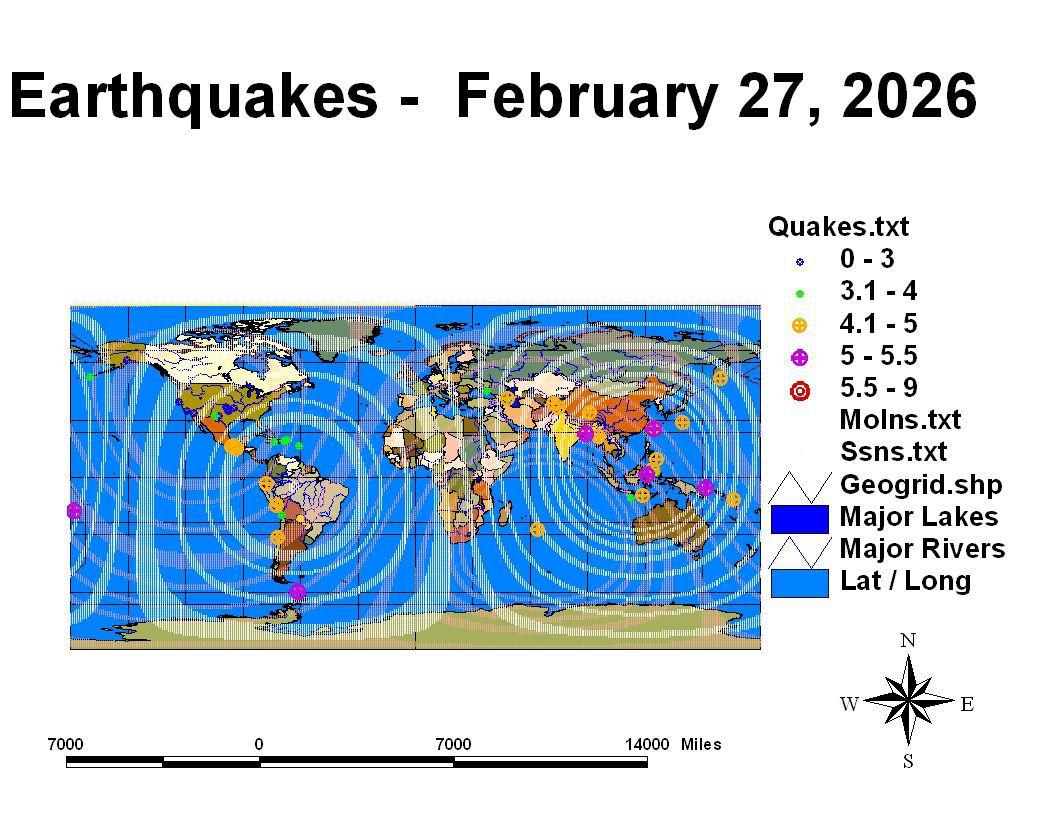

Because this summary is often behind schedule updates to the current date are being added here to make it more relEvAnt to current conditions
February 28, 2026
Notable earthquakes and events:
A moderate earthquake M 4.8 hit the region of Azerbaijan today. EMSC reported it was felt in Azerbaijan with strong intensity at Shamakhi, Aghsu, Imishli, Ceyranbatan, Khodzhi-Gasan, Badamadar, Bilajari, Baku, Binagadi, Samur, Yevlakh, Qaracuxur, Mingelchaur.
This is the strongest earthquake in Azerbaijan within about 200 km of this
epicenter since an M 5.0 on September 3, 2023. But the last such event
of significantly larger magnitude in Azerbaijan occurred as an M 5.4 on July 2, 2023.
At the time this summary noted:
"An M 5.4 was widely felt today in the area of the Caspian Sea. NEIC reported it was felt with maximum magnitude IV in Azerbaijan at Siyazan, Quba, Qonaqkend, and in Dagestan, Russia at Derbent, Usukhchay with lesser intensity II-III in Azerbaijan at Sumqayit, Haci Zeynalabdin, Qusar and in Russia at Khazar.
The last earthquake with greater magnitude in Azerbaijan or the Caspian Sea
was an M 5.5 on June 7, 2014. At the time this summary noted in this regard:
"A moderately strong earthquake also hit the region of Azerbaijan near the Caspian Sea today with M 5.6.
EMSC reported this earthquake was felt for about 30 seconds in Baku, Azerbaijan.
NEIC reported intensity III in Xocasan and Corat, Azerbaijan and Tehran, Iran.
The last earthquake of M>=5.5 within 200 km of this epicenter occurred as an M 6.5
on November 25, 2000 with M 6.5-6.8. No other events of M>5.6 have hit in this
area in the past 25 years." (June 7, 2014, July 3, 2023)
This earthquake may have been promoted by a solar flare (#8650 C1.5) which
peaked within minutes of this earthquake in Azerbaijan. Data for this flare
from SWPC follow:
Flare # START MAX END CLASS DATE Flux (Jm-2)
-------------------------------------------------------------------------
8650 1141 1148 1151 C1.5 (February 27, 2026) 8.1E-04
Azerbaijan M 4.8 11:52 UT
Today's epicenter is at the seventh node (51.4 degrees) from the North Geomagnetic
pole and may have been promoted by energy from that source.
O: 27FEB2026 23:38:38 40.6N 48.5E MB=4.2 EMSC AZERBAIJAN
O: 28FEB2026 02:34:49 40.5N 48.6E ML=4.0 EMSC AZERBAIJAN
O: 27FEB2026 11:52:47 40.6N 48.5E Mw=4.8 EMSC AZERBAIJAN
An earthquake of M 4.9 occurred today in the Southwest Indian Ridge. It was not reported
felt in this remote epicentral area. This is the strongest earthquake on the
South Indian Ridge within about 200 km of this epicenter since an M 5,3 on April 13, 2022.
Today's event appears to have been promoted by the passage of TC Horacio over this
epicenter on February 25-26 with winds up to 125 kts - one of the strongest
storms in the area in recent years - equivalent to a category 5 hurricane.
At the time this summary noted:
"A series of light earthquakes including two of M 3.9 occurred in the northern
Gulf of California today. This may be related to passage of TC Horacio near
the antipode (see above). These events were not reported felt in this area.
The last earthquake with M>=3.9 within about 100 km of these events occurred
as an M 4.2 on October 14, 2024.
These epicenters while near the antipode of TC Horacio are also at the third node
(120 degrees) from Malaysia and the sixth node (60 degrees) from the north
geomagnetic pole and may have been promoted by energy from those sources.
O: 23FEB2026 22:17:00 28.8N 113.3W ML=3.9 EMSC BAJA CALIFORNIA, MEXICO
O: 23FEB2026 22:35:57 28.9N 113.2W ML=3.9 EMSC GULF OF CALIFORNIA
O: 23FEB2026 20:15:47 29.0N 113.2W ML=3.4 EMSC GULF OF CALIFORNIA" (February 24, 2026)
An earthquake of M 3.7 hit the northern Gulf of California today. It was not
reported felt in this epicentral area. The last earthquake within about 100 km
of this epicenter in the northern Gulf of California with M>=3.7 occurred
as an M 4.4 on September 27, 2021 according to NEIC data, but EMSC has reported
more recent activity in the area. At the time of the September, 2021 event
this summary had noted:
"A strong series of earthquakes including an M 4.4 and 4.0 also hit in the northern Gulf of California today.
This region has been active in recent weeks, but this is the strongest activity
at this epicenter since an 4.4 on December 12, 2019 and June 13, 2019. The last
event of larger magnitude in the region was an M 5.2 on April 6, 2019." (September 27, 2021)
and
"This earthquake had been expected in previous issues of this summary as in the last issue as:
It should be noted that this earthquake in the northern Gulf of California
occurred exactly at the antipode of TC Horacio at the time of its occurrence." (February 25, 2026)
This epicenter is at the fourth node (90 degrees) from TC Urmil and at the sixth node (60 degrees)
from Malaysia and may have been promoted by energy from those sources.
O: 27FEB2026 16:17:07 27.6S 64.3E MB=4.9 EMSC SOUTHWEST INDIAN RIDGE
NEIC reported an earthquake of M 5.4 in New Britain was felt with intensity up to II-III in the area(s) of New Britain with likely intensity V in Kokopo, Papua New Guinea.
The last earthquake in New Britain within about 200 km of today's epicenter
with M>=5.4 occurred on September 16, 2025 with M 6.0.
This epicenter is at the sixth node (60 degrees) from the South Geomagnetic
Pole and Kamchatka and at the fourth node (90 degrees from the North
Geomagnetic pole and may have been promoted by constructive energy interference
from those sourcs.
O: 28FEB2026 06:23:27 5.5S 151.9E MW=5.4 EMSC NEW BRITAIN REGION, P.N.G.
NEIC reported an earthquake of M 5.4 in Ryukyu Islands, Japan was felt with intensity up to IV in the area(s) of Ryukyu Islands, Japan near Hirara.
The last earthquake within about 200 km of this epicenter in the Ryukyu Islands
with M>=5.4 was listed by NEIC as occurring with M 5.7 on November 30, 2024.
These epicenters are at the sixth node (60 degrees) from the North Geomagnetic Pole and
TC Urmil and at the fourth node (90 degrees) from the South Geomagnetic pole
and may have been promoted by energy from those sources.
O: 27FEB2026 14:54:30 25.4N 125.0E ML=4.3 EMSC SOUTHWESTERN RYUKYU ISL., JAPA
O: 28FEB2026 05:53:57 25.1N 125.1E Mw=5.4 EMSC SOUTHWESTERN RYUKYU ISL., JAPAN
O: 28FEB2026 01:49:21 25.2N 125.0E Mw=5.1 EMSC SOUTHWESTERN RYUKYU ISL., JAPAN
O: 27FEB2026 11:01:05 25.3N 125.1E mb=4.7 EMSC SOUTHWESTERN RYUKYU ISL., JAPAN
O: 27FEB2026 14:48:22 25.3N 125.0E mb=5.0 EMSC NORTHEAST OF TAIWAN
NEIC reported an earthquake of M 5.3 in India was felt with intensity up to II-III in the area(s) of India with VI in Bangla at Taki; V in Gopalpur, Serpur, Baduria, Noapara, Dum Dumand IV in Kanchrapara, Sahapr and Kharagpur and in Jessor, Bangladesh.
EMSC reported strong shaking in Satkhira, Phultala, Kesabpur, Khulna, Bhatpara, Jhingergacha, Jessore, Bagerhat, Bangladesh and Gosaba, Dam Dam, Madhyamgram, Taki, Habra, Bangaon, India among others.
This is the strongest earthquake within about 150 km of this epicenter
in at least 35 years. Similar events of M 5.3-5.5 occurred about 200 km
from today's epicenter on November 21, 2025; December 2, 2023 and July 9, 1992.
At the time of the December, 2023 event this summary noted:
The strongest earthquake in the world today was an M 5.5-5.8 in Bangladesh. NEIC reported it was felt with intensity up to VI in Ramganj, Bangladesh.
EMSC reported it was felt with moderate to strong intensity in Bangladesh at Chatkhil Upazila, Hajiganj, Comilla, Narayanganj, Gaurnadi, Barisal, Dhaka, Paltan, Azimpur, Tungi and as far as Kushtia and Jhenaidah and in India at Bishalgarh, Sonamura,
This is the strongest earthquake in Bangladesh within about 300 km of this epicenter
since an M 6.2 in Myanmar on November 25, 2021 but no events within 200 km
have been recorded in this area of Bangladesh in at least 35 years.
At the time of the M 6.2 in November 2021 this summary noted:
"The strongest earthquake in the world today was an M 6.2 on the Myanmar-India border. NEIC reported it was felt with maximum intensity VIII in North Vanlaiphai, India; VII in Rangamali, Bangladesh and Champhal, Mizoram, India and VI in Lunglei and Serchhip, and V in Alzaei and Mamit, Mizoram, India and in Bangladesh at Ranguna and Bandarban with IV in Saiha, Mizorm, India.
The press reported light to moderate regional damage with this earthquake.
This is the strongest earthquake within about 250 km of this epicenter since an M 6.9
on April 13, 2015 and an M 6.8 on November 11, 2012. In the past 30 years similar earthquakes
also hit the region on June 15, 1992 and January 5, 1991." (November 26, 2021)
This event occurred as Tropical Cyclone Michaung formed and made landfall to the
south in Peninsular India. It is likely that stress transfer from that landfall
event helped to trigger today's event in Bangladesh.
...
This epicenter in Bangladesh is located near the geomagnetic equator and, as
the earthquake occurred near local solar noon, it is likely it was promoted
by strong geomagnetic effects with the current geomagnetic storm and
by tidal stresses which maximize near this hour." (December 2, 2023)
Today's event occurred near local solar noon and may have been promoted by
solar and/or geomagnetic effects.
This epicenter is located at the fourth node (90 degrees) from TC Urmil and
may have been promoted by energy from that source.
O: 27FEB2026 07:52:25 22.6N 89.2E MB=5.3 EMSC BANGLADESH
NEIC reported an earthquake of M 2.5 in Oklahoma was felt with intensity up to II-III in the area(s) of Oklahoma in Ratliff City.
O: 27FEB2026 08:23:41 35.6N 98.0W ML=2.6 EMSC OKLAHOMA
O: 28FEB2026 00:25:03 34.3N 97.6W ML=1.9 EMSC OKLAHOMA
O: 27FEB2026 18:45:03 34.4N 97.4W ML=2.1 EMSC OKLAHOMA
O: 27FEB2026 22:53:56 34.4N 97.4W ML=2.2 EMSC OKLAHOMA
O: 28FEB2026 00:05:36 34.4N 97.5W ML=2.1 EMSC OKLAHOMA
O: 28FEB2026 03:49:42 34.4N 97.4W ML=2.1 EMSC OKLAHOMA
O: 28FEB2026 04:20:14 34.4N 97.5W ML=2.5 EMSC OKLAHOMA
O: 28FEB2026 04:50:04 36.6N 98.5W ML=2.4 EMSC OKLAHOMA
NEIC reported an earthquake of M 3.1 in Western Texas was felt with intensity up to II-III in the area(s) of Western Texas in Midland.
O: 27FEB2026 18:25:33 32.0N 102.2W ML=2.0 EMSC WESTERN TEXAS
O: 27FEB2026 12:26:22 31.7N 104.4W ML=2.1 EMSC WESTERN TEXAS
O: 27FEB2026 13:02:28 31.7N 104.4W ML=2.1 EMSC WESTERN TEXAS
O: 27FEB2026 14:09:25 31.7N 104.4W ML=2.6 EMSC WESTERN TEXAS
O: 27FEB2026 14:19:30 31.7N 104.4W ML=2.3 EMSC WESTERN TEXAS
O: 27FEB2026 19:15:00 31.7N 104.4W ML=3.2 EMSC WESTERN TEXAS
O: 27FEB2026 19:37:52 31.7N 104.4W ML=2.2 EMSC WESTERN TEXAS
O: 27FEB2026 18:26:22 31.9N 104.4W ML=2.3 EMSC WESTERN TEXAS
O: 27FEB2026 17:52:18 32.0N 102.2W ML=2.2 EMSC WESTERN TEXAS
NEIC reported an earthquake of M 4.1 in India was felt with intensity up to II-III in the area(s) of Northwest Kashmir, India as a light shake at Srinagar.
EMSC reported a light shake at Srinagar, India.
NEIC reported an earthquake of M 4.3 in Bhutan and India was felt with intensity up to II-III in the area(s) of Bhutan and India in Sikkin at Gangtok.
EMSC reported moderate shaking in India at Gangtok, Rangpo, Gyalshing, Naya Bazar, Singtam and Paltan, Bangladesh and Dhaka.
O: 26FEB2026 11:52:13 27.3N 88.1E MB=4.3 EMSC SIKKIM, INDIA
O: 26FEB2026 21:33:29 27.3N 88.2E mb=4.0 EMSC SIKKIM, INDIA
O: 26FEB2026 07:09:34 27.4N 88.3E ML=3.9 EMSC SIKKIM, INDIA
O: 26FEB2026 16:40:48 27.4N 88.3E ML=4.2 EMSC SIKKIM, INDIA
O: 26FEB2026 22:40:25 27.4N 88.7E ML=4.0 EMSC SIKKIM, INDIA
EMSC reported an earthquake of M 3.7 in the Caucasus, Russia was felt with intensity up to IV in the area(s) of the Caucasus, Russia in Gayduk, Sukko, Anapa, Anapskaya, and Rayevskaya.
O: 27FEB2026 22:08:41 44.8N 37.5E ML=3.7 EMSC CAUCASUS REGION, RUSSIA
SEISMIC EFFECTS OF TROPICAL CYCLONES
TROPICAL CYCLONE URMIL (23P)
---- ------- ---------- -------- ----- ------ ------- ---------------
TC URMIL 2026-02-28 00:00 UT 19.5S 169.5E 75 kts Vanuatu/Loyalty Islands
Tropical cyclone Urmil (23P) formed today in Southern Vanuatu with winds up to 75 kts. It is expected to track to the southeast over the next several days and will probably trigger enhanced seismicity in the Loyalty Islands and Southern Vanuatu in the next couple of days. The antipode of 19N 11W is off the coast of Africa near the Canaray and Madiera Islands where moderate seismic enhancement is possible at this time.
SOLAR FLARES
Following is the listing of C- M- or X-class flares from SWPC for the date
of February 27, 2026. These listings are published daily in this summary and at SWPC.
The main line gives details of flares. Subsequent lines identify some earthquakes
which are at or after the time of the flare and could have been affected by
immediate Solar Flare Effects (SFE). Some earthquakes occur at longitudes
which were at local solar noon or local solar midnight when a flare occurred and may also have
been affected by SFE. These are not identified here.
SOLAR FLARES
Flare # START MAX END CLASS DATE Flux (Jm-2)
-------------------------------------------------------------------------
8550 0018 0029 0035 C2.1 (February 27, 2026) 1.9E-03
8560 0106 0111 0118 C1.4 (February 27, 2026) 9.8E-04
8570 0216 0223 0231 C2.0 (February 27, 2026) 1.6E-03
8600 0424 0430 0439 C1.1 (February 27, 2026) 1.1E-03
8620 0708 0717 0726 C1.3 (February 27, 2026) 1.4E-03
Bangladesh M 5.3 07:52 UT
8630 0904 0912 0915 C1.1 (February 27, 2026) 7.6E-04
8650 1141 1148 1151 C1.5 (February 27, 2026) 8.1E-04
Azerbaijan M 4.8 11:52 UT
8670 1247 1259 1303 C3.5 (February 27, 2026) 2.0E-03
Kamchatka M 4.6 12:49 UT
Central Peru M 3.5 13:01 UT
8690 1810 1815 1819 C1.2 (February 27, 2026) 7.2E-04
Java M 4.0 18:17 UT
Drake Passage M 5.3 18:31 UT
8700 1932 1942 1949 C2.8 (February 27, 2026) 2.4E-03
8720 1959 2009 2014 C3.4 (February 27, 2026) 2.1E-03
*indicates modified reading from NOAA GOES Graph
GEOMAGNETIC FIELD: active March 1-2 unsettled February 28. Solar M-flare chance: 25% X-class: 5% proton storm: 1%
AP Indicies: global: 10, high: 22, mid-latitude: 9, time of max AP: 15:00 UT; Max AP: 6 Global Kp 3.33 1500-1800 UT February 27; Sunspot Number: 53; Radio Flux: 139
The sunspot number of 0 today continued quiet conditions on the sun which has lasted
for the past three days. This reduces the change of solar flares and related seismicity at this time. There were three C-class solar flares observed today.
A strong Gamma Ray Burst was recorded by SWIFT on January 27, 2026 at 17:50:34 UT (#260127A). A preliminary UVOT Magnitude was not assigned to this GRB by SWIFT.
An M 4.7 in the Ionian Sea of Italy occurred at 17:53 UT following an M 2.5 foreshock at 17:52 UT and an M 2.7 at 17:51 in the Dodecanese Islands.
A strong Gamma Ray Burst was recorded by SWIFT on January 22, 2026 at 23:13:10 UT (#260122B). A preliminary UVOT Magnitude was not assigned to this GRB by SWIFT.
A strong Gamma Ray Burst was recorded by SWIFT on January 20, 2026 at 18:00:26 UT (#260120B). A preliminary UVOT Magnitude of V>17.4 was assigned to this GRB by SWIFT.
An earthquake of M 3.4 in Kashmir was simultaneous with this GRB as was an M 3.0
in Sumatra.
February 27, 2026
Notable earthquakes and events:
Two moderate earthquakes of M 4.6 and M 4.7 occurred today in Europe. These events began
with an M 4.6 in Turkey and a similar earthquake Romania four minutes and 40 seconds
after the event in Turkey. It appears that the later event was triggered by
the S-wave from Turkey which arrived at the epicenter at 11 degrees distance
in Romania within several seconds of the earthquake at that location.
The standard explanation for this type of correlation is the the second "event"
is a misinterpretion of the seismic readings and the earthquake was simply
a ghost event - never really happened. In this case, however the epicenters
are more than 1000 km apart and both events were felt by many people over a
broad regional area so this explanation is not correct. The alternative
that the S-wave from Turkey triggered the event in Romania therefore remains
the viable alternative despite objections to this possibility from notable
geoscientists.
The earthquake in Turkey of M 4.6 was reported by NEIC to have been felt with
intensity IV in Nurhak, Kahramanmaras, Turkey.
EMSC reported moderate shaking in Turkey at Elbistan, Afsin, Kahramanmaras, Goksun, Turkoglu, Adiyaman, Andirin, Sehitkamil, Sahinbey, Gaziantep, Bahce, Haruniye, Nizip, Kadirli, Kozan, Osmaniye, Bunyan, Toprakkale, Kilis, Develi, Gesi, Talas, Kocasinan, and in Syria at I'zazand Afrin and Sivas among others.
O: 26FEB2026 17:17:09 38.1N 37.3E MW=4.6 EMSC CENTRAL TURKEY
EMSC reported the M 4.6 in Romania was felt strongly in Focsani, Ceardac, Buzau, Spataru, Gheraseni, Vrancea, Gheraseni, Smeeni, Bibiresti, Barlad, Costi, Campina, Galati, Braila, Moara Grecilor, Ghermanesti, Targoviste, Bucharest, Lunca Cetatuii, Miroslava, Podu Iloaiei, Iasi, Ceacu, Pitesti, among others and in Moldova at Vatra and Chisinau, and Stauceni among others in Bulgaria.
O: 26FEB2026 17:21:52 45.8N 26.7E MB=4.5 EMSC ROMANIA
At the same time as the earthquakes in Romania and Turkey an M 3.0 (NEIC) to 3.4 (EMSC) also occurred
near the capitol of Columbia, South Carolina. This event was widely felt
in this epicentral area. NEIC reported intensity IV in Columbia, Pelion, Lexington; III in West Columbia, Whitmire, North Augusta, Irmo.
EMSC reported a loud boon and strong shaking in South Carolina at Irmo, Lexington, Seven Oaks, Oak Grove, West Columbia, South Congaree, Blythewood, Forest Acres, Gaston, Elgin and York.
This earthquake occurred 27 seconds after the M 4.6 in Turkey.
The last earthquake within about 150 km of this epicenter in South Carolina
with M>=3.4 was listed by NEIC as occurring about 50 km to the east on June 29, 2022.
At the time this summary noted:
"An earthquake of M 3.6-3.9 occurred in northern South Carolina near Elgin today. This
continues intensification of the aftershock series in this area. NEIC reported this earthquake of M 3.6 in South Carolina was felt with intensity IV-V in the area(s) of South Carolina at Elgin, Lugoff, Columbia, Rembert, Camden, Ridgeway Elgin, Lugoff, Columbia, Rembert, Camden, Ridgeway. It was also reported with light intensity as far as Florida, North Carolina, Georgia, Maryland, Virginia.
A foreshock of M 3.6 hit the same area hours earlier and was felt in a similar area." (June 29, 2022)
and
"An M 3.4 shook area of South Carolina near Elgin today. This continues a series of events which began last month. Today's event was felt with maximum intensity IV in most of South Carolina and with lesser shaking in North Carolina, Georgia, Tennessee, Kentucky and Virginia and possibly further than that.
This was the largest earthquake in the U.S. or Canada today. This series began
with an M 3.6 on December 29, 2021 and intensified in early May when an M 3.5,
the largest in the area in the current swarm occurred on May 9, 2022.
The M 3.4 today is the third largest event in the area in at least two years." (June 26, 2022)
The last earthquake in this area of significantly larger magnitude was an M 3.9 on April 13, 1998.
The earthquakes in Turkey, Romania and South Carolina occurred at the start
of solar flare 8470 - a C1.8 class flare. Data from SWPC for this flare
follow:
Flare # START MAX END CLASS DATE Flux (Jm-2)
-------------------------------------------------------------------------
8470 1718 1739 1756 C1.8 (February 26, 2026) 3.7E-03
Central Turkey M 4.6 17:17 UT
South Carolina M 3.4 17:17 UT
Romania M 4.5 17:21 UT
O: 26FEB2026 17:17:26 34.1N 81.3W ML=3.4 EMSC SOUTH CAROLINA
NEIC reported an earthquake of M 5.3 in India was felt with intensity up to II-III in the area(s) of India with VI in Bangla at Taki; V in Gopalpur, Serpur, Baduria, Noapara, Dum Dumand IV in Kanchrapara, Sahapr and Kharagpur and in Jessor, Bangladesh.
EMSC reported strong shaking in Satkhira, Phultala, Kesabpur, Khulna, Bhatpara, Jhingergacha, Jessore, Bagerhat, Bangladesh and Gosaba, Dam Dam, Madhyamgram, Taki, Habra, Bangaon, India among others.
This is the strongest earthquake within about 150 km of this epicenter
in at least 35 years. Similar events of M 5.3-5.5 occurred about 200 km
from today's epicenter on November 21, 2025; December 2, 2023 and July 9, 1992.
At the time of the December, 2023 event this summary noted:
The strongest earthquake in the world today was an M 5.5-5.8 in Bangladesh. NEIC reported it was felt with intensity up to VI in Ramganj, Bangladesh.
EMSC reported it was felt with moderate to strong intensity in Bangladesh at Chatkhil Upazila, Hajiganj, Comilla, Narayanganj, Gaurnadi, Barisal, Dhaka, Paltan, Azimpur, Tungi and as far as Kushtia and Jhenaidah and in India at Bishalgarh, Sonamura,
This is the strongest earthquake in Bangladesh within about 300 km of this epicenter
since an M 6.2 in Myanmar on November 25, 2021 but no events within 200 km
have been recorded in this area of Bangladesh in at least 35 years.
At the time of the M 6.2 in November 2021 this summary noted:
"The strongest earthquake in the world today was an M 6.2 on the Myanmar-India border. NEIC reported it was felt with maximum intensity VIII in North Vanlaiphai, India; VII in Rangamali, Bangladesh and Champhal, Mizoram, India and VI in Lunglei and Serchhip, and V in Alzaei and Mamit, Mizoram, India and in Bangladesh at Ranguna and Bandarban with IV in Saiha, Mizorm, India.
The press reported light to moderate regional damage with this earthquake.
This is the strongest earthquake within about 250 km of this epicenter since an M 6.9
on April 13, 2015 and an M 6.8 on November 11, 2012. In the past 30 years similar earthquakes
also hit the region on June 15, 1992 and January 5, 1991." (November 26, 2021)
This event occurred as Tropical Cyclone Michaung formed and made landfall to the
south in Peninsular India. It is likely that stress transfer from that landfall
event helped to trigger today's event in Bangladesh.
...
This epicenter in Bangladesh is located near the geomagnetic equator and, as
the earthquake occurred near local solar noon, it is likely it was promoted
by strong geomagnetic effects with the current geomagnetic storm and
by tidal stresses which maximize near this hour." (December 2, 2023)
Today's event occurred near local solar noon and may have been promoted by
solar and/or geomagnetic effects.
This epicenter is located at the fourth node (90 degrees) from TC Urmil and
may have been promoted by energy from that source.
O: 27FEB2026 07:52:25 22.6N 89.2E MB=5.3 EMSC BANGLADESH
NEIC reported an earthquake of M 4.6 in Northern Chile was felt with intensity up to II-III in the area(s) of in Iquique, Tarapaca.
EMSC reported moderate intensity in Iquique, Chile.
O: 26FEB2026 18:45:40 21.1S 68.7W MB=4.5 EMSC TARAPACA, CHILE
O: 26FEB2026 10:32:42 21.7S 68.5W mb=4.3 EMSC ANTOFAGASTA, CHILE
O: 26FEB2026 09:07:46 21.8S 68.7W Mw=4.9 EMSC ANTOFAGASTA, CHILE
O: 27FEB2026 06:27:34 21.1S 70.1W MB=4.6 EMSC TARAPACA, CHILE
NEIC reported an earthquake of M 3.4 in Northern California was felt with intensity up to II-III in the area(s) of Northern California with III in Geyserville, Middletown, Saint Helena Calistoga, and II in Sonoma, Kelseyville, Santa Rosa.
O: 27FEB2026 05:25:32 38.8N 122.8W ML=3.1 EMSC NORTHERN CALIFORNIA
O: 27FEB2026 05:25:32 38.8N 122.8W ML=3.4 NEIC NORTHERN CALIFORNIA
O: 27FEB2026 01:58:52 38.8N 122.7W MD=2.7 EMSC NORTHERN CALIFORNIA
NEIC reported an earthquake of M 4.9 in Central Peru was felt with intensity up to II-III in the area(s) of Central Peru in Lima, Santa Maria and San Luis.
EMSC reported moderate shaking in Lima at Santiago de Curco, San Isidro, Independencia.
O: 26FEB2026 23:21:09 12.3S 76.8W MB=4.9 EMSC NEAR COAST OF CENTRAL PERU
NEIC reported an earthquake of M 2.6 in Montana was felt with intensity up to II-III in the area(s) of Montana in Great Falls.
EMSC reported it was not felt in Malmstrom AFB, Montana.
O: 26FEB2026 18:42:15 47.6N 111.3W ML=2.6 EMSC WESTERN MONTANA
NEIC reported an earthquake of M 4.3 in Bhutan and India was felt with intensity up to II-III in the area(s) of Bhutan and India in Sikkin at Gangtok.
EMSC reported moderate shaking in India at Gangtok, Rangpo, Gyalshing, Naya Bazar, Singtam and Paltan, Bangladesh and Dhaka.
O: 26FEB2026 11:52:13 27.3N 88.1E MB=4.3 EMSC SIKKIM, INDIA
O: 26FEB2026 21:33:29 27.3N 88.2E mb=4.0 EMSC SIKKIM, INDIA
O: 26FEB2026 07:09:34 27.4N 88.3E ML=3.9 EMSC SIKKIM, INDIA
O: 26FEB2026 16:40:48 27.4N 88.3E ML=4.2 EMSC SIKKIM, INDIA
O: 26FEB2026 22:40:25 27.4N 88.7E ML=4.0 EMSC SIKKIM, INDIA
NEIC reported an earthquake of M 3.2 in Hawaii was felt with intensity up to II-III in the area(s) of Hawaii with III in Naalehu and II in Pahala, Captain Cook, Kula and Volcano.
EMSC reported an earthquake of M 4.2 in western Iran was felt with intensity up to IV in the area(s) of western Iran in Fereydunshahr.
O: 27FEB2026 01:51:09 31.2N 48.1E MB=4.7 EMSC WESTERN IRAN
EMSC reported an earthquake of M 4.6 in Iran-Iraq was felt with intensity up to IV in the area(s) of Iran-Iraq in Sarpol-e-Zahab, Iran aind in Iraq in Khanaqin, Baghdad and As Sulaymaniyah.
O: 27FEB2026 03:51:38 34.4N 45.7E MB=4.6 EMSC IRAN-IRAQ BORDER REGION
EMSC reported an earthquake of M 4.0 in Jalisco, Mexico was felt with intensity up to IV in the area(s) of Jalisco, Mexico in Barra de Navidad.
O: 27FEB2026 03:26:54 19.3N 104.6W ML=4.0 EMSC JALISCO, MEXICO
EMSC reported an earthquake of M 2.1 in San Francisco, California was felt with intensity up to IV in the area(s) of San Francisco, California in Vallejo.
O: 26FEB2026 17:00:56 38.1N 122.2W MD=2.1 EMSC SAN FRANCISCO BAY AREA, CALIF.
EMSC reported an earthquake of M 3.6 in the Canary Islands was felt with intensity up to IV in the area(s) of the Canary Islands in San Miguel De Abona, Adeje.
O: 26FEB2026 12:26:15 28.1N 16.2W ML=3.6 EMSC CANARY ISLANDS, SPAIN REGION
SEISMIC EFFECTS OF TROPICAL CYCLONES
TROPICAL CYCLONE URMIL (23P)
---- ------- ---------- -------- ----- ------ ------- ---------------
TC URMIL 2026-02-27 00:00 UT 19.5S 169.5E 75 kts Vanuatu/Loyalty Islands
Tropical cyclone Urmil (23P) formed today in Southern Vanuatu with winds up to 75 kts. It is expected to track to the southeast over the next several days and will probably trigger enhanced seismicity in the Loyalty Islands and Southern Vanuatu in the next couple of days. The antipode of 19N 11W is off the coast of Africa near the Canaray and Madiera Islands where moderate seismic enhancement is possible at this time.
SOLAR FLARES
Following is the listing of C- M- or X-class flares from SWPC for the date
of February 26, 2026. These listings are published daily in this summary and at SWPC.
The main line gives details of flares. Subsequent lines identify some earthquakes
which are at or after the time of the flare and could have been affected by
immediate Solar Flare Effects (SFE). Some earthquakes occur at longitudes
which were at local solar noon or local solar midnight when a flare occurred and may also have
been affected by SFE. These are not identified here.
SOLAR FLARES
Flare # START MAX END CLASS DATE Flux (Jm-2)
-------------------------------------------------------------------------
8450 1504 1510 1515 C1.5 (February 26, 2026) 1.1E-03
Fiji Is. M 4.7 15:29 UT
8470 1717 1739 1756 C1.8 (February 26, 2026) 3.7E-03 *
Central Turkey M 4.6 17:17 UT
South Carolina M 3.4 17:17 UT
Romania M 4.5 17:21 UT
8500 1846 1852 1856 C1.4 (February 26, 2026) 1.1E-03
Ryukyu Is. M 4.9 18:51 UT
Tarapaca M 4.5 18:46 UT
8520 1856 1909 1917 C6.3 (February 26, 2026) 4.9E-03
Kamchatka M 4.5 18:56 UT M 4.6 18:57 UT
Oaxaca M 4.0 19:08 UT
8540 2312 2316 2319 C1.1 (February 26, 2026) 5.1E-04
Washington M 2.1 23:13 UT
Central Peru M 4.9 23:21 UT
*indicates modified reading from NOAA GOES Graph
GEOMAGNETIC FIELD: active March 1 unsettled February 27-28. Solar M-flare chance: 25% X-class: 5% proton storm: 1%
AP Indicies: global: 18, high: 36, mid-latitude: 14, time of max AP: 08:00 UT; Max AP: 6 Global Kp 4.00 0000-0600 UT February 26; Sunspot Number: 43; Radio Flux: 130
The sunspot number of 0 today continued quiet conditions on the sun which has lasted
for the past three days. This reduces the change of solar flares and related seismicity at this time. There were three C-class solar flares observed today.
A strong Gamma Ray Burst was recorded by SWIFT on January 27, 2026 at 17:50:34 UT (#260127A). A preliminary UVOT Magnitude was not assigned to this GRB by SWIFT.
An M 4.7 in the Ionian Sea of Italy occurred at 17:53 UT following an M 2.5 foreshock at 17:52 UT and an M 2.7 at 17:51 in the Dodecanese Islands.
A strong Gamma Ray Burst was recorded by SWIFT on January 22, 2026 at 23:13:10 UT (#260122B). A preliminary UVOT Magnitude was not assigned to this GRB by SWIFT.
A strong Gamma Ray Burst was recorded by SWIFT on January 20, 2026 at 18:00:26 UT (#260120B). A preliminary UVOT Magnitude of V>17.4 was assigned to this GRB by SWIFT.
An earthquake of M 3.4 in Kashmir was simultaneous with this GRB as was an M 3.0
in Sumatra.
February 26, 2026
Notable earthquakes and events:
The strongest earthquake in the world today was an M 5.7 in Kamchatka, Russia. NEIC reported it was likely felt with intensity up to VI in Vilyuchinsk, Russia.
EMSC reported light shaking in Kamchatka in Vilychinsk, Petropavlovsk-Kamchatsky and Yelizovo.
The mainshock was followed by moderate aftershocks of M 4.5, 4.5, 5.0 and 4.6 among others.
The last earthquake in Kamchatka within about 200 km of this epicenter with
M>=5.7 occurred on January 22, 2026 with M 6.2. At the time this summary noted:
"The largest earthquake in the world today was an M 6.2 in Kamchatka, Russia. It occurred near
local solar midnight and was probably promoted by effects from the major geomagnetic storm of the past several days.
It was reported to have been lightly felt with intensity up to V in Kamchatka, Russia at Vilyuchinsk.
EMSC reported it was felt with moderate intensity in Vilyuchinsk, Paratunka, Petropavlovsk-Kamchatsky, Kamchatka, Russia.
This event is the strongest in the region of Kamchatka since an M 7.8 on September 18, 2025
more than four months ago. That event seemed to end the major series
in Kamchatka that began in late July, 2025.
These epicenters are at the seventh node (51.4 degrees) from Mindanao, Philippines
and may have been promoted by energy from that source." (January 22, 2026)
O: 26FEB2026 05:09:02 51.3N 159.5E MB=4.3 EMSC OFF EAST COAST OF KAMCHATKA
O: 26FEB2026 05:57:46 51.3N 159.8E mb=4.5 EMSC OFF EAST COAST OF KAMCHATKA
O: 26FEB2026 05:58:59 51.3N 159.4E mb=5.0 EMSC OFF EAST COAST OF KAMCHATKA
O: 26FEB2026 04:59:02 51.5N 159.4E Mw=5.7 EMSC OFF EAST COAST OF KAMCHATKA
O: 26FEB2026 05:30:35 51.5N 159.8E mb=4.5 EMSC OFF EAST COAST OF KAMCHATKA
O: 26FEB2026 06:39:21 51.5N 159.6E mb=4.5 EMSC OFF EAST COAST OF KAMCHATKA
O: 26FEB2026 06:07:30 51.5N 159.5E mb=4.6 EMSC OFF EAST COAST OF KAMCHATKA
An aftershock of M 5.5 occurred today in Papua New Guinea near Madang. NEIC reported it was felt with intensity III in Goroka, Easter Highlands and II in Lae Morobe, Papua New Guinea.
EMSC reported moderate movement and bubbling sounds in PNG at Kainantu.
The mainshock occurred as an M 5.7 on February 19, 2026. At the time this summary
noted:
"A moderately strong earthquake occurred today in the area of Madang, Papua New Guinea. NEIC reported it was felt with intensity III in the New Guinea Eastern Highlands at Goroka and Kainantu.
It was preceded by an M 4.7 foreshock 75 minutes earlier which was lightly felt.
The last earthquake within about 200 km of this epicenter in New Guinea with
M>=5.7 occurred on January 20, 2026 one month ago with M 5.9." (February 19, 2026)
Today's event may have been triggered by SFE associated with solar flare 8390 (C3.9) -
the strongest flare since February 16, 2026. It occurred near the peak of that
flare. An M 5.4 in Tajikistan occurred two minutes earlier and was likely
also triggered by this flare (see below). There is not sufficient time for
seismic waves from Tajikistan to reach New Guinea so an external forcing
factor such as this flare is likely. A series of light earthquake in
France occurred near local solar noon with this flare as well.
Flare # START MAX END CLASS DATE Flux (Jm-2)
-------------------------------------------------------------------------
8390 1102 1123 1134 C3.9 (February 25, 2026) 5.2E-03
France M 2.1, 2.1, 2.4 11:01-11:03 UT
Panama M 4.1 11:11 UT
Tajikistan M 5.4 11:12 UT
New Guinea M 5.5 11:14 UT
Banda Sea M 4.4 11:13 UT
This epicenter is at the eighth node (45 degrees) from Honshu, Japan; the fourth node (90 degrees)
from the North Geomagnetic Pole and the sixth node (60 degrees) from the South Geomagnetic Pole
and Kamchatka and may have been promoted by energy from those sources.
O: 25FEB2026 11:14:03 5.3S 145.9E MW=5.5 EMSC EASTERN NEW GUINEA REG., P.N.G
An earthquake of M 3.7 hit the northern Gulf of California today. It was not
reported felt in this epicentral area. The last earthquake within about 100 km
of this epicenter in the northern Gulf of California with M>=3.7 occurred
as an M 4.4 on September 27, 2021 according to NEIC data, but EMSC has reported
more recent activity in the area. At the time of the September, 2021 event
this summary had noted:
"A strong series of earthquakes including an M 4.4 and 4.0 also hit in the northern Gulf of California today.
This region has been active in recent weeks, but this is the strongest activity
at this epicenter since an 4.4 on December 12, 2019 and June 13, 2019. The last
event of larger magnitude in the region was an M 5.2 on April 6, 2019." (September 27, 2021)
This earthquake had been expected in previous issues of this summary as in the last issue as:
"A strong nor'easter hit the northeast coast of the U.S. over the past two days.
This summary has consistently noted that such storms can have effects on the
Pacific-North American plate boundary, especially in the central region of
that from California north to Southeastern Alaska. Some enhancement of
seismicity in that area is likely in the next several days including the
possibility of a moderate earthquake. One possibility for a moderate earthquake
is in northern Gulf of California. The strong Tropical Cyclon Horacio will
be antipodal to this active region between 18:00 on February 25 and 06:00 on February 26.
A moderate antipodal earthquake near 30-31N 113-115W is considered likely
near this time. Enhanced seismicity in the Gulf of California south of this
is also possible starting today." (February 24-25, 2026)
It should be noted that this earthquake in the northern Gulf of California
occurred exactly at the antipode of TC Horacio at the time of its occurrence.
This summary had noted this in the previous issue as:
"TC HORACIO 2026-02-25 00:00 UT 30.0S 66.3E 100 kts South Indian Ocean
Tropical cyclone Horacio continued today as a strong cyclone in the southern Indian Ocean with winds up to 105 kts. This system is tracking to the south and could enhance regional seismicity along the ridge faults in the area. The antipode is at 30N 114W in the area of the northern Gulf of California and Baja California, Mexico. This is a seismic region and triggering of a moderate earthquake near this location in Mexico is possible around February 25-28, 2026 is possible." (February 24-25, 2026)
O: 25FEB2026 09:30:41 30.2N 114.2W ML=3.7 EMSC GULF OF CALIFORNIA
This earthquake may also have been promoted by solar flare 8360 (C2,6) as
it occurred near local solar midnight near the peak output of that flare. Flare
8360 joined several others today after a three day period of quiet flare
activity on the sun. Data on this flare from SWPC follow:
Flare # START MAX END CLASS DATE Flux (Jm-2)
-------------------------------------------------------------------------
8360 0848 0859 0938 C2.6 (February 25, 2026) 2.8E-03
Gulf of California M 3.7 09:30 UT
O: 25FEB2026 09:30:41 30.2N 114.2W ML=3.7 EMSC GULF OF CALIFORNIA
An earthquake of M 3.4 also occurred in Baja California northwest of the event in the
Gulf of California today. This event occurred at the maximum output of solar
flare 8380 (C1.2) and may have been promoted by SFE from that flare. Parameters
for that flare follow:
Flare # START MAX END CLASS DATE Flux (Jm-2)
-------------------------------------------------------------------------
8380 1026 1036 1040 C1.2 (February 25, 2026) 1.0E-03
Baja California M 3.4 10:35 UT
This event may also have been promoted by antipodal energy concentration
from TC Horacio as well as constructive energy interference from Malaysia and
the North Geomagnetic Pole at the sixth node (120 and 60 degrees from this
epicenter) and may have been promoted by energy from those sources.
O: 25FEB2026 10:35:00 31.8N 116.2W ML=3.4 EMSC BAJA CALIFORNIA, MEXICO
NEIC reported earthquakes of M 3.2 in Hawaii were felt with intensity up to II-III in the area(s) of Hawaii with III in Naalehu and II in Pahala and Captain Cook.
O: 25FEB2026 14:23:45 19.7N 156.2W ML=3.2 EMSC HAWAII REGION, HAWAII
O: 26FEB2026 06:52:45 19.2N 155.6W ML=3.2 EMSC ISLAND OF HAWAII, HAWAII
NEIC reported an earthquake of M 4.8 in India was felt with intensity up to II-III in the area(s) of India with V in Gezing, Sikkin and in Uttar Bagdogra, Bangla, Sualkuchi, Assam, Dharmanagar, Tripura, Agartala, Shillong, India and Rajshahi, Tungi Gazipur, Chattagam, Silhat Bangladesh with II and possibly in Dacca.
EMSC reported light shaking in Mirik, India and Rangpur, Bangladesh.
This earthquake occurred within minutes of local solar noon and may have
been promoted by tidal and/or geomagnetic effects which maximize near
this hour.
This epicenter may have been promoted by constructive energy interference
from the North Geomagnetic Pole, TC Horacio and Kamchatka all of which lie
near the sixth node (60 degrees) from this epicenter.
O: 26FEB2026 06:04:04 27.3N 88.2E MB=4.8 EMSC SIKKIM, INDIA
NEIC reported an earthquake of M 3.6 in Southern California near Johannesburg was felt with intensity up to II-III in the area(s) of Southern California near Johannesburg with II in Ridgecrest, Upland and Lancaster.
The mainshock was followed by a series of light aftershocks including an M 3.0.
The last earthquake within about 100 km of this epicenter north of Los Angeles,
California with M>=3.6 occurred on January 18, 2026 with M 3.6. The last with
larger magnitude was an M 4.6 on July 15, 2022. At the time this summary noted:
"The strongest earthquake in the U.S. or Canada today was an M 4.6 in the Ridgecrest area of Central California. NEIC reported this earthquake of M 4.6 in the California-Nevada border region was felt with intensity II-III in the area(s) of the California-Nevada border region with IV in Ridgecrest and Trona and lesser shaking in Inyokern, Weldon, Lake Isabella, Bodfish, Caliente, East Tulare County, Mojave and Wofford Heights.
This is the strongest earthquake within about 100 km of this epicenter since
an M 4.8 on August 19, 2020 - an aftershock of an M 5.8 on June 24, 2020.
A series of moderate to strong earthquake began in this area of Ridgecrest
in July 4 and 6, 2019 with M 6.4 and M 7.1 among many other moderate associated
shocks." (July 15, 2022)
O: 26FEB2026 00:20:51 35.3N 117.5W ML=3.5 EMSC SOUTHERN CALIFORNIA
O: 26FEB2026 00:20:51 35.3N 117.5W ML=3.6 NEIC SOUTHERN CALIFORNIA
O: 26FEB2026 01:41:39 35.3N 117.5W ML=2.2 EMSC SOUTHERN CALIFORNIA
O: 26FEB2026 01:43:30 35.3N 117.5W ML=3.0 EMSC SOUTHERN CALIFORNIA
NEIC reported an earthquake of M 3.5 in central Kansas was felt with intensity up to II-III in the area(s) of central Kansas with IV in Gypsum; III in Assaria, Salina, Derby, Lindsborg and II in Galva, Yates Center. It was also reported lightly felt in Kearney, Nebraska and Grandview, Missouri.
O: 25FEB2026 20:14:52 38.7N 97.5W ML=3.5 EMSC KANSAS
NEIC reported an earthquake of M 2.5 in Oklahoma was felt with intensity up to II-III in the area(s) of Duncan and Prague.
O: 25FEB2026 20:09:01 35.6N 96.7W ML=2.5 EMSC OKLAHOMA
O: 26FEB2026 07:32:03 35.6N 98.0W ML=2.4 EMSC OKLAHOMA
O: 25FEB2026 07:46:25 34.3N 97.6W ML=2.1 EMSC OKLAHOMA
NEIC reported an earthquake of M 5.1 in Myanmar was felt with intensity up to II-III in the area(s) of Myanmar with III in Monywa, and II in Falam Chin.
EMSC reported moderate shaking in Myanmar at Mandalay and in India at Imphal, Aizawl, Silchar, Saiha, Serchhip, and in Bangladesh at Bandarban, Khagrachhari, Raojin, Chittagong and as far as Thimphu, Bhutan.
This epicenter is located at the sixth node (60 degrees) from TC Horacio and may have
been promoted by energy from that source.
O: 25FEB2026 16:51:46 23.1N 94.8E MB=5.1 EMSC MYANMAR
NEIC reported an earthquake of M 5.4 in Tajikistan was felt with intensity up to II-III in the area(s) of Tajikistan in Dushanbe and in Afghanistan with III in Kabul and Eskasem, Badahsan.
EMSC reported moderate shaking in Gakuch, Mardan, Mansehra, Topi, Haripur, Islamabad, Rawalpindi, Pakistan, Mazar-e Sharif, Bahglan, Kabul, Afghanistan, Dushanbe, Tursunzoda, Almaty, Pervomayka, Tajikistan, and Sopur, India and Tashkent, Uzbekistan.
This earthquake may have been promoted by by solar flare 8390 - a C3.9 flare
and the strongest flare since flare 7340 (M2.4) on February 16, 2026.
It occurred near solar noon near the peak of this flare and could have
been triggered by SFE.
Flare # START MAX END CLASS DATE Flux (Jm-2)
-------------------------------------------------------------------------
8390 1102 1123 1134 C3.9 (February 25, 2026) 5.2E-03
France M 2.1, 2.1, 2.4 11:01-11:03 UT
Panama M 4.1 11:11 UT
Tajikistan M 5.4 11:12 UT
New Guinea M 5.5 11:14 UT
Banda Sea M 4.4 11:13 UT
O: 25FEB2026 11:12:05 37.0N 71.5E MW=5.4 EMSC TAJIKISTAN
NEIC reported an earthquake of M 5.2 in Shikoku, Japan was felt with intensity up to II-III in the area(s) of Shikoku, Japan in South Korea.
O: 25FEB2026 09:07:45 32.1N 132.7E MW=5.2 EMSC SHIKOKU, JAPAN
EMSC reported an earthquake of M 2.0 in Utah was felt with intensity up to IV in the area(s) of Utah in West Valley City.
O: 25FEB2026 12:30:41 40.7N 112.0W ML=2.0 EMSC WASATCH FRONT URBAN AREA, UTAH
SEISMIC EFFECTS OF TROPICAL CYCLONES
TROPICAL CYCLONE HORACIO (22S)
---- ------- ---------- -------- ----- ------ ------- ---------------
TC HORACIO 2026-02-26 00:00 UT 31.0S 69.3E 75 kts South Indian Ocean
Tropical cyclone Horacio continued today in the southern Indian Ocean with winds up to 75 kts. This system is tracking to the south and could enhance regional seismicity along the ridge faults in the area. The antipode is at 31N 112W in the area of the northern Gulf of California and Baja California, Mexico. This is a seismic region and triggering of a moderate earthquake near this location in Mexico is possible around February 26-27, 2026 is possible.
A tropical Cyclone may be forming over central Vanuatu. This system is currently located at 16S 167E with winds up to 28 kts and moving to the south. Regional seismicity in Central Vanuatu is expected to be enhanced over the next several days. The antipode of 16N 13W is off the coast of Africa near the Canaray and Madiera Islands where moderate seismic enhancement is possible at this time.
SOLAR FLARES
Following is the listing of C- M- or X-class flares from SWPC for the date
of February 25, 2026. These listings are published daily in this summary and at SWPC.
The main line gives details of flares. Subsequent lines identify some earthquakes
which are at or after the time of the flare and could have been affected by
immediate Solar Flare Effects (SFE). Some earthquakes occur at longitudes
which were at local solar noon or local solar midnight when a flare occurred and may also have
been affected by SFE. These are not identified here.
SOLAR FLARES
Flare # START MAX END CLASS DATE Flux (Jm-2)
-------------------------------------------------------------------------
8250 0008 0024 0032 C2.3 (February 25, 2026) 3.3E-03
South Australia M 3.7 00:14 UT
8300 0032 0045 0107 C5.3 (February 25, 2026) 9.1E-03
Utah M 2.5 00:46 UT
Fox Is. M 3.8 00:43 UT
8270 0219 0229 0242 C1.4 (February 25, 2026) 1.8E-03
8280 0259 0309 0330 C1.5 (February 25, 2026) 2.7E-03
Myanmar M 4.8 13:25 UT
Sumatra M 3.1 03:18 UT
Andreanof Is. M 4.3 03:34 UT
8310 0508 0515 0536 C4.8 (February 25, 2026) 6.3E-03
8320 0641 0656 0709 C2.6 (February 25, 2026) 3.5E-03
Peru M 4.0 07:02 UT
8350 0805 0812 0816 C1.0 (February 25, 2026) 7.1E-04
8360 0848 0859 0938 C2.6 (February 25, 2026) 2.8E-03
Banda Sea M 4.5 09:04 UT
Yucatan M 3.7 08:34 UT
Gulf of California M 3.7 09:30 UT
8370 0938 0948 0955 C3.2 (February 25, 2026) 2.2E-03
Hokkaido M 3.6 09:41 UT
Santa Cruz Is. M 5.0 09:48 UT
Jalisco M 3.4 09:38 UT
Guerrerp M 3.5 09:40 UT
8380 1026 1036 1040 C1.2 (February 25, 2026) 1.0E-03
Baja California M 3.4 10:35 UT
8390 1102 1123 1134 C3.9 (February 25, 2026) 5.2E-03
France M 2.1, 2.1, 2.4 11:01-11:03 UT
Panama M 4.1 11:11 UT
Tajikistan M 5.4 11:12 UT
New Guinea M 5.5 11:14 UT
Banda Sea M 4.4 11:13 UT
8420 1535 1559 1609 M2.3 (February 25, 2026) 2.1E-02
Myanmar M 5.1 16:51 UT
Costa Rica M 4.1 15:58 UT
*indicates modified reading from NOAA GOES Graph
GEOMAGNETIC FIELD: active February 26 unsettled February 27-28. Solar M-flare chance: 50% X-class: 5% proton storm: 1%
AP Indicies: global: 14, high: 20, mid-latitude: 11, time of max AP: 12:00 UT; Max AP: 5 Global Kp 3.67 0000-0300 UT February 25; Sunspot Number: 25; Radio Flux: 125
The sunspot number of 0 today continued quiet conditions on the sun which has lasted
for the past three days. This reduces the change of solar flares and related seismicity at this time. There were three C-class solar flares observed today.
A strong Gamma Ray Burst was recorded by SWIFT on January 27, 2026 at 17:50:34 UT (#260127A). A preliminary UVOT Magnitude was not assigned to this GRB by SWIFT.
An M 4.7 in the Ionian Sea of Italy occurred at 17:53 UT following an M 2.5 foreshock at 17:52 UT and an M 2.7 at 17:51 in the Dodecanese Islands.
A strong Gamma Ray Burst was recorded by SWIFT on January 22, 2026 at 23:13:10 UT (#260122B). A preliminary UVOT Magnitude was not assigned to this GRB by SWIFT.
A strong Gamma Ray Burst was recorded by SWIFT on January 20, 2026 at 18:00:26 UT (#260120B). A preliminary UVOT Magnitude of V>17.4 was assigned to this GRB by SWIFT.
An earthquake of M 3.4 in Kashmir was simultaneous with this GRB as was an M 3.0
in Sumatra.
A strong Gamma Ray Burst was recorded by SWIFT on January 14, 2026 at 11:40:26 UT (#260114A). A preliminary UVOT Magnitude of V>18.44 was assigned to this GRB by SWIFT.
An earthquake of M 4.0 occurred in Guatemala at 11:44 UT on January 14, 2026.
A strong Gamma Ray Burst was recorded by SWIFT on January 11, 2026 at 16:33:14 UT (#260111A). A preliminary UVOT Magnitude was not assigned to this GRB by SWIFT.
An earthquake of M 4.9 occurred in Western Iran at 17:02 UT on January 11, 2026.
A strong Gamma Ray Burst was recorded by SWIFT on January 4, 2026 at 05:37:02 UT (#260104A). A preliminary UVOT Magnitude was not assigned to this GRB by SWIFT.
A strong Gamma Ray Burst was recorded by SWIFT on January 1, 2026 at 00:56:30 UT (#260101A). A preliminary UVOT Magnitude of V>16.17 was assigned to this GRB by SWIFT.
February 25, 2026
Notable earthquakes and events:
The sunspot number of 0 today continued quiet conditions on the sun which has lasted
for the past three days. This reduces the change of solar flares and related seismicity at this time. There were three C-class solar flares observed today.
The strongest earthquake in the world today was an M 5.5 in Papua New Guinea. NEIC reported it was likely felt with intensity up to V in the epicentral area.
This earthquake may have been triggered by the strongest solar flare in the
past two days - #8220, C1.0 as it occurred towards the end of that flare.
Data for this flare from SWPC follow:
Flare # START MAX END CLASS DATE Flux (Jm-2)
-------------------------------------------------------------------------
8220 0722 0733 0747 C1.0 (February 24, 2026) 1.6E-03
Louisiana M 2.9 07:44 UT
Papua Indonesia M 5.5 07:46 UT
This epicenter is near 103 degrees from Southern California and could enhance
seismicity in that area in coming days. Strong earthquakes in Papua New
Guinea are often followed by moderate earthquakes near Los Angeles. The most
prominent of these was an M 8.1 at this epicenter on January 10, 1971
followed by the M 6.7 in the San Fernando Valley of Los Angeles on February 9, 1971.
This epicenter is at the fifth node (72 degrees) from TC Horacio; the fourth node (90 degrees)
from the north geomagnetic pole and the sixth node from Kamchatka and the
South Geomagnetic pole and may have been promoted by energy from those sources.
O: 24FEB2026 07:46:50 2.1S 138.9E MW=5.5 EMSC PAPUA, INDONESIA
NEIC reported an earthquake of M 4.3 in Andreanof Islands, Alaska was felt with intensity up to II-III in the area(s) of Andreanof Islands, Alaska in Adak.
O: 24FEB2026 19:06:51 52.0N 173.7W ML=4.6 EMSC ANDREANOF ISLANDS, ALEUTIAN IS
O: 25FEB2026 03:34:14 52.7N 173.1W mb=4.3 EMSC ANDREANOF ISLANDS, ALEUTIAN IS.
NEIC reported an earthquake of M 3.7 in the Fox Islands was felt with intensity up to II-III in the area(s) of the Fox Islands with intensity II. This event
was accompanied by a series of lighter aftershocks of the M 6.1 in the Fox
Islands two days ago. These events were not reported felt in the area.
O: 24FEB2026 12:57:08 52.6N 169.5W ML=3.2 EMSC FOX ISLANDS, ALEUTIAN ISLANDS
O: 24FEB2026 08:49:01 52.4N 169.8W ML=3.0 EMSC FOX ISLANDS, ALEUTIAN ISLANDS
O: 24FEB2026 13:05:24 52.4N 169.9W ML=3.0 EMSC FOX ISLANDS, ALEUTIAN ISLANDS
O: 24FEB2026 15:06:51 52.4N 169.8W ML=3.0 EMSC FOX ISLANDS, ALEUTIAN ISLANDS
O: 24FEB2026 16:20:05 52.4N 169.8W ML=3.3 EMSC FOX ISLANDS, ALEUTIAN ISLANDS
O: 24FEB2026 18:22:46 52.4N 169.8W ML=3.3 EMSC FOX ISLANDS, ALEUTIAN ISLANDS
O: 24FEB2026 18:56:15 52.4N 169.7W ML=2.9 EMSC FOX ISLANDS, ALEUTIAN ISLANDS
O: 24FEB2026 19:42:39 52.4N 169.9W ML=2.8 EMSC FOX ISLANDS, ALEUTIAN ISLANDS
O: 24FEB2026 22:37:15 52.4N 169.9W ML=3.1 EMSC FOX ISLANDS, ALEUTIAN ISLANDS
O: 25FEB2026 00:43:53 52.4N 169.8W ML=3.9 EMSC FOX ISLANDS, ALEUTIAN ISLANDS
O: 24FEB2026 16:21:05 52.5N 169.8W ML=3.3 EMSC FOX ISLANDS, ALEUTIAN ISLANDS
NEIC reported an earthquake of M 3.7 in Southeastern Alaska was felt with intensity up to II-III in the area(s) of Southeastern Alaska with intensity IV.
O: 24FEB2026 23:09:26 60.5N 139.8W ML=4.0 EMSC SOUTHERN YUKON TERRITORY, CANA
O: 25FEB2026 05:20:40 60.6N 139.9W ML=3.3 EMSC SOUTHERN YUKON TERRITORY, CANADA
NEIC reported an earthquake of M 4.8 in Panama was felt with intensity up to II-III in the area(s) of Panama with IV in Palmira, Chiriqui and III in Boquete, Pueblo Nuevo, and in Costa Rica at Golfito, Copey, San Isidro and in Colombia and II in Los Lomas, Guarumal, Panama and San jose, Costa Rica.
O: 24FEB2026 20:38:28 8.3N 82.9W MW=4.8 EMSC PANAMA-COSTA RICA BORDER REGIO
NEIC reported an earthquake of M 3.0 in Seattle, Washington was felt with intensity up to II-III in the area(s) of Seattle, Washington with III in Duvall, Snoqualmie, Seattle, Sultan, Kingston, Woodinville, Bothell and II in Everett.
EMSC reported it was lightly felt and heard in Washington at Monroe, Mill Creek.
O: 24FEB2026 13:42:46 47.8N 122.0W ML=3.0 EMSC SEATTLE-TACOMA AREA, WASHINGTO
NEIC reported an earthquake of M 3.6 in Hawaii was felt with intensity up to II-III in the area(s) of Hawaii in Kailua Kona and Captain Cook.
O: 24FEB2026 12:25:48 19.4N 156.2W ML=3.5 EMSC HAWAII REGION, HAWAII
NEIC reported an earthquake of M 2.6 in San Francisco, California was felt with intensity up to II-III in the area(s) of San Francisco, California with III in Fremont, Milpitas, San jose, Stanford, and II in Oakland, Sunnyvale and Newark.
O: 24FEB2026 10:21:21 37.5N 121.8W MD=2.6 EMSC SAN FRANCISCO BAY AREA, CALIF.
NEIC reported an earthquake of M 2.9 in Louisiana was felt with intensity up to II-III in the area(s) of Louisiana with III in Couoshatta and II in Oil City.
This earthquake may have been triggered by the strongest solar flare in the
past two days - #8220, C1.0 as it occurred towards the end of that flare.
Data for this flare from SWPC follow:
Flare # START MAX END CLASS DATE Flux (Jm-2)
-------------------------------------------------------------------------
8220 0722 0733 0747 C1.0 (February 24, 2026) 1.6E-03
Louisiana M 2.9 07:44 UT
O: 24FEB2026 07:44:52 32.0N 93.4W ML=2.9 EMSC LOUISIANA
EMSC reported an earthquake of M 4.1 in El Salvador was felt with intensity up to IV in the area(s) of El Salvador in Santa Tecla.
O: 24FEB2026 23:33:00 13.1N 89.3W ML=4.3 EMSC OFFSHORE EL SALVADOR
EMSC reported an earthquake of M 4.2 in Oaxaca, Mexico was felt with intensity up to IV in the area(s) of Oaxaca, Mexico in Crucecita.
O: 24FEB2026 13:46:01 15.7N 96.0W ML=4.2 EMSC OFFSHORE OAXACA, MEXICO
SEISMIC EFFECTS OF TROPICAL CYCLONES
TROPICAL CYCLONE HORACIO (22S)
---- ------- ---------- -------- ----- ------ ------- ---------------
TC HORACIO 2026-02-25 00:00 UT 30.0S 66.3E 100 kts South Indian Ocean
Tropical cyclone Horacio continued today as a strong cyclone in the southern Indian Ocean with winds up to 105 kts. This system is tracking to the south and could enhance regional seismicity along the ridge faults in the area. The antipode is at 30N 114W in the area of the northern Gulf of California and Baja California, Mexico. This is a seismic region and triggering of a moderate earthquake near this location in Mexico is possible around February 25-28, 2026 is possible.
A tropical Cyclone may be forming over central Vanuatu. This system is currently located at 16S 167E with winds up to 28 kts and moving to the south. Regional seismicity in Central Vanuatu is expected to be enhanced over the next several days. The antipode of 16N 13W is off the coast of Africa near the Canaray and Madiera Islands where moderate seismic enhancement is possible at this time.
SOLAR FLARES
Following is the listing of C- M- or X-class flares from SWPC for the date
of February 24, 2026. These listings are published daily in this summary and at SWPC.
The main line gives details of flares. Subsequent lines identify some earthquakes
which are at or after the time of the flare and could have been affected by
immediate Solar Flare Effects (SFE). Some earthquakes occur at longitudes
which were at local solar noon or local solar midnight when a flare occurred and may also have
been affected by SFE. These are not identified here.
SOLAR FLARES
Flare # START MAX END CLASS DATE Flux (Jm-2)
-------------------------------------------------------------------------
8220 0722 0733 0747 C1.0 (February 24, 2026) 1.6E-03
Louisiana M 2.9 07:44 UT
Papua Indnesia M 5.5 07:46 UT
8240 2304 2313 2320 C2.1 (February 24, 2026) 2.2E-03
Southern Yukon, Canada M 4.0 23:09 UT
*indicates modified reading from NOAA GOES Graph
GEOMAGNETIC FIELD: active February 25-26 unsettled February 27. Solar M-flare chance: 50% X-class: 5% proton storm: 1%
AP Indicies: global: 14, high: 20, mid-latitude: 11, time of max AP: 14:00 UT; Max AP: 6 Global Kp 3.67 0300-0600 UT February 24; Sunspot Number: 0; Radio Flux: 120
The sunspot number of 0 today continued quiet conditions on the sun which has lasted
for the past three days. This reduces the change of solar flares and related seismicity at this time. There were three C-class solar flares observed today.
A strong Gamma Ray Burst was recorded by SWIFT on January 27, 2026 at 17:50:34 UT (#260127A). A preliminary UVOT Magnitude was not assigned to this GRB by SWIFT.
An M 4.7 in the Ionian Sea of Italy occurred at 17:53 UT following an M 2.5 foreshock at 17:52 UT and an M 2.7 at 17:51 in the Dodecanese Islands.
A strong Gamma Ray Burst was recorded by SWIFT on January 22, 2026 at 23:13:10 UT (#260122B). A preliminary UVOT Magnitude was not assigned to this GRB by SWIFT.
A strong Gamma Ray Burst was recorded by SWIFT on January 20, 2026 at 18:00:26 UT (#260120B). A preliminary UVOT Magnitude of V>17.4 was assigned to this GRB by SWIFT.
An earthquake of M 3.4 in Kashmir was simultaneous with this GRB as was an M 3.0
in Sumatra.
A strong Gamma Ray Burst was recorded by SWIFT on January 14, 2026 at 11:40:26 UT (#260114A). A preliminary UVOT Magnitude of V>18.44 was assigned to this GRB by SWIFT.
An earthquake of M 4.0 occurred in Guatemala at 11:44 UT on January 14, 2026.
A strong Gamma Ray Burst was recorded by SWIFT on January 11, 2026 at 16:33:14 UT (#260111A). A preliminary UVOT Magnitude was not assigned to this GRB by SWIFT.
An earthquake of M 4.9 occurred in Western Iran at 17:02 UT on January 11, 2026.
A strong Gamma Ray Burst was recorded by SWIFT on January 4, 2026 at 05:37:02 UT (#260104A). A preliminary UVOT Magnitude was not assigned to this GRB by SWIFT.
A strong Gamma Ray Burst was recorded by SWIFT on January 1, 2026 at 00:56:30 UT (#260101A). A preliminary UVOT Magnitude of V>16.17 was assigned to this GRB by SWIFT.
February 24, 2026
Notable earthquakes and events:
Quiet conditions on the sun continued today. The number of observed sunspots remained at zero for the second day in a row.
Likewise there were no solar flares of C- or higher class observed. Two flares of B-class
were observed. This is the quietest time on the sun in more than a month.
Seismic conditions on the earth mirrored this quiet on the sun. There were no
significant earthquakes recorded since the previous issue of this summary with M>=5.
The strongest series in the world was reported in the previous issue
as occurring in the Fox Islands, Alaska (see below) and included events
of M 6.1 and M 5.5.
A strong nor'easter hit the northeast coast of the U.S. over the past two days.
This summary has consistently noted that such storms can have effects on the
Pacific-North American plate boundary, especially in the central region of
that from California north to Southeastern Alaska. Some enhancement of
seismicity in that area is likely in the next several days including the
possibility of a moderate earthquake. One possibility for a moderate earthquake
is in northern Gulf of California. The strong Tropical Cyclon Horacio will
be antipodal to this active region between 18:00 on February 25 and 06:00 on February 26.
A moderate antipodal earthquake near 30-31N 113-115W is considered likely
near this time. Enhanced seismicity in the Gulf of California south of this
is also possible starting today.
A series of light earthquakes including two of M 3.9 occurred in the northern
Gulf of California today. This may be related to passage of TC Horacio near
the antipode (see above). These events were not reported felt in this area.
The last earthquake with M>=3.9 within about 100 km of these events occurred
as an M 4.2 on October 14, 2024.
These epicenters while near the antipode of TC Horacio are also at the third node
(120 degrees) from Malaysia and the sixth node (60 degrees) from the north
geomagnetic pole and may have been promoted by energy from those sources.
O: 23FEB2026 22:17:00 28.8N 113.3W ML=3.9 EMSC BAJA CALIFORNIA, MEXICO
O: 23FEB2026 22:35:57 28.9N 113.2W ML=3.9 EMSC GULF OF CALIFORNIA
O: 23FEB2026 20:15:47 29.0N 113.2W ML=3.4 EMSC GULF OF CALIFORNIA
NEIC reported an earthquake of M 4.7 in Taiwan was felt with intensity up to II-III in the area(s) of Taiwan with IV in Taipei and Taoyuan; III in Yunlin, Hsinchu, Taipei and II in Taichung Counties.
O: 24FEB2026 04:37:15 24.6N 121.9E ML=4.7 EMSC TAIWAN
NEIC reported an earthquake of M 4.4 in Oaxaca, Mexico was felt with intensity up to II-III in the area(s) of Oaxaca, Mexico with II in Puerto Escondido and in Tlalnepantla.
O: 23FEB2026 19:23:56 15.9N 96.4W ML=4.4 EMSC OAXACA, MEXICO
NEIC reported an earthquake of M 3.2 in Hawaii was felt with intensity up to II-III in the area(s) of Hawaii in Kailua Kona.
O: 23FEB2026 11:53:13 19.7N 156.2W ML=3.2 EMSC HAWAII
The strongest earthquake in the U.S. or Canada today was an M 6.1 in the Fox Islands,
Aleutians, Alaska. It was followed by an M 5.5 aftershock.
NEIC reported these events were likely felt near Nikolski, Alaska with intensity up to IV.
The M 4.4 occurred near local solar midninght and may have been promoted by tidal and geomagnetic effects.
These earthquakes occurred near the fifth node (72 degrees) from the M 7.1 in
Malaysia and may have been promoted by FFA from that source.
O: 23FEB2026 09:42:33 52.4N 169.7W ML=4.2 EMSC FOX ISLANDS, ALEUTIAN ISLANDS
O: 23FEB2026 10:02:08 52.5N 169.8W Mw=5.5 EMSC FOX ISLANDS, ALEUTIAN ISLANDS
O: 23FEB2026 10:54:27 52.5N 169.0W mb=4.4 EMSC FOX ISLANDS, ALEUTIAN ISLANDS
O: 23FEB2026 20:01:40 52.5N 169.8W ML=4.3 EMSC FOX ISLANDS, ALEUTIAN ISLANDS
O: 23FEB2026 20:15:49 52.5N 169.8W ML=4.2 EMSC FOX ISLANDS, ALEUTIAN ISLANDS
O: 23FEB2026 21:11:08 52.5N 169.9W ML=4.2 EMSC FOX ISLANDS, ALEUTIAN ISLANDS
O: 23FEB2026 21:29:01 52.5N 169.9W ML=4.4 EMSC FOX ISLANDS, ALEUTIAN ISLANDS
O: 23FEB2026 23:14:32 52.5N 169.9W ML=4.2 EMSC FOX ISLANDS, ALEUTIAN ISLANDS
O: 23FEB2026 12:18:09 54.5N 168.0W mb=3.9 EMSC FOX ISLANDS, ALEUTIAN ISLANDS
EMSC reported an earthquake of M 2.7 in Central California was felt with intensity up to II-III in the area(s) of Central California in South Taft as a sharp quick jolt.
O: 23FEB2026 18:19:02 35.2N 119.4W ML=2.7 EMSC CENTRAL CALIFORNIA
EMSC reported an earthquake of M 4.0 in Bosnia and Herzegovina was felt with intensity up to IV in the area(s) of Bosnia and Herzegovina at Grude, Drinovci, Kocerin, Vitina, Gorica, and in Croatia at Vrgorac, Runovic and as far as Netretic among others.
This epicenter is at the fourth node (90 degrees) from Malaysia and may have been promoted
by energy from that source.
O: 23FEB2026 19:29:41 43.3N 17.4E ML=4.0 EMSC BOSNIA AND HERZEGOVINA
EMSC reported an earthquake of M 4.0 in Bali, Indonesia was felt with intensity up to IV in the area(s) of Bali, Indonesia in Jungtbatu Kaja Dua, Kuta, Denpasar, Legian, Banjar Gunungpande and Karangkebon Timor and Lombok.
This epicenter is at the seventh node (51 degrees) from TC Horacio and may have
been promoted by energy from that source.
O: 23FEB2026 11:36:06 9.1S 115.6E ML=4.0 EMSC SOUTH OF BALI, INDONESIA
SEISMIC EFFECTS OF TROPICAL CYCLONES
TROPICAL CYCLONE HORACIO (22S)
---- ------- ---------- -------- ----- ------ ------- ---------------
TC HORACIO 2026-02-24 00:00 UT 22.5S 64.3E 145 kts South Indian Ocean
Tropical cyclone Horacio continued today as a strong cyclone in the southern Indian Ocean with winds up to 145 kts. This system is tracking to the south and could enhance regional seismicity along the ridge faults in the area. The antipode is at 23N 116W in the area west of the Gulf of California and Baja California, Mexico. This is a seismic region and triggering of a moderate earthquake near this location in Mexico is possible around February 24-27, 2026 is possible.
SOLAR FLARES
Following is the listing of C- M- or X-class flares from SWPC for the date
of February 23, 2026. These listings are published daily in this summary and at SWPC.
The main line gives details of flares. Subsequent lines identify some earthquakes
which are at or after the time of the flare and could have been affected by
immediate Solar Flare Effects (SFE). Some earthquakes occur at longitudes
which were at local solar noon or local solar midnight when a flare occurred and may also have
been affected by SFE. These are not identified here.
SOLAR FLARES
Flare # START MAX END CLASS DATE Flux (Jm-2)
-------------------------------------------------------------------------
There were no solar flares of C- or higher class observed on February 23, 2026.
*indicates modified reading from NOAA GOES Graph
GEOMAGNETIC FIELD: active February 24-26. Solar M-flare chance: 10% X-class: 1% proton storm: 1%
AP Indicies: global: 23, high: 31, mid-latitude: 17, time of max AP: 14:00 UT; Max AP: 5 Global Kp 4.67 0300-0600 UT February 23; Sunspot Number: 0; Radio Flux: 108
The sunspot number of 0 today was the first such occurrence in the current solar cycle. This reduces
the change of solar flares and related seismicity at this time. There were four C-class solar flares observed today.
A strong Gamma Ray Burst was recorded by SWIFT on January 27, 2026 at 17:50:34 UT (#260127A). A preliminary UVOT Magnitude was not assigned to this GRB by SWIFT.
An M 4.7 in the Ionian Sea of Italy occurred at 17:53 UT following an M 2.5 foreshock at 17:52 UT and an M 2.7 at 17:51 in the Dodecanese Islands.
A strong Gamma Ray Burst was recorded by SWIFT on January 22, 2026 at 23:13:10 UT (#260122B). A preliminary UVOT Magnitude was not assigned to this GRB by SWIFT.
A strong Gamma Ray Burst was recorded by SWIFT on January 20, 2026 at 18:00:26 UT (#260120B). A preliminary UVOT Magnitude of V>17.4 was assigned to this GRB by SWIFT.
An earthquake of M 3.4 in Kashmir was simultaneous with this GRB as was an M 3.0
in Sumatra.
A strong Gamma Ray Burst was recorded by SWIFT on January 14, 2026 at 11:40:26 UT (#260114A). A preliminary UVOT Magnitude of V>18.44 was assigned to this GRB by SWIFT.
An earthquake of M 4.0 occurred in Guatemala at 11:44 UT on January 14, 2026.
A strong Gamma Ray Burst was recorded by SWIFT on January 11, 2026 at 16:33:14 UT (#260111A). A preliminary UVOT Magnitude was not assigned to this GRB by SWIFT.
An earthquake of M 4.9 occurred in Western Iran at 17:02 UT on January 11, 2026.
A strong Gamma Ray Burst was recorded by SWIFT on January 4, 2026 at 05:37:02 UT (#260104A). A preliminary UVOT Magnitude was not assigned to this GRB by SWIFT.
A strong Gamma Ray Burst was recorded by SWIFT on January 1, 2026 at 00:56:30 UT (#260101A). A preliminary UVOT Magnitude of V>16.17 was assigned to this GRB by SWIFT.
February 23, 2026
Notable earthquakes and events:
There were no sunspots observed on the sun on February 22, 2026. This is the
first such occurrence in the current solar cycle. This reduces
the change of solar flares and related seismicity at this time. There were four C-class solar flares observed today.
first such situation to occur in the current solar cycle.
On the other hand, a moderate to strong geomagnetic storm occurred today maximizing
near 15:00 UT with Kp 7 at high latitudes - the first time this has happened since January 23, 2026. The planetary A-index for the day
reached 37 with high latitude A-index of 65. This is the most disturbed
the geomagnetic field has been since Ap reached 73 (95 high latitude) a month
ago on January 21, 2026. That followed Ap of 143 and high latitude A of 174 the day
before on January 20, 2026, one of the strongest geomagnetic disturbances
in the past 10 years. Another factor affecting global seismicity today
was Tropical Storm Horatio which expanded into a major storm. Three of today's
moderately large to large earthquakes (Tonga and Fiji M 6.0, Kuril Islands M 5.8 and
Solomon Islands M 6.0) were located at 103 degrees of the eye of
TC Horatio and were probably promoted by energy from that source (see accompanying map).
A deep focus earthquake of M 7.1 occurred near local solar midnight at 620 km depth
under Malaysia on UT February 22, 2026. This is the strongest earthquake
ever recorded within about 500 km of this epicenter in Malaysia. Because
of the depth no tsunami was expected nor observed. EMSC reported strong shaking in Malaysia at Kota Kinabalu, Putatan, Renau, Tawau, Miri, Kampung Pasir Gudang Baru; in the Philippines at Cebu City, Lapu-Lapu, Igpit and in Brunei at Meniri, Bandar Seri Begawan, Tutong, Kuala Belait. It was also felt as far as 2000 km from the epicenter in Thailand, Indonesia, Singapore, Cambodia, Vietnam, among others.
NEIC reported intensity III in Malaysia at Miri, Sarawak, and Limbang with II in SabahMalaysia and Brunei.
This summary had anticipated that a significant earthquakes was likely in Malaysia around February 22, 2026 in
a rare forecast for this quiet seismic zone in forecast 179737 (see below).
The only previously recorded earthquake with M>=7 within about 500 km
of this epicenter was an M 7.0 on April 19, 1923. It occurred about 500 km southeast
of today's epicenter. This event was described
in the "HISTORY" portion of this summary last year as:
" 4 19 3 9 8 1923 2.500 117.500 60 7.0 Malaysia
The shock was strongly felt at Tarakan about 140 km north of the center and followed by a number of aftershocks. Brick buildings collapsed, cracks developed in the ground and streams were affected. The kitchen of a house seemed to be displaced over a distance of about 1 meter to the west. Structures on solid ground suffered little damage." (April 19, 2025)
Today's earthquake under Malaysia is the first earthquake of the year 2026
of M>=7 in the world. The last earthquake in the world of M>=7 occurred in
Hokkaido, Japan about 2.5 months ago as an M 7.6 on December 8, 2025.
Far-field earthquake promotion is considered likely from this quake because
it will stress areas not normally stressed by big earthquakes.
However because of its depth considerable error may occur with the enhancement
distances which are calculated for a surface focus.
Expected far-field seismicity enhancement after today's Hokkaido earthquake:
Antipodal (180 degrees)
Malaysia to Bolivia, Peru
Outer shadow zone edge (142-150 degrees)
Malaysia to Guatemala, Chiapas, Mexico, Central Mid-Atlantic, Southern Chile, East Pacific Rise,
Node 3 (120 degrees)
Malaysia to Gulf of California, South Sandwich Is, Canary Is.,
Inner shadow zone edge (101-108 degrees)
Malaysia to Washington, Oregon, northern California, Spain, Iceland, Alberta,
Node 4 (90 degrees)
Malaysia to Slovakia, Greece, Antarctica, Poland,
Node 9 (80 degrees)
Malaysia to Balleny Is, western Hawaii, Alaska Peninsula, Northern Alaska, Turkey, East African Rift,
Node 5 (72 degrees)
Malaysia to New Zealand, Ethiopia, Fiji, Tonga, Fox Islands,
Node 6 (60 degrees)
Malaysia to Vanuatu, So. Iran, Loyalty Is. Kamchatka
Node 7 (51.4 degrees)
Malaysia to So Indian Ridge, Solomon Is. Santa Cruz, Kuril Is., Pakistan, Afghanistan,
Node 8 (45 degrees)
Malaysia to Hokkaido, Xinjiang, Mongolia,
The most likely far-field earthquake from Malaysia at this writing was an
unusual M 4.1 in northwestern Hawaii in the Niihau region, far from the normal seismicity in
that area. It was felt with intensity III in the Niihau region of Hawaii at
Koloa, Princeville and II in Honolulu and Waimea. This is the largest earthquake within about 200
km of this epicenter in Hawaii in at least 35 years.
O: 22FEB2026 18:25:00 21.5N 159.9W ML=4.1 NEIC KAUAI REGION, HAWAII
O: 22FEB2026 18:25:00 21.5N 159.9W ML=4.0 EMSC KAUAI REGION, HAWAII
A series of earthquakes also followed the Malaysia earthquake in the area of
Guatemala. Some of these were lightly felt in the region of Guatemala and
Chiapas, Mexico. These events are located at 144-145 degrees from the Myanmar
epicenter and were probably promoted by energy from that source.
O: 23FEB2026 03:54:11 13.0N 91.0W mb=4.8 EMSC OFFSHORE GUATEMALA
O: 23FEB2026 03:53:00 13.1N 90.9W ML=4.4 EMSC OFFSHORE GUATEMALA
Today's epicenter in Malaysia is at 51.4 degrees (node 7) from Tropical Cyclone Horacio and
at the fifth node (72 degrees) from the South Geomagnetic pole and may have
been promoted by energy from those sources.
This event occurred near the peak of a C1.6 solar flare (#8150) and may also have
been promoted by SFE associated with that flare. Preliminary SWPC data
for this flare follow:
Flare # START MAX END CLASS DATE Flux (Jm-2)
-------------------------------------------------------------------------
8150 1526 1641 1741 C1.5 (February 22, 2026) 8.7E-03
So. Sumatra M 5.0 15:35 UT
Hokkaido M 4.3 16:37 UT
Malaysia M 7.1 16:57 UT
Guatemala M 4.3 17:15 UT
It also occurred near the peak of the geomagnetic storm (see below) which
reached Kp of 7 at high latitudes from about 12:00-17:00 UT. This is the first time Kp has reached 7
in the past month. A kP reading of 7 was also measured on January 23, 2026
following one of the strongest geomagnetic storms in the past several years.
O: 22FEB2026 16:57:46 6.8N 116.3E ML=7.1 EMSC SABAH, MALAYSIA
P: 22FEB2026 179737 2.0N 118.0E 3.5-4.9 ACBAA Malaysia
An event (see previous issue of this summary) in the Solomon Islands of M 6.0 was followed 20 minutes later by an M 4.5 in the Balleny Islands. area.
The distance between these two epicenters is 51.8 degrees (node 7). The SS-phase
seismic wave from the Solomon Islands would have been at the epicenter in
the Balleny Islands at the time of that subsequent event and may have helped
trigger it.
This earthquake, like the event in Hawaii of M 4.0 today (see above) is located
at the ninth node (80 degrees) from Malaysia and at 104 degrees from Honshu
Japan and may be related to those sources.
O: 21FEB2026 17:01:51 63.0S 169.5E MW=5.6 EMSC BALLENY ISLANDS REGION
The strongest earthquake in the U.S. or Canada today was an M 6.1 in the Fox Islands,
Aleutians, Alaska. It was followed by an M 5.5 aftershock.
NEIC reported these events were likely felt near Nikolski, Alaska with intensity up to IV.
The M 4.4 occurred near local solar midninght and may have been promoted by tidal and geomagnetic effects.
These earthquakes occurred near the fifth node (72 degrees) from the M 7.1 in
Malaysia and may have been promoted by FFA from that source.
O: 23FEB2026 05:11:49 52.5N 170.1W MW=6.1 EMSC FOX ISLANDS, ALEUTIAN ISLANDS
O: 23FEB2026 10:02:08 52.4N 169.9W MW=5.5 EMSC FOX ISLANDS, ALEUTIAN ISLANDS
O: 23FEB2026 10:54:31 52.5N 169.0W MW=4.4 EMSC FOX ISLANDS, ALEUTIAN ISLANDS
O: 23FEB2026 05:24:14 52.5N 169.9W ML=3.4 EMSC FOX ISLANDS, ALEUTIAN ISLANDS
NEIC reported an earthquake of M 5.8 in the Kuril Islands was felt with intensity up to IV in the area(s) of the Kuril Islands.
This earthquake is at the seventh node (51.4 degrees) from Malaysia and may have been
related to that source. An M 6.0 in the Kuril Islands of February 15 was also at this distance from Malaysia.
The M 5.8 in Hindu Kush of February 20 was also at 51.4
degrees from Malaysia and at 102 degrees from TC Horacio..
Ths event may also have been promoted by SFE from solar flare 8120 (C2.2) as
it occurred near the end of that flare. Data from this flare from SWPC follow:
Flare # START MAX END CLASS DATE Flux (Jm-2)
-------------------------------------------------------------------------
8120 0620 0633 0641 C2.2 (February 22, 2026) 1.8E-03
Northern Peru M 5.0 06:43 UT
Kuril Is. M 5.8 07:25 UT
Fiji Is. M 6.0 07:43 UT
O: 22FEB2026 07:25:27 46.9N 153.6E MW=5.8 EMSC KURIL ISLANDS
O: 22FEB2026 09:36:10 46.9N 153.5E mb=4.6 EMSC KURIL ISLANDS
NEIC reported an earthquake of M 4.1 in Slovakia was felt with intensity up to II-III in the area(s) of Slovakia on the border with Austria was widely felt with intensity IV in Slovakia at Samorin, Senec, Galanta, Diosek and Vel'ky Meder and in Hungary at Rajka and Halaszi with intensity III as far as Hainburg, Austria.
EMSC reported strong shaking and a loud explosion-like noise in Slovakia at Samorin, Holice, Dunajska Streda, Gabcikovo, Dunajska Luzna, and in Hungary at Halaszi, Rajka, and as far as 50 km near Hainburg an der Donau, Austria. and Tuzno, Croatia.
This epicenter is at the fourth node (90 degrees) from the M 7.1 in Malaysia
and at 144 degrees from the North Geomagnetic Pole and may be related to those
sources. The M 4.6 in Bosnia of February 17 was also at the fourth node from Malaysia.
O: 21FEB2026 12:44:04 48.0N 17.4E ML=4.3 EMSC SLOVAKIA
NEIC reported an earthquake of M 3.4 in the Channel Islands southwest of Los Angeles, California was felt with intensity up to II-III in the area(s) of the Channel Islands southwest of Los Angeles, California with IVin Torrance; III in Culver City, Compton, Hawthorne, Redondo Beach, Long Beach, Lawndale, Carson, Playa del Rey, Harbor City, Manhattan Beach, Los Angeles, Hermosa Beach and II in Rancho Palos Verdes, San Pedro, Lomita, Woodland Hills, Laguna Beach, El Segundo, Redondo Beach, Anaheim, Santa Monica and Lake Forest.
EMSC reported moderate shaking in Rancho Palos Verdes, Lomita, Redondo Beach, West Carson, Torrance, Hermosa Beach, Signal Hill, Lawndale, Alondra Park, Manhattan Beach, West Rancho Dominguez, Marina del Rey, Ladera Heights, Cudahy, Downey, Beverly Hills, Laguna Beach, West Hollywood, Oak Park, Mission Canyon.
An aftershock of M 2.0 was also reported felt.
The last earthquake within about 75 km of this epicenter west of Los Angeles
with M>=3.5 occurred on July 21, 2024 with M 3.6 but a series near this
epicenter preceded the North Ridge earthquake of M 6.7 of January 17, 1994
with M 3.7 on January 9 and M 3.6 on January 12, 1994. This alerted some
residents to the possibility of a possible significant upcoming earthquake - i.e.
the North Ridge quake of January 17, 1994.
O: 23FEB2026 05:40:34 33.5N 118.4W ML=3.5 EMSC SAN PEDRO CHANNEL, CALIFORNIA
O: 23FEB2026 05:40:34 33.5N 118.4W ML=3.6 NEIC SAN PEDRO CHANNEL, CALIFORNIA
O: 23FEB2026 05:48:08 33.6N 118.4W ML=2.0 EMSC SAN PEDRO CHANNEL, CALIFORNIA
NEIC reported an earthquake of M 3.0 in Oklahoma was felt with intensity up to II-III in the area(s) of Oklahoma with IV in Ardmore and Ratliff City.
O: 22FEB2026 18:04:28 34.3N 97.6W ML=2.2 EMSC OKLAHOMA
O: 22FEB2026 17:56:09 34.4N 97.4W ML=2.5 EMSC OKLAHOMA
O: 23FEB2026 04:51:21 34.4N 97.4W ML=3.0 EMSC OKLAHOMA
NEIC reported earthquakes of M 3.5 and M 3.7 in Southern Nevada was felt with intensity up to II-III in the area(s) of Southern Nevada in Las Vegas.
O: 23FEB2026 03:57:17 37.1N 115.3W ML=3.7 EMSC NEVADA
O: 23FEB2026 03:57:55 37.1N 115.4W ML=3.5 EMSC NEVADA
O: 23FEB2026 06:42:27 37.1N 115.3W ML=3.0 EMSC NEVADA
NEIC reported an earthquake of M 5.3 in Central Peru was felt with intensity up to II-III in the area(s) of Central Peru with V in Pisco, Ica and III in Vista Alegre and in Lima at San Luis and II in Lima.
O: 22FEB2026 22:36:16 13.5S 76.8W MB=5.3 EMSC NEAR COAST OF CENTRAL PERU
NEIC reported an earthquake of M 2.8 in Central California was felt with intensity up to II-III in the area(s) of Central California in San Jose.
O: 22FEB2026 15:05:59 36.8N 120.7W MD=2.8 EMSC CENTRAL CALIFORNIA
O: 23FEB2026 04:57:00 36.1N 120.2W MD=2.8 EMSC CENTRAL CALIFORNIA
NEIC reported an earthquake of M 2.5 in Ohio was felt with intensity up to II-III in the area(s) of Ohio near Cincinati with III in Winchester, Wilmington, New Vienna, Dayton, Leesburg, Hillsboro, and II in Peebles.
This epicenter is located ath 146 degrees from TC Horatio and from the
South Geomagnetic Pole and at the seventh node (52 degrees) from the North geomagnetic pole and may have been promoted by energy from those sources.
O: 22FEB2026 10:50:00 39.2N 83.6W MD=2.6 EMSC OHIO
NEIC reported an earthquake of M 5.4 in Tonga was felt with intensity up to II-III in the area(s) of Tonga in Nuku'alofa Tongatapu.
This epicenter is at 104 degrees from TC Horatio and at the fifth node (72 degrees)
from Malaysia and Honshu; and at the sevent node from the South Geomagnetic
pole and may have been promoted by energy from those sources.
O: 22FEB2026 08:45:47 22.2S 176.6W MW=5.4 EMSC SOUTH OF FIJI ISLANDS
NEIC reported an earthquake of M 6.0 in Fiji was felt with intensity up to II-III in the area(s) of Fiji was likely felt with intensity II in the epicentral area.
It occurred at a depth of 653 km and surface effects were negligible.
EMSC reported gentle rocking in Haveluloto, Tonga for an aftershock of M 5.4
O: 22FEB2026 07:43:24 21.8S 179.6E MW=6.0 EMSC SOUTH OF FIJI ISLANDS
O: 22FEB2026 07:54:01 21.9S 179.5E mb=5.3 EMSC SOUTH OF FIJI ISLANDS
EMSC reported an earthquake of M 4.9 in Coquimbo, Chile was felt with intensity up to IV in the area(s) of Coquimbo, Chile in Coquimbo, La Serena, amd Vicuna.
O: 22FEB2026 14:22:57 30.8S 71.4W MB=4.9 EMSC COQUIMBO, CHILE
EMSC reported an earthquake of M 5.0 in Southern Sumatra was felt with intensity up to IV in the area(s) of Southern Sumatra in Simpang Empat, Kotatua.
O: 22FEB2026 15:35:41 0.7S 99.2E MB=5.0 EMSC SOUTHERN SUMATRA, INDONESIA
SEISMIC EFFECTS OF TROPICAL CYCLONES
TROPICAL CYCLONE HORACIO (22S)
---- ------- ---------- -------- ----- ------ ------- ---------------
TC HORACIO 2026-02-23 00:00 UT 19.0S 66.5E 115 kts South Indian Ocean
Tropical cyclone Horacio continued today as a strong cyclone in the southern Indian Ocean with winds up to 115 kts. This system is tracking to the south and could enhance regional seismicity along the ridge faults in the area. The antipode is at 19N 114W in the area southwest of the Gulf of California. This is a seismic region and triggering of a moderate earthquake near this location in Mexico is possible around February 23-25, 2026 is possible.
SOLAR FLARES
Following is the listing of C- M- or X-class flares from SWPC for the date
of February 22, 2026. These listings are published daily in this summary and at SWPC.
The main line gives details of flares. Subsequent lines identify some earthquakes
which are at or after the time of the flare and could have been affected by
immediate Solar Flare Effects (SFE). Some earthquakes occur at longitudes
which were at local solar noon or local solar midnight when a flare occurred and may also have
been affected by SFE. These are not identified here.
SOLAR FLARES
Flare # START MAX END CLASS DATE Flux (Jm-2)
-------------------------------------------------------------------------
8100 0026 0037 0045 C1.2 (February 22, 2026) 1.0E-03
8120 0620 0633 0641 C2.2 (February 22, 2026) 1.8E-03
Northern Peru M 5.0 06:43 UT
Kuril Is. M 5.8 07:25 UT
Fiji Is. M 6.0 07:43 UT
8130 1139 1257 1325 C1.0 (February 22, 2026) 3.9E-03
Sichuan, China M 4.4 11:50 UT
8150 1526 1641 1741 C1.5 (February 22, 2026) 8.7E-03
So. Sumatra M 5.0 15:35 UT
Hokkaido M 4.3 16:37 UT
Malaysia M 7.1 16:57 UT
Guatemala M 4.3 17:15 UT
*indicates modified reading from NOAA GOES Graph
GEOMAGNETIC FIELD: active February 24 unsettled February 25 minor storms Febuary 23. Solar M-flare chance: 10% X-class: 1% proton storm: 1%
AP Indicies: global: 37, high: 65, mid-latitude: 24, time of max AP: 15:00 UT; Max AP: 7 Global Kp 5.33 0600-0900 UT February 21; Sunspot Number: 0; Radio Flux: 110
The sunspot number of 0 today was the first such occurrence in the current solar cycle. This reduces
the change of solar flares and related seismicity at this time. There were four C-class solar flares observed today.
A strong Gamma Ray Burst was recorded by SWIFT on January 27, 2026 at 17:50:34 UT (#260127A). A preliminary UVOT Magnitude was not assigned to this GRB by SWIFT.
An M 4.7 in the Ionian Sea of Italy occurred at 17:53 UT following an M 2.5 foreshock at 17:52 UT and an M 2.7 at 17:51 in the Dodecanese Islands.
A strong Gamma Ray Burst was recorded by SWIFT on January 22, 2026 at 23:13:10 UT (#260122B). A preliminary UVOT Magnitude was not assigned to this GRB by SWIFT.
A strong Gamma Ray Burst was recorded by SWIFT on January 20, 2026 at 18:00:26 UT (#260120B). A preliminary UVOT Magnitude of V>17.4 was assigned to this GRB by SWIFT.
An earthquake of M 3.4 in Kashmir was simultaneous with this GRB as was an M 3.0
in Sumatra.
A strong Gamma Ray Burst was recorded by SWIFT on January 14, 2026 at 11:40:26 UT (#260114A). A preliminary UVOT Magnitude of V>18.44 was assigned to this GRB by SWIFT.
An earthquake of M 4.0 occurred in Guatemala at 11:44 UT on January 14, 2026.
A strong Gamma Ray Burst was recorded by SWIFT on January 11, 2026 at 16:33:14 UT (#260111A). A preliminary UVOT Magnitude was not assigned to this GRB by SWIFT.
An earthquake of M 4.9 occurred in Western Iran at 17:02 UT on January 11, 2026.
A strong Gamma Ray Burst was recorded by SWIFT on January 4, 2026 at 05:37:02 UT (#260104A). A preliminary UVOT Magnitude was not assigned to this GRB by SWIFT.
A strong Gamma Ray Burst was recorded by SWIFT on January 1, 2026 at 00:56:30 UT (#260101A). A preliminary UVOT Magnitude of V>16.17 was assigned to this GRB by SWIFT.
February 22, 2026
Notable earthquakes and events:
UPDATE:
A deep focus earthquake of M 7.1 occurred near local solar midnight at 620 km depth
under Malaysia on UT February 22, 2026. This is the strongest earthquake
ever recorded within about 500 km of this epicenter in Malaysia. Because
of the depth no tsunami was expected nor observed. EMSC reported strong shaking in Malaysia at Kota Kinabalu, Putatan, Renau, Tawau, Miri, Kampung Pasir Gudang Baru; in the Philippines at Cebu City, Lapu-Lapu, Igpit and in Brunei at Meniri, Bandar Seri Begawan, Tutong, Kuala Belait. It was also felt as far as 2000 km from the epicenter in Thailand, Indonesia, Singapore, Cambodia, Vietnam, among others.
NEIC reported intensity III in Malaysia at Miri, Sarawak, and Limbang with II in SabahMalaysia and Brunei.
The only previously recorded earthquake with M>=7 within about 500 km
of this epicenter was an M 7.0 on April 19, 1923. It occurred about 500 km southeast
of today's epicenter. This event was described
in the "HISTORY" portion of this summary last year as:
" 4 19 3 9 8 1923 2.500 117.500 60 7.0 Malaysia
The shock was strongly felt at Tarakan about 140 km north of the center and followed by a number of aftershocks. Brick buildings collapsed, cracks developed in the ground and streams were affected. The kitchen of a house seemed to be displaced over a distance of about 1 meter to the west. Structures on solid ground suffered little damage." (April 19, 2025)
Today's earthquake under Malaysia is the first earthquake of the year 2026
of M>=7 in the world. The last earthquake in the world of M>=7 occurred in
Hokkaido, Japan about 2.5 months ago as an M 7.6 on December 8, 2025.
Far-field earthquake promotion is considered likely from this quake because
it will stress areas not normally stressed by big earthquakes.
However because of its depth considerable error may occur with the enhancement
distances which are calculated for a surface focus.
Expected far-field seismicity enhancement after today's Hokkaido earthquake:
Antipodal (180 degrees)
Malaysia to Bolivia, Peru
Outer shadow zone edge (142-150 degrees)
Malaysia to Guatemala, Chiapas, Mexico, Central Mid-Atlantic, Southern Chile, East Pacific Rise,
Node 3 (120 degrees)
Malaysia to Gulf of California, South Sandwich Is, Canary Is.,
Inner shadow zone edge (101-108 degrees)
Malaysia to Washington, Oregon, northern California, Spain, Iceland, Alberta,
Node 4 (90 degrees)
Malaysia to Slovakia, Greece, Antarctica, Poland,
Node 9 (80 degrees)
Malaysia to Balleny Is, western Hawaii, Alaska Peninsula, Northern Alaska, Turkey, East African Rift,
Node 5 (72 degrees)
Malaysia to New Zealand, Ethiopia, Fiji, Tonga,
Node 6 (60 degrees)
Malaysia to Vanuatu, So. Iran, Loyalty Is. Kamchatka
Node 7 (51.4 degrees)
Malaysia to So Indian Ridge, Solomon Is. Santa Cruz, Kuril Is., Pakistan, Afghanistan,
Node 8 (45 degrees)
Malaysia to Hokkaido, Xinjiang, Mongolia,
The most likely far-field earthquake from Malaysia at this writing was an
unusual M 4.0 in northwestern Hawaii, far from the normal seismicity in
that area. It was felt with intensity III in the Kauai region of Hawaii at
Koloa with intensity III. This is the largest earthquake within about 200
km of this epicenter in Hawaii in at least 35 years.
O: 22FEB2026 18:25:00 21.5N 159.9W ML=4.0 EMSC WESTERN HAWAII
Today's epicenter in Malaysia is at 51.4 degrees (node 7) from Tropical Cyclone Horacio and
at the fifth node (72 degrees) from the South Geomagnetic pole and may have
been promoted by energy from those sources.
This event occurred near the peak of a C2.2 solar flare and may also have
been promoted by SFE associated with that flare. Preliminary SWPC data
for this flare follow:
Flare # START MAX END CLASS DATE Flux (Jm-2)
-------------------------------------------------------------------------
XXXX 1520 1650 1800 C2.2 (February 22, 2026) 1.8E-03 *
Malaysia M 7.1 16:57 UT
It also occurred near the peak of the geomagnetic storm (see below) which
reached Kp of 7 at high latitudes from about 12:00-17:00 UT. This is the first time Kp has reached 7
in the past month. A kP reading of 7 was also measured on January 23, 2026
following one of the strongest geomagnetic storms in the past several years.
O: 22FEB2026 16:57:46 6.8N 116.3E ML=7.1 EMSC SABAH, MALAYSIA
The sunspot number of 11 today was the lowest in more than a month. This reduces
the change of solar flares and related seismicity in several days.
A G1 geomagnetic storm began early on UT morning of February 22. It reached
Kp of 5.33 around 0600-0900 UT. This could provoke enhanced seismicity
especially in the regions near 55-90E (local solar noon) near the geomagnetic equator with
possible enhancement also at 90-130W (local solar midnight) in western North America for a few hours
at the commencement of the storm. GOES magnetometers shows a sharp decline in
geomagnetic field strength around 22:00-23:00 UT on February 21. A strong
series of moderately strong earthquakes followed the geomagnetic storm
and this geomagnetic field excursion near the International Date Line (180 East
longitude) with events of M< 5.8 inthe Kuril Islands; M 6.0 in the Fiji Islands;
M 5.3 in the Fiji Islands; M 5.4 in Tonga, An M 5.0 in Peru also accompanied
the commencement of the geomagnetic storm.
An M 6.0 occurred early on UT February in the Fiji Islands. NEIC reported
it was likely felt with intensity up to II in the epicentral area. But due
to its great depth of 653 km was unlikely to have caused any damage in this
remote area.
A strong M 6.0 also occurred today in the area of the southern Solomon Islands/Santa Cruz
Islands.
O: 21FEB2026 16:42:07 11.3S 162.4E MW=6.0 EMSC SOLOMON ISLANDS
O: 21FEB2026 18:01:51 11.2S 162.6E mb=4.6 EMSC SOLOMON ISLANDS
The event in the Solomon Islands was followed 20 minutes later by an M 4.5 in the Balleny Islands. area.
The distance between these two epicenters is 51.8 degrees (node 7). The SS-phase
seismic wave from the Solomon Islands would have been at the epicenter in
the Balleny Islands at the time of that subsequent evnt and may have helped
trigger it.
O: 21FEB2026 17:01:51 63.0S 169.5E MW=5.6 EMSC BALLENY ISLANDS REGION
NEIC reported an earthquake of M 5.8 in the Kuril Islands was felt with intensity up to IV in the area(s) of the Kuril Islands.
O: 22FEB2026 07:25:29 46.9N 153.7E MW=5.8 EMSC KURIL ISLANDS
NEIC reported an earthquake of M 4.9 (GeoNet M 5.6) in South Island, New Zealand was felt with intensity up to II-III in the area(s) of South Island, New Zealand with II in Invercargill, Southland.
This earthquake occurred near local solar noon and may have been promoted by the
strong geomagnetic excursion which accompanied it.
GeoNet gives the following parameters for this event:
O: 21FEB2026 23:55:00 46.3S 166.0E ML=5.6 GEONET Felt by 55 persons in southern South Island, New Zealand. Felt with weak intensity by 45, with light intensity by 10 and with moderate intensity by 0.
O: 21FEB2026 23:55:05 46.2S 166.5E MW=4.9 EMSC OFF W. COAST OF S. ISLAND, N.Z
NEIC reported earthquakes of M 2.7 and M 2.8 in Western Texas were felt with intensity up to II-III in the area(s) of Western Texas at Stanton and Midland.
O: 21FEB2026 12:16:15 31.7N 104.1W ML=2.0 EMSC WESTERN TEXAS
O: 21FEB2026 18:30:29 31.7N 104.1W ML=2.0 EMSC WESTERN TEXAS
O: 21FEB2026 18:32:48 31.7N 104.1W ML=2.1 EMSC WESTERN TEXAS
O: 22FEB2026 04:18:50 31.7N 104.1W ML=2.2 EMSC WESTERN TEXAS
A moderate earthquake of M 4.2 occurred today in the area of the California Geysers north of San Francisco, California. NEIC reported intensity V in California at Middletown; IV in Lakeport and Kelseyville; III in Clearlake, Lower Lake, Hidden Valley, Guerneville, and II in Calistoga, Santa Rosa, Geyserville, Healdsburg, Napan, Novata and as far to the south as San Francisco.
NEIC reported an aftershock of M 2.9 in Northern California was felt with intensity up to II-III in the area(s) of Northern California in Kelseyville.
This epicenter in northern California is at 85 degrees from the Solomon Islands
and occurred 40 minutes and 40 seconds after it. This is the time it takes from
the surface wave to travel this distance from the Solomon Islands to northren
California. It is likely that the surface wave from the Solomon Islands
triggered the subsequent M 4.2 in northern California. This indicates
strong stress conditions in California at this time.
O: 21FEB2026 19:30:47 38.9N 122.9W MD=2.3 EMSC NORTHERN CALIFORNIA
O: 21FEB2026 17:22:56 38.8N 122.8W Mw=4.2 EMSC NORTHERN CALIFORNIA
O: 21FEB2026 17:23:45 38.8N 122.8W MD=2.5 EMSC NORTHERN CALIFORNIA
O: 21FEB2026 17:25:29 38.8N 122.8W MD=2.2 EMSC NORTHERN CALIFORNIA
O: 21FEB2026 20:17:18 38.8N 122.8W MD=2.6 EMSC NORTHERN CALIFORNIA
NEIC reported an earthquake of M 4.1 in Slovakia was felt with intensity up to II-III in the area(s) of Slovakia on the border with Austria was widely felt with intensity IV in Slovakia at Samorin, Senec, Galanta, Diosek and Vel'ky Meder and in Hungary at Rajka and Halaszi with intensity III as far as Hainburg, Austria.
EMSC reported strong shaking and a loud explosion-like noise in Slovakia at Samorin, Holice, Dunajska Streda, Gabcikovo, Dunajska Luzna, and in Hungary at Halaszi, Rajka, and as far as 50 km near Hainburg an der Donau, Austria. and Tuzno, Croatia.
O: 21FEB2026 12:44:04 48.0N 17.4E ML=4.3 EMSC SLOVAKIA
EMSC reported an earthquake of M 4.6 in Maule, Chile was felt with intensity up to IV in the area(s) of Maule, Chile in Talca, Parral, Cauquenes, Curico, Chillan, El Monte.
O: 21FEB2026 07:47:35 35.8S 71.3W MB=4.8 EMSC MAULE, CHILE
SEISMIC EFFECTS OF TROPICAL CYCLONES
TROPICAL CYCLONE HORACIO (22S)
---- ------- ---------- -------- ----- ------ ------- ---------------
TC HORACIO 2026-02-22 00:00 UT 17.2S 69.9E 55 kts South Indian Ocean
Tropical cyclone Horacio continued today in the southern Indian Ocean with winds up to 55 kts. This system is tracking to the south and west and could enhance regional seismicity along the ridge faults in the area. The antipode is at 17N 110W in the area of Jalisco, Mexico. This is a seismic region and triggering of a moderate earthquake near this location in Mexico around February 20-23, 2026 is possible.
SOLAR FLARES
Following is the listing of C- M- or X-class flares from SWPC for the date
of February 21, 2026. These listings are published daily in this summary and at SWPC.
The main line gives details of flares. Subsequent lines identify some earthquakes
which are at or after the time of the flare and could have been affected by
immediate Solar Flare Effects (SFE). Some earthquakes occur at longitudes
which were at local solar noon or local solar midnight when a flare occurred and may also have
been affected by SFE. These are not identified here.
SOLAR FLARES
Flare # START MAX END CLASS DATE Flux (Jm-2)
-------------------------------------------------------------------------
XXXX 0620 0633 0700 C2.2 (February 22, 2026) 1.8E-03 *
Northern Peru M 5.0 06:43 UT
Kuril Is. M 5.8 07:25 UT
Fiji Is. M 6.0 07:43 UT
8080 0853 0858 0903 B4.6 (February 21, 2026) 2.7E-04
8090 1803 1810 1813 B6.6 (February 21, 2026) 3.3E-04
Fiji M 4.5 18:11 UT
Solomon Is. M 4.6 18:02 UT
*indicates modified reading from NOAA GOES Graph
GEOMAGNETIC FIELD: active February 22 and 24 minor storms Febuary 23. Solar M-flare chance: 5% X-class: 1% proton storm: 1%
AP Indicies: global: 16, high: 8, mid-latitude: 12, time of max AP: 02:00 UT; Max AP: 4 Global Kp 4.33 2100-2400 UT February 21; Sunspot Number: 11; Radio Flux: 110
The sunspot number of 11 today was the lowest in more than a month. This reduces
the change of solar flares and related seismicity at this time.
A strong Gamma Ray Burst was recorded by SWIFT on January 27, 2026 at 17:50:34 UT (#260127A). A preliminary UVOT Magnitude was not assigned to this GRB by SWIFT.
An M 4.7 in the Ionian Sea of Italy occurred at 17:53 UT following an M 2.5 foreshock at 17:52 UT and an M 2.7 at 17:51 in the Dodecanese Islands.
A strong Gamma Ray Burst was recorded by SWIFT on January 22, 2026 at 23:13:10 UT (#260122B). A preliminary UVOT Magnitude was not assigned to this GRB by SWIFT.
A strong Gamma Ray Burst was recorded by SWIFT on January 20, 2026 at 18:00:26 UT (#260120B). A preliminary UVOT Magnitude of V>17.4 was assigned to this GRB by SWIFT.
An earthquake of M 3.4 in Kashmir was simultaneous with this GRB as was an M 3.0
in Sumatra.
A strong Gamma Ray Burst was recorded by SWIFT on January 14, 2026 at 11:40:26 UT (#260114A). A preliminary UVOT Magnitude of V>18.44 was assigned to this GRB by SWIFT.
An earthquake of M 4.0 occurred in Guatemala at 11:44 UT on January 14, 2026.
A strong Gamma Ray Burst was recorded by SWIFT on January 11, 2026 at 16:33:14 UT (#260111A). A preliminary UVOT Magnitude was not assigned to this GRB by SWIFT.
An earthquake of M 4.9 occurred in Western Iran at 17:02 UT on January 11, 2026.
A strong Gamma Ray Burst was recorded by SWIFT on January 4, 2026 at 05:37:02 UT (#260104A). A preliminary UVOT Magnitude was not assigned to this GRB by SWIFT.
A strong Gamma Ray Burst was recorded by SWIFT on January 1, 2026 at 00:56:30 UT (#260101A). A preliminary UVOT Magnitude of V>16.17 was assigned to this GRB by SWIFT.
February 21, 2026
Notable earthquakes and events:
The strongest earthquake in the world today was an M 5.8 in the Hindu Kush area
of Afghanistan near Bazarak. It was reported with intensity IV in Kabul, Afghanistan and in Peshawar, and Abottabad, North-West Frontier, Pakistan by NEIC.
EMSC reported strong shaking in Afghanistan at Pul-e Sangi, Kabul, Chandal Ba'i, Asadabad, and in Pakistan in Shabqadar, Mardan, Mazar-e Sharif, Kohat, Islamabad, Rawalpindi, Kalur Kot, Shahpur. Also reported felt in Tajikistan at Dushanbe, Khujand, Qarshi and in Samarkand, Yangiyul, Tashkent, Salor, Uzbekistan and in Osh, Kyrgyzstan and as far as Delhi, India.
This is the strongest earthquake in Afghanistan within about 150 km of this epicenter since
an M 5.8-5.9 on April 12, 2002. Most such large events in the area occur
at a greater depth and to the northeast of this epicenter. This event was
a regional aftershock of an M 7.3 in Hindu Kush on March 3, 2002. At the time of
the March, 2002 event this summary noted:
" A strong Mw 7.2 earthquake occurred in the Hindu Kush region of
Afghanistan today.
NEIS gives the event parameters as:
O: 03MAR2002 12:08:06 36.4N 70.45E MW=7.2 HINDU KUSH REGION, (195 km depth)
... It followed upon a sudden change in the geomagnetic field, possibly due to
a shower of electrons in the solar wind.
A number of forecasts for this event were extant including
a researcher in Europe who had analyses suggesting that a large
event (possibly as great as Ms 7.7) would occur between March
and May 2002 in the Hindu Kush region. This and other forecasts
for this event are on record. Two other forecasts of interest
were made on the basis of a strong perigee and full moon on
Feb. 27 (syzgy) and on observed earth motions in India. All seemed
to point to an event in Hindu Kush around this date. Other
forecasts were generally less precise or compelling.
...
This is the largest event in this area since December 1983 when a
Similar-sized earthquake of Ms 7.2 occurred. The last event which was
Larger occurred on July 30, 1974 (Ms 7.4). In the past century 23
Earthquakes of Ms>=7 have occurred within 200 km of today's epicenter
About one every 4 years." (March 3, 2002)
Today's earthquake had been anticipated in earlier editions of this summary
as it is exactly antipodal to an M 5.2 in the East Pacific Rise which occurred
on February 16, 2026.
At the time the possibility of an associated event in Hindu-Kush Afghanistan w
discussed in this summary as:
"A moderate earthquake of M 5.1 occurred today in the southern East Pacific Rise.
The last earthquake with stronger magnitude within about 200 km of this epicenter
occurred as an M 6.3 on February 23, 2024. At the time this summary noted:
"The earthquake in the Southeast Pacific Rise of M 6.3 is the strongest
earthquake in the world since an M6.5 nearly a month ago on January 28, 2024 in Brazil.
The last earthquake of significantly larger earthquake in the world was an
M 7.0-7.1 on January 22, 2024 in Xinjiang, China and within about
100 km of the M 6.4 in Hindu Kush, Afghanistan of January 11, 2024. The current
global quiet in February (one event of M>=6.3 during the month) compares with
10 such events in the previous month. Today's event in the Southeast Pacific Rise is
in the antipodal area of that event and was probably promoted by antipodal
triggering from that source. It is likely that the region of Afghanistan and
southern Xingiang, China will experience enhanced seismicity in the next
several days due to tidal and antipodal stresses. It was also probably promoted by geomagnetic
stresses associated with the X6.3 flare which began when this epicenter was
near local solar noon, a time when such stresses maximize. It is also
consistent with triggering from the upcoming full moon of February 24, 2024
as noted in this and previous issues of this summary:
"The full moon will arrive on February 24 at 12:30 UT. Longitudes which are near local solar noon at this time are located near 8 West longitude and those at local solar midnight at 172 East longitude. In the west these include areas of western Europe and the mid-Atlantic Rift as far as Iceland to the South Sandwich Islands and the southern Mid-Atlantic and in the east areas near local solar midnight at the time of this full moon include the Vanuatu-Tonga-Fiji-Kermadec Islands and New Zealand and in the north the western Aleutians. These are the most like regions to experience strong tidal triggering within about a week of this full moon. They include a number of areas near the IDL which could see a strong to major earthquake at this time." (February 21-23, 2024)
The only earthquakes in the Southeast Pacific Rise within about 300 km of today's epicenter of M>=6.3 in the past
35 years were an M 6.5 on June 10, 1997 and an M 6.7 on May 19, 2021. At the time of the 2021
event this summary noted:
" ... The only earthquake of larger magnitude in this region of the Southeast Pacific Rise in the past
30 years was an M 7.2 on October 9, 2014. At the time of this earthquake
in October, 2014, this summary noted:
"A major earthquake of M 7.0-7.1 hit the Southeast Pacific Rise near Easter Island today. This
is an area and tectonic system in which an event of this size will not generate
a sizable tsunami. The epicenter was near the triple junction of the East Pacific
Rise. The mainshock was followed by an M 6.0-6.5 aftershock 17 minutes later.
An ScS phase returning to the epicenter after reflecting off the core-mantle boundary
could have triggered the strong aftershock as it arrived 1-2 minutes prior to this event. This is the strongest earthquake ever recorded within 400 km of this epicenter.
The previous largest event was an M 7.0 on March 20, 1920, the only event of M>6.9
previously recorded in the region. An M 6.6 hit the region on October 28, 1981 and an
M 6.8 occurred in July, 1949 and again in July, 1950. This suggests about a 31-32 year
incubation period for strong earthquakes in this area (1920, 1950, 1981, 2014). In addition to tidal stresses from the full moon today, this event may have
been promoted by a pair of M-class solar flares which occurred about 15 minutes
before the quake initiated. At this point M-class flares are relatively rare.
In the past month there have been only six M1.3 -class flares or larger recorded.
The last of these was an M7.3 on October 2. The antipode of this event is
in the Pakistan-Afghanistan border region at 32N 69E." (October 9-10, 2014, May 19, 2021, February 23, 2024)
As with the February, 2024 event today's earthquake was also associated with
moderate earthquakes in Afghanistan near the antipode which was described
in this summary on February 12 and February 14, 2026 as:
"NEIC reported an earthquake of M 4.5 in Afghanistan was felt with intensity up to II-III in the area(s) of Afghanistan with IV in Mazar-e Sharif Balh.
This epicenter is near the sixth node (60 degrees) from TC Gezani, Mindanao, Honshu and the North
Geomagnetic Pole and Kamchatka and may have been promoted by constructive interference of
energy from those sources." (February 14, 2026)
and
"NEIC reported an earthquake of M 4.5 in Afghanistan was felt with intensity up to II-III in the area(s) of Afghanistan with IV in Mazar-e Sharif Balh.
This epicenter is near the sixth node (60 degrees) from TC Gezani, Mindanao, Honshu and the North
Geomagnetic Pole and Kamchatka and may have been promoted by constructive interference of
energy from those sources." (February 12, 2026)
Today's event in the Southern east Pacific Rise is at the third node (120 degrees) from the
Northern Geomagnetic Pole, Mindanao and Honshu, Japan and may have been promoted by
constructive interference of energy from those sources. The sixth node positions
with this and Afghanistan (60, 120 and 180 degrees) may have an influence
on the antipodality of these events.
...
O: 16FEB2026 03:58:10 35.1S 111.4W MB=5.1 EMSC SOUTHERN EAST PACIFIC RISE " (February 16-17, 2026)
Note that these epicenters (today's in Afghanistan and the Pacific event of February 16)
are nearly exactly antipode with latitudes of 35N and 35S and longitudes of 69E and 111W.
Today's epicenter in Afghanistan is located at the fifth node (72 degrees) from TC Gezani;
at the seventh node (72 degrees) from TC Horacio; the sixth node (60 degrees) from
Kamchatka and Mindanao and the eighth node (45 degrees) from Honshu and
may have been promoted by energy from those sources.
O: 20FEB2026 13:09:54 35.5N 69.7E ML=5.8 EMSC HINDU KUSH AFGHANISTAN
A moderately strong earthquake occurred today in the area of Madang, Papua New Guinea. NEIC reported it was felt with intensity III in the New Guinea Eastern Highlands at Goroka and Kainantu.
It was preceded by an M 4.7 foreshock 75 minutes earlier which was lightly felt.
The last earthquake within about 200 km of this epicenter in New Guinea with
M>=5.7 occurred on January 20, 2026 one month ago with M 5.9. At the time this
summary noted:
"NEIC reported an earthquake of M 5.9 in New Guinea was felt with intensity up to II-III in the area(s) of New Guinea with III in Papua New Guinea in the highlands at Kainantu and Mount Hagen.
EMSC reported strong shaking in Papua New Guinea at Kainantu.
This epicenter is at the fourth node (90 degrees) from the North Geomagnetic
Pole and at the sixth node (60 degrees) from the South Geomagnetic Pole and Kamchatka
and at the eighth node from Honshu, Japan and may have been promoted by
energy from those sources." (January 20, 2026)
This epicenter is nearly antipodal to an M 5.2 in the Central Mid-Atlantic
Ocean and had been expected (in this summary) as possible antipodal activity
associated with that event as:
"An M 5.2 also occurred on the central Mid-Atlantic Ridge today. It was not reported
felt in this epicentral area. The antipode of this epicenter is in the New Britain/New Ireland
area - an active seismic zone. Antipodal activity in these two areas is not
uncommon.
O: 18FEB2026 19:53:23 3.0N 31.4W MB=5.2 EMSC CENTRAL MID-ATLANTIC RIDGE " (February 19-20, 2026)
Today's epicenter in New Guinea is located at the fifth node (72 degrees)
from TC Horacio; the sixth node (60 degrees) from Kamchatka;
the fourth node (90 degrees) from the north geomagnetic Pole and the eight node
(45 degrees) from Honshu and may have been promoted by energy from those sources.
O: 21FEB2026 06:18:43 5.3S 145.9E ML=5.7 EMSC PAPUA NEW GUINEA
NEIC reported a moderate earthquake of M 4.8 in Southern Italy south of Rome was felt with intensity up to II-III in the area(s) of Southern Italy south of RomeSouthern Italy south of Rome. Due to its depth at 300 km this event was not widely felt on the surface.
This is the strongest earthquake within about 200 km of this epicenter since an M
5.2 on May 1, 2023. At the time this summary noted:
"An M 5.2 earthquake north of Sicily, Italy today was felt with intensity I in Bonifati, Calabria, Italy.
The last earthquake within about 150 km of this epicenter with M>=5.2 in Italy
occurred on October 31, 2022 with M 5.5 and before that on October 28, 2016 with M 5.8.
Earthquakes in this area occur at intermediate to deep focal depths (250-500 km)
and have little effect on surface features. The October 31, 2022 was, like today's
event associated about a week after a solar eclipse on October 25 as noted
in this summary at the time:
"A moderately strong earthquake occurred at intermediate depth in southern Italy today with M 5.5. It was reported by NEIC to have been felt with intensity III in Platania, Calabria, Italy.
This event was likely promoted by tidal stresses which maximized at this longitude (15E)
with the solar eclipse and new moon of October 25 as noted in previous issues of this summary:
"The new moon arrived on October 25, 2022 at 11:01 UT. This was a partial solar eclipse which will be visible in portions of the north Atlantic, Europe, Asia and Africa. Longitudes which are at local solar noon at the peak of this eclipse are near 15 East while those at local solar midnight are near 165 West. In the east these include areas of central Europe including Mt. Etna and Stromboli in Italy and the areas of Iceland and the Reykjanes Ridge in the north Atlantic and portions of Greece and in the west the central Aleutians and Hawaii. Regions in the southern Hemisphere including Tonga, Samoa and Fiji and the South Sandwich Islands in the South Atlantic may also see tidal enhancement. These regions may see significant seismic enhancements with this new moon. Other areas where fluids are involved in seismicity may also see increased seismicity near local solar noon or midnight. The chances of a tidally-related strong to major earthquake during the next week is considered to be high." (October 22-27, 2022)
The solar eclipse was near maximum over this area of Italy on October 25.
Today's earthquake of M 5.1-5.5 in Italy is the strongest located within about 200 km
of this epicenter since an M 5.7-5.8 on October 26, 2006 and prior to that an M 5.9 on September 9, 1998." (October 31, 2022, May 1, 2023)
It may be important to observe that this event in May 1, 2023 also occurred
with a solar eclipse. A solar eclipse also occurred when today's epicenter was
near local solar noon on February 17, 2026 as reported in previous issues of this summary:
"The new moon will arrive on February 17, 2026 at 12:01 UT. This will include an annular eclipse of the sun, enhancing seismic effects when it occurs. Longitudes which are at local solar noon area near 0 W/E (GMT) and those at local solar midnight at 180 W/E (IDL). These longitudes include western Europe and much of the Mid-Atlantic Ridge system as well as the Vanuatu/Tonga/Fiji/New Zealand arc and the central and western Aleutians. These are the most likely areas to see enhanced tidal triggering in the next week. A strong tidally promoted earthquake is considered likely in the time period February 14-21, 2026." (February 15-20, 2026)
Today's earthquake in Italy occurred near local solar midnight and may have
been promoted by tidal stresses which maximize near this hour.
This epicenter is located at the seventh node from the North Geomagnetic Pole and 102 degrees
from Mindanao and may have been promoted by energy from those sources.
O: 21FEB2026 00:28:44 40.3N 15.0E ML=4.8 EMSC SOUTHERN ITALY
NEIC reported an earthquake of M 4.8 in Central Chile was felt with intensity up to II-III in the area(s) of Central Chile in Talca, Maule with III and in Tome Bio-Bio with II.
EMSC reported moderate shaking in Chile at Talca, Parral, Cauquenes, Curico, Chillan and El Monte.
O: 21FEB2026 07:47:35 35.8S 71.3W MB=4.8 EMSC MAULE, CHILE
NEIC reported an earthquake of M 2.5 in Central California was felt with intensity up to II-III in the area(s) of Central California in Hanford.
O: 20FEB2026 20:14:59 36.2N 119.6W ML=2.5 EMSC CENTRAL CALIFORNIA
NEIC reported an earthquake of M 3.6 in Southern Alaska was felt with intensity up to II-III in the area(s) of Southern Alaska in the Kenai Peninsula with III in Kenai, Seward, Sterling, Anchorage and Chugiak.
O: 20FEB2026 13:13:53 60.8N 150.5W ML=3.6 EMSC KENAI PENINSULA, ALASKA
O: 21FEB2026 06:05:19 61.1N 151.2W ML=3.0 EMSC SOUTHERN ALASKA
EMSC reported an earthquake of M 4.2 in Eastern Turkey was felt with intensity up to IV in the area(s) of Eastern Turkey in Malatya, Elazig, Sanliurfa, Sehitkamil.
O: 21FEB2026 03:43:16 38.3N 38.8E MB=4.3 EMSC EASTERN TURKEY
EMSC reported an earthquake of M 4.5 in Northern Iran was felt with intensity up to IV in the area(s) of Northern Iran in Langarud, Lahijan, Rasht, and Pa'in-e Bazar-e Rudbar.
O: 21FEB2026 05:09:34 37.3N 50.1E ML=4.5 EMSC NEAR THE COAST OF NORTHERN
EMSC reported an earthquake of M 4.5 in Kamchatka was felt with intensity up to IV in the area(s) of Kamchatka at Petropavlovsk-Kamchatsky.
O: 20FEB2026 08:26:10 51.6N 158.2E MB=4.2 EMSC NEAR EAST COAST OF KAMCHATKA
O: 20FEB2026 12:34:16 51.7N 158.5E mb=4.3 EMSC NEAR EAST COAST OF KAMCHATKA
O: 20FEB2026 22:11:46 53.1N 160.0E mb=4.5 EMSC NEAR EAST COAST OF KAMCHATKA
EMSC reported an earthquake of M in was felt with intensity up to IV in the area(s) of
SEISMIC EFFECTS OF TROPICAL CYCLONES
TROPICAL CYCLONE HORACIO (22S)
---- ------- ---------- -------- ----- ------ ------- ---------------
TC HORACIO 2026-02-21 00:00 UT 15.6S 73.4E 45 kts South Indian Ocean
Tropical cyclone Horacio continued today in the southern Indian Ocean with winds up to 45 kts. This system is tracking to the south and west and could enhance regional seismicity along the ridge faults in the area. The antipode is at 17N 105W in the area of Michoacan, Mexico. This is a seismic region and triggering of a moderate earthquake near this location in Mexico around February 20-23, 2026 is possible.
SOLAR FLARES
Following is the listing of C- M- or X-class flares from SWPC for the date
of February 20, 2026. These listings are published daily in this summary and at SWPC.
The main line gives details of flares. Subsequent lines identify some earthquakes
which are at or after the time of the flare and could have been affected by
immediate Solar Flare Effects (SFE). Some earthquakes occur at longitudes
which were at local solar noon or local solar midnight when a flare occurred and may also have
been affected by SFE. These are not identified here.
SOLAR FLARES
Flare # START MAX END CLASS DATE Flux (Jm-2)
-------------------------------------------------------------------------
8050 0252 0307 0316 C2.8 (February 20, 2026) 2.8E-03
Halmahera M 4.6 02:59 UT
Turkey M 4.1 03:10 UT
Central California M 2.0 02:53 UT
8060 0554 0558 0610 B8.1 (February 20, 2026) 7.3E-04
*indicates modified reading from NOAA GOES Graph
GEOMAGNETIC FIELD: unsettled February 21 quiet February 22 active Febuary 23. Solar M-flare chance: 10% X-class: 1% proton storm: 1%
AP Indicies: global: 12, high: 17, mid-latitude: 6, time of max AP: 13:00 UT; Max AP: 5 Global Kp 4.00 2100-2300 UT February 19; Sunspot Number: 34; Radio Flux: 111
A strong Gamma Ray Burst was recorded by SWIFT on January 27, 2026 at 17:50:34 UT (#260127A). A preliminary UVOT Magnitude was not assigned to this GRB by SWIFT.
An M 4.7 in the Ionian Sea of Italy occurred at 17:53 UT following an M 2.5 foreshock at 17:52 UT and an M 2.7 at 17:51 in the Dodecanese Islands.
A strong Gamma Ray Burst was recorded by SWIFT on January 22, 2026 at 23:13:10 UT (#260122B). A preliminary UVOT Magnitude was not assigned to this GRB by SWIFT.
A strong Gamma Ray Burst was recorded by SWIFT on January 20, 2026 at 18:00:26 UT (#260120B). A preliminary UVOT Magnitude of V>17.4 was assigned to this GRB by SWIFT.
An earthquake of M 3.4 in Kashmir was simultaneous with this GRB as was an M 3.0
in Sumatra.
A strong Gamma Ray Burst was recorded by SWIFT on January 14, 2026 at 11:40:26 UT (#260114A). A preliminary UVOT Magnitude of V>18.44 was assigned to this GRB by SWIFT.
An earthquake of M 4.0 occurred in Guatemala at 11:44 UT on January 14, 2026.
A strong Gamma Ray Burst was recorded by SWIFT on January 11, 2026 at 16:33:14 UT (#260111A). A preliminary UVOT Magnitude was not assigned to this GRB by SWIFT.
An earthquake of M 4.9 occurred in Western Iran at 17:02 UT on January 11, 2026.
A strong Gamma Ray Burst was recorded by SWIFT on January 4, 2026 at 05:37:02 UT (#260104A). A preliminary UVOT Magnitude was not assigned to this GRB by SWIFT.
A strong Gamma Ray Burst was recorded by SWIFT on January 1, 2026 at 00:56:30 UT (#260101A). A preliminary UVOT Magnitude of V>16.17 was assigned to this GRB by SWIFT.
February 20, 2026
Notable earthquakes and events:
An M 5.1 occurred today in the area north of Puerto Rico. NEIC reported it was
felt with intensity IV in Hatillo, Mayaguez and III in Gurabo, Anasco, San Juan, Guanica, San German and Adjuntas, Puerto Rico.
This appears to be a continuation of moderate earthquakes in the region in
past week which has included events of M>=5 in Cuba (M 5.5); Jamaica (M 5.0);
the Dominican Republic (M 5.1); and the Virgin Islands (M 4.6+) among others.
This M 5.1 in Puerto Rico is the strongest event in the area within about 200
km of this epicenter since an M 5.6 on May 15, 2024. At the time this summary noted:
"The strongest earthquake in the U.S. Canada or posessions today was an M 5.6
in the area of Puerto Rico. NEIC reported it was felt with intensity V in Puerto Rico at San Antonio.
A foreshock of M 3.4 occurred in Dominican Republic asn was felt with intensity II in Punta Cana.
EMSC reported this earthquake was felt with moderate to strong intensity in
Puerto Rico at Aguadilla, Jobos, Isabela, Moca, Rincon, Hato Arriba, Anasco, Carreras, Arecibo, Mayaguez, Las Marias, Guanajibo, Maricao, Ciales, Rio Arriba Saliente, Jayuya, Dorado, Ponce, Canas, Villalba Arriba, Quinto, Bayamon, San Juan Antiguo, San Juan, Comerjo, Aguas Buenas, and in the Dominican Republic at Punta Cana, Santa Domingo, and Puerto Plata.
at the time of the flare. The area of Puerto Rico where the M 5.6 occurred
later in the day was at sub-solar conditions at the beginning of flare 3010
(sun directly overhead at local solar noon. This is the strongest flare observed on the sun
since an X9.3 on September 6, 2017. This sub-solar position at the time of
this major flare suggests strongly that the flare directly triggered conditions
at the Puerto Rico epicenter that led to the M 5.6 several hours later.Today's
earthquake in Puerto is the largest in that region since an M 6.4 on January 7, 2020 about
200 km southeast of today's epicenter. The last of larger magnitude in northern
Puerto within about 200 km of today's epicenter was an M 6.0 on September 24, 2019.
An earthquake of M 5.0, the only such event of M>=5 in the past 3 years in Puerto
Rico occurred on November 17, 2022. At the time of the M 6.0 in Septemberm 2019
this summary noted:
"NEIC reported the mainshock (in 2019) was felt with maximum intensity V in Puerto Rico at San Antoniom Quebradillas, IV in Aguadilla, Isabela, Aguada, Rincon, Camuy, and Anasco and within about 200 km of the epicenter in the Puerto Rico trench.
A series of moderate aftershocks including an M 5.0 and 4.4 were felt in a similar area.
An aftershock of M 4.3 was felt in Puerto Rico with maximum intensity V in Camuy and Hatillo; IV in Isabela, Quebradillas, Aguada, Rincon and Mayaguez and II-III in Aguadilla, Moca and San Sebastian among others.
The aftershocks suggest that the activity is not over and that the M 6.0 may not
have used up the available seismic energy in the trench. It has been nearly 75 years
since a strong tsunami hit in this area but such an event remains a possibility.
Built structures could be vulnerable to a strong tsunami such as that in 1946.
Thanks in large part to international and governmental efforts, the potential
for a large tsunami in the area has been recognized and preparations for such
an event have been made.
The last earthquake of M>=6.0 in the region of Puerto Rico was an M 6.4 on January 13, 2014 -
the only such event in the region in the past 30 years. Strong or major earthquakes
have been historically common in the region of Puerto Rico but not in recent years.
The last such events prior to 2014 had occurred in June, 1989 and June 1948 with M 6.4 and 6.6.
The last major event was an M 7.1 on August 3, 1961 and the last great tsunamigenic
quake occurred on August 8, 1946." (September 24, 2019, May 15, 2024)
This epicenter is at 144 degrees (node 5) from TC Moracio and at the fifth node (72 degrees)
from the north Geomagnetic Pole and may have been promoted by constructive
energy interference from those two sources.
O: 19FEB2026 14:18:04 19.9N 66.6W MB=5.1 EMSC PUERTO RICO REGION
The strongest earthquake in the U.S. or Canada today was an M 4.8 in the Fox Islands, Alaska.
NEIC reported it was likely felt with intensity III in the epicentral area.
This epicenter is at the tenth node (36 degrees) from the North Geomagnetic
Pole and from Honshu, Japan and may have been promoted by constructive
energy interference from those two sources.
O: 20FEB2026 07:19:20 51.2N 169.4W ML=3.5 EMSC FOX ISLANDS, ALEUTIAN ISLANDS
O: 20FEB2026 07:26:03 51.2N 169.2W ML=3.3 EMSC FOX ISLANDS, ALEUTIAN ISLANDS
O: 20FEB2026 07:41:55 51.2N 169.2W ML=3.1 EMSC FOX ISLANDS, ALEUTIAN ISLANDS
O: 19FEB2026 15:14:58 51.9N 169.4W ML=4.0 EMSC FOX ISLANDS, ALEUTIAN ISLANDS
O: 19FEB2026 14:38:39 52.0N 169.6W ML=4.6 EMSC FOX ISLANDS, ALEUTIAN ISLANDS
O: 19FEB2026 14:49:06 52.0N 169.6W ML=2.8 EMSC FOX ISLANDS, ALEUTIAN ISLANDS
O: 19FEB2026 12:00:24 53.6N 166.0W ML=3.4 EMSC FOX ISLANDS, ALEUTIAN ISLANDS
NEIC reported an earthquake of M 2.6 in Oklahoma was felt with intensity up to II-III in the area(s) of Oklahoma in El Reno with IV and III in Calumet.
An earlier event of M 3.1 was felt in Oklahoma with III in El Reno, Okemah, Calumet and II in Yukon.
O: 19FEB2026 12:48:24 35.6N 98.0W ML=3.2 EMSC OKLAHOMA
O: 19FEB2026 19:57:23 35.6N 98.1W ML=2.8 EMSC OKLAHOMA
NEIC reported an earthquake of M 4.8 in Northern Mindanao, Philippines was felt with intensity up to II-III in the area(s) of Northern Mindanao, Philippines in Purok, Caraga.
An eruption of Mount Kanlaon north of this also occurred today.
O: 19FEB2026 14:43:12 9.7N 126.2E MB=4.8 EMSC MINDANAO, PHILIPPINES
NEIC reported an earthquake of M 3.5 near Lisbon, Portugal was felt with intensity up to II-III in the area(s) of near Lisbon, Portugal. NEIC reported it was felt in the Lisbon area with maximum intensity IV in Torres Vedras and III in Vila Franca de Xira, Poro Salvo, Almada, Olival Basto, Ericeira and II in Estoril, Lisbon, Sao Pedro de Cadeira and Belas.
This appears to be a regional aftershock of the M 4.8 about 50 km south of this
epicenter of February 17, 2025 but is the strongest near Lisbon since an M 4.2 on August 17, 2017.
At that time this summary noted:
"An unusually large M 4.2 earthquake hit the area of Lisbon, Portugal today. NEIC
reported it was felt with intensity II-III in Carregado, Castanheira de Ribatejo, Milharado, Venda do Pinheiro, Ericeira, Lisbon, Estoril, Portugal. EMSC reported light to moderate intensity in Portugal at Alenquer, Carregado, Vila Franca de Xira, Sao Joao dos Montes, Alcoentre, Ramalhal, Alverca do Ribatejo, Torres Vedras, Salvaterra de Magos and other communities within about 50 km of the epicenter. This epicenter is
near the antipode of strong earthquakes which have occurred in New Zealand recently.
This summary has watched this region carefully because antipodal triggering was
and is a distinct possibility following the New Zealand activity. The area is
capable of great earthquakes such as the Lisbon quake of November 1, 1766 and more
recently activity off the coast of M 8+ in the 1960's. These events can and
do generate Atlantic-wide destructive tsunamis.
This is the strongest earthquake felt in mainland Portugal since an M 4.5 on December 29, 2005. The
strongest earthquake within about 250 km of this in the past 25 years occurred
in the Atlantic west of Portugal as an M 4.7 on May 26, 1990." (August 17, 2017)
This epicenter is at 102 degrees from Taiwan and may have been promoted by
energy from that source.
O: 19FEB2026 12:16:01 39.1N 9.0W ML=4.2 EMSC PORTUGAL
O: 19FEB2026 12:13:59 39.1N 9.0W ML=4.1 EMSC PORTUGAL
The most unusual earthquake of the day occurred east of central Argentina in the
Atlantic area with M 4.7. NEIC reported it was felt near Mar del Plata, Argentina with intensity II near Buenos Aires, Argentina.
the coast of Brazil and Argentina. This is the strongest earthquake within
about 200 km of this epicenter in at least 35 years. The only events with M>=4
within about 400 km of this epicenter since 1990 occurred as an M 4.5 on April 9, 2023
and an M 4.0 on May 2, 2011. Today's event may be related to the new moon
and solar eclipse which was visible south of this epicenter on February 17, 2026.
The antipode of this epicenter is in the Sea of Japan at 40N 124E. This area
occasionally sees moderate to large earthquakes.
O: 19FEB2026 11:15:34 39.6S 56.6W MB=4.7 EMSC SOUTH ATLANTIC OCEAN
NEIC reported an earthquake of M 4.5 near Tokyo, Japan was felt with intensity up to II-III in the area(s) of near Tokyo, Japan with intensity III in Kanagawa at Yokosuka and Zushi.
O: 19FEB2026 08:24:40 35.6N 139.8E MB=4.5 EMSC NEAR S. COAST OF HONSHU, JAPAN
EMSC reported an earthquake of M 4.1 in Turkey/Syria border was felt with intensity up to IV in the area(s) of Turkey/Syria border in Turkey at Kirikhan, Serinyol, Iskenderun, Reyhanli, Cirtiman, Denuzcuker, Arsuz, Dortyol, Osmaniye, in Cyprus and Nicosia and in Syria at I'zaz, Aleppo, Suran.
O: 20FEB2026 03:10:53 36.4N 36.4E ML=4.1 EMSC TURKEY-SYRIA BORDER REGION
SEISMIC EFFECTS OF TROPICAL CYCLONES
TROPICAL CYCLONE MORACIO (22S)
---- ------- ---------- -------- ----- ------ ------- ---------------
TC MORACIO 2026-02-20 00:00 UT 15.8S 75.3E 45 kts South Indian Ocean
A tropical cyclone Moracio formed today in the southern Indian Ocean with winds up to 45 kts. This system is tracking to the south and west and could enhance regional seismicity along the ridge faults in the area. The antipode is at 16N 105W in the area south of Michoacan, Mexico. This is a seismic region and triggering of a moderate earthquake near this location in Mexico around February 20-23, 2026 is possible.
SOLAR FLARES
Following is the listing of C- M- or X-class flares from SWPC for the date
of February 19, 2026. These listings are published daily in this summary and at SWPC.
The main line gives details of flares. Subsequent lines identify some earthquakes
which are at or after the time of the flare and could have been affected by
immediate Solar Flare Effects (SFE). Some earthquakes occur at longitudes
which were at local solar noon or local solar midnight when a flare occurred and may also have
been affected by SFE. These are not identified here.
SOLAR FLARES
Flare # START MAX END CLASS DATE Flux (Jm-2)
-------------------------------------------------------------------------
7950 0635 0710 0800 C2.0 (February 19, 2026) 2.2E-03 *
Andreanof Islands M 4.6 06:37 UT
India M 4.1 06:46 UT
Fiji M 4.5 06:59 UT
New Guinea M 4.9 07:02 UT
Michoacan M 4.3 07:02 UT
El Salvador M 4.4 07:30 UT
8000 1006 1015 1022 C1.0 (February 19, 2026) 8.1E-04
8030 1906 1918 1945 C1.5 (February 19, 2026) 2.6E-03
Crete M 3.4 19:10 UT
San Francisco M 2.0 19:03 UT
Timor M 4.0 19:26 UT
*indicates modified reading from NOAA GOES Graph
GEOMAGNETIC FIELD: unsettled February 20-21 quiet February 22. Solar M-flare chance: 10% X-class: 1% proton storm: 1%
AP Indicies: global: 10, high: 16, mid-latitude: 8, time of max AP: 15:00 UT; Max AP: 5 Global Kp 3.33 0000-0300 UT February 19; Sunspot Number: 39; Radio Flux: 116
A strong Gamma Ray Burst was recorded by SWIFT on January 27, 2026 at 17:50:34 UT (#260127A). A preliminary UVOT Magnitude was not assigned to this GRB by SWIFT.
An M 4.7 in the Ionian Sea of Italy occurred at 17:53 UT following an M 2.5 foreshock at 17:52 UT and an M 2.7 at 17:51 in the Dodecanese Islands.
A strong Gamma Ray Burst was recorded by SWIFT on January 22, 2026 at 23:13:10 UT (#260122B). A preliminary UVOT Magnitude was not assigned to this GRB by SWIFT.
A strong Gamma Ray Burst was recorded by SWIFT on January 20, 2026 at 18:00:26 UT (#260120B). A preliminary UVOT Magnitude of V>17.4 was assigned to this GRB by SWIFT.
An earthquake of M 3.4 in Kashmir was simultaneous with this GRB as was an M 3.0
in Sumatra.
A strong Gamma Ray Burst was recorded by SWIFT on January 14, 2026 at 11:40:26 UT (#260114A). A preliminary UVOT Magnitude of V>18.44 was assigned to this GRB by SWIFT.
An earthquake of M 4.0 occurred in Guatemala at 11:44 UT on January 14, 2026.
A strong Gamma Ray Burst was recorded by SWIFT on January 11, 2026 at 16:33:14 UT (#260111A). A preliminary UVOT Magnitude was not assigned to this GRB by SWIFT.
An earthquake of M 4.9 occurred in Western Iran at 17:02 UT on January 11, 2026.
A strong Gamma Ray Burst was recorded by SWIFT on January 4, 2026 at 05:37:02 UT (#260104A). A preliminary UVOT Magnitude was not assigned to this GRB by SWIFT.
A strong Gamma Ray Burst was recorded by SWIFT on January 1, 2026 at 00:56:30 UT (#260101A). A preliminary UVOT Magnitude of V>16.17 was assigned to this GRB by SWIFT.
February 19, 2026
Notable earthquakes and events:
A moderate solar flare of C2.0 occurred early on the UT day of February 19, 2026
Following are the preliminary parameters for this flare from SWPC.
Flare # START MAX END CLASS DATE Flux (Jm-2)
-------------------------------------------------------------------------
XXXX 0635 0710 0800 C2.0 (February 19, 2026) 2.0E-03 *
Andreanof Islands M 4.6 06:37 UT
India M 4.1 06:46 UT
Fiji M 4.5 06:59 UT
New Guinea M 4.9 07:02 UT
Michoacan M 4.3 07:02 UT
El Salvador M 4.4 07:30 UT
Like several recent solar flares of the same energy class this event was
accompanied at the start by an M 4.6 in the Andreanof Islands. NEIC reported this earthquake
was likely flet with intensity up to II in the epicentral area near Adak, Alaska.
This could indicate stress in the area which could trigger a larger earthquake
in the near future, probably associated with a strong solar flare near
local solar midnight or noon when SFE is maximized.
O: 19FEB2026 06:37:25 51.8N 179.9W MB=4.6 EMSC ANDREANOF ISLANDS, ALEUTIAN IS
A pair of moderate earthquakes occurred with M 4.1 and M 4.2 today in the
area of Portugal. EMSC reported moderate shaking for these earthquake
was felt in Portugal at Alenquer, Carregado, Abrigada, Castanheira do Ribatejo, Arruda dos Vinhos, Vila Franca de Xira, Sao Joao dos Montes, Torres, Vedras, Alhandra, Milharado, Sobral de Monte Agraco, Sobralinho, Rorres Vedras, Alcoentre, Sobralinho and as far as 100 km from the epicenter in Evora, Coimbra and Galegos, Portugal.
These events occurred within minutes of local solar noon and were likely
promoted by the new moon and solar eclipse of February 17, 2026 as they occurred
near the longitude of maximum tidal stress with that alignment as noted
in this and previous issues of this summary:
"The new moon arrived on February 17, 2026 at 12:01 UT. This included an annular eclipse of the sun visible in Antarctica and the south Pacific and South Sandwich Islands area of the Atlantic, enhancing seismic effects when it occurs. Longitudes which are at local solar noon area near 0 W/E (GMT) and those at local solar midnight at 180 W/E (IDL). These longitudes include western Europe and much of the Mid-Atlantic Ridge system as well as the Vanuatu/Tonga/Fiji/New Zealand arc and the central and western Aleutians. These are the most likely areas to see enhanced tidal triggering in the next week. A strong tidally promoted earthquake is considered likely in the time period February 14-21, 2026." (February 14-16, 2026)
The last earthquake within about 200 km of this epicenter in Portugal of M>=4.1
was an M 4.8 on February 17, 2025 - a year ago - and an M 5.4 on August 25, 2024. At the time
this summary noted:
"A moderate earthquake of M 4.8 was felt widely in the area of Portugal near Lisbon today. NEIC reported intensity up to VI (with minor damage) in Portugal in the Lisbon area at Alenquer and in Leiria Centro and in Huelva, Spain. Intensity V was felt near Lisbon at Alverca do Ribatejo, Baixa de Banheira, Famoes Poceirao, Pragal, Trafaria, Unhos with IV in Almada, Amadora, Amora, Arrentela, Barreiro, Cacilhas, Camarate, Carnaxide, Charneca de Caparica, Corroios, Cost da Caparica, Estoril, Fernao, Linda-a-Velha, Oeiras, Paco de Arcos, Santo Antonio da Charneca, Sesimbra, Sobreda, Vialonga, Barcelos and Moreira, North Portugal. Lesser shaking was reported in Italy.
EMSC reported strong shaking in Portugal. Reports of light intensity came from as far as Gibraltar and Marbella, Spain more than 400 km from the epicenter.
This earthquake occurred within minutes of local solar noon and may have been
promoted by tidal or geomagnetic effects which maximize near this hour.
This is the strongest earthquake felt in Portugal since an M 5.4 on August 26, 2024.
The only other event of M>=4.8 in Portugal in the past 35 years was an M 4.8 on September 4, 2018.
Today's earthquake could be the largest aftershock to date of the M 5.4 in August, 2024.
At the time this summary noted: (February 17, 2025)
"A moderately strong earthquake of M 5.4 was widely felt in Portugal today. It occurred
near the antipode of an earlier M 6.9 in Tonga and may have been related to
antipodal focusing of seismic energy at the antipode of that epicenter. NEIC reported
the earthquake in Portugal was felt with maximum intensity VII in Lisbon, Portugal at Benedita Lisboa e Vale do Tejo and VI in Portugal at Ponte Norte, Sines Alenteho with V in Trafaria Lisboa e Vale do Tejo, Santa Barbara de Nexe, Monte Redondo, Moita, Loures, Castro, Carregado, Bucelas, Bombarral, Arrentela, Alferrarede, Lisbon, and with lesser shaking throughout Portugal and portions of Spain.
EMSC reported a possible minor tsunami with maximum shaking in Portugal near the
towns of Sines, Zambujal de Cima, with a great deal of noise. Euro Weekly News reported no major damage or injuries with this earthquake.
The last earthquake located near Portugal with M>=5.4 occurred more than 35 years ago. The only
comparable event in the past 35 years occurred with M 5.4-5.5 on December 17, 2009 and January 10, 2006.
At the time this summary noted:
"A moderately strong earthquake of M 5.7-6.3 hit west of Gibraltar today and
was felt widely in Portugal, Spain and Morocco. Spain's Seismological Institute
gave the M 6.3 while NEIC gave M 5.7. The most likely magnitude given the
widely felt region is M 6.3. Reports from NEIC often underestimate the magnitude
of larger events initially and give larger values at a later time. NEIC reported maximum intensity
VI in Odemira, Alentjo, Portugal and V in Portugal at Boliqueime, A dos Cunhadoa, Aljezur, Azambuja, Baixa de Banheira,
Castanheira do Ribatejo, Grandola, Lagoa, Luz, Malveira, Mealhada, Monchique,
Montenegro, Pampilhosa, Portimao, Porto de Mos, Soure, Queijas, Rio Maior, Serpa, Serta,
in Spain at Caceres, and in Morocco at Khouribga and Settat. Intensity IV was generally
felt within about 300 km of the epicenter; III within about 500 km and II within
500-700 km from the epicenter. Spanish media reported the quake was also felt
in Seville, Cordoba and Huelva, Spain. The epicenter is located near the presumed
epicenter of the great Lisbon earthquake of November 1, 1755 which destroyed
along with a tsunami much of the built coast of Portugal." (December 17, 2009, August 26, 2024)
This epicenter is located at 102 degrees from Taiwan and at 147 degrees from the South Geomagnetic Pole and may have been
promoted by energy from those sources.
O: 19FEB2026 12:16:04 39.1N 9.0W ML=4.2 EMSC PORTUGAL
O: 19FEB2026 12:14:01 39.1N 9.1W ML=4.1 EMSC PORTUGAL
The strongest earthquake in the world today was an M 5.5 in Central Indonesia near Gorontalo. NEIC reported it was probably felt with intensity IV in the epicentral area.
This epicenter is located at the sixth node (60 degrees) from Kamchatka and
may have been promoted by energy from that source.
O: 19FEB2026 00:26:14 1.4N 122.1E MW=5.5 EMSC MINAHASA, SULAWESI, INDONESIA
An M 5.2 also occurred on the central Mid-Atlantic Ridge today. It was not reported
felt in this epicentral area. The antipode of this epicenter is in the New Britain/New Ireland
area - an active seismic zone. Antipodal activity in these two areas is not
uncommon.
O: 18FEB2026 19:53:23 3.0N 31.4W MB=5.2 EMSC CENTRAL MID-ATLANTIC RIDGE
An unusual earthquake of M 4.3 hit on the northern east Pacific Fise on February 17, 2026.
This is the strongest earthquake within about 150 km of this epicenter in the
northern east Pacific Rise since an M 5.4 on September 26, 2023 and a series from February
23-26, 2023 of M 4.3-4.7 which was nearly antipodal to TC Enala at the time.
This epicenter may have been promoted by energy from a new Tropical Storm
forming in the South Indian ocean which lies at the antipode of this quake
as noted in this summary:
"A tropical cyclone is forming in the southern Indian Ocean. This system is currently located at 13S 76E with winds up to 33 kts. It is expected to track to the southeast over the next several days and could enhance regional seismicity along the ridge faults in the area. The antipode is at 13N 104W in the northern East Pacific Rise south of Michoacan, Mexico. This is a seismic region and triggering of a moderate earthquake near this location around February 18-19, 2026 is possible." (February 17-19, 2026)
This epicenter is located at 145 degrees from TC Gezani and may have been
promoted by energy from that source.
O: 17FEB2026 08:03:20 14.5N 104.9W MB=4.3 EMSC NORTHERN EAST PACIFIC RISE
The most unusual earthquake of the day occurred east of central Argentina in the
Atlantic area with M 4.7. It was not reported felt in this epicentral area off
the coast of Brazil and Argentina. This is the strongest earthquake within
about 200 km of this epicenter in at least 35 years. The only events with M>=4
within about 400 km of this epicenter since 1990 occurred as an M 4.5 on April 9, 2023
and an M 4.0 on May 2, 2011. Today's event may be related to the new moon
and solar eclipse which was visible south of this epicenter on February 17, 2026.
The antipode of this epicenter is in the Sea of Japan at 40N 124E. This area
occasionally sees moderate to large earthquakes.
O: 19FEB2026 11:15:34 39.6S 56.6W MB=4.7 EMSC SOUTH ATLANTIC OCEAN
NEIC reported an earthquake of M 3.0 in western Los Angeles, California was felt with intensity up to II-III in the area(s) of western Los Angeles, California with III in Oxnard, Camarillo, Ventura, Thousand Oaks and II in Newbury Park, Santa Barbara, Port Hueneme, Oxnard, and Westlake Village.
O: 19FEB2026 04:15:29 33.9N 119.1W ML=2.9 EMSC CHANNEL ISLANDS REG., CALIFORN
NEIC reported an earthquake of M 4.7 in Nicaragua was felt with intensity up to II-III in the area(s) of Nicaragua with IV in Managua and El Crucero; III in Masatepe, Villa El Carmen, Ciudad Sandino, Managua, Catarina and II in San Rafael del Sur, Sardinal, Guanacaste, Costa Rica, Granada and San Juan del Sur Rivas, Nicaragua.
EMSC reported moderate shaking in Nicaragua at Tola, Popoyo, San Rafael del Sur, Diriamba, Masaya, Ciudad Sandino, Managua, Nagarote, and in Costa Rica at Tilaran.
O: 19FEB2026 03:00:09 11.5N 86.3W MW=4.7 EMSC NEAR COAST OF NICARAGUA
NEIC reported an earthquake of M 4.0 in Central Alaska was felt with intensity up to II-III in the area(s) of Central Alaska with III in Talkeetna and Matanuska-Susitna Borough and II in Willow, Anchorage, Chugiak and Wasilla.
O: 19FEB2026 02:11:56 62.3N 150.6W MW=3.8 EMSC CENTRAL ALASKA
O: 19FEB2026 02:11:56 62.3N 150.6W MW=4.0 NEIC CENTRAL ALASKA
NEIC reported an earthquake of M 3.4 in Hawaii was felt with intensity up to II-III in the area(s) of Hawaii at Kailua Kona.
O: 19FEB2026 00:51:07 19.6N 156.4W ML=3.3 EMSC HAWAII REGION, HAWAII
NEIC reported an earthquake of M 2.6 in British Columbia, Canada was felt with intensity up to II-III in the area(s) of British Columbia, Canada in Coolin, Idaho.
O: 18FEB2026 09:46:16 49.6N 116.5W ML=2.6 EMSC BRITISH COLUMBIA, CANADA
NEIC reported an earthquake of M 2.9 in Northern California was felt with intensity up to II-III in the area(s) of Northern California in San Francisco.
O: 18FEB2026 09:06:38 38.8N 122.7W MD=2.7 EMSC NORTHERN CALIFORNIA
O: 18FEB2026 09:06:38 38.8N 122.7W MD=2.9 NEIC NORTHERN CALIFORNIA
O: 18FEB2026 15:31:21 38.8N 122.8W MD=2.2 EMSC NORTHERN CALIFORNIA
NEIC reported an earthquake of M 4.6 in Panama was felt with intensity up to II-III in the area(s) of Panama with IV in Barranco Bocas del Toro and II-III in Almirante and Changuinola and in Costa Rica at Cahuita, Limon and Pital Alajuela.
O: 18FEB2026 09:06:35 9.7N 82.7W MB=4.6 EMSC PANAMA-COSTA RICA BORDER REGIO
O: 18FEB2026 11:08:30 9.5N 82.6W ML=4.1 EMSC PANAMA-COSTA RICA BORDER REGION
O: 18FEB2026 16:35:37 9.5N 82.6W ML=4.2 EMSC PANAMA-COSTA RICA BORDER REGION
EMSC reported an earthquake of M 5.0 in Kazakhstan was felt with intensity up to IV in the area(s) of Kazakhstan in Talghar, Almaty, Pervomayka, Burunday, Kapshagay.
O: 19FEB2026 09:09:15 42.3N 80.5E MB=5.0 EMSC KAZAKHSTAN-XINJIANG BORDER REG
EMSC reported an earthquake of M 2.2 in San Francisco, California was felt with intensity up to IV in the area(s) of San Francisco, California at San Ramon.
This event occurred within minutes of local solar midnight and may have been
promoted by tidal and/or geomagnetic effects which often maximize near this hour.
O: 19FEB2026 08:56:59 37.8N 121.9W MD=2.2 EMSC SAN FRANCISCO BAY AREA, CALIF.
EMSC reported an earthquake of M 4.5 in Honshu, Japan was felt with intensity up to IV in the area(s) of Honshu, Japan at Komae.
O: 18FEB2026 22:40:27 37.4N 142.0E MB=4.6 EMSC OFF EAST COAST OF HONSHU,
EMSC reported an earthquake of M 4.2 in India/Bangladesh was felt with intensity up to IV in the area(s) of India/Bangladesh in Paltan at Dhaka, Bangladesh.
O: 19FEB2026 06:46:56 25.0N 91.7E ML=4.1 EMSC INDIA-BANGLADESH BORDER REGION
EMSC reported an earthquake of M 4.6 in Central Greece was felt with intensity up to IV in the area(s) of Central Greece in Filiatra, Gargalianoi, Messini, Kyparissia, Valyra, Kalamata, Epitalio, Pyrgos, Karatoula, Tripoli.
O: 19FEB2026 04:53:21 37.1N 21.6E MB=4.6 EMSC SOUTHERN GREECE
SEISMIC EFFECTS OF TROPICAL CYCLONES
A tropical cyclone is forming in the southern Indian Ocean. This system is currently located at 13S 76E with winds up to 33 kts. It is expected to track to the southeast over the next several days and could enhance regional seismicity along the ridge faults in the area. The antipode is at 13N 104W in the northern East Pacific Rise south of Michoacan, Mexico. This is a seismic region and triggering of a moderate earthquake near this location around February 18-19, 2026 is possible.
SOLAR FLARES
Following is the listing of C- M- or X-class flares from SWPC for the date
of February 18, 2026. These listings are published daily in this summary and at SWPC.
The main line gives details of flares. Subsequent lines identify some earthquakes
which are at or after the time of the flare and could have been affected by
immediate Solar Flare Effects (SFE). Some earthquakes occur at longitudes
which were at local solar noon or local solar midnight when a flare occurred and may also have
been affected by SFE. These are not identified here.
SOLAR FLARES
Flare # START MAX END CLASS DATE Flux (Jm-2)
-------------------------------------------------------------------------
XXXX 0635 0710 0800 C2.0 (February 19, 2026) 2.0E-03
Andreanof Islands M 4.6 06:37 UT
India M 4.1 06:46 UT
Fiji M 4.5 06:59 UT
New Guinea M 4.9 07:02 UT
Michoacan M 4.3 07:02 UT
El Salvador M 4.4 07:30 UT
7690 0458 0507 0517 C1.4 (February 18, 2026) 1.3E-03
7870 1927 1934 1940 B9.2 (February 18, 2026) 6.3E-04
Antofagasta M 4.7 19:32 UT M 2.8 19:29 UT
Central Mid-Atlantic M 5.2 19:53 UT
7880 2017 2042 2058 C2.2 (February 18, 2026) 4.3E-03
*indicates modified reading from NOAA GOES Graph
GEOMAGNETIC FIELD: active February 19 unsettled February 20 quiet February 21. Solar M-flare chance: 10% X-class: 1% proton storm: 1%
AP Indicies: global: 10, high: 14, mid-latitude: 7, time of max AP: 12:00 UT; Max AP: 4 Global Kp 3.33 0300-0600 UT February 18; Sunspot Number: 43; Radio Flux: 129
A strong Gamma Ray Burst was recorded by SWIFT on January 27, 2026 at 17:50:34 UT (#260127A). A preliminary UVOT Magnitude was not assigned to this GRB by SWIFT.
An M 4.7 in the Ionian Sea of Italy occurred at 17:53 UT following an M 2.5 foreshock at 17:52 UT and an M 2.7 at 17:51 in the Dodecanese Islands.
A strong Gamma Ray Burst was recorded by SWIFT on January 22, 2026 at 23:13:10 UT (#260122B). A preliminary UVOT Magnitude was not assigned to this GRB by SWIFT.
A strong Gamma Ray Burst was recorded by SWIFT on January 20, 2026 at 18:00:26 UT (#260120B). A preliminary UVOT Magnitude of V>17.4 was assigned to this GRB by SWIFT.
An earthquake of M 3.4 in Kashmir was simultaneous with this GRB as was an M 3.0
in Sumatra.
A strong Gamma Ray Burst was recorded by SWIFT on January 14, 2026 at 11:40:26 UT (#260114A). A preliminary UVOT Magnitude of V>18.44 was assigned to this GRB by SWIFT.
An earthquake of M 4.0 occurred in Guatemala at 11:44 UT on January 14, 2026.
A strong Gamma Ray Burst was recorded by SWIFT on January 11, 2026 at 16:33:14 UT (#260111A). A preliminary UVOT Magnitude was not assigned to this GRB by SWIFT.
An earthquake of M 4.9 occurred in Western Iran at 17:02 UT on January 11, 2026.
A strong Gamma Ray Burst was recorded by SWIFT on January 4, 2026 at 05:37:02 UT (#260104A). A preliminary UVOT Magnitude was not assigned to this GRB by SWIFT.
A strong Gamma Ray Burst was recorded by SWIFT on January 1, 2026 at 00:56:30 UT (#260101A). A preliminary UVOT Magnitude of V>16.17 was assigned to this GRB by SWIFT.
February 18, 2026
Notable earthquakes and events:
GOES 19 magnetometer showed a significant spike in geomagnetic field beginning
about 05:05 UT on February 18. This could be a sudden infusion of electrons
and a brief geomagnetic storm. Areas at local solar noon at this time are
around 105 East longitude and include regions of central Indonesia which may
see enhanced seismicity in the next several hours.
"The new moon arrived on February 17, 2026 at 12:01 UT. This included an annular eclipse of the sun visible in Antarctica and the south Pacific and South Sandwich Islands area of the Atlantic, enhancing seismic effects when it occurs. Longitudes which are at local solar noon area near 0 W/E (GMT) and those at local solar midnight at 180 W/E (IDL). These longitudes include western Europe and much of the Mid-Atlantic Ridge system as well as the Vanuatu/Tonga/Fiji/New Zealand arc and the central and western Aleutians. These are the most likely areas to see enhanced tidal triggering in the next week. A strong tidally promoted earthquake is considered likely in the time period February 14-21, 2026." (February 14-16, 2026)
The strongest earthquakes in the U.S. or Canada today were an M 4.6-4.9 followed by an M 4.0-4.4 in the Andreanof Islands, Aleutians.
NEIC reported these were likely felt with intensity up to IV in this remote
epicentral area. The largest of these occurred within minutes of local solar
noon and was concurrent with the strongest solar flare of the day - #7670 C1.8.
This combination of timing and solar flare simultaneity strongly suggests
these Andreanof Islands events were triggered by SFE from this flare. Preliminary
data for this flare from SWPC follow:
Flare # START MAX END CLASS DATE Flux (Jm-2)
-------------------------------------------------------------------------
7670 2307 2323 2331 C1.8 (February 17, 2026) 1.8E-03
Andreanof Is. M 4.9 23:12 UT, M 4.6 23:17 UT
O: 17FEB2026 23:12:44 51.0N 178.0W ML=4.9 EMSC ANDREANOF ISLANDS, ALEUTIAN IS
O: 17FEB2026 23:17:00 51.7N 175.9W ML=4.6 EMSC ANDREANOF ISLANDS, ALEUTIAN IS
An earthquake of M 3.5-3.6 occurred east of Los Angeles in the Banning, California area today. It was widely
felt in the epicentral area. NEIC reported intensity III in Banning, San Jacinto, Wildomar, Big Bear Lake, San Jacinto, Hemet, Beaumont, Forest Falls, Indian Wells, Nuevo, Yucaipa, Homeland, Sun City, San Pedro, Riverside, Missioin Viejo, Blue Jay, Desert Hot Springs, Crestline, Idyllwild, Palm Springs, Menifee and II with in about 100 km of the epicenter.
EMSC reported moderate shaking in southern California at Banning, Beaumont, San Jacinto, (with a strange hum), East Hemet, Valle Vista, Calimesa, Pine Cove, Green Acres, Idyllwild, Palm Springs, Menifee, Desert Hot Springs, Winchester, Murrieta Hot Springs, Cathedral City, Anza, Woodcrest, and Compton in the Rancho Dominguez Hills.
O: 17FEB2026 18:57:12 33.9N 116.9W ML=3.6 NEIC SOUTHERN CALIFORNIA
O: 17FEB2026 18:57:12 33.9N 116.9W ML=3.5 EMSC SOUTHERN CALIFORNIA
NEIC reported an earthquake of M 5.0 in Kyushu, Japan was felt with intensity up to II-III in the area(s) of Kyushu, Japan in Kagoshima.
O: 18FEB2026 07:35:51 25.0N 124.1E MB=4.7 EMSC SOUTHWESTERN RYUKYU ISL., JAPA
NEIC reported an earthquake of M 4.8 in Guerrero, Mexico was felt with intensity up to II-III in the area(s) of Guerrero, Mexico in Tlalnepantla and in Tuxtla Gutierrez, Chiapas.
O: 17FEB2026 08:00:44 16.0N 98.7W ML=4.0 EMSC OFFSHORE GUERRERO, MEXICO
O: 17FEB2026 10:25:31 16.0N 98.7W ML=4.0 EMSC OFFSHORE GUERRERO, MEXICO
O: 17FEB2026 10:32:02 16.0N 98.6W ML=4.1 EMSC OFFSHORE OAXACA, MEXICO
O: 17FEB2026 10:35:26 16.0N 98.7W ML=4.1 EMSC OFFSHORE GUERRERO, MEXICO
O: 17FEB2026 11:03:09 16.0N 98.7W ML=4.0 EMSC OFFSHORE GUERRERO, MEXICO
O: 18FEB2026 00:19:10 15.4N 98.5W MW=4.8 EMSC OFFSHORE OAXACA, MEXICO
NEIC reported an earthquake of M 2.7 in South San Francisco, California was felt with intensity up to II-III in the area(s) of South San Francisco, California.
O: 17FEB2026 14:52:05 37.9N 122.6W MD=2.2 EMSC SAN FRANCISCO BAY AREA, CALIF.
NEIC reported an earthquake of M 5.0 in Java, Indonesia was felt with intensity up to II-III in the area(s) of Java, Indonesia at Karawang.
O: 17FEB2026 18:00:53 8.3S 108.1E MB=5.0 EMSC JAVA, INDONESIA
NEIC reported an earthquake of M 4.6 in Bosnia and Herzegovina was felt with intensity up to II-III in the area(s) of Bosnia and Herzegovina with intensity V in Croatia at Celine, Zabreb, Split and Marina and in Bosnia and Herzegovina with IV in Livno and Kobilja Glava.
EMSC reported long and strong shaking in Bosnia and Herzegovina at Livno, Zabrisce, Orguz, Vidosi, Podhum, and in Croatia at Gala, Otok, among others. It was felt as far as 500 km from the epicenter in North Macedonia, Albania, Serbia, Montenegro, Croatia.
O: 17FEB2026 16:31:27 43.8N 16.9E MB=4.6 EMSC BOSNIA AND HERZEGOVINA
NEIC reported an earthquake of M 4.2 in Central Peru was felt with intensity up to II-III in the area(s) of Central Peru in Ica.
O: 17FEB2026 14:16:26 12.5S 74.6W MB=4.2 EMSC CENTRAL PERU
NEIC reported an earthquake of M 4.5 in Kazakhstan was felt with intensity up to II-III in the area(s) of Kazakhstan in Almaty.
EMSC reported moderate to strong shaking in Kazakhstan in Turgen, Esik, Talghar, Otegen Batyra, Almaty, Pervomayka, Batyra, Kapshagay, Burunday, Chemolgan.
O: 17FEB2026 10:08:56 43.4N 77.8E MB=4.5 EMSC EASTERN KAZAKHSTAN
NEIC reported an earthquake of M 2.8 off the coast of northern California was felt with intensity up to II-III in the area(s) of northern California in Eureka.
NEIC reported an earthquake of M 2.5 in Western Texas was felt with intensity up to II-III in the area(s) of Western Texas with IV in Odessa.
O: 17FEB2026 18:17:09 31.9N 103.5W ML=2.2 EMSC WESTERN TEXAS
O: 17FEB2026 22:43:28 31.5N 104.2W ML=2.0 EMSC WESTERN TEXAS
O: 17FEB2026 20:01:40 31.6N 104.1W ML=2.1 EMSC WESTERN TEXAS
O: 17FEB2026 10:50:45 31.7N 104.1W ML=2.4 EMSC WESTERN TEXAS
O: 17FEB2026 11:39:39 31.7N 104.1W ML=2.0 EMSC WESTERN TEXAS
O: 17FEB2026 19:33:28 31.7N 104.3W ML=2.0 EMSC WESTERN TEXAS
O: 17FEB2026 20:30:11 31.7N 104.1W ML=2.0 EMSC WESTERN TEXAS
O: 17FEB2026 07:46:43 31.9N 102.4W ML=2.5 EMSC WESTERN TEXAS
O: 17FEB2026 18:07:19 31.9N 103.5W ML=2.3 EMSC WESTERN TEXAS
O: 17FEB2026 18:17:09 31.9N 103.5W ML=2.2 EMSC WESTERN TEXAS
O: 18FEB2026 01:02:00 32.1N 102.2W ML=2.3 EMSC WESTERN TEXAS
EMSC reported an earthquake of M 4.6 in northern Chile was felt with intensity up to IV in the area(s) of northern Chile in Calama, Antofagasta.
O: 17FEB2026 15:35:32 21.9S 68.6W MB=4.6 EMSC ANTOFAGASTA, CHILE
SEISMIC EFFECTS OF TROPICAL CYCLONES
TROPICAL CYCLONE GEZANI (21S)
---- ------- ---------- -------- ----- ------ ------- ---------------
TC GEZANI 2026-02-18 00:00 UT 31.5S 42.1E 65 kts South of Madagascar
Tropical Cyclone Gezani (21S) continued south of Madagascar today with winds up to 65 kts. It is expected to track to the south over the next day and then to dissipate. The antipode is at 32N 138W west of southern California. It is unlikely to trigger significant seismicity in this area of the North Pacific.
SOLAR FLARES
Following is the listing of C- M- or X-class flares from SWPC for the date
of February 17, 2026. These listings are published daily in this summary and at SWPC.
The main line gives details of flares. Subsequent lines identify some earthquakes
which are at or after the time of the flare and could have been affected by
immediate Solar Flare Effects (SFE). Some earthquakes occur at longitudes
which were at local solar noon or local solar midnight when a flare occurred and may also have
been affected by SFE. These are not identified here.
SOLAR FLARES
Flare # START MAX END CLASS DATE Flux (Jm-2)
-------------------------------------------------------------------------
7530 0441 0452 0502 C1.0 (February 17, 2026) 1.0E-03
7660 1837 1848 1858 C1.1 (February 17, 2026) 1.4E-03
Southern California M 3.5 18:55 UT
7670 2307 2323 2331 C1.8 (February 17, 2026) 1.8E-03
Andreanof Is. M 4.9 23:12 UT, M 4.6 23:17 UT
*indicates modified reading from NOAA GOES Graph
GEOMAGNETIC FIELD: active February 18-19 unsettled February 20. Solar M-flare chance: 10% X-class: 1% proton storm: 1%
AP Indicies: global: 11, high: 22, mid-latitude: 7, time of max AP: 09:00 UT; Max AP: 5 Global Kp 3.00 0000-0300 UT February 17; Sunspot Number: 63; Radio Flux: 122
GOES 19 magnetometer showed a significant spike in geomagnetic field beginning
about 05:05 UT on February 18. This could be a sudden infusion of electrons
and a brief geomagnetic storm. Areas at local solar noon at this time are
around 105 East longitude and include regions of central Indonesia which may
see enhanced seismicity in the next several hours.
A strong Gamma Ray Burst was recorded by SWIFT on January 27, 2026 at 17:50:34 UT (#260127A). A preliminary UVOT Magnitude was not assigned to this GRB by SWIFT.
An M 4.7 in the Ionian Sea of Italy occurred at 17:53 UT following an M 2.5 foreshock at 17:52 UT and an M 2.7 at 17:51 in the Dodecanese Islands.
A strong Gamma Ray Burst was recorded by SWIFT on January 22, 2026 at 23:13:10 UT (#260122B). A preliminary UVOT Magnitude was not assigned to this GRB by SWIFT.
A strong Gamma Ray Burst was recorded by SWIFT on January 20, 2026 at 18:00:26 UT (#260120B). A preliminary UVOT Magnitude of V>17.4 was assigned to this GRB by SWIFT.
An earthquake of M 3.4 in Kashmir was simultaneous with this GRB as was an M 3.0
in Sumatra.
A strong Gamma Ray Burst was recorded by SWIFT on January 14, 2026 at 11:40:26 UT (#260114A). A preliminary UVOT Magnitude of V>18.44 was assigned to this GRB by SWIFT.
An earthquake of M 4.0 occurred in Guatemala at 11:44 UT on January 14, 2026.
A strong Gamma Ray Burst was recorded by SWIFT on January 11, 2026 at 16:33:14 UT (#260111A). A preliminary UVOT Magnitude was not assigned to this GRB by SWIFT.
An earthquake of M 4.9 occurred in Western Iran at 17:02 UT on January 11, 2026.
A strong Gamma Ray Burst was recorded by SWIFT on January 4, 2026 at 05:37:02 UT (#260104A). A preliminary UVOT Magnitude was not assigned to this GRB by SWIFT.
A strong Gamma Ray Burst was recorded by SWIFT on January 1, 2026 at 00:56:30 UT (#260101A). A preliminary UVOT Magnitude of V>16.17 was assigned to this GRB by SWIFT.
February 17, 2026
Notable earthquakes and events:
Planetary Kp levels reached 6.0 (G1-G2 geomagnetic storm) around 19:00 UT on February 16, 2026.
The strongest changes in GOES geomagnetic field strength occurred at about
18:10 to 18:50 UT. This is the first geomagnetic storm at this disturbance level in nearly a
month. Kp levels last reached 7-8 on January 20-21, 2026. The timing of
today's geomagnetic storm sudden commencement indicates it might be related
to the M2.4 solar flare early on February 16 possibly through the CME from
that flare. Areas most likely to be affected by this storm are in eastern
Europe and western Asia and in western North America. These areas could see
enhanced seismicity today. Immediate changes in global seismicity with this
storm were observed when an M 5.7 in the Santa Cruz Islands occurred during
the storm and an M 6.1 followed several hours later in Kamchatka, Russia.
A pair of earthquakes occurred today in the area west of the South Sandwich Islands with M 5.7 and M 5.0.
NEIC reported they may have been felt with intensity III in the epicentral area.
These began with an M 5.7 in the South Sandwich Islands which may have been felt
in the epicentral area. This first event occurred near local solar noon and
was probably triggered by strong tidal stresses with today's new moon and eclipse
which maximize near this hour.
A second series occurred about 400 km west of the M 5.8 with the first of these (M 5.0) within minutes of local solar midnight
and was probably promoted by today's new moon and solar eclipse which occurs
and is visible over this area of the South Sandwich Islands and Antarctica beginning
around 10:00 UT. The expected seismic enhancement with this new moon and solar
eclipse was previously noted in this summary as:
"The new moon will arrive on February 17, 2026 at 12:01 UT. This will include an annular eclipse of the sun, enhancing seismic effects when it occurs. Longitudes which are at local solar noon area near 0 W/E (GMT) and those at local solar midnight at 180 W/E (IDL). These longitudes include western Europe and much of the Mid-Atlantic Ridge system as well as the Vanuatu/Tonga/Fiji/New Zealand arc and the central and western Aleutians. These are the most likely areas to see enhanced tidal triggering in the next week. A strong tidally promoted earthquake is considered likely in the time period February 14-21, 2026." (February 14-16, 2026)
The M 5.5 west of the South Sandwich Islands is the strongest within about 150
km of that epicenter in at least 35 years. The M 5.7 is the strongest in that
area of the eastern South Sandwich Islands since an M 6.0 on January 29, 2026. At the
time this summary noted:
"The strongest earthquake of the day was an M 6.0 in the South Sandwich Islands. The earthquake
in the South Sandwich Islands was preceded earlier in the day near local solar
noon by an M 5.0. Neither of these events was reported felt in this remote
epicentral area. The last earthquake of M>=6 in the South Sandwich Islands
was an M 6.0 on March 14, 2025 and an M 6.1 on January 1, 2025. At the time
this summary noted:
"NEIC reported the M 6.0 in the South Sandwich Islands may have been felt with intensity up to V in the epicentral area of the South Sandwich Islands although there were no reports of felt intensity for this event.
The last earthquake in the South Sandwich Islands within about 200 km of this epicenter
with M>=6.0 occurred on January 1, 2025 with the last major geomagnetic storm.
At the time this summary noted:
"The strongest earthquakes in the world today occurred in the southern oceans.
These included an M 6.1 in the South Sandwich Islands and an M 5.5 in the
Balleny Islands south of New Zealand and an M 5.2 in the Tristan da Cunha area of the
South Atlantic. None of these were reported felt
in their remote epicentral areas. The event in the South Sandwich Islands occurred
within a few minutes of local solar noon and was probably promoted by strong
tidal stresses associated with the super new moon of December 30
...
The last earthquake of M>=6.1 in the South Sandwich Islands occurred as an M 6.3 on October 25, 2022. A great M 8.1 hit the
region on August 12, 2021." (January 1, 2025, March 14, 2025)
These epicenters are at the sixth node (60 degrees) from the South Geomagnetic
Pole and may have been promoted by energy from that source." (January 29, 2026)
In addition to being nearly antipodal to Kamchatka these epicenters are also located
near the sixth node (60 degrees) from TC Gezani and the South Geomagnetic pole and may have been promoted
by energy from those sources.
O: 17FEB2026 03:36:38 57.3S 30.1W MW=5.5 EMSC SOUTH SANDWICH ISLANDS REGION
O: 17FEB2026 02:20:03 57.4S 30.1W mb=5.0 EMSC SOUTH SANDWICH ISLANDS REGION
O: 16FEB2026 14:52:59 58.0S 25.4W MW=5.7 EMSC SOUTH SANDWICH ISLANDS REGION
The strongest earthquake in the world today occurred in the nearly antipodal
area to the South Sandwich Islands - i.e. Kamchatka, Russia with M 6.1. NEIC reported
it was felt with intensity up to V in the epicentral area near Ozernovskiy, Russia.
EMSC reported moderate shaking in Russia at Paratunka, Vilyuchinsk, Petropavlovsk-Kamchatsky, and Yelizovo.
This event occurred about an hour after the geomagnetic storm with Kp of 6
at high latitudes (see above) and was probably promoted by that geomagnetic sudden commencement storm.
The last earthquake in Kamchatka within about 150 km of today's M 6.1 with
larger magnitude occurred on January 22, 2026 and prior to that on August 3, 2025 with M 6.8.
The event on January 22, 2026 occurred with the last strong geomagnetic storm
(See above) and was noted in this summary as:
"The largest earthquake in the world today was an M 6.2 in Kamchatka, Russia. It occurred near
local solar midnight and was probably promoted by effects from the major geomagnetic storm of the past several days.
It was reported to have been lightly felt with intensity up to V in Kamchatka, Russia at Vilyuchinsk.
EMSC reported it was felt with moderate intensity in Vilyuchinsk, Paratunka, Petropavlovsk-Kamchatsky, Kamchatka, Russia.
This event is the strongest in the region of Kamchatka since an M 7.8 on September 18, 2025
more than four months ago. That event seemed to end the major series
in Kamchatka that began in late July, 2025.
These epicenters are at the seventh node (51.4 degrees) from Honshu, Japan
and may have been promoted by energy from that source." (January 22, 2026)
O: 16FEB2026 21:42:53 51.3N 157.7E MW=6.1 EMSC NEAR EAST COAST OF KAMCHATKA
An earthquake of M 5.7 also occurred today in the southern Solomon Islands/Santa Cruz
Islands area. NEIC reported likely shaking with intensity up to IV in Lata, Solomon Islands.
O: 16FEB2026 19:23:41 11.6S 166.4E MW=5.7 EMSC SANTA CRUZ ISLANDS
A moderately strong M 5.5 also occurred today in the Southern Mid-Atlantic. It was
not reported felt in this remote epicentral area. This epicenter is at a longitude
which, like the South Sandwich Islands and Kamchatka was expected to seen
enhanced seismicity with today's new moon and solar eclipse.
This epicenter is at the seventh node (52 degrees) from TC Gezani and may have been promoted
by energy from that storm.
O: 16FEB2026 17:32:55 17.7S 13.2W MW=5.5 EMSC SOUTHERN MID-ATLANTIC RIDGE
An earthquake of M 4.6 also shook areas of New Zealand near Wellington and Ramati Beach
today. NEIC reported it was felt with intensity III in Kapiti, Wellington, New Zealand.
GeoNet reported the following parameters for this event:
O: 16FEB2026 08:04:27 40.7S 174.6E MB=4.2 GEONET Felt with moderate intensity in the area of Southern North Island, New Zealand and northern South Island. 329 reports of felt events were made of which 262 reported weak and 60 light intensity with 5 reports of moderate shaking and 0 with strong and 0 severe and 2 with extreme intensity came from the area.
O: 16FEB2026 08:04:27 40.8S 174.6E MB=4.6 EMSC COOK STRAIT, NEW ZEALAND
Earthquakes of M 4.4 and M 4.5 also occurred in New Zealand in south Island near Riverton and north of North Island respectively today.
This later epicenter is antipodal to the M 4.2 in Spain yesterday as reported in this
summary as:
"Today's earthquake in Spain was preceded by an M 3.8 near Napier, North Island
New Zealand earlier in the day. These are antipodal epicenters." (February 16, 2026)
This event in New Zealand is at a longitude which is highly stresses by
the new moon/solar eclipse today and may have been promoted by tidal stresses
with that alignment.
O: 16FEB2026 07:19:16 46.6S 165.9E MB=4.4 EMSC OFF W. COAST OF S. ISLAND, N.Z
O: 16FEB2026 13:16:47 46.2S 166.8E ML=4.5 EMSC OFF W. COAST OF S. ISLAND, N.Z
O: 16FEB2026 22:45:28 35.8S 179.3E ML=4.5 EMSC OFF E. COAST OF N. ISLAND, N.Z
O: 15FEB2026 23:55:21 37.0N 2.4W MB=4.2 EMSC SPAIN
NEIC reported an earthquake of M 3.7-3.8 in Western Texas was felt with intensity up to II-III in the area(s) of Western Texas with III in El Paso.
O: 16FEB2026 16:50:46 31.2N 103.3W ML=2.0 EMSC WESTERN TEXAS
O: 16FEB2026 07:05:21 31.6N 104.4W ML=3.5 EMSC WESTERN TEXAS
O: 16FEB2026 07:30:44 31.6N 104.4W ML=3.2 EMSC WESTERN TEXAS
O: 17FEB2026 06:01:17 31.7N 104.1W Mw=3.8 EMSC WESTERN TEXAS
O: 17FEB2026 06:02:33 31.7N 104.1W ML=2.4 EMSC WESTERN TEXAS
O: 17FEB2026 06:05:25 31.7N 104.1W ML=2.0 EMSC WESTERN TEXAS
O: 17FEB2026 06:07:21 31.7N 104.1W ML=2.1 EMSC WESTERN TEXAS
O: 17FEB2026 06:15:01 31.7N 104.1W ML=2.8 EMSC WESTERN TEXAS
O: 17FEB2026 06:25:20 31.7N 104.1W ML=2.5 EMSC WESTERN TEXAS
O: 16FEB2026 07:31:47 31.9N 101.8W ML=2.2 EMSC WESTERN TEXAS
O: 17FEB2026 07:46:43 31.9N 102.4W ML=2.5 EMSC WESTERN TEXAS
O: 16FEB2026 16:12:47 32.0N 103.8W ML=2.1 EMSC NEW MEXICO
O: 16FEB2026 16:16:35 32.0N 103.8W ML=2.2 EMSC NEW MEXICO
NEIC reported an earthquake of M 2.6 in Southern California was felt with intensity up to II-III in the area(s) of Southern California in Calipatria and El Centro.
O: 16FEB2026 10:21:21 33.2N 115.6W ML=2.0 EMSC SOUTHERN CALIFORNIA
O: 17FEB2026 03:13:49 33.2N 115.6W ML=2.6 EMSC SOUTHERN CALIFORNIA
NEIC reported an earthquake of M 2.9 in western Los Angeles, California was felt with intensity up to II-III in the area(s) of western Los Angeles, California with III in Camarillo and Malbu and II in Westlake Village, Newbury Park, Oak Park, Thousand Oaks, Agoura Hills, Woodland Hills and Moorpark.
O: 17FEB2026 00:52:50 34.0N 118.9W ML=2.8 EMSC CHANNEL ISLANDS REG., CALIFORN
NEIC reported an earthquake of M 2.9 in Central California was felt with intensity up to II-III in the area(s) of Central California in Hollister.
O: 16FEB2026 20:39:54 36.6N 119.9W MD=2.2 EMSC CENTRAL CALIFORNIA
O: 17FEB2026 01:53:30 36.2N 119.6W MD=2.6 EMSC CENTRAL CALIFORNIA
O: 17FEB2026 00:19:41 36.7N 121.3W MD=2.8 EMSC CENTRAL CALIFORNIA
O: 17FEB2026 01:15:40 36.9N 121.6W ML=2.4 EMSC CENTRAL CALIFORNIA
O: 16FEB2026 12:52:48 36.6N 121.3W MD=2.7 EMSC CENTRAL CALIFORNIA
NEIC reported an earthquake of M 4.6 in Central Greece was felt with intensity up to II-III in the area(s) of Southern Greece with IV in Aria Kentriki Ellada.
EMSC reported moderate shaking in Greece at Argos, Tolon, Vrakhati, Kiato, Examilia, Ligourion, Korinthos, Kyras Vrysi, Loutraki, Loutra Oraias Elenis, Sparta, Koilas, Akrata, Ermioni, Tripoli, Nafplio, Nea Tirins, Krionerion, Aria, among others. It was felt lightly as far as 120 km from the epicenter in Kifisia.
O: 16FEB2026 22:57:43 37.7N 22.5E ML=4.6 EMSC SOUTHERN GREECE
NEIC reported an earthquake of M 3.1 in Oklahoma was felt with intensity up to II-III in the area(s) of Oklahoma in El Reno.
O: 16FEB2026 22:34:26 35.6N 98.1W ML=3.1 EMSC OKLAHOMA
NEIC reported an earthquake of M 4.2 in northern Chile was felt with intensity up to II-III in the area(s) of northern Chile in Iquique, Tarapaca.
An earlier event of M 5.0 hit south of this northeast of Antofagasta, Chile today. NEIC reported it was felt with intensity II in Antofagasta.
EMSC reported this event was felt strongly in Chile at Calama and Antofagasta.
O: 16FEB2026 21:24:58 22.2S 69.0W MB=5.0 EMSC ANTOFAGASTA, CHILE
O: 16FEB2026 22:34:14 20.4S 69.3W MB=4.2 EMSC TARAPACA, CHILE
NEIC reported an earthquake of M 4.2 in Taiwan was felt with intensity up to II-III in the area(s) of Taiwan in Yungho, Taipei.
O: 16FEB2026 21:44:10 23.1N 121.4E ML=4.2 EMSC TAIWAN
O: 16FEB2026 11:00:30 24.3N 120.5E ML=4.0 EMSC TAIWAN
O: 16FEB2026 18:23:14 24.6N 122.1E Mw=4.2 EMSC TAIWAN REGION
EMSC reported an earthquake of M 2.2 in New Brunswick, Canada was felt with intensity up to IV in the area(s) of New Brunswick, Canada in Florenceville-Bristol and Mars Hill, U.S. with loud rumbling noise.
NEIC reported this earthquake was widely felt in Maine with intensity III in Westfield, Mars Hill, Bridgewater, Eastn, Blaine, Monticello, and II in Monticello, Surry, New Vineyard, Biddeford and Caribou.
O: 16FEB2026 23:55:38 46.5N 67.9W ML=2.3 EMSC NEW BRUNSWICK, CANADA
EMSC reported an earthquake of M 4.8 in Coquimbo, Chile was felt with intensity up to IV in the area(s) of Coquimbo, Chile in Ovalle and Monte Patria and Quillota.
O: 16FEB2026 09:19:39 30.8S 71.4W MB=4.8 EMSC COQUIMBO, CHILE
O: 17FEB2026 01:21:46 30.8S 71.4W Mw=4.2 EMSC COQUIMBO, CHILE
EMSC reported an earthquake of M 4.6 in Southern Xinjiang, China was felt with intensity up to IV in the area(s) of Southern Xinjiang, China in Kazakhstan at Almaty, Turgen, Talghar, and Pervomayka and in Bishkek, Kyrgyzstan.
O: 16FEB2026 07:14:33 41.1N 78.4E MB=4.6 EMSC SOUTHERN XINJIANG, CHINA
SEISMIC EFFECTS OF TROPICAL CYCLONES
TROPICAL CYCLONE GEZANI (21S)
---- ------- ---------- -------- ----- ------ ------- ---------------
TC GEZANI 2026-02-17 00:00 UT 29.6S 43.3E 65 kts South of Madagascar
Tropical Cyclone Gezani (21S) continued south of Madagascar today with winds up to 65 kts. It is expected to track to the south over the next two days and then to dissipate. The antipode is at 30N 137W west of southern California. It is unlikely to trigger significant seismicity in this area of the North Pacific.
SOLAR FLARES
Following is the listing of C- M- or X-class flares from SWPC for the date
of February 16, 2026. These listings are published daily in this summary and at SWPC.
The main line gives details of flares. Subsequent lines identify some earthquakes
which are at or after the time of the flare and could have been affected by
immediate Solar Flare Effects (SFE). Some earthquakes occur at longitudes
which were at local solar noon or local solar midnight when a flare occurred and may also have
been affected by SFE. These are not identified here.
SOLAR FLARES
Flare # START MAX END CLASS DATE Flux (Jm-2)
-------------------------------------------------------------------------
7340 0359 0435 0500 M2.4 (February 16, 2026) 5.2E-02 *
Halmahera M 4.4 04:02 UT
Honshu, Japan M 4.6 05:00 UT
East Pacfic Rise M 5.1 03:58 UT
Southern Peru M 3.7 03:59 UT
Spain M 2.6 04:38 UT
7490 1224 1307 1342 C1.0 (February 16, 2026) 3.8E-03
So. Island, NZ M 4.5 13:16 UT
Iran M 3.1 13:29 UT
*indicates modified reading from NOAA GOES Graph
GEOMAGNETIC FIELD: major storms February 17 unsettled February 18-19. Solar M-flare chance: 10% X-class: 1% proton storm: 1%
AP Indicies: global: 29, high: 47, mid-latitude: 23, time of max AP: 09:00 UT; Max AP: 6 Global Kp 6.00 1800-2100 UT February 16; Sunspot Number: 69; Radio Flux: 118
Planetary Kp levels reached 6.0 (G1-G2 geomagnetic storm) around 20:00 UT on February 16, 2026.
The strongest changes in GOES geomagnetic field strength occurred at about
18:10 to 18:50 UT. This is the first geomagnetic storm at this disturbance level in nearly a
month. Kp levels last reached 7-8 on January 20-21, 2026. The timing of
today's geomagnetic storm sudden commencement indicates it might be related
to the M2.4 solar flare early on February 16 possibly through the CME from
that flare. Areas most likely to be affected by this storm are in eastern
Europe and western Asia and in western North America. These areas could see
enhanced seismicity today.
A strong Gamma Ray Burst was recorded by SWIFT on January 27, 2026 at 17:50:34 UT (#260127A). A preliminary UVOT Magnitude was not assigned to this GRB by SWIFT.
An M 4.7 in the Ionian Sea of Italy occurred at 17:53 UT following an M 2.5 foreshock at 17:52 UT and an M 2.7 at 17:51 in the Dodecanese Islands.
A strong Gamma Ray Burst was recorded by SWIFT on January 22, 2026 at 23:13:10 UT (#260122B). A preliminary UVOT Magnitude was not assigned to this GRB by SWIFT.
A strong Gamma Ray Burst was recorded by SWIFT on January 20, 2026 at 18:00:26 UT (#260120B). A preliminary UVOT Magnitude of V>17.4 was assigned to this GRB by SWIFT.
An earthquake of M 3.4 in Kashmir was simultaneous with this GRB as was an M 3.0
in Sumatra.
A strong Gamma Ray Burst was recorded by SWIFT on January 14, 2026 at 11:40:26 UT (#260114A). A preliminary UVOT Magnitude of V>18.44 was assigned to this GRB by SWIFT.
An earthquake of M 4.0 occurred in Guatemala at 11:44 UT on January 14, 2026.
A strong Gamma Ray Burst was recorded by SWIFT on January 11, 2026 at 16:33:14 UT (#260111A). A preliminary UVOT Magnitude was not assigned to this GRB by SWIFT.
An earthquake of M 4.9 occurred in Western Iran at 17:02 UT on January 11, 2026.
A strong Gamma Ray Burst was recorded by SWIFT on January 4, 2026 at 05:37:02 UT (#260104A). A preliminary UVOT Magnitude was not assigned to this GRB by SWIFT.
A strong Gamma Ray Burst was recorded by SWIFT on January 1, 2026 at 00:56:30 UT (#260101A). A preliminary UVOT Magnitude of V>16.17 was assigned to this GRB by SWIFT.
February 16, 2026
Notable earthquakes and events:
The strongest earthquake of the day in the world was an M 6.0 in the northern Kuril Islands. It was not reported felt in this remote region.
This earthquake is the strongest within about 150 km of this epicenter in
the northern Kuril Islands since an M 6.1 on August 4, 2011. More recent earthquakes
in the area have consistently been about 200 km northeast of today's epicenter.
The most recent of these was an M 6.2 o August 3, 2025. In 2011 this summary
noted the M 6.1 as:
"A strong earthquake occurred today in the central Kuril Islands with M 6.3.
There were no immediate reports of damage or felt effects from this remote earthquake.
The Kuril Islands have been relatively quiet in recent years while the
area to the south off Honshu, Japan has been very active. This is the largest
earthquake in the Kuril Islands region in more than two years since an M 6.6 on
April 18, 2009. That event was the last strong aftershock of the M 7.4 which
occurred in the Kurils on January 15, 2009 about 200 km to the south of today's
epicenter. The occurrence of the Kuril Islands earthquake at this time may
represent a return to more normal seismicity in the region of Japan and
the Kuril Islands or may be a part of the pattern we have discussed over
the past three days including strong earthquakes near 140-150 degrees East
longitude which were triggered by a strong solar flare while this longitude band
was directly subsolar." (August 4, 2011)
Today's event in the Kuril Islands may also represent an extension of the
major regional seismicity of the past half year to the southwest and
may indicate a significant event in this region in the near future.
This epicenter is near the tenth node (36 degrees) from Taiwan and may
have been promoted by energy from that source.
O: 15FEB2026 16:12:32 48.1N 154.8E MB=4.4 EMSC KURIL ISLANDS
O: 15FEB2026 15:58:46 48.3N 154.5E Mw=6.0 EMSC KURIL ISLANDS
O: 15FEB2026 16:05:56 48.6N 154.6E mb=4.4 EMSC KURIL ISLANDS
An earthquake of M 4.2 occurred in southern Spain today.
NEIC reported this earthquake of M 4.2 in Spain was felt with intensity up to II-III in the area(s) of Spain with IV in Almeria at Tabernas and II-III in Vera and El Ejido.
EMSC reported moderate shaking in Spain at Tabernas, Turrillas, Lucaniena de las Torres, Almeria, Costacabana, Albanchez, Turre, Carboneras, Albox, Arboleas, Zurgena, Mojacar, Jaen, La Carolina. It was accompanied by a loud noise.
The last earthquake within about 150 km of this epicenter in southern Spain with M>=4.2
occurred as an M 5.2 on July 14, 2025. At the time this summary noted:
"The M 6.7 in Indonesia (of July 14, 2025) was preceded by an M 5.2 minutes before in the region
south of Spain about half an hour earlier. NEIC reported maximum intensity V was felt in Almeria, Spain at Huercal, Lubrin, Vicat; IV in Almeria, Cantoria, Carboneras, Cuevas del Almanzora, El Ejido, Garrucha, Mojacar, Roquetas de Mar, Vera, Algeciras Cartagena, Aguilas, Murcia, Cadiz, and III in Spain in Almeria, AAlacant, Granada and Malaga.
Damage was reported by the press (online) in Southern Spain to roofs and buildings. This event is the strongest in the area within about 150 km of
this epicenter in Gibraltar since an M 6.3 on April 11, 2010. At the time this summary noted:
"Because the M 6.3 under Spain was located at a depth of about 600 km the
cone of felt effects was broad but the felt intensities were low. The
earthquake was felt within about 2000 km of the epicenter with maximum
intensity II-III in Spain in Valencia, Trujillo, Torremolinos, Seville, Villa del Prado, Torrevieja, San Fernadnao, Malaga,
Melllla, Merbella, Madrid, Jerez, Guadalajara, Granada, Fuengirola, Cordoba,
Cuenca, Ciudad Real, Badajoz, and Alcala de Henares. It was felt in Algeria
at Ain Turk, and Sidi Bal'abbas; in Morocco at Tetouan, Tangier, Ouezzane,
Fez, El Aioun Sidi Mellouk, Casablanca, and Al Hoceima. NEIC reported
the quake was also felt in Gibraltar and in the United Kingdom at Poole, Brighton and London
with intensity II-III.
The earthquake occurred eight minutes after local midnight
suggesting a tidal component to the triggering especially because it is nearly
the end of the lunar month. The new month will begin on April 14 at 12:29 UT.
The only similar earthquake in historical times at this depth in Spain
in 1954 also occurred at the end of the lunar month (25 days into the month
vs 27 days for today's event).
The only other deep focus earthquake near this epicenter in the historical catalog
of M>=6.2 occurred on March 29, 1954 with M 7.0. It was followed five months
later by and M 6.8 near the surface on September 9, 1954 about 200 km to the
southeast. A strong event aslo hit this area on October 10, 1980 with M 7.7. Historic
quakes hit the area in December, 1884 and March 1829. The event in 1980
hit near El Asnan and killed more than 5000 people while injuring 9000.
The earthquake in September, 1954 also hit northern Algeria and killed 1400
while injuring more than 3000 in he rgion of Orleansville. The event in March,
1954 was larger and more damaging than today's although it hit at the same
depth and epicenter as the earthquake today. It caused extensive damage at Malaga
and was felt in the same general area as the earthquake today." (April 11, 2010, July 14, 2025)
Today's event occurred within a couple of minutes of local solar midnight,
a time when tidal stresses are maximized.
This epicenter is located at the longitude of maximum tidal stress with the
new moon of February 17, 2026 and may have been promoted by tidal stresses
with that upcoming event. This summary had expected enhanced seismicity
with this new moon and solar eclipse in previous issues as:
The new moon will arrive on February 17, 2026 at 12:01 UT. This will include an annular eclipse of the sun, enhancing seismic effects when it occurs. Longitudes which are at local solar noon area near 0 W/E (GMT) and those at local solar midnight at 180 W/E (IDL). These longitudes include western Europe and much of the Mid-Atlantic Ridge system as well as the Vanuatu/Tonga/Fiji/New Zealand arc and the central and western Aleutians. These are the most likely areas to see enhanced tidal triggering in the next week. A strong tidally promoted earthquake is considered likely in the time period February 14-21, 2026.
Today's earthquake in Spain was preceded by an M 3.8 near Napier, North Island
New Zealand earlier in the day. These are antipodal epicenters.
This epicenter in Spain is at the fifth node (72 degrees) from TC Gezani and
the fourth node from Kamchatka and 143 degrees from the South Geomagnetic
Pole and may have been promoted by energy from those sources.
O: 15FEB2026 23:55:21 37.0N 2.4W MB=4.2 EMSC SPAIN
O: 16FEB2026 04:38:08 37.1N 2.4W ML=2.6 EMSC SPAIN
A moderate earthquake of M 5.1 occurred today in the southern East Pacific Rise.
The last earthquake with stronger magnitude within about 200 km of this epicenter
occurred as an M 6.3 on February 23, 2024. At the time this summary noted:
"The earthquake in the Southeast Pacific Rise of M 6.3 is the strongest
earthquake in the world since an M6.5 nearly a month ago on January 28, 2024 in Brazil.
The last earthquake of significantly larger earthquake in the world was an
M 7.0-7.1 on January 22, 2024 in Xinjiang, China and within about
100 km of the M 6.4 in Hindu Kush, Afghanistan of January 11, 2024. The current
global quiet in February (one event of M>=6.3 during the month) compares with
10 such events in the previous month. Today's event in the Southeast Pacific Rise is
in the antipodal area of that event and was probably promoted by antipodal
triggering from that source. It is likely that the region of Afghanistan and
southern Xingiang, China will experience enhanced seismicity in the next
several days due to tidal and antipodal stresses. It was also probably promoted by geomagnetic
stresses associated with the X6.3 flare which began when this epicenter was
near local solar noon, a time when such stresses maximize. It is also
consistent with triggering from the upcoming full moon of February 24, 2024
as noted in this and previous issues of this summary:
"The full moon will arrive on February 24 at 12:30 UT. Longitudes which are near local solar noon at this time are located near 8 West longitude and those at local solar midnight at 172 East longitude. In the west these include areas of western Europe and the mid-Atlantic Rift as far as Iceland to the South Sandwich Islands and the southern Mid-Atlantic and in the east areas near local solar midnight at the time of this full moon include the Vanuatu-Tonga-Fiji-Kermadec Islands and New Zealand and in the north the western Aleutians. These are the most like regions to experience strong tidal triggering within about a week of this full moon. They include a number of areas near the IDL which could see a strong to major earthquake at this time." (February 21-23, 2024)
The only earthquakes in the Southeast Pacific Rise within about 300 km of today's epicenter of M>=6.3 in the past
35 years were an M 6.5 on June 10, 1997 and an M 6.7 on May 19, 2021. At the time of the 2021
event this summary noted:
" ... The only earthquake of larger magnitude in this region of the Southeast Pacific Rise in the past
30 years was an M 7.2 on October 9, 2014. At the time of this earthquake
in October, 2014, this summary noted:
"A major earthquake of M 7.0-7.1 hit the Southeast Pacific Rise near Easter Island today. This
is an area and tectonic system in which an event of this size will not generate
a sizable tsunami. The epicenter was near the triple junction of the East Pacific
Rise. The mainshock was followed by an M 6.0-6.5 aftershock 17 minutes later.
An ScS phase returning to the epicenter after reflecting off the core-mantle boundary
could have triggered the strong aftershock as it arrived 1-2 minutes prior to this event. This is the strongest earthquake ever recorded within 400 km of this epicenter.
The previous largest event was an M 7.0 on March 20, 1920, the only event of M>6.9
previously recorded in the region. An M 6.6 hit the region on October 28, 1981 and an
M 6.8 occurred in July, 1949 and again in July, 1950. This suggests about a 31-32 year
incubation period for strong earthquakes in this area (1920, 1950, 1981, 2014). In addition to tidal stresses from the full moon today, this event may have
been promoted by a pair of M-class solar flares which occurred about 15 minutes
before the quake initiated. At this point M-class flares are relatively rare.
In the past month there have been only six M1.3 -class flares or larger recorded.
The last of these was an M7.3 on October 2. The antipode of this event is
in the Pakistan-Afghanistan border region at 32N 69E." (October 9-10, 2014, May 19, 2021, February 23, 2024)
As with the February, 2024 event today's earthquake was also associated with
moderate earthquakes in Afghanistan near the antipode which was described
in this summary on February 12 and February 14, 2026 as:
"NEIC reported an earthquake of M 4.5 in Afghanistan was felt with intensity up to II-III in the area(s) of Afghanistan with IV in Mazar-e Sharif Balh.
This epicenter is near the sixth node (60 degrees) from TC Gezani, Mindanao, Honshu and the North
Geomagnetic Pole and Kamchatka and may have been promoted by constructive interference of
energy from those sources." (February 14, 2026)
and
"NEIC reported an earthquake of M 4.5 in Afghanistan was felt with intensity up to II-III in the area(s) of Afghanistan with IV in Mazar-e Sharif Balh.
This epicenter is near the sixth node (60 degrees) from TC Gezani, Mindanao, Honshu and the North
Geomagnetic Pole and Kamchatka and may have been promoted by constructive interference of
energy from those sources." (February 12, 2026)
Today's event in the Southern east Pacific Rise is at the third node (120 degrees) from the
Northern Geomagnetic Pole, Mindanao and Honshu, Japan and may have been promoted by
constructive interference of energy from those sources. The sixth node positions
with this and Afghanistan (60, 120 and 180 degrees) may have an influence
on the antipodality of these events.
This event in the South East Pacific Rise was also closely associated with the
strongest solar flare of the past week (M2.4) which began at the same time
as the M 5.1 in the South Pacific. Preliminary data for this flare from
SWPC follow:
Flare # START MAX END CLASS DATE Flux (Jm-2)
-------------------------------------------------------------------------
XXXX 0359 0435 0500 M2.4 (February 16, 2026) 5.2E-02 *
East Pacfic Rise M 5.1 03:58 UT
O: 16FEB2026 03:58:10 35.1S 111.4W MB=5.1 EMSC SOUTHERN EAST PACIFIC RISE
O: 12FEB2026 22:12:31 36.5N 67.6E MB=4.5 EMSC CENTRAL AFGHANISTAN
O: 14FEB2026 22:58:11 36.6N 70.3E MB=4.4 EMSC HINDU KUSH REGION, AFGHANISTAN
Another antipodal pair occurred today in Ecuador and Sumatra with M 4.2 and M 5.0 respectively. These were within
one degree of exact antipodal locations.
These events are both at the fourth node (90 degrees) from the north geomagnetic
Pole and may owe their antipodality to that relation. They occurred during
moderate geomagnetic storms which effects concentrate near the geomagnetic
poles.
O: 15FEB2026 09:37:03 0.2N 80.7W MB=4.2 EMSC NEAR COAST OF ECUADOR
O: 16FEB2026 06:00:38 0.5S 99.2E MB=5.0 EMSC SOUTHERN SUMATRA, INDONESIA
NEIC reported an earthquake of M 2.7 in Oklahoma was felt with intensity up to II-III in the area(s) of Oklahoma with III in Okarche and II in El Reno.
NEIC reported an earthquake of M 3.1 in Oklahoma was felt with intensity up to II-III in the area(s) of Oklahoma with IV in Springer, III in Ardmore and II in Tulsa and in Pilot Point, Texas.
O: 16FEB2026 04:13:35 35.6N 98.0W ML=3.5 EMSC OKLAHOMA
O: 16FEB2026 04:19:53 35.6N 98.0W ML=2.3 EMSC OKLAHOMA
O: 16FEB2026 04:47:18 35.6N 98.0W ML=2.1 EMSC OKLAHOMA
O: 16FEB2026 05:22:00 35.6N 98.0W ML=2.7 EMSC OKLAHOMA
NEIC reported an earthquake of M 3.4 in Oklahoma was felt with intensity up to II-III in the area(s) of Oklahoma with IV in Calumetn, El Reno, Okarche; III in Belle Plaine, Yukon and II in Norman.
O: 15FEB2026 10:50:07 34.3N 97.2W ML=3.4 EMSC OKLAHOMA
NEIC reported an earthquake of M 4.8 in Luzon, Philippines was felt with intensity up to II-III in the area(s) of Luzon, Philippines with III in Nangalisan, Cordillera and II in Tabio and in Bangar Ilocos.
EMSC reported it was felt in Bacnotan, Philippines.
O: 16FEB2026 01:36:11 17.1N 120.2E MB=4.8 EMSC LUZON, PHILIPPINES
EMSC reported an earthquake of M 4.7 in Kyrgyzstan was felt with intensity up to IV in the area(s) of Kyrgyzstan in Almaty, Kazakhstan, Turgen, and Bishkek.
O: 16FEB2026 07:14:34 41.3N 78.4E ML=4.5 EMSC KYRGYZSTAN
SEISMIC EFFECTS OF TROPICAL CYCLONES
TROPICAL CYCLONE GEZANI (21S)
---- ------- ---------- -------- ----- ------ ------- ---------------
TC GEZANI 2026-02-16 00:00 UT 24.9S 41.9E 90 kts South of Madagascar
Tropical Cyclone Gezani (21S) continued south of Madagascar today with winds up to 90 kts. The antipode is at 25N 138W northeast of Hawaii. It is unlikely to trigger significant seismicity in this area of the North Pacific but some enhancement is possible in the area of Hawaii in the next several days.
SOLAR FLARES
Following is the listing of C- M- or X-class flares from SWPC for the date
of February 15, 2026. These listings are published daily in this summary and at SWPC.
The main line gives details of flares. Subsequent lines identify some earthquakes
which are at or after the time of the flare and could have been affected by
immediate Solar Flare Effects (SFE). Some earthquakes occur at longitudes
which were at local solar noon or local solar midnight when a flare occurred and may also have
been affected by SFE. These are not identified here.
SOLAR FLARES
Flare # START MAX END CLASS DATE Flux (Jm-2)
-------------------------------------------------------------------------
XXXX 0359 0435 0500 M2.4 (February 16, 2026) 5.2E-02 *
Halmahera M 4.4 04:02 UT
Honshu, Japan M 4.6 05:00 UT
East Pacfic Rise M 5.1 03:58 UT
Southern Peru M 3.7 03:59 UT
Spain M 2.6 04:38 UT
7170 0719 0727 0732 C1.3 (February 15, 2026) 7.2E-04
Hokkaido M 3.8 07:19 UT
Halmahera M 4.6 07:21 UT
Veracruz Mexico M 3.1 07:22 UT
7270 2058 2106 2109 C1.8 (February 15, 2026) 7.2E-04
*indicates modified reading from NOAA GOES Graph
GEOMAGNETIC FIELD: minor storms February 16 active February 17 unsettled February 18. Solar M-flare chance: 5% X-class: 1% proton storm: 1%
AP Indicies: global: 26, high: 32, mid-latitude: 18, time of max AP: 04:00 UT; Max AP: 6 Global Kp 5.33 0000-0600 UT February 15; Sunspot Number: 65; Radio Flux: 118
A G1 geomagnetic storm occurred early on February 15 UT. The Kp reached 5.33 in the
first six hours of February 15 and Kp of 6 around 0300-0600 UT at high and middle latitudes.
Storms such as this can trigger moderate seismic enhancement at areas near
local solar noon when the storm arrives - in this case at longitudes near 160-180 East
and 160-180 West near the IDL.
A strong Gamma Ray Burst was recorded by SWIFT on January 27, 2026 at 17:50:34 UT (#260127A). A preliminary UVOT Magnitude was not assigned to this GRB by SWIFT.
An M 4.7 in the Ionian Sea of Italy occurred at 17:53 UT following an M 2.5 foreshock at 17:52 UT and an M 2.7 at 17:51 in the Dodecanese Islands.
A strong Gamma Ray Burst was recorded by SWIFT on January 22, 2026 at 23:13:10 UT (#260122B). A preliminary UVOT Magnitude was not assigned to this GRB by SWIFT.
A strong Gamma Ray Burst was recorded by SWIFT on January 20, 2026 at 18:00:26 UT (#260120B). A preliminary UVOT Magnitude of V>17.4 was assigned to this GRB by SWIFT.
An earthquake of M 3.4 in Kashmir was simultaneous with this GRB as was an M 3.0
in Sumatra.
A strong Gamma Ray Burst was recorded by SWIFT on January 14, 2026 at 11:40:26 UT (#260114A). A preliminary UVOT Magnitude of V>18.44 was assigned to this GRB by SWIFT.
An earthquake of M 4.0 occurred in Guatemala at 11:44 UT on January 14, 2026.
A strong Gamma Ray Burst was recorded by SWIFT on January 11, 2026 at 16:33:14 UT (#260111A). A preliminary UVOT Magnitude was not assigned to this GRB by SWIFT.
An earthquake of M 4.9 occurred in Western Iran at 17:02 UT on January 11, 2026.
A strong Gamma Ray Burst was recorded by SWIFT on January 4, 2026 at 05:37:02 UT (#260104A). A preliminary UVOT Magnitude was not assigned to this GRB by SWIFT.
A strong Gamma Ray Burst was recorded by SWIFT on January 1, 2026 at 00:56:30 UT (#260101A). A preliminary UVOT Magnitude of V>16.17 was assigned to this GRB by SWIFT.
February 15, 2026
Notable earthquakes and events:
It was a relatively quiet day in global seismicity today. The most active regions
were near 103 degrees from TC Gezani. The strongest event of the day was
and M 5.3 in Mindanao, Philippines. The strongest in the U.S. or Canada
was an M 5.0 in the Rat Islands. There were no significant earthquakes
recorded today.
A G1 geomagnetic storm occurred early on February 15 UT. The Kp reached 5.33 in the
first six hours of February 15 and Kp of 6 around 0300-0600 UT at high and middle latitudes.
Storms such as this can trigger moderate seismic enhancement at areas near
local solar noon when the storm arrives - in this case at longitudes near 160-180 East
and 160-180 West near the IDL.
NEIC reported an earthquake of M 4.1 in SE Honshu, Japan was felt with intensity up to II-III in the area(s) of SE Honshu, Japan in Saitama Prefecture.
O: 15FEB2026 00:55:34 39.4N 144.1E MB=4.3 EMSC OFF EAST COAST OF HONSHU,
NEIC reported an earthquake of M 2.6 in Oklahoma was felt with intensity up to II-III in the area(s) of Oklahoma in Purcell, Blanchard, Norma and II in Tuttle and Amber.
O: 15FEB2026 02:27:58 35.1N 97.6W ML=2.6 EMSC OKLAHOMA
NEIC reported an earthquake of M 5.3 in Mindanao, Philippines was felt with intensity up to II-III in the area(s) of Mindanao, Philippines with IV in Davao and III in Buayan.
O: 14FEB2026 17:23:02 5.7N 127.2E MW=5.3 EMSC PHILIPPINE ISLANDS REGION
NEIC reported an earthquake of M 4.5 in Unimak Islands, Alaska was felt with intensity up to II-III in the area(s) of Unimak Islands, Alaska at False Pass.
O: 14FEB2026 09:28:34 54.4N 164.0W MB=4.5 EMSC UNIMAK ISLAND REGION, ALASKA
NEIC reported an earthquake of M 3.8 in Southern Alaska was felt with intensity up to II-III in the area(s) of Southern Alaska with III in Palmer, Chugiak, Anchorage, Girdwood, Eagle River, Wasilla, Willos and II in Talkeetna and Elmendorf AFB.
O: 14FEB2026 08:58:48 61.7N 149.6W ML=3.8 EMSC SOUTHERN ALASKA
EMSC reported an earthquake of M 4.0 in Central Turkey was felt with intensity up to IV in the area(s) of Central Turkey in Duragan, Amasya, Tekkekoy, Etimesgut, Melikgazi.
O: 14FEB2026 21:20:47 41.1N 35.0E ML=4.0 EMSC CENTRAL TURKEY
EMSC reported an earthquake of M 2.2 in Eastern Los Angeles, California was felt with intensity up to IV in the area(s) of Eastern Los Angeles, California in Ontario as a strong jolt.
O: 14FEB2026 20:39:59 34.3N 117.1W ML=2.4 EMSC SOUTHERN CALIFORNIA
O: 14FEB2026 10:39:44 34.3N 117.1W ML=2.1 EMSC SOUTHERN CALIFORNIA
O: 14FEB2026 12:27:20 34.0N 117.6W ML=2.2 EMSC GREATER LOS ANGELES AREA, CALIF.
SEISMIC EFFECTS OF TROPICAL CYCLONES
TROPICAL CYCLONE GEZANI (21S)
---- ------- ---------- -------- ----- ------ ------- ---------------
TC GEZANI 2026-02-15 00:00 UT 26.7S 38.6E 105 kts South of Madagascar
Tropical Cyclone Gezani (21S) continued south of Madagascar today with winds up to 105 kts. It could promote regional seismic enhancement in general area. The antipode is at 26N 142W northeast of Hawaii. It is unlikely to trigger significant seismicity in this area of the North Pacific but some enhancement is possible in the area of Hawaii in the next several days.
SOLAR FLARES
Following is the listing of C- M- or X-class flares from SWPC for the date
of February 14, 2026. These listings are published daily in this summary and at SWPC.
The main line gives details of flares. Subsequent lines identify some earthquakes
which are at or after the time of the flare and could have been affected by
immediate Solar Flare Effects (SFE). Some earthquakes occur at longitudes
which were at local solar noon or local solar midnight when a flare occurred and may also have
been affected by SFE. These are not identified here.
SOLAR FLARES
Flare # START MAX END CLASS DATE Flux (Jm-2)
-------------------------------------------------------------------------
6910 0215 0229 0243 B8.0 (February 14, 2026) 1.2E-03
Vanuatu M 6.5 02:28 UT
6930 0559 0610 0618 C2.0 (February 14, 2026) 1.7E-03
Fiji M 4.5 06:18 UT
6990 1102 1113 1120 C6.0 (February 14, 2026) 3.3E-03
Kazakhstan M 4.1 11:05 UT
Colombia M 4.3 11:21 UT
*indicates modified reading from NOAA GOES Graph
GEOMAGNETIC FIELD: minor storms February 15-16 active February 17. Solar M-flare chance: 10% X-class: 1% proton storm: 1%
AP Indicies: global: 11, high: 8, mid-latitude: 8, time of max AP: 22:00 UT; Max AP: 4 Global Kp 4.33 2100-2400 UT February 14; Sunspot Number: 60; Radio Flux: 117
A G1 geomagnetic storm occurred early on February 15 UT. The Kp reached 5.33 in the
first six hours of February 15 and Kp of 6 around 0300-0600 UT at high and middle latitudes.
Storms such as this can trigger moderate seismic enhancement at areas near
local solar noon when the storm arrives - in this case at longitudes near 160-180 East
and 160-180 West near the IDL.
A strong Gamma Ray Burst was recorded by SWIFT on January 27, 2026 at 17:50:34 UT (#260127A). A preliminary UVOT Magnitude was not assigned to this GRB by SWIFT.
An M 4.7 in the Ionian Sea of Italy occurred at 17:53 UT following an M 2.5 foreshock at 17:52 UT and an M 2.7 at 17:51 in the Dodecanese Islands.
A strong Gamma Ray Burst was recorded by SWIFT on January 22, 2026 at 23:13:10 UT (#260122B). A preliminary UVOT Magnitude was not assigned to this GRB by SWIFT.
A strong Gamma Ray Burst was recorded by SWIFT on January 20, 2026 at 18:00:26 UT (#260120B). A preliminary UVOT Magnitude of V>17.4 was assigned to this GRB by SWIFT.
An earthquake of M 3.4 in Kashmir was simultaneous with this GRB as was an M 3.0
in Sumatra.
A strong Gamma Ray Burst was recorded by SWIFT on January 14, 2026 at 11:40:26 UT (#260114A). A preliminary UVOT Magnitude of V>18.44 was assigned to this GRB by SWIFT.
An earthquake of M 4.0 occurred in Guatemala at 11:44 UT on January 14, 2026.
A strong Gamma Ray Burst was recorded by SWIFT on January 11, 2026 at 16:33:14 UT (#260111A). A preliminary UVOT Magnitude was not assigned to this GRB by SWIFT.
An earthquake of M 4.9 occurred in Western Iran at 17:02 UT on January 11, 2026.
A strong Gamma Ray Burst was recorded by SWIFT on January 4, 2026 at 05:37:02 UT (#260104A). A preliminary UVOT Magnitude was not assigned to this GRB by SWIFT.
A strong Gamma Ray Burst was recorded by SWIFT on January 1, 2026 at 00:56:30 UT (#260101A). A preliminary UVOT Magnitude of V>16.17 was assigned to this GRB by SWIFT.
February 14, 2026
Notable earthquakes and events:
A series of moderate earthquakes hit the area of southern Iran today. The largest
of these was an M 4.9 which was felt with intensity IV in Kongan, Bushehr, Iran. EMSC reported
a long shake in Bandar-e Asaluyeh. These events of M 4.5. 4.9, 4.6, 4.3, 4.4, 4.5 might
be misconstrued to be related to the current hostilities in this area near
Bandar Abbas. But this appears to be a natural series. The reason relates
to triggering from solar flares. A moderately strong solar flare of M1.0
began at 08:29 UT and was given the following preliminary parameters
by SWPC:
Flare # START MAX END CLASS DATE Flux (Jm-2)
-------------------------------------------------------------------------
XXXX 0828 0858 1030 M1.0 (February 13, 2026) 1.9E-02
Iran M 4,3-4.9 10:33-19:50 UT
At M1.0 this is a moderate flare but the total enhancement over background
in the X-ray flux for this event is the strongest in at least the past week
and the integrated energy associated with the flare likewise.
As it happens southern Iran at 52 degrees East longitude was within minutes
of local solar noon when this flare began. This probably set up the area for the
subsequent series of earthquakes through SFE interaction not through artificial
means. Data on the Iranian earthquakes today from EMSC follow. This is likely
to continue for several more hours.
These epicenters are at the fifth node (72 degrees) from Honshu and from Mindanao
and may have been promoted by constructive energy interference from those sources.
O: 13FEB2026 19:50:18 27.4N 52.6E MB=4.6 EMSC SOUTHERN IRAN
O: 13FEB2026 19:44:34 27.4N 52.7E MB=4.4 EMSC SOUTHERN IRAN
O: 13FEB2026 19:33:39 27.7N 55.8E MB=4.3 EMSC SOUTHERN IRAN
O: 13FEB2026 16:03:02 28.1N 57.4E MB=4.6 EMSC SOUTHERN IRAN
O: 13FEB2026 11:08:38 27.4N 52.7E MB=4.9 EMSC SOUTHERN IRAN
O: 13FEB2026 10:33:21 27.5N 52.6E MB=4.5 EMSC SOUTHERN IRAN
A strong earthquake of M 6.5 occurred today in central Vanuatu.
NEIC reported it was likely felt in the area of Port Olry, Vanuatu with intensity up to VII.
This is the strongest earthquake observed on the earth since an M 6.5 more than
a month ago in Guerrero, Mexico on January 2, 2026.
It appears to have been triggered by a moderate B8.0 solar flare. SWPC
places this flare maximum output at the same minute as the earthquake
in Vanuatu near local solar noon in Vanuatu. Vanuatu is near sub-solar
at 14 South latitude in mid-February and effects of solar flares are
maximized under these circumstances. Preliminary data for this flare, which
was the second largest in the past day, from SWPC follow:
Flare # START MAX END CLASS DATE Flux (Jm-2)
-------------------------------------------------------------------------
XXXX 0215 0229 0243 B8.0 (February 14, 2026) 1.2E-03 *
Vanuatu M 6.5 02:28 UT
This is the strongest earthquake in Vanuatu within about 200 km of this epicenter
since an M 6.7 on November 22, 2023. At the time this summary noted:
" pair of strong earthquakes were recorded today in Halmahera south of Mindanao, Philippines
(M 6.0-6.6) and in Vanuatu (M 6.7). These occurred as a strong geomagnetic storm, the
first in more than a week began. They are near the geomagnetic equator and may
have been promoted by stresses associated with that storm as noted in this summary as:
...
The strongest earthquake in the world today was an M 6.7 in central Vanuatu.
This is the strongest earthquake within about 200 km of this epicenter in Vanuatu
since an M 7.0 on January 8, 2023. At the time this summary noted in this
regard:
"The strongest earthquake in the world today was an M 7.0 in central Vanuatu. NEIC reported it was felt with minor damage in Vanuatu in Sanma at Port Olry (VIII) and Luganville (VI) with intensity IV in Vila Shefa, Vanuatu.
This earthquake occurred near local solar midnight and was probably promoted
by strong tidal stresses with the full moon of January 6 as it occurrred near
a longitude of maximum stress with that event as previously noted in this summary
...
The last strong earthquake in central Vanuatu of M>=6.5 was an M 6.9 on August 18, 2021.
The last earthquake within about 250 km of today's epicenter with M>=7 in the region was
an M 7.0 on April 28, 2016 and prior to that an M 7.1 on October 20, 2015 near today's epicenter.
The environmental conditions at the time of the event on October 20, 2015
in Vanuatu were similar to those today with stresses from a new moon..." (January 8, 2023, November 22, 2023)
This epicenter is at the sixth node (60 degrees) from Taiwan and from Honshu, Japan
and may have been promoted by constructive energy interference from those sources. It
is also at the third node (120 degrees) from TC Gezani - another node 6 distance.
O: 14FEB2026 02:27:40 15.0S 168.5E MB=6.5 EMSC VANUATU
This event in Vanuatu may also precede a strong enhancement of global seismicity
associated with the upcoming annular solar eclipse and new moon of February 17.
This eclipse will be visible in Argentina and Chile, South Africa and Antartica
with maximum eclipse at 12:13:05 UT near the South Geomagnetic Pole when Vanuatu is within minutes of
local solar midnight. It will be a long-lasting event. The associated new moon
has the following seismic implications as per this summary:
The new moon will arrive on February 17, 2026 at 12:01 UT. This will include an annular eclipse of the sun, enhancing seismic effects when it occurs. Longitudes which are at local solar noon area near 0 W/E (GMT) and those at local solar midnight at 180 W/E (IDL). These longitudes include western Europe and much of the Mid-Atlantic Ridge system as well as the Vanuatu/Tonga/Fiji/New Zealand arc and the central and western Aleutians. These are the most likely areas to see enhanced tidal triggering in the next week. A strong tidally promoted earthquake is considered likely in the time period February 14-21, 2026.
It should also be noted that today's event in Vanuatu also saw a moderately
large earthquake in Halmahera of M 5.6. This event occurred within minutes of
local solar midnight and may have been promoted by tidal and/or geomagnetic effects.
NEIC reported an earthquake of M 5.6 in Halmahera, Indonesia was felt with intensity up to II-III in the area(s) of Halmahera, Indonesia with likely III shaking near Tobelo, Indonesia.
O: 13FEB2026 21:49:40 4.0N 126.5E mb=4.4 EMSC KEPULAUAN TALAUD, INDONESIA
O: 13FEB2026 15:55:16 4.1N 128.1E mb=4.9 EMSC NORTH OF HALMAHERA, INDONESIA
O: 13FEB2026 10:26:27 4.2N 128.4E ML=4.3 EMSC NORTH OF HALMAHERA, INDONESIA
O: 13FEB2026 10:43:33 4.2N 128.4E ML=4.1 EMSC NORTH OF HALMAHERA, INDONESIA
O: 13FEB2026 10:49:52 4.2N 128.2E ML=4.4 EMSC NORTH OF HALMAHERA, INDONESIA
O: 13FEB2026 15:09:32 4.2N 128.2E mb=4.9 EMSC NORTH OF HALMAHERA, INDONESIA
O: 13FEB2026 15:23:25 4.2N 128.3E mb=4.7 EMSC NORTH OF HALMAHERA, INDONESIA
O: 13FEB2026 18:56:54 4.2N 127.8E mb=4.5 EMSC KEPULAUAN TALAUD, INDONESIA
O: 13FEB2026 14:57:01 4.3N 128.3E Mw=5.6 EMSC NORTH OF HALMAHERA, INDONESIA
O: 13FEB2026 17:39:14 4.3N 128.2E mb=4.7 EMSC NORTH OF HALMAHERA, INDONESIA
O: 13FEB2026 21:17:02 4.3N 128.4E ML=4.4 EMSC NORTH OF HALMAHERA, INDONESIA
O: 14FEB2026 00:35:19 4.3N 128.3E mb=4.5 EMSC NORTH OF HALMAHERA, INDONESIA
O: 14FEB2026 01:02:19 4.3N 126.7E mb=4.8 EMSC KEPULAUAN TALAUD, INDONESIA
O: 13FEB2026 13:12:19 4.4N 128.3E mb=4.6 EMSC NORTH OF HALMAHERA, INDONESIA
O: 13FEB2026 20:27:55 4.0N 128.2E MB=4.6 EMSC NORTH OF HALMAHERA, INDONESIA
The most widely felt earthquake in the U.S. or Canada today was an M 3.5 in the Salt Lake City area of Utah. NEIC reported it was felt with intensity IV in Salt Lake City and Magna, Utah with III in Bingham Canyon, Orem, West Jordan, Midvale, Bountiful, Roy, Fayette, Sandy, Woods Cross, Draper, North Salt Lake, and II in Tooele, Park City, Springville, Layton, Alpine, Lehi, Herriman, Clearfield, and Riverton.
This epicenter is located at 146 degrees from TC Gezani and may have been
promoted by energy from that source.
O: 14FEB2026 01:32:48 40.7N 112.0W ML=3.5 EMSC WASATCH FRONT URBAN AREA, UTAH
NEIC reported an earthquake of M 5.0 in Rat Islands, Aleutians was felt with intensity up to II-III in the area(s) of Rat Islands, Aleutians with intensity III.
O: 14FEB2026 07:10:02 52.0N 178.4E MB=5.0 EMSC RAT ISLANDS, ALEUTIAN ISLANDS
NEIC reported an earthquake of M 2.8 in Central South Carolina near Columbia was felt with intensity up to II-III in the area(s) of Central South Carolina near Columbia with intensity IV and III in South Carolina at Irmo, Lexington, Greenville, Chapin, Lexington, Winnsboro, Leesville, and II in Gilbert, Aiken and in Charlotte, North Carolina.
EMSC reported fast moderate shaking and noise in South Carolina at Lake Murray of Richland, Lexington, Irmo, Saint Andrews and Red Bank.
O: 13FEB2026 23:43:16 34.1N 81.2W ML=2.8 EMSC SOUTH CAROLINA
NEIC reported an earthquake of M 3.2 in Southern Alaska was felt with intensity up to II-III in the area(s) of Southern Alaska with III in Anchorage, Willow, Chugiak and II in Eagle River and Wasilla.
O: 13FEB2026 12:36:19 61.7N 149.7W ML=3.2 EMSC SOUTHERN ALASKA
NEIC reported an earthquake of M 4.9 in Colombia was felt with intensity up to II-III in the area(s) of Colombia with III in Quindio at Salento and Armenia and II in Roldanillo Valle del Cauca and Pereira, Risaralda.
O: 13FEB2026 11:40:53 4.9N 76.3W MB=4.9 EMSC COLOMBIA
NEIC reported an earthquake of M 2.5 in Pacifica, California was felt with intensity up to II-III in the area(s) of Pacifica, California with III in Millbrae and II in Pacifica, San Francisco and Pinole.
O: 13FEB2026 11:25:14 37.6N 122.5W MD=2.4 EMSC SAN FRANCISCO BAY AREA, CALIF.
O: 13FEB2026 11:25:14 37.6N 122.5W MD=2.5 NEIC SAN FRANCISCO BAY AREA, CALIF.
EMSC reported an earthquake of M 4.6 in Kamchatka was felt with intensity up to IV in the area(s) of Kamchatka in Petropavlovsk-Kamchatsky, and Yelizovo.
O: 13FEB2026 11:45:33 52.1N 160.3E MB=4.4 EMSC OFF EAST COAST OF KAMCHATKA
O: 14FEB2026 05:24:17 52.8N 159.1E mb=4.6 EMSC OFF EAST COAST OF KAMCHATKA
EMSC reported an earthquake of M 2.1 in Virginia was felt with intensity up to IV in the area(s) of Virginia iwith a loud boom in Sparta.
O: 13FEB2026 17:15:26 36.5N 81.1W MD=2.1 EMSC VIRGINIA-N CAROLINA BORDER REG
SEISMIC EFFECTS OF TROPICAL CYCLONES
TROPICAL CYCLONE GEZANI (21S)
---- ------- ---------- -------- ----- ------ ------- ---------------
TC GEZANI 2026-02-14 00:00 UT 24.3S 35.7E 115 kts South of Madagascar
Tropical Cyclone Gezani (21S) continued south of Madagascar today with winds up to 115 kts. It could promote regional seismic enhancement in general area. The antipode is at 24N 145W east of Hawaii. It is unlikely to trigger significant seismicity in this area of the North Pacific but some enhancement is possible in the area of Hawaii in the next several days.
SOLAR FLARES
Following is the listing of C- M- or X-class flares from SWPC for the date
of February 13, 2026. These listings are published daily in this summary and at SWPC.
The main line gives details of flares. Subsequent lines identify some earthquakes
which are at or after the time of the flare and could have been affected by
immediate Solar Flare Effects (SFE). Some earthquakes occur at longitudes
which were at local solar noon or local solar midnight when a flare occurred and may also have
been affected by SFE. These are not identified here.
SOLAR FLARES
Flare # START MAX END CLASS DATE Flux (Jm-2)
-------------------------------------------------------------------------
XXXX 0215 0229 0243 B8.0 (February 14, 2026) 1.2E-03 *
Vanuatu M 6.5 02:28 UT
6820 0126 0131 0135 B7.7 (February 13, 2026) 4.1E-04
Minahasa, Sulawesi M 2.7 01:32 UT
Montana M 3.7 01:36 UT
6840 0742 0750 0805 B8.0 (February 13, 2026) 9.9E-04
6850 0828 0858 0920 M1.0 (February 13, 2026) 1.9E-02
Minahasa, Sulawesi M 4.7 08:59 UT
Iran M 4,3-4.9 10:33-19:50 UT
*indicates modified reading from NOAA GOES Graph
GEOMAGNETIC FIELD: unsettled February 14 minor storms February 15-16. Solar M-flare chance: 10% X-class: 5% proton storm: 1%
AP Indicies: global: 14, high: 15, mid-latitude: 8, time of max AP: 18:00 UT; Max AP: 4 Global Kp 4.00 2100-2400 UT February 13; Sunspot Number: 50; Radio Flux: 117
A strong Gamma Ray Burst was recorded by SWIFT on January 27, 2026 at 17:50:34 UT (#260127A). A preliminary UVOT Magnitude was not assigned to this GRB by SWIFT.
An M 4.7 in the Ionian Sea of Italy occurred at 17:53 UT following an M 2.5 foreshock at 17:52 UT and an M 2.7 at 17:51 in the Dodecanese Islands.
A strong Gamma Ray Burst was recorded by SWIFT on January 22, 2026 at 23:13:10 UT (#260122B). A preliminary UVOT Magnitude was not assigned to this GRB by SWIFT.
A strong Gamma Ray Burst was recorded by SWIFT on January 20, 2026 at 18:00:26 UT (#260120B). A preliminary UVOT Magnitude of V>17.4 was assigned to this GRB by SWIFT.
An earthquake of M 3.4 in Kashmir was simultaneous with this GRB as was an M 3.0
in Sumatra.
A strong Gamma Ray Burst was recorded by SWIFT on January 14, 2026 at 11:40:26 UT (#260114A). A preliminary UVOT Magnitude of V>18.44 was assigned to this GRB by SWIFT.
An earthquake of M 4.0 occurred in Guatemala at 11:44 UT on January 14, 2026.
A strong Gamma Ray Burst was recorded by SWIFT on January 11, 2026 at 16:33:14 UT (#260111A). A preliminary UVOT Magnitude was not assigned to this GRB by SWIFT.
An earthquake of M 4.9 occurred in Western Iran at 17:02 UT on January 11, 2026.
A strong Gamma Ray Burst was recorded by SWIFT on January 4, 2026 at 05:37:02 UT (#260104A). A preliminary UVOT Magnitude was not assigned to this GRB by SWIFT.
A strong Gamma Ray Burst was recorded by SWIFT on January 1, 2026 at 00:56:30 UT (#260101A). A preliminary UVOT Magnitude of V>16.17 was assigned to this GRB by SWIFT.
February 13, 2026
Notable earthquakes and events:
A strong earthquake of M 6.2 hit the region of Coquimbo, Chile today. This was the strongest earthquake in the world on this day.
NEIC reported it was felt with intensity up to VI in Coquimbo at Salamanca; V in La Serena, IV in Vicuna, Coquimbo, and San Juan, Argentina and III in Mendoza, Argentina; in Valparaiso, Chile at Calera, Quilpue, San Felipe, Vina del Mar, Quillota, Valparaiso and as far an Graneros, O'Higgins and Maule, Chile and in Villa Alemana; in Copiapo, Chile
EMSC reported moderate to strong shaking in Chile at Ovalle, Coquimbo, La Serena, Vicuna, La Ligua, Hacienda La Calera, Quillota, Vina del Mar, Limache, Valparaiso, Villa Alemana, Lampa, El Tabo, Chicureo Abajo, Providencia, Santiago, Cartagena, Buin, Nunoa, Copiapo, Talca, Antofagasta, and in Argentina at Las Heras, Mendoza, La Rioja.
The last earthquake in Coquimbo, Chile within about 200 km of today's
epicenter with M>=6.2 occurred as an M 6.2 on September 6, 2023 with the last of significantly larger magnitude an M 6.7 on January 20, 2019.
At the time this summary noted:
"A strong earthquake of M 6.7 hit the region of Central Chile near Coquimbo today.
NEIC reported strong shaking with maximum intensity VII in Coquimbo at Coquimbo, La Serena, and Ovalle; VI in Andacollo, Vicuna, Illapel, and IV in areas within about 350 km of the epicenter including Valparaiso at La Ligua, Cabildo and Caleara and in Vallenar, Atacama, Chile.
GUC reported this earthquake of M 6.7 was felt with intensity VIII in Coquimbo at La Serena; VII in Vicuna, VI in La Higuera; IV in Los Vilos; in Atacama with VI in Caldera, Chanaral, Freirinha, Huasco, Vallenar; V in Alto del Carmen, Copiapo, Tierra Amarilla, IV in Caldera, Chanaral, Diego de Almagro, in Valparaiso with V in Calera, Casablanca, La Cruz, Llaillay, Nogales, Olmue, Puchuncavi, Putendo, Quillota, San Felipe, Santa Maria, Valparaiso, VI in Zapallar, IV ini Quilpue, Los Andes, and III in Algarrobo, Cartagena, El Quisco, El Tabo, San Antonio, Santo Domingo; in Santiago with V in El Monte, Padre Hurtado, Penaflor, Puente Alto, San Bernardo, Santiago, Talagante; in O'Higgins with IV in Santa Cruz, San Fernando, Rancagua, Navidad, Mostazal, Litueche, Las Cabras and II-III in Chimbarongo, Graneros, La Estrella, Peralillo, Chile.
It is likely that high tidal stresses associated with the full moon helped
enhance this earthquake at this time. The earthquake occurred near local solar midnight,
a time when tidal stresses are maximized.
...
The last earthquake in the Coquimbo area of central Chile within about 200 km
of today's M 6.7 with M>=6.7 occurred on November 11, 2015 with M 6.9. This was
a regional aftershock about 200 km north of a great M 8.3 in the Coquimbo area which
occurred September 16, 2015." (January 20, 2019)
An aftershock of M 4.3 was reported felt with intensity II in Coquimbo.
This earthquake in Coquimbo may have been promoted by a C1.0 solar flare
which began at the same time as the flare (13:34 UT). Data on this flare from
SWPC follow:
Flare # START MAX END CLASS DATE Flux (Jm-2)
-------------------------------------------------------------------------
6760 1334 1341 1350 C1.0 (February 12, 2026) 1.0E-03
Coquimbo M 6.2 13:34 UT
O: 13FEB2026 00:58:25 30.7S 71.4W MW=4.3 EMSC COQUIMBO, CHILE
O: 12FEB2026 13:34:30 30.8S 71.4W Mw=6.2 EMSC COQUIMBO, CHILE
O: 12FEB2026 13:47:30 30.8S 71.3W ML=4.1 EMSC COQUIMBO, CHILE
O: 12FEB2026 18:19:26 30.8S 71.4W ML=4.1 EMSC COQUIMBO, CHILE
NEIC reported an earthquake of M 5.5 in Pakistan was felt with intensity up to II-III in the area(s) of Pakistan in Jocobabad, Sind.
EMSC reported moderate shaking in Mehar, Pakistan. This is the strongest earthquake
in Pakistan within about 200 km of this epicenter since an M 5.5 on September 25, 2014.
At the time this summary noted:
"The earthquake of M 5.5-5.7 in Pakistan was lightly felt in the region of Khuzdar. Forecast 82989
had expected this event within about 200 km to occur around September 21. It
is the strongest event in this region since an event of M 7.7 hit this area
a year ago on September 24, 2013 with a major aftershock of M 6.8 on September 28.
Hundreds were killed in that earthquake in Balochistan with hundreds of homes
and businesses destroyed. Like today's event that one was also preceded by
the landfall of a strong storm in southeastern Asia 1-2 days earlier. Storms
such as Fung-Yong can stress regional faults throughout southern Asia leading
to increased seismicity." (September 25, 2014)
This epicenter is near the sixth node (60 degrees) from TC Gezani, Mindanao, Honshu and the North
Geomagnetic Pole and may have been promoted by constructive interference of
energy from those sources.
O: 13FEB2026 06:30:22 28.4N 67.3E MB=5.5 EMSC PAKISTAN
NEIC reported an earthquake of M 3.7 in Northern Montana was felt with intensity up to II-III in the area(s) of Northern Montana in Power, Great Falls, Fairfield Black Eagle, Cascade, San Coulee, Fort Shaw, Helena, Malmstrom AFB, and II in Sun River, Clancy,Wolf Creek, Vaughn, East Helena, Dutton, Belt, Polson, and Missoula.
The last earthquake with M>=3.7 in northern Montana within about 150 km of
today's epicenter occurred with M 4.2 on January 29, 2026. This is probably
a regional aftershock of that event. At the time this summary noted:
"NEIC reported an earthquake of M 4.2 in Montana was felt with intensity up to II-III in the area(s) of Montana with V in Sand Coulee; IV in Great Falls, Sun River, Black Eagle, Great Falls, Malmstrom AFB, Fort Shaw, Augusta, Fairfield, Vaughn, Raynesford, Belt and III in Floweree, Hilger, Power, Fort Benton, Dutton, Cascade, Stockett, Geraldine, Choteau, Ovando, Sunburst and in general within about 150 km of the epicenter.
EMSC reported moderate shaking in Montana at Malmstrom AFB, Black Eagle, Great Falls, Fairfield, Shelby, Helena, Cut Bank, Ronan, Woods Bay, Bigfork, Orchard Homes, Kalispell, Whitefish and Marion.
EMSC reported an aftershock of M 2.5 in Montana was felt with intensity up to II-III in the area(s) of Montana at Great Falls.
This epicenter is at 105 degrees from Mindanao and at the fifth node (72 degrees)
from Honshu, Japan and may have been promoted by energy from those sources.
Like a number of other earthquakes in the western U.S. this week, this
occurred at a longitude which was sub-solar when the major geomagnetic
storm occurred early this week. It appears much of this seismicity is
related to the sudden commencement of that storm.
There have been no events within about 100 km of today's epicenter with M>4.2
in at least 35 years. The last earthquake within about 200 km of this epicenter in western Montana
with M>=4.2 occurred as an M 4.2 on October 19, 2017, an aftershock of an M 5.8
minutes earlier on July 6, 2017. At the time this summary noted:
"A moderately strong earthquake of M 5.8 in western Montana today may have
helped trigger an M 6.2 earthquake in Leyte, Central Philippines about an hour
and-a-half later. The two epicenters area separated by 103 degrees on the earth's
surface. Seismic energy from large events reflects and refracts off core-mantle
boundaries and is redirected to the surface where it concentrates around
103 degrees from the mainshock epicenter. A surge in seismicity in this
distance zone often follows and is thought to be triggered by this energy.
The earthquake in Montana was a near-midnight event and may also have been
triggered by earth tides which are maximized at this hour. The area often
is active in summer months as water becomes more accessible but it has been
some time since a large earthquake hit the area. It is possible that the Yellowstone
Wyoming/Montana swarm of the past month helped set the area up for this large
earthquake which is about 250 km north of that swarm.
The mainshock of M 5.8 was felt throughout the northwestern U.S. and southwestern Canada.
States reporting light to moderate shaking included, Montana, Idaho, Washington, Utah, Wyoming,
Oregon and in Canada, British Columbia, Saskatchewan and Alberta. Light shaking was reported from
up to 800 km from the epicenter at Portland and Beaverton, Bend, The Dalles, Oregon and in Washington at Walla Walla, Prescott, Valley, Metaline Falls, Chewelah, Sprague, Ione, Reardan, Ford, Cusick, Koon Lake, Endicott, Clayton, Medical Lake, Nine Mile Falls, Usk, Fairchile AFB, Deer Park, Cheney, Airway Heights, Spokane, Saint John, Newport, Colbert, Elk, Chattaroy, Clarkston, Colfax, Mead, Valleyford, Veradale, Otis Orchards, Newman Lakes, Fairfield, Pullman, Rockford, Uniontown, Twisp, Wenatchee, Quincy, Omak, Okanogan, Richland, Moses Lake, Keller, Incheliun, Kettle Falls, Prescott, Addy, Colville, Seattle, Lynnwood, Marysville, Auburn, Everett, Bellevue, Shelton, Port Townsend, Brush Prairie, and Yelm.
In Montana the mainshock was felt with intensity VI in Canyon Creek and Lincoln, Montana with possible
light to moderate damage in the epicentral area about 25-30 km from these communities. Intensity IV-V in Montana
included reports from Garrison, Helena, Augusta, Deer Lodge, Ovando, Clancy, East Helena, Bonner, Drummond, Cascade, Boulder, Winston, Anaconda, Seeley Lake, Clinton, Fairfield, Philipsburg, Fort Shaw, Sun River, Missoula, Butte, Townsend, Condon, Vaughn, Choteau, Great Falls, Stockett, Arlee, Stevensville, Power, Divide, Saint Ignatius, Great Falls, Corvallis, Florence, Black Eagle, San Coulee, Frenchtown, White Sulphur Springs, Malmstrom AFB, Dutton, Three Fors, Ronan, Lolo, Victor, Belt, Dixton, Hamilton, Floweree, Bigfork, Wisdom, Huson, Raynesford, Belgrade, Manhattan, Polson, Valier, Highwood, Big Arm, Sheridan, Conner, Dayton, Rollins, Darby, Lakeside, Plains, Kila, Gallatin Gateway, Virginia City, Chester, and within about 200 km of the epicenter. Intensity II-III in Montana was reported from areas up to 350 km from the epicenter including at Billings, Winnett, Joliet, Troy, Roundup, Park City, Creston, Cranbrook,
In Utah it was felt with intensity II-IV in Salt Lake City, and in Idaho at Twin Falls, Preston, Kuna, Meridian, Boise, Gooding, Eagle, Garden City, Fairfield, Garden Valley, Hailey, Arco, Ketchum, Bonners Ferry, Donnelly, Priest River, Oldtown, Blanchard, Rexburg, Spirit Lake, Rathdrum, Post Falls, Sandpoint, Lewiston, Moore, Worley, Sagle, Moscow, Genesee, Potlatch, Coeur D;Alene, Athol, Tensed, Harrison, McCall, Hayden, Saint Anthony, Clark Fork, Saint Maries, Challis, Kendrick, Deary, Kingston, Grangeville, Pinehurst, Nezperce, Island Park, Smelterville, Kellogg, Kamiah, Weippe, Leadore, Mullan, Kooskia, Pierce, Wallace, Orofino, Elk City, Salmon, Carmen, and within about 400 km of the epicenter.
It was also reported felt in Wyoming in Yellowstone National Park, Dubois, among others.
Canada felt the earthquake with intensity II-III with reports from British Columbia at White Rock, Kamloops, Kelowna, Lumby, Golden, Cranbrook, Penticton, Grand Forks, Chilliwack, Castlegar, Trail, Nelson, and Walnut Grove up to 800 km from the epicenter. It was also felt in Saskatoon, Saskatchewan; in Alberta at Beaumont, Drumheller, Calgary, Chestermere, Brooks, Medicine Hat, Claresholn, Bow Island, Fort MacLeod, Coalhurst, Coaldale, Lethbridge, Magrath, Cardston.
NEIC reported a number of moderate aftershocks of M 3.9-5.0 in the first several
hours after the mainshock in Montana. These were reported felt with intensity II-III
within about 150 km of the epicenters, in Montana at Helena, Great Falls, Missoula, Manilton, Kalispell, Polson, Whitefish, and in Idaho at Wallace, Coeur D'Alene, Post Falls and Boise among others.
A foreshock of M 2.3 also occurred at the epicenter of the mainshock about a
day earlier. There were no obvious triggers to the foreshock that would have immediately
put the area on alert for a larger event.
The last earthquake with M>=5.8 in western Montana within about 250 km of
today's event occurred on October 28, 1983 with M 7.3 near Challis, Idaho;
in Yellowstone as M 6.1 on June 30, 1975 and as the Hebgen Lake earthquake
of August 18, 1959 of M 7.7. A series of earthquake within about 50 km of today's
epicenters hit the area in October, 1935 with maximum magnitude M 6.3 on October 19, 1935 and October 31, 1935. These followed an M 5.9 foreshock on
October 12, 1935. Given this regional history it appears likely that strong
or moderately strong aftershocks of today's event are likely in the next two weeks.
This summary had noted the damage from these earthquakes 82 years ago as:
"The main earthquake in a series of earthquakes in Montana in 1935. Two were killed
by falling bricks. Damage estimated at $3 million. 300 buildings were damaged
and up to 200 chimneys were destroyed. Severe damage at Helena at the High School,
City Hall, Kessler Brewery and St. Joseph's Orphanage. Tombstones twisted
and overturned. Ground cracks were common especially in allugial material where water flowed from
the cracks. Changes in water flow in wells and springs occurred." (October 19, 2016)
The only other event of M>=5.8 within about 100 km of today's event that has been
recorded occurred on June 28, 1925 with M 6.8 about 100 km southeast of today's epicenter.
The historical account in this summary of this event read:
"This earthquake occurred east of Helena, Montana with violent shaking over 600
square miles over a felt area of about 300,000 square miles with intensity
VIII. The greatest damage occurred at Manhattan where a large schoolhouse
was destroyed. Some reinforeced concrete buildings survived. Many chimneys
fell in all directions. Rockfalls and landslides destroyed sections of railroad
track. At Three Forks similar damage was observed. A church with high unsecured
walls was strongly damaged. Cracks appears in Masonry building however frame
buildings were relatively undamaged. Cracks formed in the roads. Felt throughout
Montana, North Dakota, Washington and Wyoming." (June 28, 2017)
Water is important in promotion of seismicity in this region and the concentration
of many of the important regional historical events towards the end of June or in
early July is probably not coincidental but may be related to regional weather patterns. While regional earthquake activity is expected to be promoted, it is also likely
that changes in groundwater and wells will be noted in the next several days
as occurred in 1935." (July 6, 2017, January 29, 2026)
This epicenter is at 144 degrees from TC Gezani; the fifth node (72 degrees) from
Honshu and 105 degrees from Mindanao and may have been promoted by energy from those sources.
O: 13FEB2026 01:36:12 47.6N 111.3W ML=3.7 EMSC WESTERN MONTANA
NEIC reported an earthquake of M 3.4 in Southern Alaska was felt with intensity up to II-III in the area(s) of Southern Alaska with III in Indian, Anchorage, and Chugiak.
O: 12FEB2026 22:54:45 61.4N 150.0W ML=3.4 EMSC SOUTHERN ALASKA
NEIC reported an earthquake of M 4.5 in Afghanistan was felt with intensity up to II-III in the area(s) of Afghanistan with IV in Mazar-e Sharif Balh.
This epicenter is near the sixth node (60 degrees) from TC Gezani, Mindanao, Honshu and the North
Geomagnetic Pole and Kamchatka and may have been promoted by constructive interference of
energy from those sources.
O: 12FEB2026 22:12:31 36.5N 67.6E MB=4.5 EMSC CENTRAL AFGHANISTAN
NEIC reported an earthquake of M 5.5 in northern Ryukyu Islands, Japan was felt with intensity up to II-III in the area(s) of northern Ryukyu Islands, Japan in Okinawa at Ishikawa, Gushikawa, Okinawa, Yomitan, Chatan, Naha and Nago.
The last earthquake within about 150 km of this epicenter in the Ryukyu
Islands with M>=5.5 was an M 5.9 on May 1, 2023.
O: 12FEB2026 21:48:13 25.8N 128.6E MW=5.5 EMSC RYUKYU ISLANDS, JAPAN
NEIC reported an earthquake of M 2.6 in northern California was felt with intensity up to II-III in the area(s) of northern California in Susanville and Westwood.
This event occurred within minutes of local solar noon and was probably
promoted by tidal and/or geomagnetic effects which maximize near this hour.
O: 12FEB2026 20:06:22 40.2N 121.2W MD=2.1 EMSC NORTHERN CALIFORNIA
O: 12FEB2026 20:06:22 40.2N 121.2W MD=2.6 NEIC NORTHERN CALIFORNIA
NEIC reported an earthquake of M 3.6 in Southern Alaska was felt with intensity up to II-III in the area(s) of Southern Alaska in Anchorage, Girdwood, Kenai, Soldotna, Sterling.
O: 12FEB2026 19:51:25 60.7N 150.3W ML=3.6 EMSC KENAI PENINSULA, ALASKA
NEIC reported an earthquake of M 4.4 in Guerrero, Mexico was felt with intensity up to II-III in the area(s) of Guerrero, Mexico in Tlatnepantla.
EMSC reported light shaking in Ciudad de Huitzuco.
O: 12FEB2026 18:33:31 17.7N 98.5W MB=4.4 EMSC GUERRERO, MEXICO
A moderately strong earthquake of M 5.5 also was felt in Guam today. NEIC reported it was
felt with intensity IV in Guam at Talofofo, Dededo; III in Santa Rita, Tamuning, Tinian, Mangilao, Yigo, and II in Asan, Mongmong.
EMSC reported moderate shaking and rumble in Guam at Yigo Village, Tamuning-Tumon-Harmon Village, Mongmong-Toto=Maite, Chalan Pago-Ordot, Inarajan, without damage.
This epicenter was within minutes of local solar noon when the M1.5 solar
flare occurred several hours before and may have been promoted
by effects from that flare. The last earthquake in Guam with M>=5.5 within
about 200 km of this epicenter was an M 5.9 on November 4, 2025. At the
time this summary noted:
The strongest earthquake in the world today outside of Kamchatka was an M 5.9
south of Guam. NEIC reported it was felt with intensity III in Guam at Tamuning, Yigo, Hagatna and Hagatna Heights.
This earthquake may have been triggered by Typhoon Kalmaegi as that storm
passed near Guam on October 31 and November 1, 2025 as noted at the time in this
summary
...
The last earthquake reported in the region of Guam with M>=5.9 occurred on
August 10, 2025 with M 5.9 and also with M 5.9 on June 23, 2020. The last of larger
magnitude within about 200 km of today's epicenter was an M 6.7 on September 17, 2014.
At the time this summary noted:
"A major earthquake of M 6.6-7.1 hit the region of Guam in the Mariana Islands today.
This is the first of several strong earthquakes expected from the results of the
X-flare and geomagnetic storm of the past five days. But in addition to solar
flare effects (SFE) and geomagnetic induction effects, the area has also been
subject to two major tropical storms in the past week and was situated near maximum
tidal effects from the full moon of September 9. All of these probably played
a triggering role in this earthquake in Guam today, the largest in that region
since events of M 6.6 and 6.9 on August 13 and 14, 2010 and of M 6.7 on May 9, 2008.
Today's event was given M 6.7-7.1 by NEIC which reported it was felt with intensity
V in Guam at Tamuning, Barrigada, Yona, Umatacm, Mangilao, Yigo, Talofofo; IV in Hagatna, Dededo, Santa Rita, Asan, Sinajana and in the Mariana Islands at Gualo Rai and Koblerville, Saipan, and in Tota and Tinian with intensity III-IV.
It was preceded three minutes earlier by an M 5.6 in Vanuatu and followed three minutes later by an M 4.7 in Pakistan in the Hindu Kush region.
As this earthquake was at more than 100 km depth effects on the surface were
mitigated and no major damage or injuries were reported. Due to the depth
no tsunami was generated.
...
A month ago this summary noted the relation between strong earthquakes in Guam
and regional tropical storms as follows:
"Seismicity in the region of Guam is often activated by strong storms
in that region. This results in a tendency for local seismicity to concentrate
in summer months. The largest recent earthquakes in the area occurred in late July,
2011 (M 5.6, 5.6); July and August, 2010 (M 5.5, 5.5). In the past 20 years
128 earthquakes of M>=5.3 have hit near Guam. Of these 45, nearly a third
have occurred in the summer monts of July, August and September while only
about 30 would have been expected by chance." (July 27, 2013, August 13, 2014, November 4, 2025)
This epicenter is at 104 degrees from Tropical Cyclone Gezani - a strong
storm near Madagascar and may have been promoted by energy from that source.
O: 12FEB2026 10:30:16 14.0N 144.7E ML=5.5 EMSC GUAM REGION
SEISMIC EFFECTS OF TROPICAL CYCLONES
TROPICAL CYCLONE GEZANI (21S)
---- ------- ---------- -------- ----- ------ ------- ---------------
TC GEZANI 2026-02-13 00:00 UT 21.3S 38.2E 110 kts South of Madagascar
Tropical Cyclone Gezani (21S) continued over Madagascar today with winds up to 110 kts. It could promote regional seismic enhancement in the Mozambique Channel. The antipode is at 21N 142W east of Hawaii. It is unlikely to trigger significant seismicity in this area of the North Pacific but some enhancement is possible in the area of Hawaii in the next several days.
SOLAR FLARES
Following is the listing of C- M- or X-class flares from SWPC for the date
of February 12, 2026. These listings are published daily in this summary and at SWPC.
The main line gives details of flares. Subsequent lines identify some earthquakes
which are at or after the time of the flare and could have been affected by
immediate Solar Flare Effects (SFE). Some earthquakes occur at longitudes
which were at local solar noon or local solar midnight when a flare occurred and may also have
been affected by SFE. These are not identified here.
SOLAR FLARES
Flare # START MAX END CLASS DATE Flux (Jm-2)
-------------------------------------------------------------------------
6690 0229 0240 0340 M1.5 (February 12, 2026) 1.1E-03 *
Norwegian Sea M 4.1 02:54 UT
Gulf of California M 4.2 03:45 UT
San Francisco M 2.2 03:54 UT
Chiapas M 4.0 03:53 UT
6710 0725 0740 0756 C1.1 (February 12, 2026) 1.9E-03
Argentina M 4.2 07:31 UT
Wyoming M 3.0 07:54 UT
6760 1334 1341 1350 C1.0 (February 12, 2026) 1.0E-03
Coquimbo M 6.2 13:34 UT
Andreanof Is. M 3.9 13:58 UT
Fiji M 5.1 13:52 UT
6770 1620 1636 1657 C1.1 (February 12, 2026) 2.2E-03
Taiwan M 4.7 16:22 UT
Kuril Is. M 5.4 16:45 UT
Argentina M 4.2 16:50 UT
*indicates modified reading from NOAA GOES Graph
GEOMAGNETIC FIELD: quiet February 13 unsettled February 14 minor storms February 15. Solar M-flare chance: 10% X-class: 5% proton storm: 1%
AP Indicies: global: 9, high: 18, mid-latitude: 6, time of max AP: 18:00 UT; Max AP: 5 Global Kp 2.67 1200-1500 UT February 12; Sunspot Number: 82; Radio Flux: 129
A strong Gamma Ray Burst was recorded by SWIFT on January 27, 2026 at 17:50:34 UT (#260127A). A preliminary UVOT Magnitude was not assigned to this GRB by SWIFT.
An M 4.7 in the Ionian Sea of Italy occurred at 17:53 UT following an M 2.5 foreshock at 17:52 UT and an M 2.7 at 17:51 in the Dodecanese Islands.
A strong Gamma Ray Burst was recorded by SWIFT on January 22, 2026 at 23:13:10 UT (#260122B). A preliminary UVOT Magnitude was not assigned to this GRB by SWIFT.
A strong Gamma Ray Burst was recorded by SWIFT on January 20, 2026 at 18:00:26 UT (#260120B). A preliminary UVOT Magnitude of V>17.4 was assigned to this GRB by SWIFT.
An earthquake of M 3.4 in Kashmir was simultaneous with this GRB as was an M 3.0
in Sumatra.
A strong Gamma Ray Burst was recorded by SWIFT on January 14, 2026 at 11:40:26 UT (#260114A). A preliminary UVOT Magnitude of V>18.44 was assigned to this GRB by SWIFT.
An earthquake of M 4.0 occurred in Guatemala at 11:44 UT on January 14, 2026.
A strong Gamma Ray Burst was recorded by SWIFT on January 11, 2026 at 16:33:14 UT (#260111A). A preliminary UVOT Magnitude was not assigned to this GRB by SWIFT.
An earthquake of M 4.9 occurred in Western Iran at 17:02 UT on January 11, 2026.
A strong Gamma Ray Burst was recorded by SWIFT on January 4, 2026 at 05:37:02 UT (#260104A). A preliminary UVOT Magnitude was not assigned to this GRB by SWIFT.
A strong Gamma Ray Burst was recorded by SWIFT on January 1, 2026 at 00:56:30 UT (#260101A). A preliminary UVOT Magnitude of V>16.17 was assigned to this GRB by SWIFT.
February 12, 2026
Notable earthquakes and events:
The M1.5 solar flare which began about 02:35 UT on February 12, 2026 is
among the strongest solar flares recorded in the past week. The timing of this
event suggests most likely seismic enhancement near 130-150 degrees east
longitude which incorporates areas of Japan, Guam and Indonesia/New Guinea. These
areas may see seismic enhancement in the next day. Preliminary data for
this flare from SWPC follow:
Flare # START MAX END CLASS DATE Flux (Jm-2)
-------------------------------------------------------------------------
XXXX 0235 0250 0340 M1.5 (February 12, 2026) 1.1E-03 *
The strongest earthquake in the world today was an M 5.5 in Guam. NEIC reported it was
felt with intensity IV in Guam at Talofofo, Dededo; III in Santa Rita, Tamuning, Tinian, Mangilao, Yigo, and II in Asan, Mongmong.
EMSC reported moderate shaking and rumble in Guam at Yigo Village, Tamuning-Tumon-Harmon Village, Mongmong-Toto=Maite, Chalan Pago-Ordot, Inarajan, without damage.
This epicenter was within minutes of local solar noon when the M1.5 solar
flare occurred several hours before (see above) and may have been promoted
by effects from that flare. The last earthquake in Guam with M>=5.5 within
about 200 km of this epicenter was an M 5.9 on November 4, 2025. At the
time this summary noted:
The strongest earthquake in the world today outside of Kamchatka was an M 5.9
south of Guam. NEIC reported it was felt with intensity III in Guam at Tamuning, Yigo, Hagatna and Hagatna Heights.
This earthquake may have been triggered by Typhoon Kalmaegi as that storm
passed near Guam on October 31 and November 1, 2025 as noted at the time in this
summary
...
The last earthquake reported in the region of Guam with M>=5.9 occurred on
August 10, 2025 with M 5.9 and also with M 5.9 on June 23, 2020. The last of larger
magnitude within about 200 km of today's epicenter was an M 6.7 on September 17, 2014.
At the time this summary noted:
"A major earthquake of M 6.6-7.1 hit the region of Guam in the Mariana Islands today.
This is the first of several strong earthquakes expected from the results of the
X-flare and geomagnetic storm of the past five days. But in addition to solar
flare effects (SFE) and geomagnetic induction effects, the area has also been
subject to two major tropical storms in the past week and was situated near maximum
tidal effects from the full moon of September 9. All of these probably played
a triggering role in this earthquake in Guam today, the largest in that region
since events of M 6.6 and 6.9 on August 13 and 14, 2010 and of M 6.7 on May 9, 2008.
Today's event was given M 6.7-7.1 by NEIC which reported it was felt with intensity
V in Guam at Tamuning, Barrigada, Yona, Umatacm, Mangilao, Yigo, Talofofo; IV in Hagatna, Dededo, Santa Rita, Asan, Sinajana and in the Mariana Islands at Gualo Rai and Koblerville, Saipan, and in Tota and Tinian with intensity III-IV.
It was preceded three minutes earlier by an M 5.6 in Vanuatu and followed three minutes later by an M 4.7 in Pakistan in the Hindu Kush region.
As this earthquake was at more than 100 km depth effects on the surface were
mitigated and no major damage or injuries were reported. Due to the depth
no tsunami was generated.
...
A month ago this summary noted the relation between strong earthquakes in Guam
and regional tropical storms as follows:
"Seismicity in the region of Guam is often activated by strong storms
in that region. This results in a tendency for local seismicity to concentrate
in summer months. The largest recent earthquakes in the area occurred in late July,
2011 (M 5.6, 5.6); July and August, 2010 (M 5.5, 5.5). In the past 20 years
128 earthquakes of M>=5.3 have hit near Guam. Of these 45, nearly a third
have occurred in the summer monts of July, August and September while only
about 30 would have been expected by chance." (July 27, 2013, August 13, 2014, November 4, 2025)
This epicenter is at 104 degrees from Tropical Cyclone Gezani - a strong
storm near Madagascar and may have been promoted by energy from that source.
O: 12FEB2026 10:30:16 14.0N 144.7E ML=5.5 EMSC GUAM REGION
NEIC reported an earthquake of M 4.1 in Southern Chile was felt with intensity up to II-III in the area(s) of Southern Chile with III in Ancud, Los Lagos.
O: 12FEB2026 04:04:36 41.7S 73.9W ML=3.3 EMSC OFFSHORE LOS LAGOS, CHILE
NEIC reported an earthquake of M 2.5 in South Carolina was widely felt with intensity up to II-III in the area(s) of South Carolina with III in Charleston, Eutawville, North Charleston, Ladson, Columbia and in Savannah, Georgia.
EMSC reported a small shake and loud rumble at Centerville, South Carolina.
This is the strongest earthquake in a recent series of minor quakes in this
area. The last event within about 100 km of this epicenter with M>=2.5
occurred on February 8, 2026 with M 2.9 and prior to that as an M 2.5 on
July 24, 2023 - an event that also occurred in conjunction with an M 5.6 in
the Mariana Islands near Guam (as with today's - see above). The last of larger
magnitude was an M 3.3 on Septembrer 27, 2021. At the time this summary noted:
"A light earthquake of M 3.3 was widely felt in South Carolina today. NEIC reported maximum intensity VI in South Carolina at Summerville, Lasson and North Charleston with II-III shaking in Charleston, Goose Creek, Johns Island, Saint George, Walterboro, Sumter, Tybee. It was also reported lightly felt in Georgia, North Carolina, Virginia and Florida among others.
A foreshock of M 2.8 was felt with intensity II-III in South Carolina at Summerville, Ladson, North Charleston, Ridgeville, Charleston, Goose Creek, Moncks Corner.
This activity may be related to Hurricane Teresa which has been lingering
off the east coast of the Carolinas for the past several days as noted in previous issues of this summary:
"TS Teresa formed today in the area east of North Carolina with winds up to 40 kts. It is expected to track to the north over the next day and stay in the central Atlantic." (September 24-26, 2021)
This system is currently off the coast of South and North Carolina at 35N 60W.
The M 7.7 in Charleston, South Carolina of August 31, 1886 followed a great
earthquake in southern Greece several days earlier and has been suggested
on several occasions in this and other reports (even at the time of that quake) to have been a far-field
aftershock of the M 8.4 in Greece as noted in the history section of this summary:
"The Charleston, South Carolina earthquake. This earthquake was preceded by four days of small foreshocks which began immediately after an M 8.4 in central Greece. That earthquake may have disturbed the groundwater sufficiently to lubricate the fault responsible for the for the Charleston quakes ultimately triggering the strong event." (August 31, 2021)
Today's activity may also have been related to the M 6.0 in Crete several hours earlier.
The M 3.3 today is the strongest earthquake within about 150 km of this epicenter
since an M 3.6 on December 16, 2008." (September 27, 2021)
This epicenter is at the third node (120 degrees) from Taiwan and may have
been promoted by energy from that source.
O: 12FEB2026 02:00:26 32.9N 80.2W ML=2.5 EMSC SOUTH CAROLINA
NEIC reported an earthquake of M 2.6 in San Francisco, California was felt with intensity up to II-III in the area(s) of San Francisco, California with III in Sunol, Pleasanton and II in Dublin, Morgan Hill, Union City and Livermore and San Ramon.
O: 12FEB2026 01:53:47 37.6N 121.9W MD=2.6 EMSC SAN FRANCISCO BAY AREA, CALIF.
O: 12FEB2026 03:54:22 37.8N 121.9W MD=2.2 EMSC SAN FRANCISCO BAY AREA, CALIF.
A notable series of light to moderate earthquakes began early on UT February 11, 2026
in the Baja California region south of the California border. The largest at this writing was an M 4.2.
NEIC reported it was felt with intensity IV in California at Brawley and in Mexicali Baja, California, Mexico. Intensity III was reported from Baja California at Guadalupe Victoria, and Delta and Puebla with similar shaking in Yuna, Arizona, and Heber, California. Intensity II was reported in Southern California at Imperial, El Centro, Calexico and San Diego.
This series appears to have been short-lived lasting only during the
geomagnetic excursion. These earthquakes in Baja California began near local solar midnight and may have been promoted by a moderate
solar flare with the following preliminary parameters from SWPC:
Flare # START MAX END CLASS DATE Flux (Jm-2)
-------------------------------------------------------------------------
XXXX 0835 0850 0900 C1.5 (February 11, 2026) 1.2E-03
These epicenters are located at 102 degrees from Taiwan and may have been
promoted by energy from that source. They are also near the sixth node (60 degrees)
from Kamchatka and the North Geomagnetic Pole.
O: 11FEB2026 08:37:09 32.4N 115.3W ML=2.5 EMSC BAJA CALIFORNIA, MEXICO
O: 11FEB2026 08:38:34 32.4N 115.3W ML=4.2 EMSC BAJA CALIFORNIA, MEXICO
O: 11FEB2026 08:40:36 32.4N 115.3W ML=3.6 EMSC BAJA CALIFORNIA, MEXICO
O: 11FEB2026 08:43:12 32.4N 115.3W ML=2.9 EMSC BAJA CALIFORNIA, MEXICO
O: 11FEB2026 08:56:40 32.4N 115.3W ML=3.9 EMSC BAJA CALIFORNIA, MEXICO
O: 11FEB2026 09:01:13 32.4N 115.3W ML=2.8 EMSC BAJA CALIFORNIA, MEXICO
O: 11FEB2026 09:07:10 32.4N 115.3W ML=2.1 EMSC BAJA CALIFORNIA, MEXICO
O: 11FEB2026 09:12:18 32.4N 115.3W ML=2.2 EMSC BAJA CALIFORNIA, MEXICO
O: 11FEB2026 09:14:56 32.4N 115.3W ML=3.0 EMSC BAJA CALIFORNIA, MEXICO
NEIC reported an earthquake of M 3.7 in Northern Alaska was felt with intensity up to II-III in the area(s) of Central Alaska with III in North Pole, Fairbanks and II in Fort Wainwright, Eielson, Delta Junction.
O: 11FEB2026 23:48:55 65.0N 146.4W ML=3.7 EMSC NORTHERN ALASKA
NEIC reported an earthquake of M 2.7 in Oklahoma was felt with intensity up to II-III in the area(s) of Oklahoma in El Reno.
O: 12FEB2026 04:24:36 34.3N 97.6W ML=2.0 EMSC OKLAHOMA
O: 11FEB2026 11:33:40 35.6N 98.0W ML=2.2 EMSC OKLAHOMA
O: 11FEB2026 14:48:10 35.6N 98.0W ML=2.1 EMSC OKLAHOMA
O: 11FEB2026 22:03:28 35.6N 98.0W ML=2.8 EMSC OKLAHOMA
O: 12FEB2026 02:06:38 35.6N 98.0W ML=2.2 EMSC OKLAHOMA
NEIC reported an earthquake of M 5.1 in Kuril Islands was felt with intensity up to II-III in the area(s) of Kuril Islands with III in Kurilsk, Sakhalin, Russia.
EMSC reported moderate shaking in Shikotan, Russia.
O: 11FEB2026 18:00:28 44.3N 147.5E MB=5.1 EMSC KURIL ISLANDS
NEIC reported an earthquake of M 3.3 off the coast of northern California was felt with intensity up to II-III in the area(s) of northern California with III in Eureka and II in Petrolia and Fortuna.
O: 11FEB2026 17:00:37 40.3N 124.7W ML=3.0 EMSC OFFSHORE NORTHERN CALIFORNIA
O: 12FEB2026 01:39:08 40.4N 125.4W ML=3.3 EMSC OFFSHORE NORTHERN CALIFORNIA
O: 11FEB2026 13:00:32 40.6N 124.2W MD=2.0 EMSC NORTHERN CALIFORNIA
NEIC reported an earthquake of M 2.7 in Southern California was felt with intensity up to II-III in the area(s) of Southern California in Brawley.
O: 11FEB2026 16:55:50 33.0N 115.5W ML=2.6 EMSC SOUTHERN CALIFORNIA
O: 11FEB2026 14:16:39 33.0N 115.5W ML=2.0 EMSC SOUTHERN CALIFORNIA
NEIC reported an earthquake of M 3.5 in Central California was felt with intensity up to II-III in the area(s) of Central California with III in Salinas, Hollister.
EMSC reported a hard shake in Hollister, California.
O: 11FEB2026 12:55:09 36.5N 121.1W MD=2.4 EMSC CENTRAL CALIFORNIA
O: 11FEB2026 11:30:32 36.8N 121.4W ML=2.5 EMSC CENTRAL CALIFORNIA
O: 11FEB2026 11:34:54 36.8N 121.4W ML=3.1 EMSC CENTRAL CALIFORNIA
O: 11FEB2026 11:34:54 36.8N 121.4W ML=3.5 NEIC CENTRAL CALIFORNIA
O: 11FEB2026 11:37:52 36.8N 121.4W ML=2.5 EMSC CENTRAL CALIFORNIA
O: 11FEB2026 11:39:27 36.8N 121.4W MD=2.1 EMSC CENTRAL CALIFORNIA
EMSC reported an earthquake of M 4.4 in Argentina was felt with intensity up to IV in the area(s) of Argentina in Antofagasta, Chile.
O: 11FEB2026 14:58:05 23.4S 66.7W ML=4.4 EMSC JUJUY, ARGENTINA
O: 12FEB2026 07:31:23 23.7S 66.9W ML=4.2 EMSC JUJUY, ARGENTINA
SEISMIC EFFECTS OF TROPICAL CYCLONES
TROPICAL CYCLONE GEZANI (21S)
---- ------- ---------- -------- ----- ------ ------- ---------------
TC GEZANI 2026-02-12 00:00 UT 19.7S 42.2E 65 kts Madagascar
Tropical Cyclone Gezani (21S) continued over Madagascar today with winds up to 65 kts. It could promote regional seismic enhancement in the Mozambique Channel. The antipode is at 20N 138W east of Hawaii. It is unlikely to trigger significant seismicity in this area off western Mexico at this time but some enhancement is possible in Baja and the Gulf of California, Mexico in the next several days. Gezani is then expected to reverse direction around February 15 and track back into the Indian Ocean possibly bringing it to an area antipodal to southern California next week.
SOLAR FLARES
Following is the listing of C- M- or X-class flares from SWPC for the date
of February 11, 2026. These listings are published daily in this summary and at SWPC.
The main line gives details of flares. Subsequent lines identify some earthquakes
which are at or after the time of the flare and could have been affected by
immediate Solar Flare Effects (SFE). Some earthquakes occur at longitudes
which were at local solar noon or local solar midnight when a flare occurred and may also have
been affected by SFE. These are not identified here.
SOLAR FLARES
Flare # START MAX END CLASS DATE Flux (Jm-2)
-------------------------------------------------------------------------
XXXX 0235 0250 0340 M1.5 (February 12, 2026) 1.1E-03 *
Norwegian Sea M 4.1 02:54 UT
Gulf of California M 4.2 03:45 UT
San Francisco M 2.2 03:54 UT
Chiapas M 4.0 03:53 UT
6320 0029 0044 0050 M1.1 (February 11, 2026) 1.5E-02
6380 0253 0301 0313 C2.6 (February 11, 2026) 3.0E-03
Papua M 3.9 03:07 UT
Mayotte M 3.0 02:53 UT
6410 0519 0527 0533 C2.0 (February 11, 2026) 1.7E-03
6450 0719 0725 0727 C2.3 (February 11, 2026) 1.0E-03
So. Island, New Zealand M 4.1 07:19 UT
6480 1008 1016 1022 C1.7 (February 11, 2026) 1.4E-03
Gulf of California M 4.1 10:30 UT
6510 1247 1312 1325 M1.4 (February 11, 2026) 1.9E-02
Solomon Is. M 4.6 13:04 UT
Central California M 2.4 12:66 UT
6580 1753 1804 1814 C1.8 (February 11, 2026) 2.3E-03
Kuril Is. M 5.1 18:00 UT
Guerrero M 4.1 18:08 UT
6590 1902 1907 1911 C2.0 (February 11, 2026) 1.2E-03
Malay Peninsula M 3.2 19:07 UT
6600 1943 1948 1952 C3.1 (February 11, 2026) 1.4E-03
Guerrero M 3.5 19:44 UT
6640 2116 2122 2126 C1.3 (February 11, 2026) 7.8E-04
New Guinea M 4.0 21:30 UT
6660 2323 2329 2335 C3.1 (February 11, 2026) 2.0E-03
The M1.5 solar flare which began about 02:35 UT on February 12, 2026 is
among the strongest solar flares recorded in the past week. The timing of this
event suggests most likely seismic enhancement near 130-145 degrees east
longitude which incorporates areas of Japan and Indonesia/New Guinea. These
areas may see seismic enhancement in the next day.
*indicates modified reading from NOAA GOES Graph
GEOMAGNETIC FIELD: quiet February 12-13 unsettled February 14. Solar M-flare chance: 10% X-class: 5% proton storm: 1%
AP Indicies: global: 18, high: 24, mid-latitude: 13, time of max AP: 18:00 UT; Max AP: 5 Global Kp 4.00 2100-2400 UT February 11; Sunspot Number: 84; Radio Flux: 129
A strong Gamma Ray Burst was recorded by SWIFT on January 27, 2026 at 17:50:34 UT (#260127A). A preliminary UVOT Magnitude was not assigned to this GRB by SWIFT.
An M 4.7 in the Ionian Sea of Italy occurred at 17:53 UT following an M 2.5 foreshock at 17:52 UT and an M 2.7 at 17:51 in the Dodecanese Islands.
A strong Gamma Ray Burst was recorded by SWIFT on January 22, 2026 at 23:13:10 UT (#260122B). A preliminary UVOT Magnitude was not assigned to this GRB by SWIFT.
A strong Gamma Ray Burst was recorded by SWIFT on January 20, 2026 at 18:00:26 UT (#260120B). A preliminary UVOT Magnitude of V>17.4 was assigned to this GRB by SWIFT.
An earthquake of M 3.4 in Kashmir was simultaneous with this GRB as was an M 3.0
in Sumatra.
A strong Gamma Ray Burst was recorded by SWIFT on January 14, 2026 at 11:40:26 UT (#260114A). A preliminary UVOT Magnitude of V>18.44 was assigned to this GRB by SWIFT.
An earthquake of M 4.0 occurred in Guatemala at 11:44 UT on January 14, 2026.
A strong Gamma Ray Burst was recorded by SWIFT on January 11, 2026 at 16:33:14 UT (#260111A). A preliminary UVOT Magnitude was not assigned to this GRB by SWIFT.
An earthquake of M 4.9 occurred in Western Iran at 17:02 UT on January 11, 2026.
A strong Gamma Ray Burst was recorded by SWIFT on January 4, 2026 at 05:37:02 UT (#260104A). A preliminary UVOT Magnitude was not assigned to this GRB by SWIFT.
A strong Gamma Ray Burst was recorded by SWIFT on January 1, 2026 at 00:56:30 UT (#260101A). A preliminary UVOT Magnitude of V>16.17 was assigned to this GRB by SWIFT.
February 11, 2026
Notable earthquakes and events:
A moderate geomagnetic storm appears to have begun early on February 11, 2026. GOES-8 magnetometers
show a strong increase in geomagnetic field beginning around 08:46 UT and doubling
in the next 15 minutes. This could have sparked a swarm of earthquakes in Baja California, Mexico
that began about the same time. Astrong drop in geomagnetic field strength
occurred starting around 20:30 UT on October 10. This was accompanied by
a sharp global seismic enhancement for the 20 minutes of this geomagnetic excursion.
Events in this period which may have been promoted by this sharp change
in geomagnetic field strength included an M 5.6 in Tonga, felt with intensity IV
in the epicentral area; an earthquake of M 4.5 in Kosovo felt with maximum
intensity V; an M 5.0 in the Dominican Republic felt with intensity up to IV;
an M 6.2 in Fiji, likely felt with intensity III and an M 4.6 in southern Alaska
near Anchorage felt with intensity up to IV.
A notable series of light to moderate earthquakes began early on UT February 11, 2026
in the Baja California region south of the California border. The largest at this writing was an M 4.2.
NEIC reported it was felt with intensity IV in California at Brawley and in Mexicali Baja, California, Mexico. Intensity III was reported from Baja California at Guadalupe Victoria, and Delta and Puebla with similar shaking in Yuna, Arizona, and Heber, California. Intensity II was reported in Southern California at Imperial, El Centro, Calexico and San Diego.
This series appears to have been short-lived lasting only during the
geomagnetic excursion. These earthquakes in Baja California began near local solar midnight and may have been promoted by a moderate
solar flare with the following preliminary parameters from SWPC:
Flare # START MAX END CLASS DATE Flux (Jm-2)
-------------------------------------------------------------------------
XXXX 0835 0850 0900 C1.5 (February 11, 2026) 1.2E-03
The strongest earthquake in the U.S. or Canada today was an M 5.0 in the
Andreanof Islands, Alaska. NEIC reported it was felt with intensity II near
Adak, Alaska. This event occurred within minutes of local solar noon and may
have been promoted by tidal and/or geomagnetic effects.
O: 10FEB2026 23:09:08 52.4N 175.9W MB=5.0 EMSC ANDREANOF ISLANDS, ALEUTIAN IS
The strongest earthquake in the world today was an M 6.2 in Fiji. NEIC reported
it was likely felt with intensityup to III in the epicentral area.
O: 10FEB2026 20:44:53 21.1S 178.3W MW=6.2 EMSC FIJI REGION
O: 11FEB2026 03:32:16 21.5S 178.0W mb=4.6 EMSC FIJI REGION
An earthquake of M 4.6 was widely felt near Anchorage, Southern Alaska today.
NEIC reported maximum intensity IV in Matanuska-Susitna Borough; III in Willow, Talkeetna, Anchorage, Eagle River, Chugiak, Girdwood, Wasilla and Elmendorf AFB with II in Fort Richardson, Palmer, and Moose Pass.
EMSC reported light to moderate shaking in southern Alaska at Wasilla, Eagle River, Elmendorf AFB, Anchorage.
O: 10FEB2026 20:42:19 61.7N 149.6W ML=4.6 EMSC SOUTHERN ALASKA
n earthquake of M 4.7-5.0 occurred today in the area of the Dominican Republic. It was reported with intensity IV in Mayaguez, and II in Rincon, Puerto Rico.
This continues a series significant earthquakes in the northern Caribbean
over the past several days including an M 5.5 in Cuba, M 5.0 in Jamaica;
M 4.4 in St Kitts and an M 4.4 and highly energetic swarm in the Virgin Islands.
In previous issues of this summary it has been shown that these are directly
related in space and time to the antipode of TC Mitchell off the northern coast
of Australia and were probably triggered by antipodally focused energy
from that storm.
O: 10FEB2026 20:49:09 17.6N 68.0W MB=5.0 EMSC DOMINICAN REPUBLIC REGION
O: 10FEB2026 10:12:53 17.8N 68.5W MD=3.4 EMSC DOMINICAN REPUBLIC REGION
A moderate earthquake of M 4.5 occurred today in Serbia and Kosovo. NEIC reported this event was felt with maximum intensity V in Serbia and Montenegro at Urosevac and Metohija and in Tetovo, Macedonia at Vratnica and Tetovo. Intensity IV was felt in Serbia and Kosovo at Prizren and Polje kosovo and in Saraj, Macedonia with III in Serbia dn Montenegro at Podujevo, Pristina and Djakovica.
EMSC reported moderat to strong shaking in Kosovo at Strpce, Prizren, and in North Macedonia at Prsovce, Slatino, Dobroste, Neraste, Vratnica, Sipkovica, Dzepciste, Selce, Tetovo, among others and it was felt as far as 300 km in Bosnia and Herzegovina, Bulgaria, Serbia, Albania, Greece, Montenegro.
NEIC reported an earthquake of M 4.7 in Southern Argentina was felt with intensity up to II-III in the area(s) of Southern Argentina with III in Elcalafe, Santa Cruz.
O: 10FEB2026 21:05:28 42.1N 21.0E MW=4.5 EMSC KOSOVO
NEIC reported an earthquake of M 5.6 in the Sea of Okhotsk, Russia was felt with intensity up to IV in the area(s) of the Sea of Okhotsk, Russia.
EMSC reported light shaking in Magadan, Russia.
O: 11FEB2026 06:29:51 57.9N 146.6E MB=5.6 EMSC SEA OF OKHOTSK
NEIC reported an earthquake of M 4.8 in northern Colombia was felt with intensity up to II-III in the area(s) of northern Colombia in the Bucaramanga area at Envigado, Antioquia.
EMSC reported a rapid strong jolt in Colombia at Floridablanca.
O: 11FEB2026 05:59:40 6.7N 73.0W MB=4.8 EMSC NORTHERN COLOMBIA
NEIC reported an earthquake of M 2.8 in western Texas was felt with intensity up to II-III in the area(s) of western Texas with III in Stanton.
O: 10FEB2026 14:32:47 31.5N 104.0W ML=2.7 EMSC WESTERN TEXAS
O: 10FEB2026 20:27:18 32.1N 101.9W ML=2.2 EMSC WESTERN TEXAS
O: 10FEB2026 20:30:21 32.1N 101.9W ML=2.0 EMSC WESTERN TEXAS
O: 10FEB2026 21:36:21 32.1N 101.9W ML=2.9 EMSC WESTERN TEXAS
O: 10FEB2026 22:08:52 32.1N 101.9W ML=2.2 EMSC WESTERN TEXAS
NEIC reported an earthquake of M 5.6 in Samoa/Tonga was felt with intensity up to II-III in the area(s) of Samoa/Tonga near Hihifo.
O: 10FEB2026 21:14:43 14.9S 173.0W MW=5.6 EMSC SAMOA ISLANDS REGION
NEIC reported an earthquake of M 2.7 in Central California was felt with intensity up to II-III in the area(s) of Central California at Palmdale.
O: 10FEB2026 08:37:38 35.9N 117.7W ML=2.1 EMSC CENTRAL CALIFORNIA
O: 10FEB2026 19:33:13 35.7N 117.8W ML=2.0 EMSC SOUTHERN CALIFORNIA
O: 10FEB2026 15:20:17 35.4N 117.8W ML=2.7 EMSC SOUTHERN CALIFORNIA
NEIC reported an earthquake of M 2.6 in San Francisco Bay, California was felt with intensity up to II-III in the area(s) of San Francisco Bay, California with III in Walnut Creek and San Ramon and II in Fremont, Brentwood, Danville, Dublin, and San Francisco.
O: 10FEB2026 12:18:58 37.8N 121.9W MD=2.6 EMSC SAN FRANCISCO BAY AREA, CALIF.
NEIC reported an earthquake of M 5.0 in the Southern Atlantic near Tristan Da Cunha was felt with intensity up to II-III in the area(s) of the Southern Atlantic near Tristan Da Cunha.
This epicenter is in the South Atlantic geomagnetic Anomaly and was probably
triggered by solar flare 6210 (C1.4) which began when this epicenter was
within minutes of local solar noon. Data for this flare from SWPC follow:
Flare # START MAX END CLASS DATE Flux (Jm-2)
-------------------------------------------------------------------------
6210 1347 1355 1405 C1.4 (February 10, 2026) 1.5E-03
Tristan Da Cunha M 5.0 13:46 UT
O: 10FEB2026 13:46:27 35.6S 15.4W MB=5.0 EMSC TRISTAN DA CUNHA REGION
EMSC reported an earthquake of M 4.1 in Eastern Turkey was felt with intensity up to IV in the area(s) of Eastern Turkey in Gorele and Yomra.
O: 10FEB2026 21:38:29 39.7N 38.8E ML=4.1 EMSC EASTERN TURKEY
EMSC reported an earthquake of M 4.0 in Meghalaya, India was felt with intensity up to IV in the area(s) of Meghalaya, India in Shillong, Guwahati, North Guwahati, and in Bangladesh at Paltan and Dhaka.
O: 10FEB2026 11:32:32 25.1N 91.9E ML=4.0 EMSC MEGHALAYA, INDIA REGION
SEISMIC EFFECTS OF TROPICAL CYCLONES
TROPICAL CYCLONE GEZANI (21S)
---- ------- ---------- -------- ----- ------ ------- ---------------
TC GEZANI 2026-02-11 00:00 UT 18.2S 48.3E 85 kts Madagascar
Tropical Cyclone Gezani (21S) continued over Madagascar today with winds up to 85 kts. It could promote regional seismic enhancement in the Mozambique Channel. The antipode is at 18N 132W east of Hawaii. It is unlikely to trigger significant seismicity in this area off western Mexico at this time but some enhancement is possible in Baja and the Gulf of California, Mexico in the next several days. Gezani is then expected to reverse direction around February 15 and track back into the Indian Ocean possibly bringing it to an area antipodal to southern California next week.
SOLAR FLARES
Following is the listing of C- M- or X-class flares from SWPC for the date
of February 10, 2026. These listings are published daily in this summary and at SWPC.
The main line gives details of flares. Subsequent lines identify some earthquakes
which are at or after the time of the flare and could have been affected by
immediate Solar Flare Effects (SFE). Some earthquakes occur at longitudes
which were at local solar noon or local solar midnight when a flare occurred and may also have
been affected by SFE. These are not identified here.
SOLAR FLARES
Flare # START MAX END CLASS DATE Flux (Jm-2)
-------------------------------------------------------------------------
XXXX 0835 0850 0900 C1.5 (February 11, 2026) 1.2E-03
6050 0017 0034 0043 C2.6 (February 10, 2026) 4.1E-03
Chiapas M 4.0 00:37 UT
San Francisco M 2.4 00:28 UT
6060 0043 0048 0052 C2.6 (February 10, 2026) 1.6E-03
6340 0529 0548 0606 C2.3 (February 10, 2026) 4.9E-03
Virgin Is. M 3.4 05:47 UT
Oaxaca M 4.2 05:51 UT
6100 0606 0648 0654 C3.6 (February 10, 2026) 8.7E-03
XXXX 0654 0704 0708 C3.9 (February 10, 2026) 3.0E-03
XXXX 0750 0820 0830 C3.2 (February 10, 2026) 2.3E-03
Jamaica M 5.0 08:18 UT
6190 1257 1306 1315 C2.5 (February 10, 2026) 2.4E-03
Hawaii M 2.3 12:59 UT
Banda Sea M 3.8 13:08 UT
6210 1347 1355 1405 C1.4 (February 10, 2026) 1.5E-03
Tristan Da Cunha M 5.0 13:46 UT
6230 1547 1555 1601 C1.5 (February 10, 2026) 1.3E-03
Kamcatka M 4.5 15:47 UT
6280 1827 1910 1946 C3.2 (February 10, 2026) 1.3E-02
Honshu M 4.9 18:52 UT
Northern California M 2.1 18:51 UT
Southern California M 2.3 19:48 UT
6310 2356 0009 0020 M1.2 (February 10, 2026) 1.1E-02
Oaxaca M 4.1 00:03 UT
Central Californai M 2.2 00:19 UT
*indicates modified reading from NOAA GOES Graph
GEOMAGNETIC FIELD: quiet February 11-13. Solar M-flare chance: 65% X-class: 25% proton storm: 25%
AP Indicies: global: 10, high: 10, mid-latitude: 8, time of max AP: 11:00 UT; Max AP: 5 Global Kp 4.33 2100-2400 UT February 10; Sunspot Number: 105; Radio Flux: 142
A moderate geomagnetic storm appears to have begun early on February 11, 2026. GOES-8 magnetometers
show a strong increase in geomagnetic field beginning around 08:46 UT and doubling
in the next 15 minutes. This could have sparked a swarm of earthquakes in Baja California, Mexico
that began about the same time. Astrong drop in geomagnetic field strength
occurred starting around 20:30 UT on October 10. This was accompanied by
a sharp global seismic enhancement for the 20 minutes of this geomagnetic excursion.
A strong Gamma Ray Burst was recorded by SWIFT on January 27, 2026 at 17:50:34 UT (#260127A). A preliminary UVOT Magnitude was not assigned to this GRB by SWIFT.
An M 4.7 in the Ionian Sea of Italy occurred at 17:53 UT following an M 2.5 foreshock at 17:52 UT and an M 2.7 at 17:51 in the Dodecanese Islands.
A strong Gamma Ray Burst was recorded by SWIFT on January 22, 2026 at 23:13:10 UT (#260122B). A preliminary UVOT Magnitude was not assigned to this GRB by SWIFT.
A strong Gamma Ray Burst was recorded by SWIFT on January 20, 2026 at 18:00:26 UT (#260120B). A preliminary UVOT Magnitude of V>17.4 was assigned to this GRB by SWIFT.
An earthquake of M 3.4 in Kashmir was simultaneous with this GRB as was an M 3.0
in Sumatra.
A strong Gamma Ray Burst was recorded by SWIFT on January 14, 2026 at 11:40:26 UT (#260114A). A preliminary UVOT Magnitude of V>18.44 was assigned to this GRB by SWIFT.
An earthquake of M 4.0 occurred in Guatemala at 11:44 UT on January 14, 2026.
A strong Gamma Ray Burst was recorded by SWIFT on January 11, 2026 at 16:33:14 UT (#260111A). A preliminary UVOT Magnitude was not assigned to this GRB by SWIFT.
An earthquake of M 4.9 occurred in Western Iran at 17:02 UT on January 11, 2026.
A strong Gamma Ray Burst was recorded by SWIFT on January 4, 2026 at 05:37:02 UT (#260104A). A preliminary UVOT Magnitude was not assigned to this GRB by SWIFT.
A strong Gamma Ray Burst was recorded by SWIFT on January 1, 2026 at 00:56:30 UT (#260101A). A preliminary UVOT Magnitude of V>16.17 was assigned to this GRB by SWIFT.
February 10, 2026
Notable earthquakes and events:
The strongest earthquakes in the world today were an M 5.1 in the Azores and an
M 5.0 in Jamaica. The earthquake in Jamaica today continued a series in the Caribbean
over the past three days. These began in the Saint Kitts region with an M 4.6
and migrated to the north and west to a major swarm in the Virgin Islands
yesterday and an M 5.5 in Cuba. This summary has been following these
carefully as they are following the antipodal of a strong Tropical
Cyclone (Mitchell) and are probably being triggered by antipodal focusing
for energy from that storm. The earthquake of M 5.0 in Jamaica is also
consistent with triggering from TC Mitchell. NEIC reported it was felt with intensity
IV in Jaimaica at Port Antonio and Kingston, Saint Andrew and III in Mona, Kingston, Manchioneal, Portland, Ocho Rios, Saint Ann, Constant Spring, and Stony Hill, Saint Andrew and II in Mandeville, Manchester, Jamaica.
EMSC reported moderate shaking in Jamaica at Kingston, Constant Spring, Portmore, Oracabessa.
The last earthquake in the region of Jamaica within about 150 km of today's
epicenter and with M>=5 occurred more than 35 years ago. An M 7.2 occurred about 200 km east
of today's epicenter on August 14, 2021.
In previous issues of this summary the earthquakes in Cuba (M 5.5) and the swarm
in the Virgin Islands had been discussed in part as:
"An M 5.5 earthquake in Cuba is being reported at this time early on February 8, 2026.
EMSC reported it was strongly felt in Haiti at Gonaives and Port-au-Prince. This epicenter is near the antipode
of storm TC Mitchell and may have been promoted by energy from that source.
"Tropical Cyclone Mitchell continued north of western Australia today with winds up to 85 kts. This system is expected to track to the west and south. Some seismic enhancement in the region of north and western Australia and north in southern Indonesia is possible at this time. The antipode at 21N 66W is in the area of the northern and eastern Caribbean. A moderate earthquake near this epicenter is likely in the next two days." (February 8, 2026)
This event in Cuba may have been promoted by an M1.3 solar flare which
reached its maximum several minutes before this earthquake in Cuba.
This earthquake occurred at the end of a strong solar flare (#5600 M 1.7). Preliminary
data from SWPC for this flare follow:
Flare # START MAX END CLASS DATE Flux (Jm-2)
-------------------------------------------------------------------------
5590 1113 1118 1121 M1.8 (February 8, 2026) 5.1E-03
5600 1132 1143 1159 M1.7 (February 8, 2026) 2.0E-02
Cuba M 5.5 12:00 UT
Panama M 3.8 12:02 UT
This earthquake is the strongest in Cuba within about 200 km since an M
5.8 on August 15, 2021 - an aftershock of an M 7.2 on August 14, 2021. ... (Feebruary 9, 2026)
and
"A series of light to moderate earthquakes occurred today in the Virgin Islands.
The strongst of these were M 4.0 and were felt lightly in the Virgin Islands.
Like the earthquake in Cuba (see above) these events are located near the
antipode of Tropical Cyclone Mitchell and were likely promoted by energy
related to that storm.
...
These epicenters are located near the antipode of TC Mitchell. This storm
passed over the antipode of the Virgin Islands on on February 7, 2026 and
had been expected (in this summary) to enhance seismicity in this region
of the Caribbean... " (February 9, 2026)
Today's earthquake in Jamaica may have been promoted by a moderate C3.2 class
solar flare as it occurred within two minutes of the peak output of that flare.
Preliminary data from SWPC for this flare follow:
Flare # START MAX END CLASS DATE Flux (Jm-2)
-------------------------------------------------------------------------
XXXX 0750 0820 0830 C3.2 (February 10, 2026) 2.3E-03
Jamaica M 5.0 08:18 UT
In addition to being nearly antipodal to TC Mitchel this epicenter is also at
146 degrees from Mindanao and may have been promoted by energy from those sources.
O: 10FEB2026 08:18:17 18.2N 75.5W ML=5.0 EMSC JAMAICA
The swarm in the Virgin Islands settled down a bit today but several events of M>=3.5 and an M 4.0 continued in the region.
NEIC reported these events were felt with IV in Road Town Tortola, Bristish Virgin Islands and in the U.S. Virgin Ilsnads with intensity II-III in Saint John and Saint Thomas.
An M 4.4-4.5 also occurred today in the Virgin Islands near Cruz Bay and was reported felt
with intensity III in the same area as the M 4.0. The M 4.5 in the Virgin Islands
is the strongest earthquake in that region since an M 5.6 on May 4, 2025.
At the time this summary noted:
"The strongest earthquake in the western Hemisphere today was an M 5.6 in the Virgin Islands, Caribbean. NEIC reported it was felt with intensity V in Puerto Rico at Mayaguez and Santa Isabel and IV in Morovis, Arroyo, Fajardo, San Lorenzo, Bayamon, Trujillo Alto, and in the U.S. Virgin Islands at Saint Thomas, Christiansted, Saint John and in the British Virgin Islands in Road Town, as well as in Saint John, Antigua and Barbuda and Simpson Bay, Netherlands Antilles. Intensity III was also felt in the regions of Puerto Rico, the U.S. Virgin Islands, Netherland Antilles, and as far as Venezuela and in general within about 200 km of the epicenter.
EMSC reported strong shaking in the British Virgin Islands at Virgin Gorda, in French Saint Martin; East End (U.S. Virgin Islands) and in Puerto Rico.
This epicenter is near 135 degrees (node 8) from recent strong earthquakes in Myanmar;
Macquarie Islands and the South Geomagnetic Pole where strong effects from
the current geomagnetic storm continued today. It is also near the fifth node
(72 degrees) from the Drake Passage quake of May 2. Other earthquakes
today at this distance from the Drake Passage included a series in the Kermadec
Islands and northern New Zealand (See below). It occurred near local solar midnight when
the geomagnetic storm reach Kp values near 6 with high latitude A for the day
at severe storm levels of 5.1. These effects probably helped promote this
earthquake in the Virgin Islands at this time.
...
The last earthquake in the Virgin Islands with M>=5.6 occurred on December 9, 2023 with M 5.7
but the last earthquake in the area within about 200 km of today's epicenter in the Virgin
Islands was an M 6.0 on October 11, 2008. At the time this summary noted:
"The strongest earthquake in the world today was an M 5.7 in the U.S. Virgin Islands. NEIC reported it was felt with intensity up to V in Cruz Bay, V.I. It occurred near local solar noon and may have been promoted by tidal stresses which maximize near this hour.
EMSC reported moderate shaking in the British Virgin Islands in West End; in Puerto Rico at Fajardo, Pitahaya, Trujillo Alto, San Juan, Guaynabo, Jagueyes, Levittown, Toa Alta, Barahona, Las Ochenta.
The last earthquake in the Virgin Islands within about 200 km of today's epicenter
with M>=5.7 occurred on October 11, 2008 with M 6.1 and prior to that as an M 5.9-6.0 on October 17, 2001." December 10, 2023, May 4, 2025)
These epicenters are located near the antipode of TC Mitchell. This storm
passed over the antipode of the Virgin Islands on on February 7, 2026 and
had been expected (in this summary) to enhance seismicity in this region
of the Caribbean as noted in previous issues of this summary:
"TC MITCHELL 2026-02-07 00:00 UT 19.4N 117.6E 80 kts North of Western Australia
Tropical Cyclone Mitchell continued north of western Australia today with winds up to 80 kts. This system is expected to track to the west and south. Some seismic enhancement in the region of north and western Australia and north in southern Indonesia is possible at this time. The antipode at 19N 62W is in the area of the Leeward Islands, eastern Caribbean. A moderate earthquake near this epicenter is likely in the next two days." (February 6-7, 2026)
O: 09FEB2026 15:32:43 18.6N 64.6W MD=4.0 EMSC VIRGIN ISLANDS REGION
O: 09FEB2026 13:56:26 18.9N 64.4W MD=3.4 EMSC VIRGIN ISLANDS REGION
O: 09FEB2026 19:58:39 18.9N 64.5W MD=3.3 EMSC VIRGIN ISLANDS REGION
O: 09FEB2026 14:02:46 19.0N 64.4W MD=3.3 EMSC VIRGIN ISLANDS REGION
O: 09FEB2026 09:50:47 19.1N 64.4W MD=3.9 EMSC VIRGIN ISLANDS REGION
O: 09FEB2026 10:30:02 19.1N 64.6W ML=4.2 EMSC VIRGIN ISLANDS REGION
O: 09FEB2026 10:35:26 19.1N 64.5W MD=3.1 EMSC VIRGIN ISLANDS REGION
O: 09FEB2026 10:56:09 19.1N 64.4W MD=3.4 EMSC VIRGIN ISLANDS REGION
O: 09FEB2026 12:08:53 19.1N 64.4W ML=3.9 EMSC VIRGIN ISLANDS REGION
O: 09FEB2026 12:14:56 19.1N 64.4W MD=3.3 EMSC VIRGIN ISLANDS REGION
O: 09FEB2026 13:36:28 19.1N 64.5W mb=4.5 EMSC VIRGIN ISLANDS REGION
O: 09FEB2026 14:05:16 19.1N 64.3W MD=3.2 EMSC VIRGIN ISLANDS REGION
O: 09FEB2026 17:07:16 19.1N 64.5W MD=3.1 EMSC VIRGIN ISLANDS REGION
O: 09FEB2026 09:30:38 19.2N 64.4W MD=4.0 EMSC VIRGIN ISLANDS REGION
O: 09FEB2026 13:41:25 19.2N 64.4W MD=3.2 EMSC VIRGIN ISLANDS REGION
O: 09FEB2026 13:43:14 19.2N 64.4W MD=3.0 EMSC VIRGIN ISLANDS REGION
O: 09FEB2026 13:45:08 19.2N 64.4W MD=3.0 EMSC VIRGIN ISLANDS REGION
O: 10FEB2026 02:35:04 19.2N 64.4W MD=3.4 EMSC VIRGIN ISLANDS REGION
NEIC reported an earthquake of M 4.0 in Greece was felt with intensity up to II-III in the area(s) of Greece in the Dodecanese Islands with III in Aghios Nikolaos, Nisia, Aigaiou, Crete.
O: 10FEB2026 04:34:58 36.0N 25.9E MB=4.0 EMSC DODECANESE ISLANDS, GREECE
NEIC reported an earthquake of M 3.3 in Northern California was felt with intensity up to II-III in the area(s) of Northern California in Glenbrook, Nevada.
O: 10FEB2026 04:18:03 39.8N 122.8W ML=3.1 EMSC NORTHERN CALIFORNIA
NEIC reported an earthquake of M 2.5 in San Francisco Bay area, California was felt with intensity up to II-III in the area(s) of San Francisco Bay area, California with II in Berkeley, Bolinas and San Francisco.
O: 10FEB2026 00:28:24 37.8N 122.7W MD=2.4 EMSC OFFSHORE NORTHERN CALIFORNIA
NEIC reported an earthquake of M 4.8 in the Caucasus, Russia was felt with intensity up to II-III in the area(s) of the Caucasus, Russia at Krasnodar.
EMSC reported moderate to strong shaking in the Caucasus, Russia at Rayevskaya, Sukko, Verkhnebakanskiy, Gayduk, Anapskaya, Abrau-Dyurso, Anapa, Novorossiysk, Tsemdolina, Gostagayevskkaya, Myskhako, Tsibanobalka, among others.
This epicenter is at the fifth node (72 degrees) from Honshu and Kamchatka and at the fourth node (90 degrees)
from TC Mitchell and may have been promoted by energy from those sources.
O: 09FEB2026 23:21:03 44.8N 37.5E MW=4.8 EMSC CAUCASUS REGION, RUSSIA
NEIC reported an earthquake of M 5.1 in the Azores, Portugal was felt with intensity up to II-III in the area(s) of the Azores, Portugal in the area of Santa Cruz das Flores.
This epicenter is at 101 degrees from Honshu, Japan and may have been promoted
by energy from that source.
O: 09FEB2026 22:31:58 39.8N 29.6W MW=5.1 EMSC AZORES ISLANDS, PORTUGAL
NEIC reported an earthquake of M 2.5 in Oklahoma was felt with intensity up to II-III in the area(s) of Oklahoma with IV in Calumet and Oklahoma City (III).
O: 09FEB2026 07:45:51 35.6N 98.0W ML=2.2 EMSC OKLAHOMA
SEISMIC EFFECTS OF TROPICAL CYCLONES
TROPICAL CYCLONE MITCHELL
---- ------- ---------- -------- ----- ------ ------- ---------------
TC MITCHELL 2026-02-10 00:00 UT 23.1S 108.6E 50 kts North of Western Australia
Tropical Cyclone Mitchell continued north of western Australia today with winds up to 50 kts. This system is expected to track to the west and south. Some seismic enhancement in the region of north and western Australia and north in southern Indonesia is possible at this time. The antipode at 23N 73W is in the area of the northern and eastern Caribbean including Jamaica and Cuba. A moderate earthquake near this epicenter is likely in the next two days.
TROPICAL CYCLONE GEZANI (21S)
---- ------- ---------- -------- ----- ------ ------- ---------------
TC GEZANI 2026-02-10 00:00 UT 18.2S 52.1E 110 kts East of Madagascar
Tropical Cyclone Gezani (21S) continued east of Madagascar in the Indian Ocean today with winds up to 110 kts. It could promote regional seismic enhancement in Indian Ocean ridge systems and the Mozambique Channel. The antipode is at 18N 128W southwest of the Gulf of California. It is unlikely to trigger significant seismicity in this area off western Mexico at this time but some enhancement is possible in Baja and the Gulf of California, Mexico in the next several days.
SOLAR FLARES
Following is the listing of C- M- or X-class flares from SWPC for the date
of February 9, 2026. These listings are published daily in this summary and at SWPC.
The main line gives details of flares. Subsequent lines identify some earthquakes
which are at or after the time of the flare and could have been affected by
immediate Solar Flare Effects (SFE). Some earthquakes occur at longitudes
which were at local solar noon or local solar midnight when a flare occurred and may also have
been affected by SFE. These are not identified here.
SOLAR FLARES
Flare # START MAX END CLASS DATE Flux (Jm-2)
-------------------------------------------------------------------------
XXXX 0017 0034 0043 C2.6 (February 10, 2026) 2.2E-03
Chiapas M 4.0 00:37 UT
San Francisco M 2.4 00:28 UT
XXXX 0043 0048 0052 C2.5 (February 10, 2026) 2.2E-03
XXXX 0529 0548 0606 C2.3 (February 10, 2026) 2.1E-03
Virgin Is. M 3.4 05:47 UT
Oaxaca M 4.2 05:51 UT
XXXX 0606 0648 0654 C3.6 (February 10, 2026) 2.5E-03
XXXX 0654 0704 0708 C3.9 (February 10, 2026) 3.0E-03
XXXX 0750 0820 0830 C3.2 (February 10, 2026) 2.3E-03
Jamaica M 5.0 08:18 UT
5770 0009 0013 0015 C7.4 (February 9, 2026) 3.3E-03
Virgin Is. M 3.4 00:09 UT
5790 0141 0148 0151 C2.9 (February 9, 2026) 2.5E-03
5810 0151 0157 0200 C4.2 (February 9, 2026) 2.3E-03
5800 0214 0227 0248 M2.8 (February 9, 2026) 3.4E-02
Kodiak Alaska M 3.9 02:17 UT
Chiapas M 4.1 02:26 UT
Java M 3.4 02:17 UT
5830 0806 0816 0832 C8.2 (February 9, 2026) 1.2E-02
5840 0832 0836 0842 C6.6 (February 9, 2026) 4.5E-03
5900 1334 1348 1355 C4.0 (February 9, 2026) 4.2E-03
5930 1511 1520 1528 C2.7 (February 9, 2026) 2.5E-03
5970 1801 1817 1822 C3.0 (February 9, 2026) 2.9E-03
6020 2253 2302 2304 C9.2 (February 9, 2026) 2.8E-03
6030 2347 2359 0017 C2.6 (February 9, 2026) 4.6E-03
*indicates modified reading from NOAA GOES Graph
GEOMAGNETIC FIELD: unsettled February 10 quiet February 11-12. Solar M-flare chance: 65% X-class: 25% proton storm: 25%
AP Indicies: global: 7, high: 5, mid-latitude: 5, time of max AP: 15:00 UT; Max AP: 3 Global Kp 2.67 0000-0300 UT February 9; Sunspot Number: 107; Radio Flux: 144
A strong Gamma Ray Burst was recorded by SWIFT on January 27, 2026 at 17:50:34 UT (#260127A). A preliminary UVOT Magnitude was not assigned to this GRB by SWIFT.
An M 4.7 in the Ionian Sea of Italy occurred at 17:53 UT following an M 2.5 foreshock at 17:52 UT and an M 2.7 at 17:51 in the Dodecanese Islands.
A strong Gamma Ray Burst was recorded by SWIFT on January 22, 2026 at 23:13:10 UT (#260122B). A preliminary UVOT Magnitude was not assigned to this GRB by SWIFT.
A strong Gamma Ray Burst was recorded by SWIFT on January 20, 2026 at 18:00:26 UT (#260120B). A preliminary UVOT Magnitude of V>17.4 was assigned to this GRB by SWIFT.
An earthquake of M 3.4 in Kashmir was simultaneous with this GRB as was an M 3.0
in Sumatra.
A strong Gamma Ray Burst was recorded by SWIFT on January 14, 2026 at 11:40:26 UT (#260114A). A preliminary UVOT Magnitude of V>18.44 was assigned to this GRB by SWIFT.
An earthquake of M 4.0 occurred in Guatemala at 11:44 UT on January 14, 2026.
A strong Gamma Ray Burst was recorded by SWIFT on January 11, 2026 at 16:33:14 UT (#260111A). A preliminary UVOT Magnitude was not assigned to this GRB by SWIFT.
An earthquake of M 4.9 occurred in Western Iran at 17:02 UT on January 11, 2026.
A strong Gamma Ray Burst was recorded by SWIFT on January 4, 2026 at 05:37:02 UT (#260104A). A preliminary UVOT Magnitude was not assigned to this GRB by SWIFT.
A strong Gamma Ray Burst was recorded by SWIFT on January 1, 2026 at 00:56:30 UT (#260101A). A preliminary UVOT Magnitude of V>16.17 was assigned to this GRB by SWIFT.
February 9, 2026
Notable earthquakes and events:
The strongest earthquake in the world today was an M 5.7 event in Oaxaca,
Mexico. NEIC reported it was felt with intensity IV in Oaxaca t Puerto Escondido, Santa Lucia del Camino and III in Oaxaca at Oaxaca, Zadani, Pochutla, Pinotepa Nacional and Atzompa and in Veracruz at Playa Viente, Tierra Blanca, and Cordoba.
EMSC reported it was strongly felt in Oaxaca, Mexico in Birsas de Zicatela, San Bernardino, Colonia Libertad, Puerto Escondido, La Barra de Colotepec, San Miguel Figueroa, Crucecita, Santa Ana del Valle, Santa Maria del Tule, Oaxaca, Chilpancingo, Veracruz, Santiago Momoxpan, Huamantla, Apizaco, Ejido la Venta Cuautlalpan, Xochimilco, Texcoco de Mora, Coyoaca, Venustiano Carranza, Cuauhtemoc, Polanco, Gustavo Adolfo Madero, Mesa de los Leones, Nicolas R. Casillas, San Jose del Valle.
This earthquake occurred near local solar noon and was probably promoted
by strong geomagnetic changes which maximize near this hour.
This is the strongest earthquake in Oaxaca, Mexico within about 200 km of this
epicenter since an M 5.8 on August 2, 2025. At the time this summary noted
in this regard:
"A moderately strong earthquake of M 5.8 also hit the area of Chiapas and Oaxaca, Mexico today. NEIC reported intensity IV in Oaxaca at Cuilapam, Etla, wit III in Huajuapan, Mexico City, Naucalpan, Concordia, and II in Morelos, Cuernavac, Tlalnepantla.
EMSC reported strong Shaking in Oaxaca, Mexico at Santa Ana del Valle, Brisas de Zicatela, San Luis Acatlan, San Bernardino Tlaxcalancingo, San Matias, Ciudad de Huitzuco, Ixtapaluca, Fraccionamiento Lomas de Ahuarlan, Coyoacan, Alvaro Obregon, Santa Rosa, and Azcapotzalco and Mexico City.
A foreshock earlier in the day of M 4.3 was also felt in Oaxaca, Mexico.
This epicenter is located near the fourth node (90 degrees) from Kamchatka
and at the sixth node (60 degrees) from the M 7.3 in the Alaska Peninsula or July 16
and may have been promoted by energy from those sources.
This event occurred at the beginning of the strongest solar flare in several
days - a C3.1 (#950). It may have been promoted by SFE from that flare." (August 2, 2025)
This epicenter is at 102 degrees from Honshu, Japan and may have been promoted
by energy from that source.
O: 08FEB2026 21:42:10 16.2N 96.6W ML=5.7 EMSC OAXACA, MEXICO
A series of light earthquakes occurred today in the area of Los Angeles, California
These events of M 2.2, 2.5 and 2.8 were located in the valleys west of Los Angeles.
NEIC reported these earthquakes were felt with intensity III in the Los
Angeles area in Canyon Country, Simi Valley, Newhall, Stevenson Ranch, Valencia, Santa Clarita and II in Los Angeles, Glendale, Castaic, Santa Fe Springs, Porter Ranch.
The M 2.2 in eastern Los Angeles was felt and heard in Muscoy, California.
These events occurred 55 years within a day after the strong San Fernando earthquake
of February 9, 1971 and at the same epicenter. Readers may be interested to
note that this is the fifth solar cycle (11X5=55 years) since 1971. Data published in this
summary for that event follow:
2 9 14 0 55 1971 34.400 -118.434 9 6.7 So. California
The San Fernando earthquake. Maximum intensity VI when the Olive View Hospital was destroyed. 58 killed of which 49 were at the San Fernando Veterans Ad. Hospital. More than 2,000 injured. Damage estimated at more than $500 millioin. The near-failure of the Lower Van Norman Dam caused evacuation of thousands. Electrical and utilities were completely disrupted. Ground faulting was observed in the San Fernando area and landslides were common. Highway overpasses, railroads, pipelines were severely damaged by slides. Roads were blocked by rockfalls.
This area was directly at local solar midnight when the largest solar flare
of the past day occurred peaking several minutes before these earthquakes
began. Preliminary data for this flare from SWPC follow:
Flare # START MAX END CLASS DATE Flux (Jm-2)
-------------------------------------------------------------------------
5560 0732 0746 0757 C6.1 (February 8, 2026) 8.0E-03
Los Angeles CA, M 2.3, 2.2, 2.2, 2.7 08:11-08:39 UT
This may also be related to a cancelled forecast for enhanced seismicity
in the region published in this summary last week as:
"Tropical cyclone Fytia formed west of Madagascar with winds up to 100 kts today. The antipode at 15N 138W is in the north Pacific west of Mexico and is not expected to see seismicity at this time. There is a potential, however that this storm will reach a position antipodal to Baja and Southern California around February 5-7, 2026. This could lead to a moderate regional event in southern California around that time in that area.
A bomb cyclone is forming off the east coast of the U.S. This storm is expected to turn into a strong nor'easter
passing over Massachusetts and the U.S. northeast in the next several days.
Nor'easters of this type often see associated enhanced seismicity along the
western border of North America and the various tectonic plates to the west
including the Juan de Fuca and the Pacific plates. Some of the strongest
recent earthquakes along these borders recently have occurred as a nor'easter
was striking the east coast of the U.S. The area is therefore being placed
under seismic alert for the first week of February, 2026 by this summary.
A seismic alert suggests that conditions may be suitable for a moderate to
strong earthquake in the area in the time period in question and that residents
should update their earthquake preparedness and watch for further updates accordingly." (February 1, 2026)
The last earthquake in the San Fernando Valley, Los Angeles area with M>=2.7
was an M 2.7 on December 27, 2025 and prior to that an M 2.9 on July 23, 2025.
The last significant earthquakes in the area were an M 3.7 on February 15, 2025 and an M 4.1 on March 9, 2025 to the west
of today's epicenter and an M 3.8 on March 3, 2025 south of today's epicenter.
Some of these may have been promoted by solar flare 5560 (C6.1) which was
finishing up when these events occurred. Data on this flare from SWPC follow:
This epicenter is at 105 degrees from Mindanao and may have been promoted
by energy from that source.
O: 08FEB2026 08:37:58 34.4N 118.6W ML=2.2 EMSC GREATER LOS ANGELES AREA, CALI
O: 08FEB2026 08:38:57 34.4N 118.6W ML=2.5 EMSC GREATER LOS ANGELES AREA, CALIF.
O: 08FEB2026 08:39:47 34.4N 118.6W ML=2.8 EMSC GREATER LOS ANGELES AREA, CALIF.
O: 09FEB2026 03:19:12 34.4N 118.6W ML=2.0 EMSC GREATER LOS ANGELES AREA, CALIF.
An M 5.5 earthquake in Cuba is being reported at this time early on February 8, 2026.
EMSC reported it was strongly felt i Haiti at Gonaives and Port-au-Prince. This epicenter is near the antipode
of storm TC Mitchell and may have been promoted by energy from that source.
"Tropical Cyclone Mitchell continued north of western Australia today with winds up to 85 kts. This system is expected to track to the west and south. Some seismic enhancement in the region of north and western Australia and north in southern Indonesia is possible at this time. The antipode at 21N 66W is in the area of the northern and eastern Caribbean. A moderate earthquake near this epicenter is likely in the next two days." (February 8, 2026)
This event in Cuba may have been promoted by an M1.3 solar flare which
reached its maximum several minutes before this earthquake in Cuba.
This earthquake occurred at the end of a strong solar flare (#5600 M 1.7). Preliminary
data from SWPC for this flare follow:
Flare # START MAX END CLASS DATE Flux (Jm-2)
-------------------------------------------------------------------------
5590 1113 1118 1121 M1.8 (February 8, 2026) 5.1E-03
5600 1132 1143 1159 M1.7 (February 8, 2026) 2.0E-02
Cuba M 5.5 12:00 UT
Panama M 3.8 12:02 UT
This earthquake is the strongest in Cuba within about 200 km since an M
5.8 on August 15, 2021 - an aftershock of an M 7.2 on August 14, 2021. At the
time this summary noted:
"A major earthquake hit the region of Haiti today. This event of M 7.2 was initially
reported to have killed more than 225 people but hundreds more are missing or
injured. The mainshock was reported by NEIC to have been felt with intensity IV in Haiti
at Saint-Louis-du-Sud, Torbeck, VIII in Asile Grande, Petit-Trou-de-Nippes, Jeremie Grand; VII in Port-au-Prince, VI in Grand-Goave; V in Saint-Marc, Petot-Goave, Cavaillon.
It was reported to have been felt lightly as far as Rhode Island, New Jersey, Maryland, South Carolina, Florida, Colombia, Trinidad and Tobago, Jamaica, Puerto Rico, Cuba,
A strong M 5.8 aftershock occurred and was felt with intensity IX in Haiti at Chardonnieres; IV in Kenscoff and Kingston and II-III in Petit Goave, Port-au-Prince, Petionville, Port-de=Paix, Haiti and in Santiago de Cuba, Cuba Kingston, Jamaica and Caracas, Venezuela.
Internet photos show damaged and collapsed buildings in Haiti.
The most damage probably occurred in the area of the towns of Les Caves and Jeremie, Petit Trou de Nipes which was
near the epicenter. Many buildings collapsed in the earthquake and hospitals were
overwhelmed. A tsunami warning was issued but later withdrawn. An earthquake of M 7.0
hit Haiti on January, 12, 2010 killing more than 200,000 people and causing massive
dislocation and loss of property and infrastructure. It was followed months
later by a cholera epidemic which killed more than 10,000 and affected nearly
a million people. ...
The only earthquake in historical record in Haiti of M>=7.2 was an M 7.2 in 1887
but the date is not known. A similar event may have occurred with M 7.2 in 1770 and in October 1751.
More recently earthquakes in the region of Puerto Rico, Dominican Republic and Haiti
occurred north of Puerto Rico with M 7.3 on April 21, 1948; M 8.1 and 7.9 in August, 1946 and
M 7.9 on July 29, 1943. Earthquakes in northern Puerto Rico also occurred in the 1900's on October 11, 1918 with M 7.5 and
with M 7.2 on April 24, 1916. This suggest such event occur in clusters and
more such events in the next several years in the area are likely. (August 14, 2021)
In addition to being nearly antipodal to TC Mitchell, this epicenter is also at 145
degrees from Mindanao and at the fifth node from the North Geomagnetic Pole
and may have been promoted by energy from those sources.
O: 08FEB2026 12:00:09 19.9N 74.4W MB=5.5 EMSC CUBA
A series of light to moderate earthquakes occurred today in the Virgin Islands.
The strongst of these were M 4.0 and were felt lightly in the Virgin Islands.
Like the earthquake in Cuba (see above) these events are located near the
antipode of Tropical Cyclone Mitchell and were likely promoted by energy
related to that storm.
Many of these events in the Virgin Islands were also closely associated with
moderately strong solar flares as per the following examples from SWPC:
Flare # START MAX END CLASS DATE Flux (Jm-2)
-------------------------------------------------------------------------
5770 0009 0013 0015 C7.4 (February 9, 2026) 7.4E-03 *
Virgin Is. M 3.4 00:09 UT
5540 0450 0456 0459 C4.8 (February 8, 2026) 2.5E-03
Virgin Is M 3.4 05:08 UT
5610 1346 1353 1357 M2.7 (February 8, 2026) 9.9E-03
Virgin Is. M 3.5 13:46 UT
5650 1516 1520 1523 C5.6 (February 8, 2026) 2.4E-03
Virgin Is. M 3.3 15:24 UT
5760 2332 2354 0009 C7.4 (February 8, 2026) 1.4E-02
Virgin Is. M 3.7 23:32 UT
Sumba M 3.2 23:32 UT
These epicenters are located near the antipode of TC Mitchell. This storm
passed over the antipode of the Virgin Islands on on February 7, 2026 and
had been expected (in this summary) to enhance seismicity in this region
of the Caribbean as noted in previous issues of this summary:
"TC MITCHELL 2026-02-07 00:00 UT 19.4N 117.6E 80 kts North of Western Australia
Tropical Cyclone Mitchell continued north of western Australia today with winds up to 80 kts. This system is expected to track to the west and south. Some seismic enhancement in the region of north and western Australia and north in southern Indonesia is possible at this time. The antipode at 19N 62W is in the area of the Leeward Islands, eastern Caribbean. A moderate earthquake near this epicenter is likely in the next two days." (February 6-7, 2026)
O: 08FEB2026 19:47:15 19.0N 64.4W MD=3.1 EMSC VIRGIN ISLANDS REGION
O: 09FEB2026 01:40:58 19.0N 64.2W MD=3.4 EMSC VIRGIN ISLANDS REGION
O: 08FEB2026 13:32:42 19.1N 64.4W MD=3.4 EMSC VIRGIN ISLANDS REGION
O: 08FEB2026 19:55:40 19.1N 64.4W MD=3.9 EMSC VIRGIN ISLANDS REGION
O: 08FEB2026 20:12:39 19.1N 64.4W MD=3.6 EMSC VIRGIN ISLANDS REGION
O: 08FEB2026 22:10:45 19.1N 64.3W MD=3.1 EMSC VIRGIN ISLANDS REGION
O: 08FEB2026 22:16:14 19.1N 64.3W MD=3.1 EMSC VIRGIN ISLANDS REGION
O: 09FEB2026 00:18:16 19.1N 64.3W MD=3.3 EMSC VIRGIN ISLANDS REGION
O: 09FEB2026 01:27:27 19.1N 64.3W MD=3.3 EMSC VIRGIN ISLANDS REGION
O: 09FEB2026 02:28:28 19.1N 64.4W MD=3.0 EMSC VIRGIN ISLANDS REGION
O: 09FEB2026 03:09:49 19.1N 64.4W MD=3.2 EMSC VIRGIN ISLANDS REGION
O: 09FEB2026 03:27:52 19.1N 64.3W MD=3.9 EMSC VIRGIN ISLANDS REGION
O: 09FEB2026 09:50:47 19.1N 64.4W MD=3.9 EMSC VIRGIN ISLANDS REGION
O: 09FEB2026 10:30:02 19.1N 64.6W ML=4.2 EMSC VIRGIN ISLANDS REGION
O: 09FEB2026 10:35:26 19.1N 64.5W MD=3.1 EMSC VIRGIN ISLANDS REGION
O: 08FEB2026 13:18:34 19.2N 64.4W MD=3.8 EMSC VIRGIN ISLANDS REGION
O: 08FEB2026 13:45:43 19.2N 64.4W MD=3.5 EMSC VIRGIN ISLANDS REGION
O: 08FEB2026 14:52:54 19.2N 64.4W MD=3.3 EMSC VIRGIN ISLANDS REGION
O: 08FEB2026 15:24:15 19.2N 64.4W MD=3.3 EMSC VIRGIN ISLANDS REGION
O: 08FEB2026 18:02:15 19.2N 64.4W MD=4.0 EMSC VIRGIN ISLANDS REGION
O: 08FEB2026 18:18:24 19.2N 64.3W MD=3.5 EMSC VIRGIN ISLANDS REGION
O: 08FEB2026 20:43:00 19.2N 64.4W MD=3.8 EMSC VIRGIN ISLANDS REGION
O: 08FEB2026 20:47:53 19.2N 64.4W MD=3.1 EMSC VIRGIN ISLANDS REGION
O: 08FEB2026 21:00:10 19.2N 64.3W MD=3.3 EMSC VIRGIN ISLANDS REGION
O: 08FEB2026 21:18:40 19.2N 64.4W MD=3.8 EMSC VIRGIN ISLANDS REGION
O: 08FEB2026 22:36:57 19.2N 64.3W MD=3.1 EMSC VIRGIN ISLANDS REGION
O: 09FEB2026 00:46:53 19.2N 64.3W MD=3.1 EMSC VIRGIN ISLANDS REGION
O: 09FEB2026 09:30:38 19.2N 64.4W MD=4.0 EMSC VIRGIN ISLANDS REGION
O: 08FEB2026 21:11:18 19.3N 64.3W MD=3.2 EMSC VIRGIN ISLANDS REGION
O: 08FEB2026 23:31:35 19.3N 64.2W MD=3.7 EMSC VIRGIN ISLANDS REGION
O: 09FEB2026 00:33:03 19.3N 64.5W MD=3.3 EMSC VIRGIN ISLANDS REGION
O: 08FEB2026 20:34:13 19.4N 64.4W MD=3.7 EMSC VIRGIN ISLANDS REGION
O: 09FEB2026 00:09:50 19.4N 64.3W MD=3.4 EMSC VIRGIN ISLANDS REGION
A series of light to moderate earthquakes shook the Kodiak Island region in southern
Alaska today. The largest of these was an M 4.4. Aftershocks included several of M 3.8 and M 3.9 were reported
by NEIC to have been lightly felt in the epicentral area near Akhiok, Alaska.
These events occurred near local solar noon and may have been promoted by
tidal and/or geomagnetic effects.
The initial M 4.4 occurred at the end of solar flare 5730.
A moderate aftershock of M 3.9 occurred with flare 5800 (M2.8) as that
flare was initially observed. Data on this flare from SWPC follow:
Flare # START MAX END CLASS DATE Flux (Jm-2)
-------------------------------------------------------------------------
5730 2005 2005 2044 SF (February 8, 2026) ERU *
5800 0214 0227 0310 M2.8 (February 9, 2026) 3.4E-02 *
Vancouver M 4.3 03:58 UT
Kodiak Alaska M 3.9 02:17 UT
This epicenter is at the eighth node (45 degrees) from Honshu, Japan and
may have been promoted by energy from that source.
O: 08FEB2026 20:36:11 56.0N 153.4W ML=3.8 EMSC KODIAK ISLAND REGION, ALASKA
O: 08FEB2026 20:37:45 56.0N 153.3W ML=3.9 EMSC SOUTH OF ALASKA
O: 08FEB2026 20:47:42 56.0N 153.3W ML=3.4 EMSC SOUTH OF ALASKA
O: 09FEB2026 02:17:56 56.0N 153.3W ML=3.9 EMSC KODIAK ISLAND REGION, ALASKA
O: 09FEB2026 02:24:02 56.0N 153.2W ML=3.2 EMSC SOUTH OF ALASKA
O: 08FEB2026 20:45:25 56.1N 153.4W mb=4.4 EMSC KODIAK ISLAND REGION, ALASKA
O: 08FEB2026 15:20:35 55.9N 153.2W ML=3.0 EMSC SOUTH OF ALASKA
An M 4.3 also occurred near Vancouver Island, British Columbia, Canada today.
It was not reported felt in this remote area. This is the strongest earthquake
in this area since an M 5.3 on February 25, 2025. At the time this summary noted:
"The earthquake Puerto Rico followed an M 5.3 in Vancouver, British Columbia, Canada
which NEIC reported was felt in the area of British Columbia with light intensity II at Victoria, Port Alberni, Sidney aind in Washington State at Forks, Washington.
the Puerto Rico event occurred 11.5 minutes after the quake in British Columbia.
These two epicenters are at the sixth node (60.0 degrees) and the Puerto Rico
quake may have been promoted by energy from British Columbia. The P-wave from
British Columbia would have been at the Puerto Rico epicenter at the time of
that earthquake and probably helped trigger the later event.
This earthquake of M 5.3 is the strongest in the Vancouver Island of British
Columbia since an M 6.5 on September 15, 2024 and an M 5.6 on September 17, 2023.
At the time this summary noted:
"The strongest earthquake in the world today was an M 6.5 in the Queen Charlotte Islands area of British Columbia, Canada.
The mainshock was reported by NEIC to have been felt with intensity up to III in Washington State in Seattle, and in Portland Oregon and possibly as far as California.
A foreshock of M 4.5 occurred 43 minutes before the mainshock but was not reported felt.
No tsunami threat was issued with this earthquake. Aftershocks were reported felt with light intensity in British Columbia, Canada.
This earthquake occurred near the time of the full moon near local solar noon
and was probably promoted by energy associated with strong tidal stresses
as noted in previous issues of this summary:
...
Two other factors probably influenced the timing of the M 6.5 in Vancouver
today. These include landfall of Tropical Cyclone Eight off South Carolina
and an X4.8 solar flare which occurred yesterday." (September 15, 2024)
Like these previous events, today's M 5.3 in Vancouver Island was closely
associated with yesterday's X2.0 solar flare and with a major nor'easter
storm in the northeastern U.S. currently in progress.
A moderately strong aftershock of M 5.4 also occurred today in the Cayman Islands. NEIC reported intensity IV in Grand Cayman, Cayman Islands at George Town and West Bay with lesser shaking in Bodden Town and North Side, Cauman Islands.
This is the stronget aftershock to day of the M 7.6 that struck the region on
February 8, 2025. It may have been triggered by newly-formed TC Bianca as noted
below." (February 25, 2025)
Readers may note the combination of factors on February 25, 2025 was not dissimilar to
those today.
The event may have been promoted by an M2.8 solar flare (#5800) which was
finishing about the time this event in Vancouver occurred (see above).
Following is preliminary data from SWPC for this event:
Flare # START MAX END CLASS DATE Flux (Jm-2)
-------------------------------------------------------------------------
5800 0214 0227 0310 M2.8 (February 9, 2026) 3.4E-02 *
O: 09FEB2026 03:58:52 50.7N 130.6W ML=4.3 EMSC VANCOUVER ISLAND, CANADA REGIO
An earthquake of M 5.7 also occurred in northern Chile today after the quake
in Cuba. NEIC reported it was felt with intensity IV in Tarapaca, Chile at Iquique and III in Arica.
The M 5.7 occurred within minutes of local solar noon and was probably promoted
by geomagnetic effects related to a C5 class solar flare which occurred
at the same time. Data of this flare from SWPC follow:
Flare # START MAX END CLASS DATE Flux (Jm-2)
-------------------------------------------------------------------------
6560 1457 1605 1630 C5.6 (February 8, 2026) 2.4E-03
Chile M 5.7 16:23 UT
The last earthquake with M>=5.7 in northern Chile within about 200 km of this
epicenter occurred as an M 5.7 on May 26, 2025 and prior to that an M 6.1 on January 2, 2025.
Similar conditions existed with the M 5.7 on May 26, 2025 including the timing
at local solar noon and the concurrence with a moderate solar flare. At the time this summary noted:
An moderately strong earthquake of M 5.7-5.8 occurred in the Tarapaca area of northern Chile on May 26.
NEIC reported it was felt with intensity IV in Tarapaca, Chile at Arica and Iquique; III in Antofagasta, Chile and Tacna, Peru with intensity II in Antofagasta at Calama, and in Arequipa, Peru.
EMSC reported strong shaking in Chile at Iquique, Alto Hospicio, Arica, and in Peru at Pocollay, Cayma.
CSN reported this earthquake was felt with intensity V at Arica and Parinacota at Codpa, Cuya; IV at Arica, San Miguel de Azapa, Pocon Chile, Putre; in Tarapaca with V in Camina; IV in Alto Hospicio, Iquique, Huara, La Tirana, Mamina, Pica, Pisagua, Pozo Almonte, and in Antofagasta with IV in Mejillones and III in Tocopilla. A tsunami was not expected.
A foreshock of M 4.0 occurred about 9 hours earlier and was reported by CSN to
have been felt with intensity III in Chile at Arica and Parinacota at Codpa, Arica and Cuya; in Tarapaca with III in Pisagua and II in Iquique and Alto Hospicio, Chile. No damage.
EMSC reported this event with light shaking in Arica, Chile.
This is the strongest earthquake within about 200 km of this epicenter since an M 6.1 on December 6, 2020.
At the time this summary noted:
"The strongest earthquake in the world today was an M 6.1 in northern Chile. It was reported with maximum intensity VI in Iquique, Tarapaca and V in Tocopilla, Antofagasta and IV in Calama and Arica, Antofagasta and Arequipa.
GUC reported this earthquake was felt with intensity VI in Tarapaca at Alto Hospicio, Camina, Huara, Iquique, La Tirana, Pica, with V in El Loa, Mamina, Pisagua and Ujina; IV in La Tirana, Pozo Almonte and III in Colchane; Antofagasta with IV in Calama, Quillagua, Tocopilla and III in Maria Elena; IV in Arica and Parinacota at Arica, Codpa, Cuya and III in Pocon Chile and San Miguel de Azapa, Chile.
This continues strong activity in the region over the past week. The last
earthquakes in northern Chile of M>=6.1 occurred on September 11, 2020 and prior to that on November 1, 2018. A major event of M 7.6 hit the area on April 3, 2014 after an M 8.2 to the north on April 1, 2014. Today's event is about 150 km east of those epicenters. This event
occurred within several minutes of local solar noon and was probably promoted
by high tidal stresses which maximize at this hour." (December 6, 2020)
Earthquakes of M 6.0-6.1 also occurred in the area within about 300 km of
today's epicenter near local solar noon on December 14, 2020 and local solar midnight on
July 28, 2022.
Today's epicenter was within several minutes of local solar noon when a strong X1.0
solar flare (#5630 M8.9) occurred at 16:39 UT on May 25. It was probably promoted by SFE from that flare.
Data from SWPC for this flare follow:
Flare # START MAX END CLASS DATE Flux (Jm-2)
-------------------------------------------------------------------------
5630 1618 1630 1636 M8.9 (May 25, 2025) 3.4E-02
Tarapaca M 3.3 16:42 UT
Tarapaca M 5.8 03:50 UT (May 26)" (May 26, 2025)
This epicenter is located at 145 degrees from Honshu, Japan and may have
been promoted by energy from that source.
O: 08FEB2026 07:25:45 21.4S 68.5W MB=4.2 EMSC ANTOFAGASTA, CHILE
O: 08FEB2026 16:23:57 20.1S 69.0W MB=5.7 EMSC TARAPACA, CHILE
NEIC reported earthquakes of M 3.2 and M 3.7 in Northern California was felt with intensity up to II-III in the area(s) of Northern California with III in Kelseyville, Clearlake Oaks and II in Middletown, Lower Lake, Santa Cruz, San Rafael, Santa Rosa.
The last earthquake in the Geysers area of northern California with M>=3.7
occurred on January 8, 2026 with M 4.2 and was reported at the time in this summary as:
"An earthquake of M 4.2 occurred at local solar midnight in the Geysers area
of Northern California north of San Francisco today.
This event was discussed in the previous issue of this summary in part as:
"An earthquake of M 4.2 shook regions of northern California in the Geysers area
north of San Francisco today. NEIC reported it was widely felt with intensity up to V in California at Nice;
IV in Middletown; III in Cloverdale, Geyserville, Penngrove, Kelseyville, Calistoga, Clearlake Oaks, Lakeport, Healdsburg and II in Forestville, Petaluma, Ukiah, Clearlake, Saratoga, Fairfield, Napa, Santa Rosa, Rohnert Park, Saint Helena, Cotati, and Yorkville.
This earthquake occurred within several minutes of local solar midnight and
was probably promoted by tidal stresses which maximize near this hour.
The last earthquake of M>=4.2 within about 50 km of this epicenter in the
California Geysers area occurred as an M 4.7 on January 2, 2025 more than
a year ago.
...
This epicenter is at 144 degrees from Tropical Cyclone Jenna; the seventh
node (52 degrees) from Kamchatka and 101 degrees from Mindanao, Philippines
and may have been promoted by energy from those sources." (January 8, 2026)
Triggering within minutes of local solar midnight and local solar noon often indicates high levels of regional stress
and can precede stronger regional events." (January 8, 2026)
Today's event in the Geysers area of California of M 3.7 occuured within minutes
of local solar noon and was also probably triggered by geomagnetic and/or
tidal stresses.
O: 08FEB2026 15:11:54 38.8N 122.8W MD=2.2 EMSC NORTHERN CALIFORNIA
O: 08FEB2026 19:17:45 38.8N 122.8W Mw=3.2 EMSC NORTHERN CALIFORNIA
O: 08FEB2026 19:17:45 38.8N 122.8W Mw=3.7 NEIC NORTHERN CALIFORNIA
O: 08FEB2026 19:25:27 38.9N 122.8W ML=3.0 EMSC NORTHERN CALIFORNIA
NEIC reported an earthquake of M 3.5 in Northern Nevada was felt with intensity up to II-III in the area(s) of Northern Nevada at Battle Mountain.
O: 08FEB2026 18:49:53 41.2N 116.8W ML=3.5 EMSC NEVADA
GeoNet reported an earthquake in South Island, New Zealand today with the following parameters:
This earthquake occurred near local solar midnight and was likely promoted
by tidal and/or geomagnetic effects which tend to maximize near this hour.
O: 07FEB2026 12:09:21 44.8S 167.0E MB=4.2 GEONET Felt with weak intensity in the area south of Te Anau, South Island. 2 reports of felt intensity came from the area east and north of the epicenter including 1 with weak intensity; 0 light; 0 moderate; 0 strong; 0 severe and 1 extreme.
O: 07FEB2026 12:09:21 44.8S 167.0E ML=4.4 EMSC OFF W. COAST OF S. ISLAND, N.Z
GeoNet reported an earthquake of M 4.2 in Cook Strait, New Zealand today with the following parameters:
This eicenter is at the fourth node (90 degrees) from TC Mitchell and may have
been promoted by energy from that source.
O: 08FEB2026 14:27:31 40.7S 174.1E MB=4.2 GEONET Felt with moderate intensity in the area of Southern North Island, New Zealand and northern South Island. 124 reports of felt events were made of which 89 reported weak and 32 light intensity with 3 reports of moderate shaking and 0 with strong and 0 severe and 0 with extreme intensity came from the area.
O: 08FEB2026 14:27:31 40.7S 174.1E ML=4.1 EMSC COOK STRAIT, NEW ZEALAND
EMSC reported an earthquake of M 3.6 in South Africa was felt with intensity up to IV in the area(s) of South Africa in Klerksdorp where it was also heard.
This epicenter is at 103-105 degrees from Honshu, Japan and Mindanao and
may have been promoted by energy from those sources.
O: 08FEB2026 17:10:14 26.9S 26.8E ML=3.6 EMSC SOUTH AFRICA
SEISMIC EFFECTS OF TROPICAL CYCLONES
TROPICAL CYCLONE MITCHELL
---- ------- ---------- -------- ----- ------ ------- ---------------
TC MITCHELL 2026-02-09 00:00 UT 23.1S 113.6E 70 kts North of Western Australia
Tropical Cyclone Mitchell continued north of western Australia today with winds up to 70 kts. This system is expected to track to the west and south. Some seismic enhancement in the region of north and western Australia and north in southern Indonesia is possible at this time. The antipode at 23N 67W is in the area of the northern and eastern Caribbean. A moderate earthquake near this epicenter is likely in the next two days.
TROPICAL CYCLONE GEZANI (21S)
---- ------- ---------- -------- ----- ------ ------- ---------------
TC GEZANI 2026-02-09 00:00 UT 17.9N 55.6E 55 kts East of Madagascar
Tropical Cyclone Gezani (21S) continued east of Madagascar in the Indian Ocean today with winds up to 55 kts. It could promote regional seismic enhancement in Indian Ocean ridge systems and the Mozambique Channel. The antipode is at 18N 125W southwest of the Gulf of California. It is unlikely to trigger significant seismicity in this area off western Mexico at this time but some enhancement is possible in Baja and the Gulf of California, Mexico in the next several days.
SOLAR FLARES
Following is the listing of C- M- or X-class flares from SWPC for the date
of February 8, 2026. These listings are published daily in this summary and at SWPC.
The main line gives details of flares. Subsequent lines identify some earthquakes
which are at or after the time of the flare and could have been affected by
immediate Solar Flare Effects (SFE). Some earthquakes occur at longitudes
which were at local solar noon or local solar midnight when a flare occurred and may also have
been affected by SFE. These are not identified here.
SOLAR FLARES
Flare # START MAX END CLASS DATE Flux (Jm-2)
-------------------------------------------------------------------------
5770 0009 0013 0015 C7.4 (February 9, 2026) 7.4E-03 *
Virgin Is. M 3.4 00:09 UT
5800 0214 0227 0310 M2.8 (February 9, 2026) 3.4E-02 *
Kodiak Alaska M 3.9 02:17 UT
Chiapas M 4.1 02:26 UT
Java M 3.4 02:17 UT
5540 0450 0456 0459 C4.8 (February 8, 2026) 2.5E-03
Virgin Is M 3.4 05:08 UT
5560 0732 0746 0757 C6.1 (February 8, 2026) 8.0E-03
5590 1113 1118 1121 M1.8 (February 8, 2026) 5.1E-03
5600 1132 1143 1159 M1.7 (February 8, 2026) 2.0E-02
Cuba M 5.5 12:00 UT
Panama M 3.8 12:02 UT
5610 1346 1353 1357 M2.7 (February 8, 2026) 9.9E-03
Virgin Is. M 3.5 13:46 UT
Banda Sea M 3.6 13:52 UT
6560 1457 1605 1630 C5.6 (February 8, 2026) 2.4E-03
No. California M 2.2 15:16 UT
New Britain M 4.9 15:16 UT
Banda Sea M 3.5 15:16 UT
Virgin Is. M 3.3 15:24 UT
Chile M 5.7 16:23 UT
5660 1658 1703 1711 C3.2 (February 8, 2026) 3.0E-03
5670 1712 1738 1753 C8.6 (February 8, 2026) 1.7E-02
Oaxaca M 4.1 17:36 UT
South Africa M 3.6 17:10 UT
5760 2332 2354 0009 C7.4 (February 8, 2026) 1.4E-02
Virgin Is. M 3.7 23:32 UT
Sumba M 3.2 23:32 UT
Kodiak M 2.9 23:55 UT
*indicates modified reading from NOAA GOES Graph
GEOMAGNETIC FIELD: active February 9 unsettled February 10 quiet February 11. Solar M-flare chance: 65% X-class: 25% proton storm: 25%
AP Indicies: global: 8, high: 6, mid-latitude: 5, time of max AP: 08:00 UT; Max AP: 3 Global Kp 2.67 0000-0300 UT February 8; Sunspot Number: 118; Radio Flux: 167
A strong Gamma Ray Burst was recorded by SWIFT on January 27, 2026 at 17:50:34 UT (#260127A). A preliminary UVOT Magnitude was not assigned to this GRB by SWIFT.
An M 4.7 in the Ionian Sea of Italy occurred at 17:53 UT following an M 2.5 foreshock at 17:52 UT and an M 2.7 at 17:51 in the Dodecanese Islands.
A strong Gamma Ray Burst was recorded by SWIFT on January 22, 2026 at 23:13:10 UT (#260122B). A preliminary UVOT Magnitude was not assigned to this GRB by SWIFT.
A strong Gamma Ray Burst was recorded by SWIFT on January 20, 2026 at 18:00:26 UT (#260120B). A preliminary UVOT Magnitude of V>17.4 was assigned to this GRB by SWIFT.
An earthquake of M 3.4 in Kashmir was simultaneous with this GRB as was an M 3.0
in Sumatra.
A strong Gamma Ray Burst was recorded by SWIFT on January 14, 2026 at 11:40:26 UT (#260114A). A preliminary UVOT Magnitude of V>18.44 was assigned to this GRB by SWIFT.
An earthquake of M 4.0 occurred in Guatemala at 11:44 UT on January 14, 2026.
A strong Gamma Ray Burst was recorded by SWIFT on January 11, 2026 at 16:33:14 UT (#260111A). A preliminary UVOT Magnitude was not assigned to this GRB by SWIFT.
An earthquake of M 4.9 occurred in Western Iran at 17:02 UT on January 11, 2026.
A strong Gamma Ray Burst was recorded by SWIFT on January 4, 2026 at 05:37:02 UT (#260104A). A preliminary UVOT Magnitude was not assigned to this GRB by SWIFT.
A strong Gamma Ray Burst was recorded by SWIFT on January 1, 2026 at 00:56:30 UT (#260101A). A preliminary UVOT Magnitude of V>16.17 was assigned to this GRB by SWIFT.
February 8, 2026
Notable earthquakes and events:
A series of light earthquakes hit the Los Angeles area of California early
on UT day February 8. These included an M 2.3 in eastern Los Angeles
and a swarm of M 2.2, 2.2 and 2.7 in the Valleys west of Los Angeles.
NEIC reported these earthquakes were felt with intensity III in the Los
Angeles area in Canyon Country, Simi Valley, Newhall, Stevenson Ranch, Valencia, Santa Clarita and II in Los Angeles, Glendale, Castaic, Santa Fe Springs, Porter Ranch.
These events occurred 55 years within a day after the strong San Fernando earthquake
of February 9, 1971 and at the same epicenter. Readers may be interested to
note that this is the fifth solar cycle (11X5=55 years) since 1971. Data published in this
summary for that event follow:
2 9 14 0 55 1971 34.400 -118.434 9 6.7 So. California
The San Fernando earthquake. Maximum intensity VI when the Olive View Hospital was destroyed. 58 killed of which 49 were at the San Fernando Veterans Ad. Hospital. More than 2,000 injured. Damage estimated at more than $500 millioin. The near-failure of the Lower Van Norman Dam caused evacuation of thousands. Electrical and utilities were completely disrupted. Ground faulting was observed in the San Fernando area and landslides were common. Highway overpasses, railroads, pipelines were severely damaged by slides. Roads were blocked by rockfalls.
This area was directly at local solar midnight when the largest solar flare
of the past day occurred peaking several minutes before these earthquakes
began. Preliminary data for this flare from SWPC follow:
Flare # START MAX END CLASS DATE Flux (Jm-2)
-------------------------------------------------------------------------
XXXX 0732 0746 0757 C6.1 (February 8, 2026) 8.0E-03
Los Angeles CA, M 2.3, 2.2, 2.2, 2.7 08:11-08:39 UT
This may be related to a cancelled forecast for enhanced seismicity
in the region published in this summary last week as:
"Tropical cyclone Fytia formed west of Madagascar with winds up to 100 kts today. The antipode at 15N 138W is in the north Pacific west of Mexico and is not expected to see seismicity at this time. There is a potential, however that this storm will reach a position antipodal to Baja and Southern California around February 5-7, 2026. This could lead to a moderate regional event in southern California around that time in that area.
A bomb cyclone is forming off the east coast of the U.S. This storm is expected to turn into a strong nor'easter
passing over Massachusetts and the U.S. northeast in the next several days.
Nor'easters of this type often see associated enhanced seismicity along the
western border of North America and the various tectonic plates to the west
including the Juan de Fuca and the Pacific plates. Some of the strongest
recent earthquakes along these borders recently have occurred as a nor'easter
was striking the east coast of the U.S. The area is therefore being placed
under seismic alert for the first week of February, 2026 by this summary.
A seismic alert suggests that conditions may be suitable for a moderate to
strong earthquake in the area in the time period in question and that residents
should update their earthquake preparedness and watch for further updates accordingly." (February 1, 2026)
The last earthquake in the San Fernando Valley, Los Angeles area with M>=2.7
was an M 2.7 on December 27, 2025 and prior to that an M 2.9 on July 23, 2025.
The last significant earthquakes in the area were an M 3.7 on February 15, 2025 and an M 4.1 on March 9, 2025 to the west
of today's epicenter and an M 3.8 on March 3, 2025 south of today's epicenter.
This epicenter is at 105 degrees from Mindanao and may have been promoted
by energy from that source.
O: 08FEB2026 08:39:47 34.4N 118.6W MB=2.7 EMSC GREATER LOS ANGELES AREA, CA
O: 08FEB2026 08:37:58 34.4N 118.6W ML=2.2 EMSC GREATER LOS ANGELES AREA, CALI
O: 08FEB2026 08:38:57 34.4N 118.6W ML=2.2 EMSC GREATER LOS ANGELES AREA, CALIF.
A pair of earthquakes also occurred in the area of the Strait of Mozambique
west of Madagascar today with M 4.7 and 4.6. This area (see above) had been
the site of the strong tropical cyclone Fytia at the beginning of the week.
Stresses from this storm may have helped promote today's seismicity. A
second storm (TC Gezani) is approaching the area from the east at this time and may
continue the current swarm.
These epicenters are at the fourth node (90 degrees) from Taiwan and Mindanao
and may have been promoted by constructive energy interference from those sources.
O: 08FEB2026 02:32:22 16.3S 42.9E MB=4.7 EMSC MOZAMBIQUE CHANNEL
O: 07FEB2026 20:42:39 17.1S 40.5E MB=4.8 EMSC MOZAMBIQUE CHANNEL
An M 5.5 earthquake in Cuba is being reported at this time early on February 8, 2026.
Details at this writing are not yet available. This epicenter is near the antipode
of stron TC Mitchell and may have been promoted by energy from that source.
"Tropical Cyclone Mitchell continued north of western Australia today with winds up to 85 kts. This system is expected to track to the west and south. Some seismic enhancement in the region of north and western Australia and north in southern Indonesia is possible at this time. The antipode at 21N 66W is in the area of the northern and eastern Caribbean. A moderate earthquake near this epicenter is likely in the next two days." (February 8, 2026)
This event in Cuba may have been promoted by an M1.3 solar flare which
reached its maximum several minutes before this earthquake in Cuba.
This earthquake occurred at the end of a strong solar flare. Preliminary
data from SWPC for this flare follow:
Flare # START MAX END CLASS DATE Flux (Jm-2)
-------------------------------------------------------------------------
XXXX 1132 1143 1200 M1.7 (February 8, 2026) 1.0E-02 *
Cuba M 5.5 12:00 UT
This earthquake is the strongest in Cuba within about 200 km since an M
5.8 on August 15, 2021 - an aftershock of an M 7.2 on August 14, 2021. At the
time this summary noted:
"A major earthquake hit the region of Haiti today. This event of M 7.2 was initially
reported to have killed more than 225 people but hundreds more are missing or
injured. The mainshock was reported by NEIC to have been felt with intensity IV in Haiti
at Saint-Louis-du-Sud, Torbeck, VIII in Asile Grande, Petit-Trou-de-Nippes, Jeremie Grand; VII in Port-au-Prince, VI in Grand-Goave; V in Saint-Marc, Petot-Goave, Cavaillon.
It was reported to have been felt lightly as far as Rhode Island, New Jersey, Maryland, South Carolina, Florida, Colombia, Trinidad and Tobago, Jamaica, Puerto Rico, Cuba,
A strong M 5.8 aftershock occurred and was felt with intensity IX in Haiti at Chardonnieres; IV in Kenscoff and Kingston and II-III in Petit Goave, Port-au-Prince, Petionville, Port-de=Paix, Haiti and in Santiago de Cuba, Cuba Kingston, Jamaica and Caracas, Venezuela.
Internet photos show damaged and collapsed buildings in Haiti.
The most damage probably occurred in the area of the towns of Les Caves and Jeremie, Petit Trou de Nipes which was
near the epicenter. Many buildings collapsed in the earthquake and hospitals were
overwhelmed. A tsunami warning was issued but later withdrawn. An earthquake of M 7.0
hit Haiti on January, 12, 2010 killing more than 200,000 people and causing massive
dislocation and loss of property and infrastructure. It was followed months
later by a cholera epidemic which killed more than 10,000 and affected nearly
a million people. ...
The only earthquake in historical record in Haiti of M>=7.2 was an M 7.2 in 1887
but the date is not known. A similar event may have occurred with M 7.2 in 1770 and in October 1751.
More recently earthquakes in the region of Puerto Rico, Dominican Republic and Haiti
occurred north of Puerto Rico with M 7.3 on April 21, 1948; M 8.1 and 7.9 in August, 1946 and
M 7.9 on July 29, 1943. Earthquakes in northern Puerto Rico also occurred in the 1900's on October 11, 1918 with M 7.5 and
with M 7.2 on April 24, 1916. This suggest such event occur in clusters and
more such events in the next several years in the area are likely. (August 14, 2021)
In addition to being nearly antipodal to TC Mitchell, this epicenter is also at 145
degrees from Mindanao and at the fifth node from the North Geomagnetic Pole
and may have been promoted by energy from those sources.
O: 08FEB2026 12:00:09 19.9N 74.4W MB=5.5 EMSC CUBA
This event in Cuba follows an M 4.4 in Saint Kitts and Nevis at the antipode
to TC Mitchell yesterday as reported in the previous issue of this summary:
"A second earthquake which may have triggered by energy from Tropical Cyclone
Mitchell today was an M 4.4 at the antipode of this epicenter when it occurred
as discussed in the previous issue of this summary:
"Tropical Cyclone Mitchell formed north of western Australia today with winds up to 75 kts. This system is expected to track to the west. Some seismic enhancement in the region of north and western Australia is is possible at this time. The antipode at 18N 60W is in the area of the Leeward Islands, eastern Caribbean. A moderate earthquake near this epicenter is likely in the next two days." (February 6, 2026)
Today's event of M 4.4 in the Saint Kitts and Nevis region was probably
felt lightly in the area. It is the strongest earthquake within about 150
km of today's epicenter since an M 4.6 on April 18, 2025. At the time this
summary noted:
"An unusually large event of M 4.6 shook the area of Antigua and Barbuda today. NEIC reported it was felt with intensity IV in Antigua and Barbuda at Cedar Grove and in Saint Kitts and Nevis at Basseterre, Newcastlr and Cotton Ground with III in Carlisle, Antigua and Barbuda and Mansion, Christ Church Saint Kitts and Nevis. It may have been felt as far as Floreida where it was reported with intensity II in Everglades-Monroe County.
This event occurred at local solar noon and was probably promoted by tidal and/or
geomagnetic effects which dominate near this hour.
The last earthquake within about 150 km of this epicenter in the area of
Antigua and Barbuda occurred as an M 4.9 on November 15, 2024 followied by an M 4.8 on November 16, 2024.
At the time this summary noted:
"A series of light to moderate earthquakes began today in the region of Antigua and Barbuda, Caribbean with M 4.9. NEIC reported maximum intensity V in Netherlands Antilles at Cul De Sac Sint; III in Antigua and Barbuda at Potters Village and Freetown and in Basseterre, Saint Kitts and Nevis with II in Guadeloupe, Saint Kitts and Nevis and Antigua and Barduda.
EMSC reported it was felt with moderate to strong motion in Codrington, Antigua and Barbuda and lightly in Guadeloupe at Baie-Mahault and Lamentin." (November 16, 2024)
The last earthquake in the Antigua and Barbuda area of significantly larger
magnitude than today's M 4.6 occurred as an M 5.2 on December 2, 2023. At the
time this summary noted:
"An M 5.3 and M 4.5 also continued the seismic swarm today in the Guadeloupe
region of the Leeward Islands, Caribbean. This had been noted in the previous
issue of this summary as:
"A series of moderate earthquakes also occurred today in the Guadeloupe Islands of The Leeward
Islands in the eastern Caribbean. The last strong earthquake in Guadeloupe
occurred as an M 6.2 on January 20, 2023. Aftershocks of magnitude around 5.0
occurred on February 2 and April 16, 2023. At the time of the mainshock in
January 2023 this summary noted:
"A strong earthquake of M 6.2 also occurred in the area of Guadeloupe today where it was
widely felt. NEIC reported maximum intensity IV in Guadeloupe in Basse-Terre at Le Gosier, Saint-Claude, Baie-Mahault, Petit-Bourg and II-III in Bouillant, Point-Noire, Sante-Rose, Lamentin, Terre-de-Bas and in Montserrat.
This earthquake occurred at intermediate focal depth of 166 km. Several foreshocks hit the area in the past week.
The last earthquake in the west Indies within about 300 km of today's event
of M 6.2 with equal or greater magnitude was an M 7.4 on November 29, 2007. Like today's
earthquake it occurred at an intermediate depth of 156 km about 250 km southeast
of today's epicenter. The last and only event within about 100 km of this epicenter
with equal or larger magnitude in the past 35 years was an M 6.2 on November 21, 2004." (January 21, 2023, December 2, 2023, April 18, 2025)
This epicenter was antipodal to TC Mitchell at the time of its occurrence
and was probably promoted by focused antipodal energy from that storm.
O: 06FEB2026 13:46:30 17.5N 62.4W ML=4.4 EMSC SAINT KITTS AND NEVIS REGION
An earthquake of M 5.7 also occurred in northern Chile today after the quake
in Cuba. NEIC reported it was felt with intensity IV in Tarapaca, Chile at Iquique and III in Arica.
The M 5.7 occurred within minutes of local solar noon and was probably promoted
by geomagnetic effects related to a C5 class solar flare which occurred
at the same time. Data of this flare from SWPC follow:
Flare # START MAX END CLASS DATE Flux (Jm-2)
-------------------------------------------------------------------------
XXXX 1600 1615 1625 C4.1 (February 8, 2026) 6.0E-03
Chile M 5.7 16:23 UT
The last earthquake with M>=5.7 in northern Chile within about 200 km of this
epicenter occurred as an M 5.7 on May 26, 2025 and prior to that an M 6.1 on January 2, 2025.
Similar conditions existed with the M 5.7 on May 26, 2025 including the timing
at local solar noon and the concurrence with a moderate solar flare. At the time this summary noted:
An moderately strong earthquake of M 5.7-5.8 occurred in the Tarapaca area of northern Chile on May 26.
NEIC reported it was felt with intensity IV in Tarapaca, Chile at Arica and Iquique; III in Antofagasta, Chile and Tacna, Peru with intensity II in Antofagasta at Calama, and in Arequipa, Peru.
EMSC reported strong shaking in Chile at Iquique, Alto Hospicio, Arica, and in Peru at Pocollay, Cayma.
CSN reported this earthquake was felt with intensity V at Arica and Parinacota at Codpa, Cuya; IV at Arica, San Miguel de Azapa, Pocon Chile, Putre; in Tarapaca with V in Camina; IV in Alto Hospicio, Iquique, Huara, La Tirana, Mamina, Pica, Pisagua, Pozo Almonte, and in Antofagasta with IV in Mejillones and III in Tocopilla. A tsunami was not expected.
A foreshock of M 4.0 occurred about 9 hours earlier and was reported by CSN to
have been felt with intensity III in Chile at Arica and Parinacota at Codpa, Arica and Cuya; in Tarapaca with III in Pisagua and II in Iquique and Alto Hospicio, Chile. No damage.
EMSC reported this event with light shaking in Arica, Chile.
This is the strongest earthquake within about 200 km of this epicenter since an M 6.1 on December 6, 2020.
At the time this summary noted:
"The strongest earthquake in the world today was an M 6.1 in northern Chile. It was reported with maximum intensity VI in Iquique, Tarapaca and V in Tocopilla, Antofagasta and IV in Calama and Arica, Antofagasta and Arequipa.
GUC reported this earthquake was felt with intensity VI in Tarapaca at Alto Hospicio, Camina, Huara, Iquique, La Tirana, Pica, with V in El Loa, Mamina, Pisagua and Ujina; IV in La Tirana, Pozo Almonte and III in Colchane; Antofagasta with IV in Calama, Quillagua, Tocopilla and III in Maria Elena; IV in Arica and Parinacota at Arica, Codpa, Cuya and III in Pocon Chile and San Miguel de Azapa, Chile.
This continues strong activity in the region over the past week. The last
earthquakes in northern Chile of M>=6.1 occurred on September 11, 2020 and prior to that on November 1, 2018. A major event of M 7.6 hit the area on April 3, 2014 after an M 8.2 to the north on April 1, 2014. Today's event is about 150 km east of those epicenters. This event
occurred within several minutes of local solar noon and was probably promoted
by high tidal stresses which maximize at this hour." (December 6, 2020)
Earthquakes of M 6.0-6.1 also occurred in the area within about 300 km of
today's epicenter near local solar noon on December 14, 2020 and local solar midnight on
July 28, 2022.
Today's epicenter was within several minutes of local solar noon when a strong X1.0
solar flare (#5630 M8.9) occurred at 16:39 UT on May 25. It was probably promoted by SFE from that flare.
Data from SWPC for this flare follow:
Flare # START MAX END CLASS DATE Flux (Jm-2)
-------------------------------------------------------------------------
5630 1618 1630 1636 M8.9 (May 25, 2025) 3.4E-02
Tarapaca M 3.3 16:42 UT
Tarapaca M 5.8 03:50 UT (May 26)" (May 26, 2025)
This epicenter is located at 145 degrees from Honshu, Japan and may have
been promoted by energy from that source.
O: 08FEB2026 07:25:45 21.4S 68.5W MB=4.2 EMSC ANTOFAGASTA, CHILE
O: 08FEB2026 16:23:57 20.1S 69.0W MB=5.7 EMSC TARAPACA, CHILE
NEIC reported an earthquake of M 4.7 in Sichuan, China was felt with intensity up to II-III in the area(s) of Sichuan, China in Huayang.
O: 08FEB2026 06:06:46 29.5N 102.1E MB=4.7 EMSC WESTERN SICHUAN, CHINA
NEIC reported an earthquake of M 4.9 in Honshu, Japan was felt with intensity up to II-III in the area(s) of Honshu, Japan with III in Hitachi, Ibaraki and II in Sendai, Miyagi.
O: 08FEB2026 01:59:33 36.3N 141.9E MB=4.9 EMSC NEAR EAST COAST OF HONSHU,
NEIC reported an earthquake of M 4.6 in Sikkim, India was felt with intensity up to II-III in the area(s) of Sikkim, India with IV in Sikkim at Singtam and Gezing and III in Namchi. It was also felt with intensity II-III in Birtnagar, Nepal and in Bangla, India at Kalimpong, Namchi, Shiliguri, Jalpaiguri.
O: 07FEB2026 13:05:23 27.3N 88.2E MB=4.6 EMSC SIKKIM, INDIA
NEIC reported an earthquake of M 2.7 in Northern California was felt with intensity up to II-III in the area(s) of Northern California in Calistoga, Hidden Valley Lake, San Mateo, South San Francisco and Middletown.
O: 07FEB2026 12:02:47 38.7N 122.5W MD=2.7 EMSC NORTHERN CALIFORNIA
GeoNet reported an earthquake in South Island, New Zealand today with the following parameters:
O: 07FEB2026 12:09:21 44.8S 167.0E MB=4.2 GEONET Felt with weak intensity in the area south of Te Anau, South Island. 2 reports of felt intensity came from the area east and north of the epicenter including 1 with weak intensity; 0 light; 0 moderate; 0 strong; 0 severe and 1 extreme.
O: 07FEB2026 12:09:21 44.8S 167.0E ML=4.4 EMSC OFF W. COAST OF S. ISLAND, N.Z
SEISMIC EFFECTS OF TROPICAL CYCLONES
TROPICAL CYCLONE MITCHELL
---- ------- ---------- -------- ----- ------ ------- ---------------
TC MITCHELL 2026-02-08 00:00 UT 22.3S 114.6E 85 kts North of Western Australia
Tropical Cyclone Mitchell continued north of western Australia today with winds up to 85 kts. This system is expected to track to the west and south. Some seismic enhancement in the region of north and western Australia and north in southern Indonesia is possible at this time. The antipode at 21N 66W is in the area of the northern and eastern Caribbean. A moderate earthquake near this epicenter is likely in the next two days.
TROPICAL STORM PENHA (DEPRESSION 02W)
---- ------- ---------- -------- ----- ------ ------- ---------------
TS PENHA 2026-02-08 00:00 UT 10.1N 122.9E 35 kts East of Mindanao, Philippines
Tropical Storm Penha (Depression 02W) continued east of Central Mindanao, Philippines today with winds up to 35 kts. This system is expected to track to the west making landfall in Mindanao today and to dissipate on February 7. Some seismic enhancement in the region of Mindanao is is possible at this time as it is unstable at this time. The antipode at 10S 58W is in the area of northeastern Brazil, a non-seismic area - which is not expected to see seismicity at this time.
TROPICAL CYCLONE GEZANI
---- ------- ---------- -------- ----- ------ ------- ---------------
TC GEZANI 2026-02-08 00:00 UT 18.1N 57.1E 35 kts East of Madagascar
Tropical Cyclone Gezani formed east of Madagascar in the Indian Ocean today with winds up to 35 kts. It could promote regional seismic enhancement in Indian Ocean ridge systems and Madagascar. The antipode is at 18N 122W southwest of the Gulf of California. It is unlikely to trigger significant seismicity in this area off western Mexico at this time but some enhancement is possible in Baja and the Gulf of California, Mexico in the next several days.
SOLAR FLARES
Following is the listing of C- M- or X-class flares from SWPC for the date
of February 7, 2026. These listings are published daily in this summary and at SWPC.
The main line gives details of flares. Subsequent lines identify some earthquakes
which are at or after the time of the flare and could have been affected by
immediate Solar Flare Effects (SFE). Some earthquakes occur at longitudes
which were at local solar noon or local solar midnight when a flare occurred and may also have
been affected by SFE. These are not identified here.
SOLAR FLARES
Flare # START MAX END CLASS DATE Flux (Jm-2)
-------------------------------------------------------------------------
XXXX 0732 0746 0757 C6.1 (February 8, 2026) 8.0E-03 *
Los Angeles CA, M 2.3, 2.2, 2.2, 2.7 08:11-08:39 UT
XXXX 1711 1738 1753 C8.7 (February 8, 2026) 8.0E-03 *
XXXX 1658 1703 1711 C3.2 (February 8, 2026) 3.0E-03 *
XXXX 1600 1615 1625 C4.1 (February 8, 2026) 6.0E-03 *
XXXX 1050 1118 1120 M1.2 (February 8, 2026) 1.0E-02 *
XXXX 1132 1143 1200 M1.7 (February 8, 2026) 1.0E-02 *
XXXX 1346 1353 1357 M2.8 (February 8, 2026) 3.0E-02 *
5230 0633 0639 0641 C2.1 (February 7, 2025) 1.1E-03
Western Turkey M 4.0 06:41 UT
5260 0742 0748 0753 C2.0 (February 7, 2025) 1.4E-03
5270 0809 0819 0829 C7.3 (February 7, 2025) 5.8E-03
Michoacan M 4.0 08:19 UT
Gulf of California M 3.5 08:14 UT
5360 1355 1359 1408 C1.9 (February 7, 2025) 1.6E-03
5410 1634 1647 1655 C3.2 (February 7, 2025) 3.4E-03
5520 2329 2347 0007 C5.6 (February 7, 2025) 1.0E-02
Molucca Sea M 4.7 23:35 UT
Sakhalin Russia M 4.8 00:06 UT
*indicates modified reading from NOAA GOES Graph
GEOMAGNETIC FIELD: active February 9-10 minor storms February 8. Solar M-flare chance: 75% X-class: 25% proton storm: 25%
AP Indicies: global: 15, high: 18, mid-latitude: 11, time of max AP: 08:00 UT; Max AP: 4 Global Kp 3.33 0500-0800 UT February 7; Sunspot Number: 128; Radio Flux: 169
A strong Gamma Ray Burst was recorded by SWIFT on January 27, 2026 at 17:50:34 UT (#260127A). A preliminary UVOT Magnitude was not assigned to this GRB by SWIFT.
An M 4.7 in the Ionian Sea of Italy occurred at 17:53 UT following an M 2.5 foreshock at 17:52 UT and an M 2.7 at 17:51 in the Dodecanese Islands.
A strong Gamma Ray Burst was recorded by SWIFT on January 22, 2026 at 23:13:10 UT (#260122B). A preliminary UVOT Magnitude was not assigned to this GRB by SWIFT.
A strong Gamma Ray Burst was recorded by SWIFT on January 20, 2026 at 18:00:26 UT (#260120B). A preliminary UVOT Magnitude of V>17.4 was assigned to this GRB by SWIFT.
An earthquake of M 3.4 in Kashmir was simultaneous with this GRB as was an M 3.0
in Sumatra.
A strong Gamma Ray Burst was recorded by SWIFT on January 14, 2026 at 11:40:26 UT (#260114A). A preliminary UVOT Magnitude of V>18.44 was assigned to this GRB by SWIFT.
An earthquake of M 4.0 occurred in Guatemala at 11:44 UT on January 14, 2026.
A strong Gamma Ray Burst was recorded by SWIFT on January 11, 2026 at 16:33:14 UT (#260111A). A preliminary UVOT Magnitude was not assigned to this GRB by SWIFT.
An earthquake of M 4.9 occurred in Western Iran at 17:02 UT on January 11, 2026.
A strong Gamma Ray Burst was recorded by SWIFT on January 4, 2026 at 05:37:02 UT (#260104A). A preliminary UVOT Magnitude was not assigned to this GRB by SWIFT.
A strong Gamma Ray Burst was recorded by SWIFT on January 1, 2026 at 00:56:30 UT (#260101A). A preliminary UVOT Magnitude of V>16.17 was assigned to this GRB by SWIFT.
February 7, 2026
Notable earthquakes and events:
The strongest earthquake of the day was an M 5.9 in the Banda Sea area (Tanimbar) of Indonesia
north of western Australia.
This earthquake may have been promoted by the passage of Tropical Cyclone
Mitchell south of this epicenter in the past several days. TC Mitchell was
located south of this epicenter two days ago over northern Australia.
The current position and expectations for TC Mitchell as seen in this
summary are:
"TC MITCHELL 2026-02-07 00:00 UT 19.4N 117.6E 80 kts North of Western Australia
Tropical Cyclone Mitchell continued north of western Australia today with winds up to 80 kts. This system is expected to track to the west and south. Some seismic enhancement in the region of north and western Australia and north in southern Indonesia is possible at this time. The antipode at 19N 62W is in the area of the Leeward Islands, eastern Caribbean. A moderate earthquake near this epicenter is likely in the next two days." (February 6-7, 2026)
The last earthquake with M>=5.9 within about 200 km of this epicenter in Tanimbar, Banda Sea,
Indonesia occurred on October 28, 2025 with M 6.4. At the time this summary noted it as:
"The strongest earthquake in the world today was an M 6.4-6.8 in the Banda Sea of
Indonesia. NEIC reported it was felt with intensity III in Dili, East Timor and in the Northern Territory of Australia with intensity II-III in Palmerston, Darwin, Coonawarra and Humpty Doo-MacMinns Lagoon.
BMG reported intensity IV in Kab. Maluku at Dawelor Da; III in Banda, at Tengah and in Tenggara at Kei, Manyeuw, Hoat Sorba; in Tanimbat at Wer, Tanimbar, Yaru, Wuar Labob, Kormomolin, Nirunmas, Molu Maru, in Seram at Wakate, Pulau Panj, Teor among others.
EMSC reported moderate shaking in Dili, Timor and Sorong and in Australia at Brinkin, KLeamyer, Karama, Ludmilla, Stuart Park, Larrakeyah, Driver, Johnston, Woodroffe, Bellamack, Katherine, Kununurra.
Strong earthquakes in the Banda Sea are often reported felt in Northern Territory, Australia.
This event follows a series of strong earthquakes in Central Indonesia
over the past several days. This region is located on the geomagnetic
equator where geomagnetic storms are geoeffective. Today's event occurred
at the peak of a geomagnetic storm which maximized with KP 6 about the
time of the Banda Sea event." (October 28, 2025)
"The strongest earthquake in the world today was an M 6.7 in the Banda Sea area of Indonesia. NEIC reported it was felt in Indonesia at Ambon, Maluku with intensity IV in in the Northern Terrirory of Australia at Coonawarra with III in Darwin, Howard Springs, Humpty Doo-MacMinns Lagoon, Palmerston, and in Tual, Maluu, Indonesia with intensity II.
EMSC reported moderate shaking in Dili, Tanimbar and in Australia at Berrimah, Woolner, Darwin, Larrakeyah, Stuart Park, Driver, Humpty Doo, Kununurra.
An M 4.4 foreshock occurred about 6 hours before the mainshock in the Banda Sea. This is the strongest earthquake in the world in more than two months - since an M 7.4 in the
Drake Passage south of South America on May 2, 2025. It is also the strongest earthquake
in the Banda Sea within about 250 km of this epicenter since an M 7.1 on November 8, 2023.
At the time this summary noted:
The strongest earthquakes in the world today were a pair of strong to major earthquakes of M 6.7 and 7.1 in the Banda Sea, Indonesia.
NEIC reported it was felt with maximum intensity III in the Banda Sea, Indonesia area.
The mainshock of M 7.1 was preceded about a minute early by a forecshock of M 6.7 which was felt in the area with maximum intensity VI.
These events were also felt in northern Australia at Darwin. BMG reported the mainshock
of M 7.1 was felt with intensity up to V in the Tanimbar Islands. BMG reported this
activity in the Tanimbar region was felt with intensity IV in Bandaneira, III in Maluku Tengah, Banda, Maluku Tenggara, at Kecil, Manyeuw, Hoat Sorbay, in Tanimbar at Tanimbar Selatan, Selaru, Wer Tamrian, Wer Maktian; in Seram Bagian in Maluku Barat Daya and in Kota Tual and many other communities experienced lesser shaking.
No tsunamis were observed or expected with these events. A moderate foreshock
hit the region yesterday and was reported in this summary as:
and
"The strongest earthquake near the geomagnetic equator in Indonesia today was an M 5.2
in the Banda Sea. EMSC reported this earthquake of M 5.2 in Banda Sea, Indonesia was felt with intensity II-III in the area(s) of Banda Sea, Indonesia in Dili, Timor.
BMG reported intensity III-IV in Timur, Alor, Nusa, Tengara, Maluku, Tengah Selatan, amont others.
This follows a relatively quiet period in Indonesia over the past week and probably
is the first salvo of enhanced seismicity in the area with the major geomagnetic
storm of yesterday and today (see above). The last earthquake of M>=5.2 in
the Banda Sea area was an M 5.8 on September 23, 2023. At the time this summary noted:
"The strongest earthquake in the world today was an M 5.8 in the Banda Sea, Indonesia at a deep focus. NEIC reported it was felt in East Timor at Dili in Dili and Dare and in northern Territory, Australia with IV in Howard Springs, Katherine and II-III in Coonawarra, Darwin, Humpty Doo-MacMinns Lagoon.
This is the largest earthquake within about 200 km of this epicenter since an
M 5.9 on August 29, 2023, and an M 6.2 on May 24, 2023. A major M 7.6 hit near
today's epicenter on January 9, 2023. This may be an aftershock of that mainshock." (November 7, 2023, September 23, 2023)
The strongest earthquake within about 250 km of today's earthquake in Indonesia
with M>=7.1 occurred on January 9, 2023 with M 7.6. At the time this summary noted:
When a similar M 7.5-7.6 hit at deep focus near today's Indonesian epicenter
on January 27, 2006 this summary noted in this regard:
"A major earthquake initially given magnitude of M 7.7 occurred today
in the Banda Sea region of Southern Indonesia south of Ambon, Moluccas.
Data on the NEIC website indicates that this event was felt with maximum
intensity V at Dili, East Timore and with intensity III in northwestern
Australia at Darwin, Howard Springs and Humpty Doo-MacMinns Lagoon and with
lesser intensity at Jabiru and Palmerston, Australia nearly 900 km to the
southeast of this epicenter. Press accounts on Associated Press indicate
that the earthquake was felt strongly on Ambon, the capital of Maluku
province. Residenst of Ambon ran out of homes to higher places in fear of
a tsunami. The quake was also felt with lesser intensity at Bali, Sorong
and in south Sulawesi province, Indonesia. Residents also fled their homes
about 440 km to the south in East Timor. There were no immediate reports
of serious damage or casualties. The earthquake hit at a depth of about
350 km and there is no danger of a major tsunami from earthquakes which
occur at such depths and do not propagate to the surface. Some local
landslide tsunamis may occur, but in this case the shaking on the surface
was probably not sufficient to trigger these. Strong earthquakes of M 7.5-8.5
have hit the area in 1963, 1950, 1948, 1938, 1917-1918 and 1899. Like most of the other large
events in the past month, this epicenter is located at the Core-mantle
Shadow Zone Boundary (MSZB) from the strong M 7.4 which hit the South
Atlantic on Jan. 2, 2006." (January 9, 2023, November 8, 2023, July 14, 2025)
O: 06FEB2026 21:20:14 7.8S 130.1E MW=5.9 EMSC KEP. TANIMBAR REGION, INDONESI
O: 06FEB2026 21:20:16 7.8S 130.2E Mw=5.9 BMG KEP. TANIMBAR REGION, INDONESIA
O: 06FEB2026 23:04:57 7.5S 130.2E ML=4.1 EMSC KEP. TANIMBAR REGION, INDONESIA
O: 06FEB2026 22:09:31 7.9S 130.2E ML=4.1 EMSC KEP. TANIMBAR REGION, INDONESIA
A second earthquake which may have triggered by energy from Tropical Cyclone
Mitchell today was an M 4.4 at the antipode of this epicenter when it occurred
as discussed in the previous issue of this summary:
"Tropical Cyclone Mitchell formed north of western Australia today with winds up to 75 kts. This system is expected to track to the west. Some seismic enhancement in the region of north and western Australia is is possible at this time. The antipode at 18N 60W is in the area of the Leeward Islands, eastern Caribbean. A moderate earthquake near this epicenter is likely in the next two days." (February 6, 2026)
Today's event of M 4.4 in the Saint Kitts and Nevis region was probably
felt lightly in the area. It is the strongest earthquake within about 150
km of today's epicenter since an M 4.6 on April 18, 2025. At the time this
summary noted:
"An unusually large event of M 4.6 shook the area of Antigua and Barbuda today. NEIC reported it was felt with intensity IV in Antigua and Barbuda at Cedar Grove and in Saint Kitts and Nevis at Basseterre, Newcastlr and Cotton Ground with III in Carlisle, Antigua and Barbuda and Mansion, Christ Church Saint Kitts and Nevis. It may have been felt as far as Floreida where it was reported with intensity II in Everglades-Monroe County.
This event occurred at local solar noon and was probably promoted by tidal and/or
geomagnetic effects which dominate near this hour.
The last earthquake within about 150 km of this epicenter in the area of
Antigua and Barbuda occurred as an M 4.9 on November 15, 2024 followied by an M 4.8 on November 16, 2024.
At the time this summary noted:
"A series of light to moderate earthquakes began today in the region of Antigua and Barbuda, Caribbean with M 4.9. NEIC reported maximum intensity V in Netherlands Antilles at Cul De Sac Sint; III in Antigua and Barbuda at Potters Village and Freetown and in Basseterre, Saint Kitts and Nevis with II in Guadeloupe, Saint Kitts and Nevis and Antigua and Barduda.
EMSC reported it was felt with moderate to strong motion in Codrington, Antigua and Barbuda and lightly in Guadeloupe at Baie-Mahault and Lamentin." (November 16, 2024)
The last earthquake in the Antigua and Barbuda area of significantly larger
magnitude than today's M 4.6 occurred as an M 5.2 on December 2, 2023. At the
time this summary noted:
"An M 5.3 and M 4.5 also continued the seismic swarm today in the Guadeloupe
region of the Leeward Islands, Caribbean. This had been noted in the previous
issue of this summary as:
"A series of moderate earthquakes also occurred today in the Guadeloupe Islands of The Leeward
Islands in the eastern Caribbean. The last strong earthquake in Guadeloupe
occurred as an M 6.2 on January 20, 2023. Aftershocks of magnitude around 5.0
occurred on February 2 and April 16, 2023. At the time of the mainshock in
January 2023 this summary noted:
"A strong earthquake of M 6.2 also occurred in the area of Guadeloupe today where it was
widely felt. NEIC reported maximum intensity IV in Guadeloupe in Basse-Terre at Le Gosier, Saint-Claude, Baie-Mahault, Petit-Bourg and II-III in Bouillant, Point-Noire, Sante-Rose, Lamentin, Terre-de-Bas and in Montserrat.
This earthquake occurred at intermediate focal depth of 166 km. Several foreshocks hit the area in the past week.
The last earthquake in the west Indies within about 300 km of today's event
of M 6.2 with equal or greater magnitude was an M 7.4 on November 29, 2007. Like today's
earthquake it occurred at an intermediate depth of 156 km about 250 km southeast
of today's epicenter. The last and only event within about 100 km of this epicenter
with equal or larger magnitude in the past 35 years was an M 6.2 on November 21, 2004." (January 21, 2023, December 2, 2023, April 18, 2025)
This epicenter was antipodal to TC Mitchell at the time of its occurrence
and was probably promoted by focused antipodal energy from that storm.
O: 06FEB2026 13:46:30 17.5N 62.4W ML=4.4 EMSC SAINT KITTS AND NEVIS REGION
NEIC reported an earthquake of M 2.8 in northern California was felt with intensity up to II-III in the area(s) of northern California with III in Truckee and II in Sacramento.
O: 06FEB2026 19:17:32 39.2N 120.4W MD=2.5 EMSC NORTHERN CALIFORNIA
NEIC reported an earthquake of M 4.7 in eastern Honshu near Tokyo, Japan was felt with intensity up to II-III in the area(s) of in eastern Honshu near Tokyo, Japan with III in Fussa, Chiba, Kawasaki, Kanagawa, Tokyo and II in Inagi, Matsudo, Shiraoka, Saitama, and Komae.
EMSC reported moderate shaking and rattling in Tokyo, Koganei, Kamagaya, Urayasu, Kawasaki, Komae.
O: 06FEB2026 15:58:26 36.0N 139.7E ML=4.1 EMSC EASTERN HONSHU, JAPAN
O: 06FEB2026 15:58:26 36.0N 139.7E ML=4.7 NEIC EASTERN HONSHU, JAPAN
NEIC reported an earthquake of M 4.8 in Eastern Turkey was felt with intensity up to II-III in the area(s) of Eastern Turkey near Regahiye.
EMSC reported moderate shaking in eastern Turkey at Erzincan, Zara, Elazig, Dogankent, Giresun, Sivas, Malatya, Akcaabat, Yesilyurt, Trabzon, Ordu, Yomra, Altinordu, Tokat.
O: 06FEB2026 11:16:15 39.7N 38.8E MB=4.8 EMSC EASTERN TURKEY
SEISMIC EFFECTS OF TROPICAL CYCLONES
TROPICAL CYCLONE MITCHELL
---- ------- ---------- -------- ----- ------ ------- ---------------
TC MITCHELL 2026-02-07 00:00 UT 19.4N 117.6E 80 kts North of Western Australia
Tropical Cyclone Mitchell continued north of western Australia today with winds up to 80 kts. This system is expected to track to the west and south. Some seismic enhancement in the region of north and western Australia and north in southern Indonesia is possible at this time. The antipode at 19N 62W is in the area of the Leeward Islands, eastern Caribbean. A moderate earthquake near this epicenter is likely in the next two days.
TROPICAL STORM PENHA (DEPRESSION 02W)
---- ------- ---------- -------- ----- ------ ------- ---------------
TS PENHA 2026-02-07 00:00 UT 10.1N 122.9E 35 kts East of Mindanao, Philippines
Tropical Storm Penha (Depression 02W) continued east of Central Mindanao, Philippines today with winds up to 35 kts. This system is expected to track to the west making landfall in Mindanao today and to dissipate on February 7. Some seismic enhancement in the region of Mindanao is is possible at this time as it is unstable at this time. The antipode at 10S 58W is in the area of northeastern Brazil, a non-seismic area - which is not expected to see seismicity at this time.
A tropical cyclone may be forming in the Indian Ocean. This system is currently located at 18S 58E with winds up to 33 kts and moving WSW. It could promote regional seismic enhancement in Indian Ocean ridge systems. The antipode is at 18N 122W southwest of the Gulf of California. It is unlikely to trigger significant seismicity in this area off western Mexico at this time but some enhancement is possible in Baja and the Gulf of California, Mexico in the next several days.
SOLAR FLARES
Following is the listing of C- M- or X-class flares from SWPC for the date
of February 6, 2026. These listings are published daily in this summary and at SWPC.
The main line gives details of flares. Subsequent lines identify some earthquakes
which are at or after the time of the flare and could have been affected by
immediate Solar Flare Effects (SFE). Some earthquakes occur at longitudes
which were at local solar noon or local solar midnight when a flare occurred and may also have
been affected by SFE. These are not identified here.
SOLAR FLARES
Flare # START MAX END CLASS DATE Flux (Jm-2)
-------------------------------------------------------------------------
4810 0223 0232 0245 C3.8 (February 6, 2026) 4.7E-03
Xinjiang, China M 4.5 02:25 UT
Tarapaca M 5.0 02:27 UT M 4.4 02:40 UT
Kuril Is. M 4.6 02:27 UT
4850 0546 0554 0601 C5.0 (February 6, 2026) 3.4E-03
Kamchatka M 4.6 05:57 UT
4870 0734 0754 0802 C2.6 (February 6, 2026) 3.7E-03
Fiji M 4.9 07:57 UT
4880 0923 0932 0940 C3.1 (February 6, 2026) 3.0E-03
Oaxaca M 4.3 09:24 UT
Kamchatka M 4.8 09:45 UT
4890 1010 1021 1026 C6.9 (February 6, 2026) 4.2E-03
Michoacan M 3.9 10:11 UT
4930 1205 1208 1213 C2.8 (February 6, 2026) 1.3E-03
4960 1402 1406 1410 C2.5 (February 6, 2026) 1.3E-03
5000 1450 1457 1501 C4.2 (February 6, 2026) 2.1E-03
5040 1648 1703 1709 C3.3 (February 6, 2026) 3.2E-03
Honshu M 4.1 16:55 UT
5060 1748 1754 1759 C2.1 (February 6, 2026) 1.4E-03
Honshu M 4.5 17:56 UT
Guerrero M 4.1 18:02 UT
5090 1835 1842 1849 C2.1 (February 6, 2026) 1.7E-03
Guerrero M 3.8 18:38 UT
Halmahera M 4.1 18:45 UT
Channel Is. CA., M 2.0 18:44 UT
5130 2129 2132 2140 C4.1 (February 6, 2026) 2.3E-03
Banda Sea M 5.9 21:20 UT
Myanmar M 3.9 21:31 UT
*indicates modified reading from NOAA GOES Graph
GEOMAGNETIC FIELD: active February 7 and 9 minor storms February 8. Solar M-flare chance: 80% X-class: 35% proton storm: 25%
AP Indicies: global: 16, high: 32, mid-latitude: 14, time of max AP: 18:00 UT; Max AP: 6 Global Kp 4.33 1500-1800 UT February 7; 6 at high latitudes on February 6 around 1700-2000 UT; Sunspot Number: 132; Radio Flux: 164
A minor geomagnetic storm appears to have occurred beginning arou 06:30 UT
on February 7, 2026. GOES 18 and 19 magnetomenter show an increae of field strength
of about 25% within about 15 minutes, usually an indication of a moderate
geomagnetic storm commencement. The GOES magnetometers showed a moderate increase in field strength of about 10% at the
time (17:50 UT) of this GRB. There was no concurrent spike in global seismicity
at this time.
A strong Gamma Ray Burst was recorded by SWIFT on January 27, 2026 at 17:50:34 UT (#260127A). A preliminary UVOT Magnitude was not assigned to this GRB by SWIFT.
An M 4.7 in the Ionian Sea of Italy occurred at 17:53 UT following an M 2.5 foreshock at 17:52 UT and an M 2.7 at 17:51 in the Dodecanese Islands.
A strong Gamma Ray Burst was recorded by SWIFT on January 22, 2026 at 23:13:10 UT (#260122B). A preliminary UVOT Magnitude was not assigned to this GRB by SWIFT.
A strong Gamma Ray Burst was recorded by SWIFT on January 20, 2026 at 18:00:26 UT (#260120B). A preliminary UVOT Magnitude of V>17.4 was assigned to this GRB by SWIFT.
An earthquake of M 3.4 in Kashmir was simultaneous with this GRB as was an M 3.0
in Sumatra.
A strong Gamma Ray Burst was recorded by SWIFT on January 14, 2026 at 11:40:26 UT (#260114A). A preliminary UVOT Magnitude of V>18.44 was assigned to this GRB by SWIFT.
An earthquake of M 4.0 occurred in Guatemala at 11:44 UT on January 14, 2026.
A strong Gamma Ray Burst was recorded by SWIFT on January 11, 2026 at 16:33:14 UT (#260111A). A preliminary UVOT Magnitude was not assigned to this GRB by SWIFT.
An earthquake of M 4.9 occurred in Western Iran at 17:02 UT on January 11, 2026.
A strong Gamma Ray Burst was recorded by SWIFT on January 4, 2026 at 05:37:02 UT (#260104A). A preliminary UVOT Magnitude was not assigned to this GRB by SWIFT.
A strong Gamma Ray Burst was recorded by SWIFT on January 1, 2026 at 00:56:30 UT (#260101A). A preliminary UVOT Magnitude of V>16.17 was assigned to this GRB by SWIFT.
February 6, 2026
Notable earthquakes and events:
The strongest earthquake in the world today was an M 5.8 (EMSC) to 6.4 (BMG) in Java, Indonesia. NEIC reported it was felt with maximum intensity V in Java at Jatiroto, Gondanglegi and in Yogyakarta at Pendong, Depok and Sweon with IV in Java at Jaten, Kediri, Magelang, Kanigoro, Surakarta, Mlati, and III in Driyorego, Grogol, and II in Grogol, Tabanan, Bandung, Karawang and Degangan.
EMSC reported strong shaking in Java at Sudimoro, Pacitan, Wonogiri, Karanganyar, Temenggungan, Klampok, Madiun, Bambanglipuro, Pugeran Maguwoharjo, Gampengrego, Yogyakarta, Surakarta, Depok Kasihan Me.ati amonther others where it woke many.
The last earthquake within about 200 km of this epicenter with M>=5.8 occurred
on June 30, 2023 with M 5.8. At the time this summary noted:
"A strong earthquake of M 5.8-6.4 shook the region of Java, Indonesia today.
BMG reported this earthquake of M 6.4 in Java, Indonesia was felt with intensity II-III in the area(s) of Java, Indonesia with VI in Pracimantoro, Wonogiri, Java, Pacitan; V in Wonogiri, Gunungkidul, Kebumen, Purworejo, Mageland, Kulon Progo, Bantul, Gunungkidul, Sleman, Yogyakarta, Pacitan, Ponorogo, Pasuruan, Mojokerto, Bojonegoro, Lombok.
NEIC reported an aftershock of M 4.9 in Bali, Indonesia was felt with intensity II-III in the area(s) of Bali, Indonesia in Kuta.
News sources reported the quake injured at least 10 people while one person died of a heart attack during the quake.
The associated shaking caused minor damage to hundreds of residences, offices and health and school facilites
mainly in Yogyakarta and Central Java. No tsunami was expected or observed with
This earthquake may have been triggered by SFE from flare #6340 which was ending
simultaneously with this earthquake (see flare list below).
This is the strongest earthquake within about 200 km of this epicenter in
Java since an M 6.1 on January 25, 2014. The last event of M>=6.4
in this area occurred more than 35 years ago." (June 30, 2023)
Today's earthquake occurred within about an hour of local solar midnight and may have
been promoted by geomagnetic effects which maximize near this hour.
The earthquake occurred at the end of solar flare 4650 (M 1.5) which began when
this epicenter was near local solar midnight. Preliminary data from SWPC for this flare follow:
SOLAR FLARES
Flare # START MAX END CLASS DATE Flux (Jm-2)
-------------------------------------------------------------------------
4650 1731 1741 1810 M1.5 (February 5, 2026) 1.7E-02 *
Java M 5.8 18:06 UT
O: 05FEB2026 18:06:12 8.7S 111.2E MW=5.8 EMSC JAVA, INDONESIA
O: 05FEB2026 18:06:10 9.0S 111.2E MW=6.4 BMG JAVA, INDONESIA
O: 05FEB2026 18:10:03 8.9S 111.2E ML=4.0 EMSC JAVA, INDONESIA
The strongest earthquake in the U.S. or Canada today was an M 4.7 off the coast of northern California.
NEIC reported it was widely felt in northern California with intensity IV in Rio Dell; III in Scotia, Trinidad, Loleta, Whitethorn, Fortuna, Bayside, San Francisco, Arcata, Eureka, Samoa, Laytonville, McKinleyville, and II in Ferndale, Garberville, Kneeland an Blue Lake, California.
The last earthquake off the coast of Northern California with M>=4.7 occurred
as an M 5.3 on December 16, 2024 - an aftershock of an M 7.0 on December 5, 2024.
At the time this summary noted:
"A major earthquake of M 7.0-7.3 occurred on December 5, 2024 near local noon off the coast of Northern California.
The Joint Typhoon Warning Center (JTWC) gave this event M 7.3 and several other magnitudes were
given by various international agencies, but it appears to qualify as a "major" earthquake.
This event occurred near the end of a minor C-class solar flare. It also
occurred at an epicenter where the second strongest M-class flare of the day
was at maximum at exactly local solar midnight as seen in SWPC data:
SOLAR FLARES
Flare # START MAX END CLASS DATE Flux (Jm-2)
-------------------------------------------------------------------------
4340 0638 0641 0645 C3.3 (December 5, 2024) 1.3E-03
4350 0656 0709 0733 M1.0 (December 5, 2024) 1.6E-02
4370 0812 0820 0824 M1.1 (December 5, 2024) 4.2E-03
Northern California M 7.0 18:44 UT (antipodal local solar midnight 08:20 UT)
4470 1917 1930 1935 C3.8 (December 5, 2024) 7.0E-04
East Pacific Rise M 5.1 19:41 UT
Northern California M 7.0 18:44 UT
It also occurred while a northeast clipper was hitting the northeastern U.S. Both of these are
possible triggers for such an event. The epicenter of this earthquake is about 104-105
degrees from a series of events including an M 5.7 in southern Iran yesterday
and may have been promoted by energy from that source.
A tsunami warning for the west coast of the U.S. was issued but tsunamis from
large earthquakes in this area are not usually powerful and it is likely
that any tsunami associated with today's event would be in the centimeters
height range. This warning was later withdrawn when no significant tsunami
waves were observed.
A series of moderate earthquake in the Geysers area of northern California
followed the M 7.0 off the California coast. They were likely triggered
by P- and/or S-waves from that earthquake. This series included events of M 2.5 and 4.3.
NEIC reported these were felt with intensity up to III in northern and Central
California at Felton, San Jose, Santa Rosa, Yuba City, Rohnert Park and Fremont.
Today's mainshock was reported by NEIC to have been felt with damage with intensity
VIII at Redcrest and VII in Ferndale and Rio Dell. Intensity VI was reported thoughout most
of Northern California including at Alderpint, Carlotta, Fortuna, Garberville, Hydesville, Loleta, Myers Flat, Scotia, Whitethorn and Six Rivers National Forest. Intensity V was felt as far as 150 km of the epicenter; IV up to 300 km as far as Oregon and III in Nevada and the remainder of California. Light shaking of II was reported in Arizona, Washington, Oregon, British Columbia, and within about 500 km of the epicenter.
Earthquakes in this area can occur in pairs and can help trigger far-field
seismicity, so readers are advised not to relax quite yet.
The last earthquake within about 200 km of today's epicenter off the coast of
Northern California with M>=7 occurred as an M 7.0-7.1 on June 15, 2005. Other
such event (all of M 7.0-7.1) in the past 35 years occurred on August 17, 1991, April 25, 1992,
and September 1, 1994. At the time of the last such earthquake off the coast
of northern California, this summary noted:
"Strong earthquakes occurred today in two areas of the U.S. and Canada. The
strongest of these was an M 7.0-7.5 which occurred late tonight off the coast
of Northern California. This was preceded by an earthquake of M6.6-6.8 in the
Rat/Andreanof Islands region of the central Aleutian Islands, Alaska. A
tsunami warning was issued by the USGS following the event off the coast
of Northern California. That earthquake was strongly felt along the coast
of Oregon and California and was reported slightly felt as far away as
Keller, Texas and Berthoud, Colorado. It was felt to the south as far as Los Angeles.
and as far to the north as Colville, Washington more than 1000 km away from
the epicenter. The quake was also felt in the Seattle area. Maximum felt
intensity was VI at Myrtle Point, Oregon. This is the first event located
in the region off the coast of California (38-42N 124-130W) since an earthquake
of M 7.1 on Sept. 1, 1994 (M 7.1) and April 25, 1992 (M 7.1). The largest
earthquake previously located in the region was an M 7.2 on Nov. 8, 1980
(NEIC data) If the current magnitude of M 7.4 is not revised downward, this
would be the strongest earthquake ever recorded in this region off the northern
coast of California (the largest previous had been M 7.3 on Jan. 31, 1922).
This summary had expected a strong earthquake in the region could occur
at this time. We had emphasized this in our lead article in this summary three
weeks ago on May 23, 2005 and to a lesser extent on Feb. 25, 2005 in this
summary. Readers may read these warning summaries in full by clicking on
more> below. The area was under very strong seismic watch conditions at
the time of the quake. This seismic watch arose from triggering effects
from the landfall of Tropical Storm Arlene, a strong geomagnetic storm two
days ago and the occurrence of a great earthquake in Chile yesterday (M 7.8-7.9)
in addition to a recent activation of the area." (June 15, 2005)
In the previous issues this summary had detailed the lull in major seismic
global activity preceding today's event (see summaries and updates for December 1-5 for
details). This earthquake at M 7.0 is a "major event"
earthquake" and occurs 102-103 days after the last earthquake of M 6.9 in Tonga
on August 26, 2024, not quite breaking the length of the previous quiet period
of 103-104 days in 2019.
When a slightly smaller event of M 6.9 hit the coast of Northern California
on March 10, 2014, this summary noted the strong quiet period preceding it as:
"A strong earthquake of M 6.9 hit off the coast of Northern California early
on March 10 (March 9 local time). NEIC reported this earthquake was widely
felt along the coast of northern California. Maximum intensity V was felt
at Blue Lake and Samoa with intensity IV at Eureka, Ferndale, MacKinleyville, North Bend, Whitethorn, Trinidad, Rio Dell, Loleta, Hydesville, Barberville, Fortuna, Ferndale, Bayside, Arcata, Littleriver, California. Intensity II-III was felt in Brisbane, Daly City, Billbrae, San Gregorio, San Francisco, Oakland, Albany, San Rafael, Bodega, Inverness, Mill Valley, Aptos, Boulder Creek, Santa Cruz, Scotts Valley, Santa Rosa, Albion, Compiche, Elk, Fort Bragg, Guerneville, Mendocino, Ukiah, Willits, Bridgeville, Burnt Ranch, Carlotta, Crescent City, Klamath, Korbel, Myers Flat, Salyer, Somes Bar, Zenia, Davis, Esparto, Lincoln,Dutch Flat, Sacramento, Chico, Grass Valley, Magalia, Nevada City, Paradise, Quincy, Chico, Redding, Big Bar, Dunsmuir, Gerber, Hayfork, Lewiston, Mount Shasta, Palo Cedro, Weaverville, Crescent City, Klamath, Point Arena and San Mateo. It was also felt in Oregon with intensity IV in North Bend and II-II in Klamath Falls, Selma, O'Brien, Grants Pass, Cave Junction, North Bend, Gold Beach, Brookings and Eugene.
A foreshock of M 3.3 occurred about 15 minutes before the mainshock but was
not reported felt in the area. A smaller foreshock occurred about noon today.
NEIC reported this earthquake of M 2.6 off the coast of Northern California was felt with intensity II-III in the area(s) of Rio Dell, California.
This is the strongest earthquake to hit off northern California since an M 7.2
on June 15, 2005 and an M 7.1 on September 1, 1994. A series of events in July and
August, 1991 and on April 25, 1992 registered M 6.9-7.1 in the area. It is also
the strongest earthquake in the United States outside Alaska since the Easter
Day earthquake in Baja California of April 4, 2010. The epicenter of that event,
however was not within the borders of the U.S. and the last event within the U.S.
territorial borders were the events of June 2005 and September 1994.
It is also the strongest earthquake in the world since an event of M 7.8 in
the Scotia Sea on November 17, 2013." (March 11, 2014, December 5, 2024)
Today earthquake also appears to have been triggered by a strong solar Flare. An M 1,7 class fkare bega
It occurred near the maximum of solar 4540 of C6.0 and at the beginning
of an M1.6 flare (#4590). Data on these flares from SWPC follow:
Flare # START MAX END CLASS DATE Flux (Jm-2)
-------------------------------------------------------------------------
4540 1242 1252 1259 C6.0 (February 5, 2026) 5.5E-03
4590 1259 1304 1309 M1.6 (February 5, 2026) 8.5E-03
Off Northern California M 4.7 12:49 UT
This epicenter is at 102 degrees from Mindanao; at the fifth node (72 degrees) from
Honshu, Japan, and at the third node (120 degrees) from the South Geomagnetic
Pole and may have been promoted by energy from those sources.
O: 05FEB2026 12:49:30 40.4N 125.5W MW=4.7 EMSC OFFSHORE NORTHERN CALIFORNIA
O: 05FEB2026 14:26:19 40.3N 124.6W MD=2.2 EMSC OFFSHORE NORTHERN CALIFORNIA
NEIC reported an earthquake of M 5.0 in Northern Chile was felt with intensity up to II-III in the area(s) of Northern Chile with V in Iquique, Tarapaca.
The mainshock was followed by an M 4.4 aftershocks also felt lightly in the area of Iquique, Tarapaca.
O: 06FEB2026 02:27:21 20.6S 70.0W MB=5.0 EMSC TARAPACA, CHILE
O: 06FEB2026 02:40:00 20.6S 70.1W mb=4.4 EMSC TARAPACA, CHILE
NEIC reported earthquakes including events of M 2.5, M 2.5 and M 2.7 in eastern San Francisco, California was felt with intensity up to II-III in the area(s) of eastern San Francisco, California with III in Pleasanton, San Ramon, Hayward and II in Dublin, Alamo, Walnut Creek, San Leandro.
O: 05FEB2026 16:55:34 37.8N 122.0W MD=2.5 EMSC SAN FRANCISCO BAY AREA, CALIF.
O: 05FEB2026 17:12:49 37.8N 122.0W MD=2.0 EMSC SAN FRANCISCO BAY AREA, CALIF.
O: 05FEB2026 22:01:45 37.8N 121.9W MD=2.2 EMSC SAN FRANCISCO BAY AREA, CALIF.
O: 05FEB2026 23:12:05 37.8N 121.9W MD=2.4 EMSC SAN FRANCISCO BAY AREA, CALIF.
O: 05FEB2026 23:59:53 37.8N 121.9W MD=2.7 EMSC SAN FRANCISCO BAY AREA, CALIF.
O: 06FEB2026 00:32:02 37.8N 121.9W MD=2.5 EMSC SAN FRANCISCO BAY AREA, CALIF.
NEIC reported an earthquake of M 3.5 in Northern Utah was felt with intensity up to II-III in the area(s) of Northern Utah iwith IV in Lehi, Saratoga Springs, III in Eagle Mountain, Draper, Sandy, Riverton, Bingham Canyon, Park City, Alpine, American Fork, Cedar Valley, Herriman, South Jordan, Salt Lake City, Roy, Sandy and II in Clearfield, Tooele, Provo, Orem, West Jordan, Midvale, Lindon, Spanish Fork, Magna, Pleasant Grove, among others.
This is the strongest earthquake within about 150 km near Salt Lake City, Utah
since an M 5.7 on March 18, 2020. At the time this summary noted:
"A moderately strong M 5.6-5.7 earthquake shook the Salt Lake City area of Utah today. It cut power to a large swatch of the city as well as the international airport. Work was suspended at many sites which included attempts to control the spread of the Corona Virus CORVID-19. The epicenter was about 16 km west of Salt Lake City in Magma, Utah. It damaged buildings throughout the region but no one was injured or killed according to early reports. At the Mormon Temple in Salt Lake City damage occurred to spires and figures. Internet pictures showed extensive damage to buildings with some collapses.
The earthquake occurred at about 7 a.m. local time when rush hour often occurs. But many people were not on the roads, instead working at home due to restrictions on travel related to the Corona Virus Pandemic.
Many schools were closed also because of the Virus. Most extensive damage occurred to
downtown buildings but gas and chemical leaks occurred in Kennecott. NEIC reported maximum shaking VI (some damage) in Utah at Magna, Salt Lake City, North Salt Lake City; V in West Jordan, Herriman, IV in Centerville, Sandy, Farmington, Draper and other sites within about 50 km. Lesser shaking was reported in southwestern Montana, southern Idaho, Nevada, Wyoming, Colorado, and South Dakota. Reports of felt activity as far as more than 1000 km from the epicenter in Illinois, for example, were probably mistaken.
The strongest aftershocks to date were of M 4.5 and M 4.6 - events felt with intensity V in Magna, Salt Lake City, North Salt Lake City and West Jordan, Utah.
One promotional factor for the quake at this time is its near-antipodal location
with the only tropical cyclone currently active - TC Herold currently at 26S 70E (antipode 26N 110W).
The last earthquake within about 150 km of this epicenter in Utah with M>=3.9 was an M 3.9 on September 24, 2019. This summary had noted
that event at the time as:
"The largest earthquake in the U.S. or Canada today was an M 4.1 in northern Utah. NEIC reported it was felt with intensity III in Utah at Garland, Tremonton, Plymouth, Fielding, Portage, Snowville, Collinston, Deweyville, and Honeyville.
This is the strongest earthquake in northern Utah within about 250 km of this
epicenter since an M 4.3 on January 26, 2018 and the strongest within about 100
km since November, 1992." (September 25, 2019)
An M 4.0 also hit in Utah near Milford on January 17 about 250 km to the southwest of today's epicenter.
The only earthquake in Utah in the past 30 years of M>=5.6 occurred on September 2, 1992
in the Saint George area about 450 km to the southwest of today's event. This summary had described this event which followed several hours after an M 7.4 in Nicaragua which killed more than 180 and left 13,000 homeless in the quake and tsunami, in the History section as:
"Damage occurred at Cedar City and Hurricane to St. George. A large landslide was triggered and destroyed three homes at Springdale. Maximum intensity was V in the Glendale and Enterprise, UT area. Also felt in Arizona and southestern Nevada and as far away as Flagstaff, Arizona. Felt slightly in Las Vegas." (September 2, 2019, March 18, 2020)
Readers may note that this latitude is the same as the M 4.7 off the coast
of Northern California several hours earlier. This summary has reported
on this coincidence when significant earthquakes occurred earlier in the
two areas within hours. An example of this occurred on March 18, 2020
when an M 5.7 in Utah occurred at the same latitude as an M 5.0 off the
coast of Northern California within hours. At the time this summary noted:
"A moderate earthquake (M 5.0) was also felt in Northern California today. This event of M 5.0-5.2 occurred near the coast and was felt with maximum intensity VI in Ferndale and Scotia according to data from NEIC. Intensity V shaking occurred in California at Rio Dell, Fortuna and Eureka and IV in Petrolia and Hydesville with lesser shaking in Lleta, Carlotta and Myers Flat. Light shaking was reported as far as Central California and southern Oregon. Several light aftershocks followed.
This is probably a regional aftershock of the M 5.8 which hit the area to the
west on March 9, 2020 in a regional activation from Alaska to southern California.
This summary had noted this at the time as:
"The strongest earthquake in the world today was an M 5.8 off the Coast of Northern California. NEIC reported it was felt along the coast with maximum intensity at Ferndale, Petrolia, Loleta, Rio Dell, Fortuna, Hydesville, and Scotia and III in Samoa, Eureka.
A moderate aftershock of M 4.9-5.0 off the coast of California was reported by NEIC to have been felt with intensity II-III along the coast of Northern California at Ferndale, Petrolia, Loleta, Rio Dell, Fortuna, Samoa, Hydesville, Eureka and Scotia. Several smaller aftershocks of M 2.9 and 2.5 were also lightly felt along the coast.
This appears to be the culminating event in the regional activation which began in Alaska
several days ago and was alluded to in this summary in previous issues as:
"The activation of Alaska and the northwest North American Plate at this time is reminiscent of the activation
of early July, 2019 which culminated in the M 7.1 Ridgecrest, California event of July 6, 2019." (March 2, 10, 2020, March 18, 2020)
O: 05FEB2026 19:53:10 40.4N 111.9W ML=3.5 EMSC WASATCH FRONT URBAN AREA, UTAH
NEIC reported an earthquake of M 4.6 in northern India near Gyalshing was felt with intensity up to II-III in the area(s) of Sikkim, India with V in Gezing; IV in Rangpo, III in Singtam, Gangtok and III in Bangla, India at Darjeeling and Shiliguri.
EMSC re[prted fe;t aftershocks in Sikkim of M 4.2 and M 2.8 among others.
O: 05FEB2026 20:50:43 27.2N 88.1E MB=4.4 EMSC SIKKIM, INDIA
O: 05FEB2026 19:39:28 27.4N 88.2E mb=4.6 EMSC SIKKIM, INDIA
O: 05FEB2026 21:41:30 27.4N 88.4E ML=4.2 EMSC SIKKIM, INDIA
NEIC reported an earthquake of M 4.0 in the Rat Islands was felt with intensity up to II-III in the area(s) of in the Rat Islands.
O: 05FEB2026 19:33:33 51.6N 177.3E ML=4.3 EMSC RAT ISLANDS, ALEUTIAN ISLANDS
O: 05FEB2026 19:33:33 51.6N 177.3E ML=4.0 NEIC RAT ISLANDS, ALEUTIAN ISLANDS
NEIC reported an earthquake of M 5.0 in Northern Mindanao, Philippines was felt with intensity up to II-III in the area(s) of Northern Mindanao, Philippines in Dinagat.
s earthquake occurred as Tropical Storm Penha was passing over the epicenter and
was probably promoted by energy from that landfall event as noted in this
summary:
"TS PENHA 2026-02-06 00:00 UT 09.2N 125.9E 45 kts East of Mindanao, Philippines
Tropical Storm Penha (Depression 02W) continued east of Central Mindanao, Philippines today with winds up to 45 kts. This system is expected to track to the west making landfall in Mindanao today. Some seismic enhancement in the region of Mindanao is is possible at this time as it is unstable at this time. The antipode at 9S 55W is in the area of northeastern Brazil, a non-seismic area - which is not expected to see seismicity at this time.' (February 5-6, 2026)
O: 05FEB2026 18:15:52 9.9N 125.6E MB=5.0 EMSC MINDANAO, PHILIPPINES
NEIC reported an earthquake of M 3.7 in New Mexico was felt with intensity up to II-III in the area(s) of New Mexico with III in Carlsbad and II in Roswell, La Luz and in El Paso, Texas.
O: 05FEB2026 19:48:23 31.5N 104.0W ML=2.1 EMSC WESTERN TEXAS
O: 05FEB2026 18:06:21 31.8N 103.8W ML=2.6 EMSC WESTERN TEXAS
O: 05FEB2026 18:05:15 32.3N 104.4W ML=3.7 EMSC NEW MEXICO
O: 06FEB2026 01:01:37 32.5N 104.6W ML=2.5 EMSC NEW MEXICO
NEIC reported an earthquake of M 4.7 in Kazakhstan was felt with intensity up to II-III in the area(s) of Kazakhstan in Almaty.
EMSC reported strong shaking in Kazakhstan at Zharkent, Tekeli, Taldykorgan, Kapshagay, Talghar, Ptegen Batyra, Pervomayka, Almaty, Burunday, and Chemolgan.
O: 05FEB2026 08:39:41 44.8N 79.8E MB=4.7 EMSC EASTERN KAZAKHSTAN
EMSC reported an earthquake of M 5.1 in Kamchatka was felt with intensity up to IV in the area(s) of Kamchatka in Russia at Yelizovo and Petropavlovsk-Kamchatsky.
O: 06FEB2026 04:24:33 53.1N 159.8E MW=5.1 EMSC NEAR EAST COAST OF KAMCHATKA
O: 06FEB2026 05:57:08 53.3N 159.9E mb=4.6 EMSC NEAR EAST COAST OF KAMCHATKA
O: 05FEB2026 07:42:40 53.4N 160.2E mb=4.2 EMSC NEAR EAST COAST OF KAMCHATKA
EMSC reported an earthquake of M 4.9 in Argentina was felt with intensity up to IV in the area(s) of Argentina in Copiapo, Chile.
O: 06FEB2026 03:44:53 28.9S 68.8W MW=4.9 EMSC LA RIOJA, ARGENTINA
SEISMIC EFFECTS OF TROPICAL CYCLONES
TROPICAL CYCLONE MITCHELL
---- ------- ---------- -------- ----- ------ ------- ---------------
TC MITCHELL 2026-02-06 00:00 UT 18.0N 120.0E 75 kts North of Western Australia
Tropical Cyclone Mitchell formed north of western Australia today with winds up to 75 kts. This system is expected to track to the west. Some seismic enhancement in the region of north and western Australia is is possible at this time. The antipode at 18N 60W is in the area of the Leeward Islands, eastern Caribbean. A moderate earthquake near this epicenter is likely in the next two days.
TROPICAL STORM PENHA (DEPRESSION 02W)
---- ------- ---------- -------- ----- ------ ------- ---------------
TS PENHA 2026-02-06 00:00 UT 09.2N 125.9E 45 kts East of Mindanao, Philippines
Tropical Storm Penha (Depression 02W) continued east of Central Mindanao, Philippines today with winds up to 45 kts. This system is expected to track to the west making landfall in Mindanao today. Some seismic enhancement in the region of Mindanao is is possible at this time as it is unstable at this time. The antipode at 9S 55W is in the area of northeastern Brazil, a non-seismic area - which is not expected to see seismicity at this time.
A tropical cyclone may be forming in the Indian Ocean. This system is currently located at 16S 60E with winds up to 28 kts and moving SSW. It could promote regional seismic enhancement in Indian Ocean ridge systems. The antipode is at 16N 120W southwest of the Gulf of California. It is unlikely to trigger significant seismicity in this area off western Mexico at this time but some enhancement is possible in Baja and the Gulf of California, Mexico in the next several days.
SOLAR FLARES
Following is the listing of C- M- or X-class flares from SWPC for the date
of February 5, 2026. These listings are published daily in this summary and at SWPC.
The main line gives details of flares. Subsequent lines identify some earthquakes
which are at or after the time of the flare and could have been affected by
immediate Solar Flare Effects (SFE). Some earthquakes occur at longitudes
which were at local solar noon or local solar midnight when a flare occurred and may also have
been affected by SFE. These are not identified here.
SOLAR FLARES
Flare # START MAX END CLASS DATE Flux (Jm-2)
-------------------------------------------------------------------------
XXXX 1249 1304 1309 M1.6 (February 5, 2026) 8.3E-03 *
Coast of No. California M 4.7 12:49 UT
4340 0054 0101 0106 C4.7 (February 5, 2026) 2.8E-03
4360 0144 0151 0157 C4.9 (February 5, 2026) 3.0E-03
4370 0213 0222 0232 C3.2 (February 5, 2026) 3.6E-03
Hokkaido M 4.1 02:11 UT
Sumbawa M 4.4 02:33 UT
4380 0240 0254 0306 C8.9 (February 5, 2026) 9.9E-03
4420 0425 0436 0441 M2.7 (February 5, 2026) 2.9E-02
4440 0613 0619 0627 M1.3 (February 5, 2026) 1.0E-02
4460 0751 0802 0806 C8.1 (February 5, 2026) 4.7E-03
So Island, N.Z. M 3.8 08:33 UT
4480 0819 0833 0838 M1.0 (February 5, 2026) 1.1E-02
Honshu M 4.3 08:33 UT
4480 0838 0846 0850 M1.2 (February 5, 2026) 8.8E-03
Kazakhstan M 4.7 08:39 UT
4510 1006 1014 1028 C7.9 (February 5, 2026) 8.3E-03
Kuril Is. M 4.4 10:16 UT
4520 1138 1142 1146 C4.3 (February 5, 2026) 2.0E-03
Banda Sea M 4.0 11:38 UT
4540 1242 1252 1259 C6.0 (February 5, 2026) 5.5E-03
Off Northern California M 4.7 12:49 UT
Banda Sea M 3.8 13:10 UT
New Britain M 4.4 12:52 UT
4590 1259 1304 1309 M1.6 (February 5, 2026) 8.5E-03
4570 1411 1422 1433 C4.4 (February 5, 2026) 5.4E-03
Off Northern California M 2.2 14:26 UT
4580 1443 1455 1506 C4.4 (February 5, 2026) 5.7E-03
So. Texas M 2.1 15:04 UT
4600 1508 1513 1520 M1.8 (February 5, 2026) 1.0E-02
Banda Sea M 4.5 15:08 UT
4630 1549 1601 1609 C3.5 (February 5, 2026) 4.0E-03
Fiji M 4.716:05 UT
4640 1620 1630 1646 M1.6 (February 5, 2026) 1.6E-02
4650 1731 1741 1756 M1.5 (February 5, 2026) 1.7E-02
Java M 5.8 18:06 UT
New Mexico M 2.7 18:05 UT
4660 1858 1905 1908 C2.1 (February 5, 2026) 1.3E-03
4670 1928 1934 1938 M2.2 (February 5, 2026) 9.0E-03
Rat Is. M 4.3 19:39 UT
Sikkim, India M 4.6 19:39 UT
4730 2210 2217 2220 M1.1 (February 5, 2026) 3.5E-03
4780 2347 2352 2358 C2.0 (February 5, 2026) 1.3E-03
San Francisco CA. M 2.7 23:59 UT
Central California M 2.4 23:48 UT
*indicates modified reading from NOAA GOES Graph
GEOMAGNETIC FIELD: active February 7 minor storms February 6 and 8. Solar M-flare chance: 80% X-class: 35% proton storm: 25%
AP Indicies: global: 22, high: 23, mid-latitude: 15, time of max AP: 18:00 UT; Max AP: 5 Global Kp 5.33 0300-0600 UT February 5; 5 at high latitudes on February 5 around 1700-2000 UT; Sunspot Number: 139; Radio Flux: 176
A strong Gamma Ray Burst was recorded by SWIFT on January 27, 2026 at 17:50:34 UT (#260127A). A preliminary UVOT Magnitude was not assigned to this GRB by SWIFT.
An M 4.7 in the Ionian Sea of Italy occurred at 17:53 UT following an M 2.5 foreshock at 17:52 UT and an M 2.7 at 17:51 in the Dodecanese Islands.
The GOES magnetometers showed a moderate increase in field strength of about 10% at the
time (17:50 UT) of this GRB.
A strong Gamma Ray Burst was recorded by SWIFT on January 22, 2026 at 23:13:10 UT (#260122B). A preliminary UVOT Magnitude was not assigned to this GRB by SWIFT.
A strong Gamma Ray Burst was recorded by SWIFT on January 20, 2026 at 18:00:26 UT (#260120B). A preliminary UVOT Magnitude of V>17.4 was assigned to this GRB by SWIFT.
An earthquake of M 3.4 in Kashmir was simultaneous with this GRB as was an M 3.0
in Sumatra.
A strong Gamma Ray Burst was recorded by SWIFT on January 14, 2026 at 11:40:26 UT (#260114A). A preliminary UVOT Magnitude of V>18.44 was assigned to this GRB by SWIFT.
An earthquake of M 4.0 occurred in Guatemala at 11:44 UT on January 14, 2026.
A strong Gamma Ray Burst was recorded by SWIFT on January 11, 2026 at 16:33:14 UT (#260111A). A preliminary UVOT Magnitude was not assigned to this GRB by SWIFT.
An earthquake of M 4.9 occurred in Western Iran at 17:02 UT on January 11, 2026.
A strong Gamma Ray Burst was recorded by SWIFT on January 4, 2026 at 05:37:02 UT (#260104A). A preliminary UVOT Magnitude was not assigned to this GRB by SWIFT.
A strong Gamma Ray Burst was recorded by SWIFT on January 1, 2026 at 00:56:30 UT (#260101A). A preliminary UVOT Magnitude of V>16.17 was assigned to this GRB by SWIFT.
February 5, 2026
UPDATE
A moderate earthquake of M 4.7 struck off the coast of northern California today.
NEIC reported this earthquake was felt with intensity IV in California at Rio Dell with III in Scotia, Trinidad, Whitethorn, Fortuna, Bayside, Arcata, Eureka and II in McKinleyville.
The last earthquake with M>=4.7 off the northern coast of California occurred
on December 15, 2024 with M 5.3 - an aftershock of an M 7.0 on December 5, 2024.
At the time this summary noted:
A major earthquake of M 7.0-7.3 occurred on December 5, 2024 near local noon off the coast of Northern California.
The Joint Typhoon Warning Center (JTWC) gave this event M 7.3 and several other magnitudes were
given by various international agencies, but it appears to qualify as a "major" earthquake.
This event occurred near the end of a minor C-class solar flare. It also
occurred at an epicenter where the second strongest M-class flare of the day
was at maximum at exactly local solar midnight as seen in SWPC data
...
It also occurred while a northeast clipper was hitting the northeastern U.S. Both of these are
possible triggers for such an event. The epicenter of this earthquake is about 104-105
degrees from a series of events including an M 5.7 in southern Iran yesterday
and may have been promoted by energy from that source.
A tsunami warning for the west coast of the U.S. was issued but tsunamis from
large earthquakes in this area are not usually powerful and it is likely
that any tsunami associated with today's event would be in the centimeters
height range. This warning was later withdrawn when no significant tsunami
waves were observed.
A series of moderate earthquake in the Geysers area of northern California
followed the M 7.0 off the California coast. They were likely triggered
by P- and/or S-waves from that earthquake. This series included events of M 2.5 and 4.3.
NEIC reported these were felt with intensity up to III in northern and Central
California at Felton, San Jose, Santa Rosa, Yuba City, Rohnert Park and Fremont.
Today's mainshock was reported by NEIC to have been felt with damage with intensity
VIII at Redcrest and VII in Ferndale and Rio Dell. Intensity VI was reported thoughout most
of Northern California including at Alderpint, Carlotta, Fortuna, Garberville, Hydesville, Loleta, Myers Flat, Scotia, Whitethorn and Six Rivers National Forest. Intensity V was felt as far as 150 km of the epicenter; IV up to 300 km as far as Oregon and III in Nevada and the remainder of California. Light shaking of II was reported in Arizona, Washington, Oregon, British Columbia, and within about 500 km of the epicenter.
Earthquakes in this area can occur in pairs and can help trigger far-field
seismicity, so readers are advised not to relax quite yet.
The last earthquake within about 200 km of today's epicenter off the coast of
Northern California with M>=7 occurred as an M 7.0-7.1 on June 15, 2005. Other
such event (all of M 7.0-7.1) in the past 35 years occurred on August 17, 1991, April 25, 1992,
and September 1, 1994." (December 5, 2024)
This event off northern California appears to have been triggered by an M1.7
class solar flare which began at the same time as the earthquake in northern
California. Data on this flare from SWPC follow:
Flare # START MAX END CLASS DATE Flux (Jm-2)
-------------------------------------------------------------------------
XXXX 1249 1304 1309 M1.7 (February 5, 2026) 8.3E-03 *
Coast of No. California M 4.7 12:49 UT
This epicenter is at 102 degrees from Mindanao; at the fifth node from Honshu, Japan
and at the third node (120 degrees) from the South Geomagnetic Pole and
may have been promoted by energy from those sources.
O: 05FEB2026 12:49:28 40.4N 125.6W ML=4.7 EMSC OFFSHORE NORTHERN CALIFORNIA
Notable earthquakes and events:
A moderate geomagnetic storm may have begun around 02:00 UT on February 5. Global
Kp for the period increased to Kp 5.0 during this period (G1 geomagnetic storm).
The CME from the X8.1 flare is likely to reach the earth's magnetosphere
later in the UT day of February 5-6 and if it is strong could help trigger
significant seismicity at that time.
A major solar flare of X4.2 occurred on February 4, 2026.
Preliminary data from SWPC for this flare follows:
Flare # START MAX END CLASS DATE Flux (Jm-2)
-------------------------------------------------------------------------
4160 1202 1213 1245 X4.2 (February 4, 2026) 2.0E-01 *
This flare started when western Europe and the mid-Atlantic Ridge were near
local solar noon and the area of the Kermadec Islands, Tonga, Fiji, New Zealand
and the Rat and Andreanof Islands in the Aleutians were at local solar midnight.
These are the most likely areas to see enhanced seismicity with this flare.
Initially it appears that areas of western Europe were immediately affects
by this flare with M 2.1 and 2.4 in France and M 2.6 in northern Italy
at the start. An M 3.4 in Tarapaca, Chile at 12:00 UT also may have been promoted by
energy associated with this flare. Earthquakes of M 2.0 and 1.7 also occurred
in San Francisco near the start of this flare. A strong radio blackout (R3) is currently in progress).
Current NOAA models indicate that the CME from the X8.2 flare is likely to reach
earth late on UT February 5. A G1-G2 geomagnetic storm is expected with the
arrival of that CME. Areas where seismicity would most likely affected would include the western U.S.
Notable earthquakes and events:
The strongest earthquake of the day was an M 6.1 in the Kermadec Islands, New Zealand.
NEIC reported it was probably felt with intensity up to IV in the epicentral area
despite its intermediate depth of 184 km. This epicenter occurred within about
an hour of local solar midnight and was likely promoted by tidal and/or geomagnetic
stresses which maximize near this hour. A foreshock of M 4.4 occurred in the
Kermadec Islands within a few minutes of local solar noon and was probably
precursory to the larger M 6.1 near midnight.
A moderate solar flare accompanied the event in the Kermadec Islands. This
flare of M 1.6 began at about 10:40 UT according to SWPC data. An M 3.1 flare
was concluding at the time of the M 6.1 in the Kermadec Islands. These
may have promoted this event. Preliminary data on these flare from SWPC follow:
Flare # START MAX END CLASS DATE Flux (Jm-2)
-------------------------------------------------------------------------
4090 0948 0959 1010 C6.2 (February 4, 2026) 9.5E-03
Kermadec Islands M 6.1 10:40 UT
4120 1040 1055 1120 M1.5 (February 4, 2026) 8.0E-03 *
Oaxaca M 4.0 10:56 UT
Gulf of California M 3.6 10:51 UT
This epicenter is located at the eighth node (46 degrees) from the South
geomagnetic pole and at 106 degrees from TC Fytia and may have been promoted
by energy from those sources.
O: 04FEB2026 10:39:29 29.6S 178.6W MW=6.1 NEIC KERMADEC ISLANDS, NEW ZEALAND
O: 04FEB2026 10:39:31 29.6S 178.6W MW=6.1 EMSC KERMADEC ISLANDS, NEW ZEALAND
O: 04FEB2026 00:03:05 31.4S 179.6W MW=4.4 NEIC KERMADEC ISLANDS, NEW ZEALAND
O: 04FEB2026 00:03:05 31.4S 179.7W MB=4.4 EMSC KERMADEC ISLANDS REGION
The strongest felt earthquake of the day was an M 5.5 in the northern Ryukyu Islands of
Japan. NEIC reported it was likely felt with intensity up to IV in the epicentra
area near Tatsugo, Japan. The last earthquake of M>=5.5 within about 200
km of this epicenter in the Ryukyu Islands, Japan was an M 5.6 on July 2, 2025
and befor that an M 5.7 on March 8, 2025.
O: 04FEB2026 18:20:43 29.2N 130.4E Mw=5.5 EMSC RYUKYU ISLANDS, JAPAN
NEIC reported an earthquake of M 4.8 in El Salvador was felt with intensity up to II-III in the area(s) of El Salvador in Antiguo Cuscatlan, La Libertad.
EMSC reported moderat to strong shaking in El Salvador at Santa Tecla and San Salvador.
This event occurred within minutes of local solar midnight and may have been
promoted by tidal and/or geomagnetic effects which maximize near this hour.
It occurred near the start of an M 1.6 solar flare. SWPC gives preliminary
data for this flare as:
Flare # START MAX END CLASS DATE Flux (Jm-2)
-------------------------------------------------------------------------
XXXX 0540 0610 0630 M1.6 (February 5, 2026) 1.7E-02 *
This epicenter is at the third node (120 degrees) from the South Geomagnetic Pole,
and the fourth node (90 degrees) from Kamchatka and may have been promoted by energy from
those sources.
O: 05FEB2026 05:39:47 13.2N 89.2W mb=4.8 EMSC OFFSHORE EL SALVADOR
NEIC reported an earthquake of M 4.6 near Tokyo, Japan was felt with intensity up to II-III in the area(s) of near Tokyo, Japan with III in Yokohama, Kanagawa and II in Kamakura and Tokyo.
EMSC reported moderate shaking in Tokyo and Yokohama, Japan.
O: 05FEB2026 00:19:46 35.6N 140.4E mb=4.6 EMSC NEAR EAST COAST OF HONSHU,
NEIC reported an earthquake of M 4.7 in Southern Iran near Mohr was felt with intensity up to II-III in the area(s) of Southern Iran near Mohr.
This event occurred near local solar midnight and may have been promoted by
geomagnetic effects. An M 5.2 hit near this epicenter on February 1, 2026.
It had been suggested that that event was triggered by a local explosion.
This epicenter is at the fifth node (72 degrees) from Mindanao and Honshu and
may have been promoted by constructive energy interference from those sources.
O: 04FEB2026 17:17:50 27.3N 52.6E mb=4.7 EMSC SOUTHERN IRAN
The strongest earthquake in the U.S. or Canada today was an M 4.4 in Southern
Alaska. NEIC reported it was felt with intensity III in Elmendorf AFB, Sterling and Anchorage, Alaska with II in Kenai, Seward, and Girdwood.
The last earthquake within about 150 km of this epicenter with M >= 4.4 occurred
as an M 6.0 on November 27, 2025 and today's event may be a regional aftershock
of that. At the time this summary noted:
A strong earthquake of M 6.0 shook the areas near Anchorage, and Elmendorf AFB, Alaska today.
More than 7000 responses from citizens in the area to NEIC revealed it was felt
with intensity V in Alaska at Anchorage, Talkeetna, Willow, Palmer, IV in Matanuska-Susitna Borough, Chugia, Clam Gulch, Skwentana, Eagle River, Wasilla, Girdwood, Kenai, Elmendorf AFB, Fort Richarson, Indian, Cooper Landing, Kasilof, with intensity III as far as about 400 km from the epicenter.
No tsunami was expected nor observed with this earthquake. This earthquake
occurred at the peak of a high latitude geomagnetic storm with k-index of 7
and was probably promoted by that storm (see above). It is also near 100 degrees
from the earlier M 6.6 in Sumatra and the accompanying eye of Tropical Cyclone
Senyar today and at the eighth node (45 degrees) from northern Honshu, Japan today may have been promoted by energy
from those sources. This area has seen
a series of minor foreshocks in the past several days, but the last earthquake
within about 200 km of this epicenter with M>=6 occurred on November 30, 2018 with M 7.0.
At the time this summary noted:
"A major earthquake of M 7.0 occurred near Anchorage, Alaska today. No deaths or tsunami were reported with the quake but much damage to infrastructure occurred. The area
has seen a continuing series of moderate to strong earthquakes over the past several months
and, as a high latitude quake, was part of the activation of high latitude
seismicity seen over the past two week. The year 2018 has been very active for Alaska.
A great earthquake of M 7.9 hit the Gulf of Alaska on January 23, 2018. This was
followed by an M 6.4 and series in northern Alaska beginning on August 12, 2018 and an M 6.6 on August 15, 2018 in the Andreanof Islands.
The last regional earthquake with M>=7 within about 300 km of today's epicenter
was an M 7.1 on January 24, 2016 about 300 km to the southwest at intermediate focus which prevented damage on January 24, 2016.
This summary at the time noted activity in Nebraska and other unusual seismicity
as precursory to this event. Interested readers are urged to revisit that and
other summaries for more information.
The current activation of seismicity at high latitudes began in mid-November as noted
in this summary and continued through late November. The initial activation
was noted as:
"A new geomagnetic storm may begin today and will help to shape the aftershocks
in Alaska.
NEIC reported the mainshock of M 7.0 was felt with damage with intensity VIII in Eagle River, VII in Willow, Trapper Creek, Chugiak, Anchorage, Talkeetna, Sterling, Palmer, Denali National Park, Elmendorf AFB, Anchorage, Light intensity shaking with intensity II-III was reported as far as 1000 km from the epicenter with intensity IV-V as far as 500 km from the epicenter including at Fairbanks and Kodiak. Many aftershocks were reported felt with intensity as high as VI, especially in the Anchorage, Chugiak, Elmendorf AFB, Fort Richardson, and Wasilla areas of Southern Alaska.
Initial reports indicate no one was killed in this earthquake. Roads and other
infrastructure was not as lucky however, Pictures on the internet show buckled
highways in the region. Highways into and out of Anchorage were closed and gas lines
were ruptured. Power was out to many. There was damage to roads and bridges but
no major structural collapses of buildings were reported. Portionis of the Glenn Highway
disappeared. Seiche was observed. Becase of wintry conditions, most of the repair
work will have to wait till Spring." (November 30, 2018)
An earthquake of M 6.1 also occurred about 200 km northeast of today's epicenter
on May 31, 2021 which was described in this summary at the time as:
"The strongest earthquake in the world today was an M 6.1 in the region of central Alaska. NEIC reported it was felt with maximum intensity V in Alaska at Glennallen, Eagle River, and Talkeetna and IV in Maranuska-Sustina border, Palmer, Cantwell, Chugiak, Wasilla, Willow, and Fort Richardson.
An M 3.2 regional foreshock occurred about an hour earlier and was reported felt with intensity IV in Anchorage and II-III in Valdez, Seward, Fairbanks and Port Wainwright.
An earlier foreshock of M 3.4 was also felt with intensity II in Talkeetna and Chugiak, Alaska.
No major damage was reported from these earthquakes. The last earthquake in
Central Alaska within about 200 km of today's epicenter with M>=6.1 occurred on November 30, 2018
near Anchorage, Alaska with M 7.0 about 150 km southwest of today's epicenter.
The largest earthquake in the area in the past 30 years was an M 7.9 in the
Denali National Park on November 3, 2002 about 150 km northeast of today's epicenter.
Other earthquakes of M>=6.1 in the past 30 years occurred on September 25, 2014 (M 6.2);
October 23, 2002 (M 6.7) and May 1, 1991 (M 6.3). Forecast 134213 had expected today's event within about 100 km was likely
around May 27.
...
Today's event is located at 101-102 degrees from the M 6.6 in Sumatra of May 14, 2021"(May 31, 2021)
The last earthquake (and possible regional foreshock) near 200 km of today's
epicenter was an M 5.4 on October 30, 2025. At the time this summary noted
in this regard:
"The strongest earthquake felt in the world today was an M 5.4 in the Kenai, Alaska area. NEIC reported it was felt with intensity V in Alaska at Cooper Landing; IV in Homer, Anchor Point, Seward, Clam Gulch, Kenai, Soldotna, Moose Pass and III in Sterling and Girdwood.
EMSC reported moderate shaking in Alaska at Diamond Ridge, Seward, Honer, MacDonald Spit, Seldovia, Bear Creek, Ninichik, Anchor Point, Funny River, Soldotna, Kenai, Nikiski, Girdwood, Anchorage, Eagle River.
No damage or casualties or tsunami was reported with this earthquake. The
last earthquake of M>=5.4 in the Kenai Peninsula, Alaska within abouot 200 km
of today's epicenter was an M 5.4 on March 19, 2023 with the last of larger magnitude
and M 5.8 more than six years ago on May 27, 2019.
...
The last earthquake of larger magnitude within about 200 km of today's event
occurred about 50 km south of today's epicenter on January 24, 2016 with M 7.1 and
prior to that an M 6.2 on July 29, 2015. Both of these events were associated
with strong solar outbursts. Today's earthquake occurred within minutes of
local solar noon (like the M 7.2 in Northern California yesterday) and
was likely promoted by strong tidal and geomagnetic stresses which maximize
near this hour." (December 21, 2021, March 19, 2023)
Today's event appears to have been triggered by a strong geomagnetic storm
at high latitudes. High latitude k-index reached 7 at the time of the earthquake
in Alaska. This is the greatest geomagnetic disturbance at high latitudes
since October 1, 2025 (nearly a month ago) when K also reached 7." (November 27, 2025)
Today's Alaskan earthquake was likely promoted by two solar flares - an X4.2 (#4160)
and an M1.8. The epicenter was near local solar midnight when the X4.2 flare
occurred and flare 4220 initiation occurred simultaneously with this earthquake
in Southern Alaska. Data for these flares from SWPC follow:
Flare # START MAX END CLASS DATE Flux (Jm-2)
-------------------------------------------------------------------------
4160 1202 1213 1218 X4.2 (February 4, 2026) 2.0E-01
Northern Italy M 2.6; France M 2.1, 2.1 12:09-12:24 UT
4220 1525 1534 1555 M1.8 (February 4, 2026) 2.1E-02
Southern Alaska M 3.3 15:25 UT
This epicenter is at the eighth node (45 degrees) from Honshu and may have
been promoted by energy from that source.
O: 04FEB2026 15:24:45 61.5N 151.6W ML=4.4 EMSC SOUTHERN ALASKA
NEIC reported an earthquake of M 4.9 in northern Mindanao, Philippines was felt with intensity up to II-III in the area(s) of northern Mindanao, Philippines near Cortes, Philippines.
This event may have been promoted by Tropical Storm Penha as it made landfall today
in Mindanao near this epicenter. This was expected in this summary as:
"TS PENHA 2026-02-05 00:00 UT 08.2N 127.9E 50 kts East of Mindanao, Philippines
Tropical Storm Penha (Depression 02W) continued east of Central Mindanao, Philippines today with winds up to 50 kts. This system is expected to track to the west reaching Mindanao around February 5. Some seismic enhancement in the region of Mindanao is is possible at this time as it is unstable at this time. The antipode at 8S 53W is in the area of northeastern Brazil, a non-seismic area - which is not expected to see seismicity at this time." (February 5, 2026)
O: 04FEB2026 07:11:29 9.4N 126.4E mb=4.9 EMSC MINDANAO, PHILIPPINES
EMSC reported an earthquake of M 4.0 in Albania was felt with intensity up to IV in the area(s) of Albania in Hocisht, Korce, Mborje, Pojan, Voskopoje, Pogradec, Tirana, Gramsh, Paskuqan; in Greece at Kozani and in North Macedonia at Resen, Ohrid, Lavci, Bitola.
Several foreshocks in the same area occurred. The largest of these was an M 3.8 which was widely felt.
O: 04FEB2026 22:10:59 40.6N 20.9E ML=4.0 EMSC ALBANIA
O: 04FEB2026 18:50:27 40.6N 20.9E ML=3.8 EMSC ALBANIA
EMSC reported an earthquake of M 4.2 in Antofagasta, Chile was felt with intensity up to IV in the area(s) of Antofagasta, Chile in Calama strongly.
O: 04FEB2026 17:43:03 23.9S 69.2W mb=4.2 EMSC ANTOFAGASTA, CHILE
O: 05FEB2026 03:05:17 21.4S 68.5W mb=4.1 EMSC ANTOFAGASTA, CHILE
O: 04FEB2026 08:01:54 22.1S 68.9W mb=4.8 EMSC ANTOFAGASTA, CHILE
SEISMIC EFFECTS OF TROPICAL CYCLONES
TROPICAL STORM PENHA (DEPRESSION 02W)
---- ------- ---------- -------- ----- ------ ------- ---------------
TS PENHA 2026-02-05 00:00 UT 08.2N 127.9E 50 kts East of Mindanao, Philippines
Tropical Storm Penha (Depression 02W) continued east of Central Mindanao, Philippines today with winds up to 50 kts. This system is expected to track to the west reaching Mindanao around February 5. Some seismic enhancement in the region of Mindanao is is possible at this time as it is unstable at this time. The antipode at 8S 53W is in the area of northeastern Brazil, a non-seismic area - which is not expected to see seismicity at this time.
A tropical cyclone may be forming in the Indian Ocean. This system is currently located at 14S 62E with winds up to 33 kts and moving SSW. It could promote regional seismic enhancement in Indian Ocean ridge systems. The antipode is at 14N 118W southwest of the Gulf of California. It is unlikely to trigger significant seismicity in this area off western Mexico at this time but some enhancement is possible in Baja and the Gulf of California, Mexico in the next several days.
SOLAR FLARES
Following is the listing of C- M- or X-class flares from SWPC for the date
of February 4, 2026. These listings are published daily in this summary and at SWPC.
The main line gives details of flares. Subsequent lines identify some earthquakes
which are at or after the time of the flare and could have been affected by
immediate Solar Flare Effects (SFE). Some earthquakes occur at longitudes
which were at local solar noon or local solar midnight when a flare occurred and may also have
been affected by SFE. These are not identified here.
SOLAR FLARES
Flare # START MAX END CLASS DATE Flux (Jm-2)
-------------------------------------------------------------------------
XXXX 0350 0430 0520 M2.6 (February 5, 2026) 2.7E-02 *
XXXX 0540 0610 0630 M1.6 (February 5, 2026) 1.7E-02 *
XXXX 0751 0802 0806 C8.1 (February 5, 2026) 4.7E-03 *
3960 0102 0110 0116 M1.2 (February 4, 2026) 9.1E-03
Rat Is. M 3.4 01:19 UT
3970 0126 0139 0145 M1.4 (February 4, 2026) 1.8E-02
3980 0232 0239 0255 M4.9 (February 4, 2026) 5.8E-02
3990 0348 0355 0402 M2.1 (February 4, 2026) 1.4E-02
Albania M 2.7 03:47 UT
Oregon M 2.1 03:52 UT
El Salvador M 3.0 03:52 UT
4030 0615 0623 0635 C4.5 (February 4, 2026) 4.4E-03
Xizang M 4.9 06:26 UT
Kuril Is. M 4.7 06:46 UT
++
4040 0650 0655 0701 C3.5 (February 4, 2026) 2.2E-03
Mindanao M 4.9 07:11 UT
4060 0826 0838 0841 C3.7 (February 4, 2026) 2.9E-03
Honshu M 3.8 08:27 UT
4070 0850 0902 0911 C6.7 (February 4, 2026) 5.6E-03
4080 0912 0920 0923 M1.8 (February 4, 2026) 6.8E-03
No. Sumatra M 2.6 09:13 UT
4090 0948 0959 1010 C6.2 (February 4, 2026) 9.5E-03
Kermadec Islands M 6.1 10:40 UT
4120 1040 1055 1058 M1.5 (February 4, 2026) 8.0E-03
Oaxaca M 4.0 10:56 UT
Gulf of California M 3.6 10:51 UT
4130 1131 1135 1141 M1.1 (February 4, 2026) 6.8E-03
Gulf of California M 4.2 11:35 UT M4.2 11:34 UT
4160 1202 1213 1218 X4.2 (February 4, 2026) 2.0E-01
Northern Italy M 2.6; France M 2.1, 2.1 12:09-12:24 UT
4220 1525 1534 1555 M1.8 (February 4, 2026) 2.1E-02
Southern Alaska M 3.3 15:25 UT
4280 2019 2033 2040 C6.6 (February 4, 2026) 5.7E-03
Albania M 2.2 20:21 UT
4290 2142 2147 2154 C3.0 (February 4, 2026) 2.2E-03
So. Sumatra M 3.7 21:52 UT
*indicates modified reading from NOAA GOES Graph
GEOMAGNETIC FIELD: active February 7 minor storms February 5-6. Solar M-flare chance: 80% X-class: 40% proton storm: 30%
AP Indicies: global: 11, high: 10, mid-latitude: 8, time of max AP: 22:00 UT; Max AP: 4 Global Kp 5.33 0300-0600 UT February 5; 5 at high latitudes on February 4 around 1700-2000 UT; Sunspot Number: 166; Radio Flux: 167
A moderate geomagnetic storm may have begun around 02:00 UT on February 5. Global
Kp for the period increased to Kp 5.0 during this period (G1 geomagnetic storm).
The CME from the X8.1 flare is likely to reach the earth's magnetosphere
later in the UT day of February 5-6 and if it is strong could help trigger
significant seismicity at that time.
A strong Gamma Ray Burst was recorded by SWIFT on January 27, 2026 at 17:50:34 UT (#260127A). A preliminary UVOT Magnitude was not assigned to this GRB by SWIFT.
An M 4.7 in the Ionian Sea of Italy occurred at 17:53 UT following an M 2.5 foreshock at 17:52 UT and an M 2.7 at 17:51 in the Dodecanese Islands.
The GOES magnetometers showed a moderate increase in field strength of about 10% at the
time (17:50 UT) of this GRB.
A strong Gamma Ray Burst was recorded by SWIFT on January 22, 2026 at 23:13:10 UT (#260122B). A preliminary UVOT Magnitude was not assigned to this GRB by SWIFT.
A strong Gamma Ray Burst was recorded by SWIFT on January 20, 2026 at 18:00:26 UT (#260120B). A preliminary UVOT Magnitude of V>17.4 was assigned to this GRB by SWIFT.
An earthquake of M 3.4 in Kashmir was simultaneous with this GRB as was an M 3.0
in Sumatra.
A strong Gamma Ray Burst was recorded by SWIFT on January 14, 2026 at 11:40:26 UT (#260114A). A preliminary UVOT Magnitude of V>18.44 was assigned to this GRB by SWIFT.
An earthquake of M 4.0 occurred in Guatemala at 11:44 UT on January 14, 2026.
A strong Gamma Ray Burst was recorded by SWIFT on January 11, 2026 at 16:33:14 UT (#260111A). A preliminary UVOT Magnitude was not assigned to this GRB by SWIFT.
An earthquake of M 4.9 occurred in Western Iran at 17:02 UT on January 11, 2026.
A strong Gamma Ray Burst was recorded by SWIFT on January 4, 2026 at 05:37:02 UT (#260104A). A preliminary UVOT Magnitude was not assigned to this GRB by SWIFT.
A strong Gamma Ray Burst was recorded by SWIFT on January 1, 2026 at 00:56:30 UT (#260101A). A preliminary UVOT Magnitude of V>16.17 was assigned to this GRB by SWIFT.
February 4, 2026
UPDATE
A major solar flare of X4.2 occurred while this summary was being published.
Preliminary data from SWPC for this flare follows:
Flare # START MAX END CLASS DATE Flux (Jm-2)
-------------------------------------------------------------------------
XXXX 1200 1210 1245 X4.2 (February 4, 2026) 5.0E-01 *
This flare started when western Europe and the mid-Atlantic Ridge were near
local solar noon and the area of the Kermadec Islands, Tonga, Fiji, New Zealand
and the Rat and Andreanof Islands in the Aleutians were at local solar midnight.
These are the most likely areas to see enhanced seismicity with this flare.
Initially it appears that areas of western Europe were immediately affects
by this flare with M 2.1 and 2.4 in France and M 2.6 in northern Italy
at the start. An M 3.4 in Tarapaca, Chile at 12:00 UT also may have been promoted by
energy associated with this flare. Earthquakes of M 2.0 and 1.7 also occurred
in San Francisco near the start of this flare. A strong radio blackout (R3) is currently in progress).
Current NOAA models indicate that the CME from the X8.2 flare is likely to reach
earth late on UT February 4. A G1-G2 geomagnetic storm is expected with the
arrival of that CME. Areas where seismicity would most likely affected would include the western U.S.
Notable earthquakes and events:
The most unusual earthquake of the day was an M 4.9 in Antartica. While it was note
reported felt in this remote area, it is the strongest earthquake within about
500 km of this epicenter since an M 5.3 on July 23, 2008 and an M 5.6 on November 4, 2007.
These are the only two earthquakes recorded in this region in the past 35 years.
Seismic history for this region is limited to periods with modern instrumentation
but the complete record for this region shows no other such events in the
historical record of M>4.9 but an M 4.9 did occur on May 19, 1984.
At the time of the earthquake on November 4, 2007, this summary noted:
"A moderately strong earthquake of M 5.8 hit the region of eastern Antarctica today in the area of the Sabrina Coast. This is a completely unprecedented earthquake. In the time since earthquakes have been recorded there have been none of M>=5.8 ever recorded south of 66 South latitude. Today's earthquake occurred at 67 South latitude making it the furthest south event of this size ever recorded. In addition, no earthquake of this size has ever been recorded within the continent of Antarctica. Most such events in the region occur north on the Pacific-Antarctic ridge which largely surrounds the continent. We can only speculate on the cause of this event. It may be related to loss of ice from the ice cap due to global warming which reduces the load on the continent. The complete lack of significant seismicity in Antarctica is probably in some way related to this load of ice and as it reduces, more rebound seismicity is likely to occur. If more earthquakes of this size or larger occur, it may aid in the breakup of the ice cap. This is a global concern and the area should be closely monitored in coming days. Data and analyses of this and other earthquakes which occurred today follow.
O: 4NOV2007 20:35:37 67.1S 111.6E MB=5.8 NEIS ANTARCTICA " (November 4, 2007)
Today's epicenter is near the South Geomagnetic Dip pole at 64S 135E. Today's event
may have been promoted by the major geomagnetic storm a week ago as lines
of geomagnetic force are perpendicular to the surface and solar wind
particles are drawn to this point on the earth's surface.
This epicenter is at the fourth node (90 degrees) from Taiwan and the sixth node (60 degrees) from TC Fytia and may have been promoted
by energy from those sources.
O: 04FEB2026 O0:30:29 67.5S 114.3E MW=4.9 NEIC ANTARCTICA
O: 04FEB2026 00:30:30 67.6S 114.2E MB=4.9 EMSC ANTARCTICA
The strongest earthquake of the day was an M 6.1 in the Kermadec Islands, New Zealand.
NEIC reported it was probably felt with intensity up to IV in the epicentral area
despite its intermediate depth of 184 km. This epicenter occurred within about
an hour of local solar midnight and was likely promoted by tidal and/or geomagnetic
stresses which maximize near this hour. A foreshock of M 4.4 occurred in the
Kermadec Islands within a few minutes of local solar noon and was probably
precursory to the larger M 6.1 near midnight.
A moderate solar flare accompanied the event in the Kermadec Islands. This
flare of M 1.6 began at about 10:40 UT according to SWPC data. An M 3.1 flare
was concluding at the time of the M 6.1 in the Kermadec Islands. These
may have promoted this event. Preliminary data on these flare from SWPC follow:
Flare # START MAX END CLASS DATE Flux (Jm-2)
-------------------------------------------------------------------------
XXXX 1000 1010 1045 M3.1 (February 4, 2026) 5.0E-02 *
XXXX 1040 1050 1120 M1.7 (February 4, 2026) 3.0E-02 *
This epicenter is located at the eighth node (46 degrees) from the South
geomagnetic pole and at 106 degrees from TC Fytia and may have been promoted
by energy from those sources.
O: 04FEB2026 10:39:29 29.6S 178.6W MW=6.1 NEIC KERMADEC ISLANDS, NEW ZEALAND
O: 04FEB2026 10:39:31 29.6S 178.6W MW=6.1 EMSC KERMADEC ISLANDS, NEW ZEALAND
O: 04FEB2026 00:03:05 31.4S 179.6W MW=4.4 NEIC KERMADEC ISLANDS, NEW ZEALAND
O: 04FEB2026 00:03:05 31.4S 179.7W MB=4.4 EMSC KERMADEC ISLANDS REGION
An earthquake of M 4.4 was widely felt in New Zealand today. NEIC reported it was
felt with intensity III in Wellington, New Zealand.
This event with epicenter in the Cook Strait between North and South Island occurred within minutes of local solar noon and was probably promoted
by tidal and/or geomagnetic effects which maximize near this hour.
GeoNet reported the following parameters for this earthquake:
O: 03FEB2026 23:35:31 41.6S 174.2E ML=4.4 GEONET 1561 people reported feeling this earthquake with 943 at weak intensity and 563 with light shaking and 49 with moderate intensity 3 with strong, 1 with severe and 2 with extreme intensity.
O: 03FEB2026 23:35:30 41.7S 174.3E MW=4.4 NEIC COOK STRAIT, NEW ZEALAND
NEIC reported earthquakes of M 2.0-4.0 continued in the swarm near San Francisco, California and were felt with intensity up to II-III in the area(s) of Central California with III in Danville, Dublin, San Ramon and II in San Mateo, Oakland, Concord, Pleasanton among others.
O: 04FEB2026 03:15:51 37.7N 121.9W MD=2.2 EMSC SAN FRANCISCO BAY AREA, CALIF.
O: 04FEB2026 11:06:44 37.7N 121.9W MD=2.1 EMSC SAN FRANCISCO BAY AREA, CALIF.
O: 03FEB2026 07:47:33 37.8N 121.9W MD=2.6 EMSC SAN FRANCISCO BAY AREA, CALIF.
O: 03FEB2026 17:01:02 37.8N 121.9W MD=2.8 EMSC SAN FRANCISCO BAY AREA, CALIF.
O: 03FEB2026 20:49:46 37.8N 121.9W MD=2.0 EMSC SAN FRANCISCO BAY AREA, CALIF.
O: 03FEB2026 21:45:26 37.8N 121.9W MD=2.5 EMSC SAN FRANCISCO BAY AREA, CALIF.
NEIC reported an earthquake of M 5.9 in Myanmar west of Yenangyaung was felt with intensity up to II-III in the area(s) of Myanmar west of Yenangyaung with IV in Co'xs Bazar, Bangladesh and Sagaing, Myanmar and in Blangla India at Rajpur, Chakdaha, Khardaha, Basirhat, II in Dacca, Bangladesh, Barabazar, India and in Myanmar at Pyinmana and Mandalay.
EMSC reported moderate shaking in Myanmar at Pakokku, Myingyan, Mandalay, Indein, Shwebo, Yangon, Pyin Oo Lwin, Pyapon, and in Narayanganj, Dhaka, Azimput, Paltan, Rungi, Khulna, Jessore, Chittagong, Cox's Bazar, Bangladesh, Monywa, and in India at Taki, Gopalpur, Dam Dam, Champahati, Kolkata, Madhyamgran, Garui, Laketown, Bara Bazar, Santoshpur, Sodpur, Khardah, Bali, Bishnupur, Konnagar, Barakpur, Santoshpur, Raha, Guwahati.
This event appears to have been triggered by an X-class solar flare as it
It was followed by an M 5.2 17 minutes later which was also felt in this area.
occurred towards the end of that flare. This is the strongest earthquake within
about 200 km of this epicenter since an M 6.8 on August 24, 2016. A major M 7.7 hit
about 300 km northeast of this epicenter on March 28, 2025 killing thousands
and doing massive damage in the area. At the time of the event in August, 2016 this summary
reviewed its history as follows:
"The earthquake in Burma/Myanmar of M 5.3 was the strongest event in the world today
and the largest within about 150 km of this epicenter since an M 6.9 on April 13, 2016
and is probably an aftershock of that earthquake. A strong earthquake about 150
km to the northwest of this also hit the area on January 3, 2016 (M 6.7)." (August 24, 2016)
This epicenter is at the seventh node (52 degrees) from Taiwan and the South Geomagnetic
Pole and may have been promoted by constructive energy interference from those
sources.
O: 03FEB2026 15:34:01 20.5N 94.0E MW=5.9 NEIC MYANMAR
O: 03FEB2026 15:34:02 20.5N 94.0E MW=5.9 EMSC MYANMAR
O: 03FEB2026 15:51:29 20.6N 94.0E mb=5.2 EMSC MYANMAR
NEIC reported an earthquake of M 5.0 near the east coast of Honshu, Japan was felt with intensity up to II-III in the area(s) of near the east coast of Honshu, Japan with III in Hitachi, Ibaraki; Tokyo, Tomisato, Chiba, Ageo Sairama and II in Kawasaki Kanagawa.
EMSC reported weak shaking in Japan at Urayasu, Tokyo.
O: 03FEB2026 09:03:23 36.8N 140.9E MB=5.0 EMSC NEAR EAST COAST OF HONSHU, JAP
EMSC reported an earthquake of M 4.2 in Antofagasta, Chile was felt with intensity up to IV in the area(s) of Antofagasta, Chile in Calama strongly.
O: 04FEB2026 08:01:54 22.1S 68.9W MB=4.8 EMSC ANTOFAGASTA, CHILE
O: 03FEB2026 16:39:59 22.9S 69.3W mb=4.5 EMSC ANTOFAGASTA, CHILE
EMSC reported an earthquake of M 4.1 in Arunachal Pradesh, India was felt with intensity up to IV in the area(s) of Arunachal Pradesh, India in Soalkuchi.
O: 04FEB2026 03:27:36 27.0N 92.3E ML=4.1 EMSC ARUNACHAL PRADESH, INDIA
EMSC reported an earthquake of M 4.4 in northwestern Iran was felt with intensity up to IV in the area(s) of northwestern Iran in Marand, Tabriz, Osku, Khowy, Orumiyeh, and in Yuksekova, Turkey.
O: 03FEB2026 19:01:41 38.3N 45.8E MB=4.4 EMSC NORTHWESTERN IRAN
EMSC reported an earthquake of M 2.3 in South Carolina was felt with intensity up to IV in the area(s) of Summerville, Centerville, Sangaree, Ladson with a fumble.
NEIC reported it was felt with intensity III in South Carolina at Charleston, Summerville, Ladson, Augusta and Goose Creek.
It occurred the day after a major coast nor'easter hit the region and may
have been promoted by energy associated with that storm.
O: 03FEB2026 16:24:58 33.0N 80.2W ML=2.4 EMSC SOUTH CAROLINA
SEISMIC EFFECTS OF TROPICAL CYCLONES
TROPICAL DEPRESSION 02W
---- ------- ---------- -------- ----- ------ ------- ---------------
TD 02W 2026-02-04 00:00 UT 08.7N 132.6E 40 kts East of Mindanao, Philippines
Tropical Depression 02W formed east of Central Mindanao, Philippines today with winds up to 40 kts. This system is expected to track to the west reaching Mindanao around February 5-6. Some seismic enhancement in the region of Mindanao is is possible at this time as it is unstable at this time. The antipode at 8S 58W is in the area of northeastern Brazil, a non-seismic area - which is not expected to see seismicity at this time. This storm will probably dissipate in the next day before reaching antipodal locations near Southern California and the alert based on that antipodal possibility previously published in this summary is now cancelled for that region. Coming effects from a geomagnetic storm, however, could bring enhanced seismicity to the region in the next several days.
TROPICAL CYCLONE FYTIA (19S)
---- ------- ---------- -------- ----- ------ ------- ---------------
TC FYTIA 2026-02-04 00:00 UT 23.5S 54.9E 40 kts South-East of Madagascar
Tropical cyclone Fytia continued south-east of Madagascar with winds up to 40 kts today. This system is expected to track to the east and south. Some seismic enhancement in the region near Madagascar and the South Indian Ocean Ridges is possible at this time. The antipode at 23N 125W is in the north Pacific west of Mexico and is not expected to see seismicity at this time. This storm will probably dissipate in the next day before reaching antipodal locations near Southern California and the alert based on that antipodal possibility previously published in this summary is now cancelled for that region. Coming effects from a geomagnetic storm, however, could bring enhanced seismicity to the region in the next several days.
SOLAR FLARES
Following is the listing of C- M- or X-class flares from SWPC for the date
of February 3, 2026. These listings are published daily in this summary and at SWPC.
The main line gives details of flares. Subsequent lines identify some earthquakes
which are at or after the time of the flare and could have been affected by
immediate Solar Flare Effects (SFE). Some earthquakes occur at longitudes
which were at local solar noon or local solar midnight when a flare occurred and may also have
been affected by SFE. These are not identified here.
SOLAR FLARES
Flare # START MAX END CLASS DATE Flux (Jm-2)
-------------------------------------------------------------------------
XXXX 1000 1010 1045 M3.1 (February 4, 2026) 5.0E-02
XXXX 1040 1050 1120 M1.7 (February 4, 2026) 3.0E-02
XXXX 1200 1210 1245 X4.5 (February 4, 2026) 5.0E-01 *
3600 0044 0049 0053 C7.8 (February 3, 2026) 4.4E-03
3640 0131 0149 0221 M1.5 (February 3, 2026) 3.5E-02
Peru M 4.4 02:08 UT
3660 0413 0422 0435 M1.7 (February 3, 2026) 1.5E-02
3670 0545 0555 0603 M2.6 (February 3, 2026) 1.6E-02
3680 0643 0701 0719 M7.2 (February 3, 2026) 7.4E-02
Rajasthan, India M 3.9 07:04 UT
So. Texas M 2.0 07:04 UT
3690 0743 0747 0752 M3.6 (February 3, 2026) 1.9E-02
Banda Sea M 4.0 07:55 UT
San Francisco M 2.6 07:47 UT
3710 0941 1012 1028 M3.6 (February 3, 2026) 6.1E-02
3750 1241 1249 1254 C4.0 (February 3, 2026) 3.1E-03
Utah M 2.2 12:43 UT
3760 1358 1408 1418 X1.5 (February 3, 2026) 9.4E-02
3770 1445 1456 1503 M7.2 (February 3, 2026) 5.6E-02
Myanmar M 5,9 15:34 UT
Indian-Antarctic Ridge M 5.1 15:38 UT
3810 1629 1636 1640 M2.1 (February 3, 2026) 1.4E-02
Southern California M 2.2 16:29 UT
Antofagasta M 3.4 16:40 UT
South Carolina M 2.4 16:25 UT
3820 1753 1808 1822 M2.5 (February 3, 2026) 3.6E-02
Veracruz Mexico M 4.3 18:13 UT
3850 1926 1933 1936 C7.8 (February 3, 2026) 4.4E-03
Tonga M 5.2 19:34 UT
3880 2050 2057 2108 C7.9 (February 3, 2026) 7.4E-03
San Francisco M 2.0 20:49 UT
3890 2133 2136 2141 C5.9 (February 3, 2026) 3.1E-03
New Guinea M 4.6 21:25 UT
3900 2231 2250 2256 M2.0 (February 3, 2026) 2.3E-02
New Ireland M 4.5 22:31 UT
West Chile Rise M 5.2 22:39 UT
3910 2256 2309 2320 M3.4 (February 3, 2026) 4.5E-02
Cook Strait, New Zealand M 4.4 23:35 UT
*indicates modified reading from NOAA GOES Graph
GEOMAGNETIC FIELD: quiet February 4 minor storms February 5-6. Solar M-flare chance: 80% X-class: 40% proton storm: 30%
AP Indicies: global: 5, high: 4, mid-latitude: 3, time of max AP: 10:00 UT; Max AP: 3 Global Kp 2.00 1800-2100 UT; Sunspot Number: 171; Radio Flux: 178
A strong Gamma Ray Burst was recorded by SWIFT on January 27, 2026 at 17:50:34 UT (#260127A). A preliminary UVOT Magnitude was not assigned to this GRB by SWIFT.
An M 4.7 in the Ionian Sea of Italy occurred at 17:53 UT following an M 2.5 foreshock at 17:52 UT and an M 2.7 at 17:51 in the Dodecanese Islands.
The GOES magnetometers showed a moderate increase in field strength of about 10% at the
time (17:50 UT) of this GRB.
A strong Gamma Ray Burst was recorded by SWIFT on January 22, 2026 at 23:13:10 UT (#260122B). A preliminary UVOT Magnitude was not assigned to this GRB by SWIFT.
A strong Gamma Ray Burst was recorded by SWIFT on January 20, 2026 at 18:00:26 UT (#260120B). A preliminary UVOT Magnitude of V>17.4 was assigned to this GRB by SWIFT.
An earthquake of M 3.4 in Kashmir was simultaneous with this GRB as was an M 3.0
in Sumatra.
A strong Gamma Ray Burst was recorded by SWIFT on January 14, 2026 at 11:40:26 UT (#260114A). A preliminary UVOT Magnitude of V>18.44 was assigned to this GRB by SWIFT.
An earthquake of M 4.0 occurred in Guatemala at 11:44 UT on January 14, 2026.
A strong Gamma Ray Burst was recorded by SWIFT on January 11, 2026 at 16:33:14 UT (#260111A). A preliminary UVOT Magnitude was not assigned to this GRB by SWIFT.
An earthquake of M 4.9 occurred in Western Iran at 17:02 UT on January 11, 2026.
A strong Gamma Ray Burst was recorded by SWIFT on January 4, 2026 at 05:37:02 UT (#260104A). A preliminary UVOT Magnitude was not assigned to this GRB by SWIFT.
A strong Gamma Ray Burst was recorded by SWIFT on January 1, 2026 at 00:56:30 UT (#260101A). A preliminary UVOT Magnitude of V>16.17 was assigned to this GRB by SWIFT.
February 3, 2026
A series of X-class solar flares occurred on February 1 late in the UT day.
These included X1.0, X2.5, X1.7 and X8.2 flares and could have a potential
to disrupt global seismicity patterns as CME from these flares arrives in
the terrestrial environment. The X8.2 flare is the strongest recorded on the
sun by SWPC since an X9.0 on October 3, 2024 (#5530) and an X8.7 on May 14, 2024 (#3010). These flares however are local and impulsive with little or no significant
of mass, unlike eruptive flares which emit much mass in a CME. This greatly
limits the expected effect of these flares on the earth environment despite
their high energy class. Furthermore they are located on the solar rim and
may not be directed towards earth. Subsequent solar observations have confirmed that a CME was
released with the X8.2 flare and is headed in an earthward direction. This
is expected to arrive on February 4 in the terrestrial environment. A strong
geomagnetic storm is possible with this CME. Sudden commencement of the
storm, if it occurs, could trigger enhanced seismicity especially near local
solar noon and midnight at the commencement time. Some effects on global seismicity are expected
due to their high energy, but at this time they not expected to be major.
For the moment immediate effects from these flares has been muted and included an M 5.2 in the western Aleutian Islands (Andreanof Islands)
at the peak of the X1.0 and an M 4.8 in Kashmir, Pakistan which was widely
felt near the end of the peak of the X8.2 and an unprecedented earthquake of
of M 4.8 in Crimea, Ukraine at the end of the latest flare. At the peak of this
flare an M 5.3-6.0 earthquake occurred south of South Island, New Zealand and
was probably promoted by that solar flare (see below for furthern details).
A series of light earthquakes in southern Texas has also apparently been
closely associated with these major flares. Data on these flares from SWPC
can be found in this summary below.
Notable earthquakes and events:
An earthquake of M 4.8 occurred today in the Crimea region of Ukraine. This
is the strongest earthquake in Crimea within about 200 km of this epicenter
in at least 35 years. Earthquakes of M>=4.8 in Crimea were last reported
as an M 4.9 on August 8, 1875 with the only event of significatly larger
magnitude an M 5.7 on June 5, 1615. Most earthquakes in this region of M>5.9
occur about 200 km southwest of today's epicenter. An M 5.5 hit that region about 200 km east of this epicenter on
November 9, 2002.
While there is no evidence that this earthquake was directly triggered by
current hotly contested combat in this area, some studies have suggested
that earthquake activity is enhanced in regions where the earth is constantly
subject to man-made explosions. At M 5.2 or M 4.8 a single explosion is an
unlikely culprit. Such explosions rarely register with magnitude greater than
2.0. The largest - nuclear explosions can reach high 5's and even 6.0. An earthquake of M 5.2 in southern Iran
yesterday in the Bandar Abbas region - another war zone - leads to further
speculation whether a new type of weapon (sonic?) is somehow triggering
these seismic disturbances or if coincidence is a sufficient explanation
for these events. Some have also suggested the Iranian event was a triggered
earthquake from a test explosion, but while this is possible this has not been confirmed.
In the case of Ukraine, this event occurred towards the end of an X2 flare
and was at a longitude which was at maximum tidal stress with the full
moon at the time of occurrence. The occurrence time was within minutes of local
solar noon suggesting tidal and/or geomagnetic effects were effective in this
situation. EMSC reported this earthquake was felt in Ukraine with moderate
intensity at Lenino, Melitopol, Zarechnoye, Rozivka, Sevastopol, Dnipro, Kramators'k, and Odessa.
The full moon arrived on February 1, 2026 at 22:09 UT. Longitudes which are at local solar midnight at this time are located at about 27 East while those at local solar noon are near 153 West. In the east these include most of Europe and Iceland while in the west areas of the eastern Aleutians, southern Alaska, Hawaii. These are the most likely areas to see significant tidal triggering with this full moon. Other areas may also see tidal promotion in the next week especially at times of large solar flares and near local solar midnight and solar noon. The likelihood of a strong associated earthquake with this full moon are considerted to be moderate to high.
This epicenter in Crimea is located near the fifth node (72 degrees) from TC Fytia,
Taiwan, Honshu, Japan and Kamchatka and may have been promoted by constructive energy
interference from those sources.
O: 02FEB2026 09:47:52 45.7N 36.6E ML=4.8 EMSC CRIMEA REGION, UKRAINE
SWPC reported approximate parameters for the flare related to Crimea
as follow:
Flare # START MAX END CLASS DATE Flux (Jm-2)
-------------------------------------------------------------------------
3320 0739 0814 0940 X1.6 (February 2, 2026) 3.8E-01 *
Sulawesi M 4.4 07:55 UT
So. Island, New Zeaand M 6.0 08:15 UT
Crimea M 4.8 09:47 UT
3420 1449 1501 1514 M4.0 (February 2, 2026) 3.6E-02
San Francisco M 4.4 15:01 UT M 2.5 14:49 UT Swarm after and before M 4.4
O: 02FEB2026 09:47:52 45.7N 35.6E MB=4.8 EMSC CRIMEA REGION, UKRAINE
The series of light to moderate earthquakes continued today in the East San Francisco
Bay, California area with maximum magnitude of M 4.2-4.4. At least 45 earthquakes
of M>=2.0 have been recorded in this area near San Ramon, California in the
past 24 hours. This is the strongest series thus far in this swarm. A somewhat
similar but smaller series occurred on November 10-11, 2025. This followed
an X-flare on November 9, 2025. This situation was similar to what was seen
today with this series closely related to the series of X-class flares today.
At the time this summary made the connection between these events in the
San Francisco Bay area and major solar flares as:
"A series of light earthquakes shook the San Francisco Bay, California area today.
The largest of these was an M 3.8 according to NEIC. NEIC reported it and other
events in the area today were widely felt in the San Francisco Bay area. Intensity IV
was reported from San Ramon, Diablo, Danville, San Mateo, San Ramon and Dublin with III in Palo Alto, Berkeley, Pleasanton, San Leandro, Discovery Bay, Daly City, Lafayette, Alamo, Oakland, Fremont, Livermore, San Leandro, Concord, Richmond, Benicia, Miliptas, San Francisco, Alameda, Hercules, San Lorenzo, Oakland, Emeryville, Union city, Concord, among others.
This is the strongest earthquake in the region of the San Francisco Bay area
of California since an M 4.3 northwest of this epicenter on September 22, 2025
but the last earthquake nearer to this epicenter of M>=3.8 was an M 3.9 on March 18, 2025
with these two earthquakes the only such event in the area in the past year.
At the time of the M 4.3 on September 22, 2025, this summary noted in part:
"Today's earthquake of M 4.3 in San Francisco, California is the strongest
recorded within about 50 km of San Francisco since an M 4.5 two years ago on
October 15, 2019. At the time this summary noted:
"The activity in San Francisco began several hours before local solar midnight
and was probably promoted by strong tidal stresses associated with the full moon
...
The last event in the San Francisco Bay area within about 75 km of today's epicenter
which exceeded M 4.5 occurred on August 24, 2014 when an M 6.0 hit the Napa area.
The last within the San Francisco Bay area was an M 5.6 more than 11 years ago on October 31, 2007." (October 15, 2019)
The last earthquake felt in this area of San Francisco (M 3.3) occurred on September 15 at the beginning of the strong geomagnetic storm aand
was noted in this summary as:
"A light earthquake of M 3.3 was widely felt in the San Francisco, California area today. NEIC reported it was felt with intensity III in Central California at Danville, Antioch, Brentwood, Clayton, Concord, Pittsburg, San Ramon, Walnut Creek, Novato and Santa Rosa with II shking in Salinas, Mountain View, San Francisco, Discovery Bay, Concord, Hayward, Livermore, Oakley, Dublin, San Ramon, Walnut Creek, Oakland, Santa Clara, Stockton, Oakdale, Wilton and Sacramento.
EMSC reported a quick shake in California at Antioch, Pittsburg, Clayton, Brentwood, Bay Point, Waldon, and Concord.
This event occurred near local solar noon and may have been promoted by tidal
stresses which maximize near this hour. The last event within about 50 km
of this epicenter in the San Francisco, California area with M>=3.2 occurred
on June 9, 2025. At the time this summary noted:
"A light M 3.2 was widely felt today in the area of San Francisco, California. NEIC receieved nearly 5000 felt reports from this event. These include maximum intensity IV in Half Moon Bay, Crockett, Hercules, Pinole, Port Costa, Rodeo, Berkeley, El Sobrante and III in Miramonte, Redwood City, Sunnyvale, San Francisco, San Mateo, American Canyon, Benicia, El Cerrito, Fairfield, Martinez, Napa, Orinda, Vallejo, Oakland, Albany, Richmond, San Pablo, San Rafael, Fairfax, Mill Valley, San Jose, Daly City, among others." (June 9, 2025, September 22, 2025)
The area of San Francisco was at exactly midnight local solar time when the
X1.7 flare occurred earlier in the day. This had been noted in the previous
issue of this summary as:
"It is of some interest that the X1.7 flare which appears to have triggered the
M 6.8 in Northern Honshu, Japan occurred while the area of San Francisco
and the western U.S. was near local solar midnight. This summary has
argued on several recent previous occasions that such a flare could trigger
a moderate earthquake in that area. Readers should be aware of this possibility
in the next several days. This was noted on October 26 issue of this
summary as:
"NEIC reported an earthquake of M 2.8 in Central California was felt with intensity up to II-III in the area(s) of Central California in Big Sur.
This continues a series of light earthquakes in Central California over the
past several days which has included a series in northern and southern San
Francisco Bay. As these events area located near 103 degrees from the
recent earthquakes in Mindanao and Leyte of M>7 it is likely they are
being promoted by energy from those sources. A moderate to strong earthquake
in this area of California is still considered likely in the near future.
Such a quake is most likely near local solar noon or midnight in conjuction
with a strong M- or X-class solar flare." (October 26, 2025, November 9, 2025)
Flare # START MAX END CLASS DATE Flux (Jm-2)
-------------------------------------------------------------------------
4640 0654 0733 0843 X1.7 (November 9, 2025) 3.2E-01 *
Honshu M 6.8 08:03 UT
Andreanof Is. M 4.0 07:49 UT
Honshu M 4.5 07:36 UT
Ryukyu M 3.7 07:34 UT
Spain M 2.8 07:29 UT
Santa Barbara M 2.5 07:16 UT
Oaxaca M 4.5 07:06 UT
Taiwan M 4.1 07:01 UT
4720 1651 XXXX 1735 RSP (November 9, 2025) 4.4E-03
4730 1748 1807 1810 C3.4 (November 9, 2025) 4.4E-03
San Francisco M 2.3 18:00 UT M 2.3 17:48 UT M 3.8 17:39 UT
It is likely that the mainshock was promoted by SFE related to these
two solar flares." (November 10, 2025)
The X1.6 flare maximized near 08:14 UT, a time when western U.S. is at local
solar midnight and subject to Solar Flare effects. It should not come as
a surprise to readers, therefore that events of M 3.7-3.9 and M 4.4 occurred in San Francisco
California after this flare as San Francisco was at local solar midnight
when this flare reached its maximum output. In particular, the M 4.4 earthquake
at 15:01 UT exactly coincides with the maximum output of an M 4.0 flare. The M 3.7 was followed by aftershocks
including an M 4.4 and M 3.3. EMSC reported these events with loud noise and lots of shaking in San Ramon, Blackhawk, Dublin, Diablo, Pleasanton, Castro Valley, Lafayette, Pleasant Hill, Fremont, Pacheco, Martinez, Sunnyvale and Vallejo, California.
NEIC reported it was felt with intensity IV in California at Danville, San Ramon, Fremont, Concord, Dublin, Burlingame and III in Walnut Creek and Pleasanton.
This is the one of the strongest event to date in the series of quakes in eastern San Francisco Bay near San Ramon.
Similar events occurred starting with an M 3.9 on March 18, 2025 and continued with
quakes of M 3.8-4.0 on November 9 and December 20-21, 2025. The largst of these was an M 4.0 on December 20, 2025.
At the time this summary noted:
"The swarm near San Ramon east of San Francisco, California continued today.
The largest of today's events was an M 3.8. NEIC reported it was felt with
intensity IV in California at San Ramon, Dublin, Castro Valley, San Jose, Pleasanton, Danville, and II in Walnut Creek, San Anselmo and San Francisco.
Other events in the swarm were felt with intensity upt o IV in San Lorenzo, and III in Castro Valley, Dublin, San Ramon, Alamda, San
Bruno, Danville and II in Pleasanton, Hayward, and Morago. A widespread
power outage also occurred in San Francisco today but was probably not
related to the current elevated seismicity in that area. This summary
had reported last on this swarm in the previous issue as:
"The major swarm of light to moderate earthquakes in the eastern San Francisco
California Bay area today included several events of M 4.0 and M 3.8-3.9 which
were widely felt. NEIC reported more than 2000 people responded to them with
felt reports from each of these events. These included intensity V in California at Lafayette,
Hayward, IV in Brentwood, San Lorenzo, Oakland, San Jose, San Ramon, Vallejo, Union City, Alamo, Dublin, San Francisco and III in Millbrae, Fremont and Pleasanton among others." (December 20, 2025)
These epicenters are located at 102 degrees from central Philippines and at the
fifth node (72 degrees) from Hokkaido and may have been promoted by energy
from those sources." (December 20-21, 2025)
The swarm of earthquakes in San Francisco is continuing at this writing. The most
recent was an M 3.4 which NEIC reported was felt with intensity V in San Ramon, IV in Danville, III in Walnut Creek, Livermore, Concord, Dublin, Union City, and Pleasanton, California.
EMSC reported it was felt with moderate intensity in California at San Ramon,
Blackhawk, Dublin, Diablo, Saranap, Fremont, Mission District.
O: 02FEB2026 15:01:14 37.8N 121.9W ML=4.4 EMSC SAN FRANCISCO BAY AREA, CALIFORNIA
O: 02FEB2026 15:01:14 37.8N 121.9W ML=4.2 NEIC SAN FRANCISCO BAY AREA, CALIFORNIA
O: 03FEB2026 05:06:14 37.4N 121.8W MD=2.1 EMSC SAN FRANCISCO BAY AREA, CALIF.
O: 02FEB2026 15:07:07 37.7N 122.0W MD=2.6 EMSC SAN FRANCISCO BAY AREA, CALIF.
O: 02FEB2026 15:27:45 37.7N 121.9W Mw=3.8 EMSC SAN FRANCISCO BAY AREA, CALIF.
O: 02FEB2026 15:48:26 37.7N 121.9W MD=2.6 EMSC SAN FRANCISCO BAY AREA, CALIF.
O: 02FEB2026 18:32:42 37.7N 121.9W MD=2.0 EMSC SAN FRANCISCO BAY AREA, CALIF.
O: 02FEB2026 18:51:08 37.7N 121.9W MD=2.4 EMSC SAN FRANCISCO BAY AREA, CALIF.
O: 02FEB2026 22:00:29 37.7N 121.9W MD=2.1 EMSC SAN FRANCISCO BAY AREA, CALIF.
O: 02FEB2026 23:08:07 37.7N 121.9W MD=2.4 EMSC SAN FRANCISCO BAY AREA, CALIF.
O: 02FEB2026 14:29:56 37.8N 121.9W ML=3.2 EMSC SAN FRANCISCO BAY AREA, CALIF.
O: 02FEB2026 14:32:34 37.8N 121.9W MD=2.0 EMSC SAN FRANCISCO BAY AREA, CALIF.
O: 02FEB2026 14:39:05 37.8N 121.9W MD=2.0 EMSC SAN FRANCISCO BAY AREA, CALIF.
O: 02FEB2026 14:48:57 37.8N 121.9W MD=2.5 EMSC SAN FRANCISCO BAY AREA, CALIF.
O: 02FEB2026 14:56:17 37.8N 121.9W MD=2.5 EMSC SAN FRANCISCO BAY AREA, CALIF.
O: 02FEB2026 15:01:14 37.8N 121.9W Mw=4.4 EMSC SAN FRANCISCO BAY AREA, CALIF.
O: 02FEB2026 15:03:56 37.8N 122.0W ML=2.7 EMSC SAN FRANCISCO BAY AREA, CALIF.
O: 02FEB2026 15:06:14 37.8N 121.9W ML=2.8 EMSC SAN FRANCISCO BAY AREA, CALIF.
O: 02FEB2026 15:09:56 37.8N 121.9W MD=2.3 EMSC SAN FRANCISCO BAY AREA, CALIF.
O: 02FEB2026 15:14:57 37.8N 121.9W MD=2.0 EMSC SAN FRANCISCO BAY AREA, CALIF.
O: 02FEB2026 15:23:04 37.8N 121.9W ML=2.9 EMSC SAN FRANCISCO BAY AREA, CALIF.
O: 02FEB2026 15:26:24 37.8N 121.9W MD=2.1 EMSC SAN FRANCISCO BAY AREA, CALIF.
O: 02FEB2026 15:32:47 37.8N 121.9W MD=2.6 EMSC SAN FRANCISCO BAY AREA, CALIF.
O: 02FEB2026 15:34:56 37.8N 121.9W MD=2.5 EMSC SAN FRANCISCO BAY AREA, CALIF.
O: 02FEB2026 15:36:06 37.8N 121.9W MD=2.4 EMSC SAN FRANCISCO BAY AREA, CALIF.
O: 02FEB2026 15:40:12 37.8N 121.9W MD=2.2 EMSC SAN FRANCISCO BAY AREA, CALIF.
O: 02FEB2026 15:41:13 37.8N 121.9W MD=2.5 EMSC SAN FRANCISCO BAY AREA, CALIF.
O: 02FEB2026 15:42:01 37.8N 121.9W MD=2.8 EMSC SAN FRANCISCO BAY AREA, CALIF.
O: 02FEB2026 15:54:08 37.8N 121.9W MD=2.8 EMSC SAN FRANCISCO BAY AREA, CALIF.
O: 02FEB2026 16:19:42 37.8N 121.9W MD=2.2 EMSC SAN FRANCISCO BAY AREA, CALIF.
O: 02FEB2026 16:44:10 37.8N 121.9W MD=2.5 EMSC SAN FRANCISCO BAY AREA, CALIF.
O: 02FEB2026 17:03:42 37.8N 121.9W MD=2.5 EMSC SAN FRANCISCO BAY AREA, CALIF.
O: 02FEB2026 19:02:46 37.8N 121.9W MD=2.0 EMSC SAN FRANCISCO BAY AREA, CALIF.
O: 02FEB2026 20:17:44 37.8N 121.9W MD=2.2 EMSC SAN FRANCISCO BAY AREA, CALIF.
O: 02FEB2026 22:06:59 37.8N 121.9W MD=2.5 EMSC SAN FRANCISCO BAY AREA, CALIF.
O: 02FEB2026 22:38:49 37.8N 121.9W MD=2.2 EMSC SAN FRANCISCO BAY AREA, CALIF.
O: 02FEB2026 22:56:14 37.8N 121.9W ML=3.0 EMSC SAN FRANCISCO BAY AREA, CALIF.
O: 02FEB2026 23:04:19 37.8N 122.0W ML=3.0 EMSC SAN FRANCISCO BAY AREA, CALIF.
O: 02FEB2026 23:06:39 37.8N 122.0W ML=2.9 EMSC SAN FRANCISCO BAY AREA, CALIF.
O: 02FEB2026 23:09:22 37.8N 121.9W MD=2.2 EMSC SAN FRANCISCO BAY AREA, CALIF.
O: 03FEB2026 00:26:08 37.8N 121.9W MD=2.2 EMSC SAN FRANCISCO BAY AREA, CALIF.
O: 03FEB2026 01:24:36 37.8N 121.9W MD=2.5 EMSC SAN FRANCISCO BAY AREA, CALIF.
O: 03FEB2026 01:42:46 37.8N 121.9W MD=2.3 EMSC SAN FRANCISCO BAY AREA, CALIF.
O: 03FEB2026 04:30:06 37.8N 121.9W ML=3.3 EMSC SAN FRANCISCO BAY AREA, CALIF.
O: 03FEB2026 06:34:55 37.8N 121.9W MD=2.3 EMSC SAN FRANCISCO BAY AREA, CALIF.
The largest earthquake in the world today was an M 5.3 (EMSC) to M 6.0 (GeoNet)
in the Snares Island area south of South Island, New Zealand.
NEIC reported an earthquake of M 5.3 west of South Island, New Zealand was felt with intensity up to II-III in the area(s) of west of South Island, New Zealand in Invercargill.
EMSC reported a light shaking with earthquake noise in Invercargill.
GeoNet gave this event ML 6.0 with the following parameters:
O: 02FEB2026 08:15:42 46.7S 165.8E ML=6.0 GEONET Felt by 92 persons in southern South Island, New Zealand. Felt with weak intensity by 72, with light intensity by 18 and with moderate intensity by 2.
This earthquake appears to have been triggered by CME from a strong X1.6 solar
flare (#3320) as it occurred at the peak output of that flare as given in
data from SWPC:
Flare # START MAX END CLASS DATE Flux (Jm-2)
-------------------------------------------------------------------------
3320 0739 0814 0840 X1.6 (February 2, 2026) 3.8E-01
Sulawesi M 4.4 07:55 UT
So. Island, New Zealand M 6.0 08:15 UT
The last earthquake of M>=6 in the Snares Island region of New Zealand occurred
with M 6.3 on July 7, 2025. At the time this summary noted:
"A strong earthquake of M 6.3 occurred today in the Snares Island region south of South Island, New Zealand. NEIC reported it was felt with intensity up to V in Southland, New Zealand at Wallacetown and IV in Invercargill and III in Te Anau and Queenstown, Otago with lesser shaking in Dunedin, Wyndham. No tsunami was expected nor observed.
GeoNet reported it with M up to M 6.7 with the following parameters:
O: 07JUL2025 12:53:41 47.3S 165.5E ML=6.7 GEONET Felt weakly by 564 and lightly by 545 respondents , with moderate shaking by 86, Strong 2 and severe 1 in Southern South Island and in Snares Island, New Zealand.
O: 07JUL2025 14:14:32 47.3S 165.8E ML=4.8 GEONET Not immediately reported felt.
O: 07JUL2025 15:07:46 47.3S 165.6E ML=4.3 GEONET Felt with weak intensity by 4 persons.
The M 4.3 aftershock was felt with weak intensity by 4 persons.
This is the strongest earthquake in the Snares Island area within about 200 km
since an M 6.7 on March 25, 2025 and is the strongest aftershock of that event to date. At the time this summary noted:
"A major earthquake occurred with M 6.8-7.0 off the southern coast of South Island, New Zealand today.
GeoNet noted that 4726 reports of felt events were made of which 2318 reported weak and 1895 light intensity with 440 reports of moderate shaking and 63 with strong and 3 severe and 6 with extreme intensity came from the area. Strong currents were expected with this earthquake by GeoNet.
NEIC reported it was felt widely in Australia and New Zealand. Intensity V was reported at Tuatapere, Southland, New Zealand with IV as far as 1300 km north in Auckland and closer to the epicenter in Otago at Queenstown, Otago, Roxburgh, and in Southland at Bluff, Invercargill, Mamapouri, and Te Anau. Intensity III was reported in Australia at Queensland at Toowoomba, Ulverstone and in Otago and Southland, New Zealand at Arrowtown, Wanaka, Gore, Clyde, with II in Cromwell, Dunedin, Milton, Lumsden and Nelson.
EMSC reported long, hard shaking in Invercargill, New Zealand. An aftershock of M 5.5 followed. The earthquake occurred within minutes of local
solar noon, a time when geomagnetic sudden commencement storms and tidal stresses
maximize their effects on earth systems and that may have been the case in
this situation. A strong geomagnetic storm was in progress when the event
occurred and tidal stresses are strong with the upcoming full moon and eclipse
of March 29, 2025.
Earthquakes of M>=7 often trigger tsunamis but the tectonics of this region
suggest that such a tsunami would be minor if it occurred. News reports suggested
fear of a tsunami but did not indicate a tsunami had occurred.
This may have been promoted by the strong geomagnetic storm currently in progress
...
The last earthquake within about 250 km of today's epicenter in New Zealand
with magnitude equal or larger than M 6.7 occurred on July 15, 2009 with M 7.7.
Other such events in the past 35 years have hit the area on November 22, 2004 (M 7.0-7.1), August 21, 2003 (M 7.0)
and August 10, 1993 (M 7.0). At the time of the M 7.7 on July 15, 2009 this
summary noted:
"A very strong earthquake of M 7.6 hit off the southwest coast of New Zealand today
in the Fiordland region of South Island. It was followed later in the day
by an M 6.1 in the region of New Ireland, P.N.G. There were no reports of
damage or casualties in New Ireland where the quake hit southwest of
the town of Kavieng according to AFP. The New Zealand earthquake was felt strongly
on South Island and caused minor damage but no major damage or casualties
according to initial reports. It was followed by at least 10 moderate to
strong aftershocks of M 5.2, 5.4, 5.2 and 5.8 which were generally fel with
intensity up to IV for the larger and IV-V for the more moderate events
in general at Invercargill and Gore, New Zealand. An M 5.4 aftershock off the
coast was reported felt with intensity VI at Te Anau. A foreshock
about 100 km to the northeast occurred on July 12 with M 4.0 in the Haast
area according to GeoNet and was reported on here. GeoNet initially reported
the earthquake as an M 6.6 but revised the moment magnitude to M 7.8 later.
That agency reported the earthquake was widely felt in the South Island and
as far north as Taranaki. An aftershock about 20 minutes after the mainshock
of M 5.8-6.1 was also felt on the southern South Island according to GeoNet.
NEIC reported maximum intensity VI at Tuatapere and Te Anau, Southland, N.Z. with intensity
V at Bluff, Edendale, Greymouth, Lumsden, and Winton, Southland, N.Z. Intensity
IV was reported generally within about 200 km but as far as 600 km from the epicenter at Wyndham, Westport, Wanaka,
Stirling, Riversdale, Queenstown, Outram, Invercargill, Balclutha and Arrowtown.
Lesser intensities were felt on North Island as far as Auckland 1200 km to the
north and in Sydney, Australia nearly 2000 km to the northwest. The M 5.8-6.1
aftershock was also reported felt with intensity VI at Tuatapere and IV at Queenstown,
Otago as well as within about 500 km of the epicenter. A tsunami alert was
issued but the maximum size of the tsunami thus far reported was about 20 cm.
At Jackson Bay and Bluff the tsunami arrived about 30 minutes after the quake and measured
about 17 cm. The tsunami was also observed across the Tasman Sea in Sydney. The
Australian Bureau of Meteorology reported a tsunami was felt along the coast
in New South Wales, Victoria, Tasmania, Lord Howe and Norfolk Island and
several waves and strong currents were detected mostly with heights of 20-30 cm.
Tsunamis in this area are generally not large and seldom are
damaging. Some power outages occurred with the quake. There were some reports
of downed power and phone lines in east Invercargill and Otatara and cracks in houses at Invercargil and Wanaka. Residents
in Queenstown ran into the streets in panic. The quake was described as
strong and rolling motion. It is quite possible that the quake added stress
to other faults along the Alpine Fault system bringing some closer to rupture.
A major break on the Alpine fault may be overdue and could come sooner rather
than later following today's earthquake. A strong earthquake hit the same region on August
22, 2003 with M 7.1. It caused significant landslides in part of South Island.
Similar earthquakes of M 7.0-7.1 hit the region on August 10, 1993 and November
22, 2004 but this is apparently the strongest earthquake in the region since
an M 8.0 in 1826, although the magnitude of that event is questionable.
This is the second largest earthquake to occur in the 500 year history of
New Zealand. The largest was an M 8.2 which hit in 1855 and killed eight
in the area of Wellington and Wairarapa. A similar M 7.8 hit in Hawke's Bay 78 years
ago and killed 256 people. The entire city of Napier was flattened. In 1929 an M 7.8
earthquake hit Buller killing 15 people." (March 25, 2025)
The earthquake of M 6.7 in southern New Zealand on March 25, 2025 kicked off
a series of major earthquakes around the world, the last such series. This
could occur again in the next week as a three month quiet in global seismicity
is rare.
The mainshock occurred with several minutes of local solar midnight and
may have been promoted by tidal and/or geomagnetic effects which maximize near
this hour." (July 7, 2025)
This epicenter is at 101 degrees from Kamchatka and at the fourth node (90 degrees) from TC Fytia and from Honshu
Japan and may have been promoted by constructive energy interference from
those sources.
O: 02FEB2026 08:20:33 46.7S 165.7E ML=4.2 EMSC OFF W. COAST OF S. ISLAND, N.Z.
O: 02FEB2026 08:15:42 46.6S 165.6E MW=5.3 EMSC OFF W. COAST OF S. ISLAND, N.Z
O: 02FEB2026 08:15:42 46.6S 165.6E ML=6.0 GeoNet OFF W. COAST OF S. ISLAND, N.Z
NEIC reported an earthquake of M 4.6 in Eastern Honshu, Japan was felt with intensity up to II-III in the area(s) of Eastern Honshu, Japan in Sendai, Miyagi.
O: 02FEB2026 21:58:49 37.6N 142.4E MB=4.6 EMSC OFF EAST COAST OF HONSHU,
NEIC reported an earthquake of M 2.9 in Northern Kansas was felt with intensity up to II-III in the area(s) of Northern Kansas with III in Hays and II in Manhattan.
O: 02FEB2026 16:48:12 39.0N 99.4W ML=2.9 EMSC KANSAS
NEIC reported an earthquake of M 4.3 in Tarapaca, Chile was felt with intensity up to II-III in the area(s) of Tarapaca, Chile in Iquique.
O: 03FEB2026 00:06:41 20.7S 70.1W MB=4.3 EMSC TARAPACA, CHILE
NEIC reported an earthquake of M in was felt with intensity up to II-III in the area(s) of
NEIC reported an earthquake of M in was felt with intensity up to II-III in the area(s) of
EMSC reported an earthquake of M 4.2 in Myanmar was felt with intensity up to IV in the area(s) of Myanmar in Mandalay.
O: 03FEB2026 06:12:03 22.0N 96.1E ML=4.2 EMSC MYANMAR
EMSC reported an earthquake of M 4.1 in Bangladesh was felt with intensity up to IV in the area(s) of Bangladesh in Satkhira, Khulna, Paltan, Tungi.
O: 02FEB2026 22:36:46 22.8N 89.0E ML=4.1 EMSC BANGLADESH
EMSC reported an earthquake of M 4.4 in Valparaiso, Chile was felt with intensity up to IV in the area(s) of Valparaiso, Chile in Llaillay, Providencia, Villa Alemana, Vina del Mar.
O: 02FEB2026 13:40:06 32.7S 70.5W MW=4.4 EMSC VALPARAISO, CHILE
EMSC reported an earthquake of M in was felt with intensity up to IV in the area(s) of
EMSC reported an earthquake of M in was felt with intensity up to IV in the area(s) of
SEISMIC EFFECTS OF TROPICAL CYCLONES
TROPICAL CYCLONE FYTIA (19S)
---- ------- ---------- -------- ----- ------ ------- ---------------
TC FYTIA 2026-02-03 00:00 UT 23.3S 54.0E 70 kts South-East of Madagascar
Tropical cyclone Fytia continued south-east of Madagascar with winds up to 70 kts today. This system is expected to track to the east and south. Some seismic enhancement in the region near Madagascar and the South Indian Ocean Ridges is possible at this time. The antipode at 23N 126W is in the north Pacific west of Mexico and is not expected to see seismicity at this time. This storm will probably dissipate before reaching antipodal locations near Southern California and the alert based on that antipodal possibility previously published in this summary is now cancelled for that region. Coming effects from a geomagnetic storm, however, could bring enhanced seismicity to the region in the next several days.
SOLAR FLARES
Following is the listing of C- M- or X-class flares from SWPC for the date
of February 2, 2026. These listings are published daily in this summary and at SWPC.
The main line gives details of flares. Subsequent lines identify some earthquakes
which are at or after the time of the flare and could have been affected by
immediate Solar Flare Effects (SFE). Some earthquakes occur at longitudes
which were at local solar noon or local solar midnight when a flare occurred and may also have
been affected by SFE. These are not identified here.
SOLAR FLARES
Flare # START MAX END CLASS DATE Flux (Jm-2)
-------------------------------------------------------------------------
3240 0031 0036 0040 X2.8 (February 2, 2026) 1.2E-01
3260 0235 0242 0244 M4.4 (February 2, 2026) 2.0E-02
3270 0245 0251 0259 M5.2 (February 2, 2026) 4.2E-02
JuJuy Argentina M 3.0 02:46 UT
Chiapas M 4.3 02:57 UT
3280 0344 0346 0349 M1.9 (February 2, 2026) 6.8E-03
3290 0439 0447 0456 M3.0 (February 2, 2026) 2.3E-02
Mindanao M 4.0 04:40 UT
3300 0510 0516 0519 M1.6 (February 2, 2026) 1.3E-02
3310 0519 0527 0535 M2.3 (February 2, 2026) 2.2E-02
Kamchatka M 4.5 05:28 UT
Papua M 3.8 05:25 UT
3320 0739 0814 0840 X1.6 (February 2, 2026) 3.8E-01
Sulawesi M 4.4 07:55 UT
So. Island, New Zeaand M 5.3 08:15 UT
3330 1017 1024 1034 M1.9 (February 2, 2026) 1.8E-02
Greece M 3.7 10:34 UT
Gulf of California M 3.6 10:43 UT
So. Texas M 2.0 10:38 UT
3340 1115 1124 1130 M6.7 (February 2, 2026) 4.0E-02
Southern Texas M 2.4 11:37 UT
3400 1332 1339 1343 M1.1 (February 2, 2026) 7.1E-03
Valparaiso M 4.4 13:40 UT
3420 1449 1501 1514 M4.0 (February 2, 2026) 3.6E-02
San Francisco M 4.4 15:01 UT M 2.5 14:49 UT Swarm after and before M 4.4
3430 1703 1710 1730 M2.3 (February 2, 2026) 3.0E-02
San Francisco M 2.5 17:03 UT
Solomon Is. M 4.6 17:29 UT
3440 1826 1829 1831 M2.3 (February 2, 2026) 6.4E-03
San Francisco M 2.0 18:32 UT
So. Texas M 2.118:36 UT
West of Australia M 2.7 18:33 UT
3490 1941 2005 2032 M2.9 (February 2, 2026) 6.9E-02
3530 2052 2108 2117 M3.3 (February 2, 2026) 3.8E-02
3560 2310 2319 2321 C7.2 (February 2, 2026) 7.8E-03
San Francisco M 2.9, 2.4, 2.2 23:07-23:10 UT
3610 2321 2327 2331 M2.5 (February 2, 2026) 1.1E-02
Argentina M 4.1 23:34 UT
Washington M 2.8 23:32 UT
*indicates modified reading from NOAA GOES Graph
GEOMAGNETIC FIELD: quiet February 3-4 minor storms February 5. Solar M-flare chance: 80% X-class: 40% proton storm: 50%
AP Indicies: global: 6, high: 3, mid-latitude: 4, time of max AP: 10:00 UT; Max AP: 2 Global Kp 2.67 0300-0600 UT; Sunspot Number: 131; Radio Flux: 174
A strong Gamma Ray Burst was recorded by SWIFT on January 27, 2026 at 17:50:34 UT (#260127A). A preliminary UVOT Magnitude was not assigned to this GRB by SWIFT.
An M 4.7 in the Ionian Sea of Italy occurred at 17:53 UT following an M 2.5 foreshock at 17:52 UT and an M 2.7 at 17:51 in the Dodecanese Islands.
The GOES magnetometers showed a moderate increase in field strength of about 10% at the
time (17:50 UT) of this GRB.
A strong Gamma Ray Burst was recorded by SWIFT on January 22, 2026 at 23:13:10 UT (#260122B). A preliminary UVOT Magnitude was not assigned to this GRB by SWIFT.
A strong Gamma Ray Burst was recorded by SWIFT on January 20, 2026 at 18:00:26 UT (#260120B). A preliminary UVOT Magnitude of V>17.4 was assigned to this GRB by SWIFT.
An earthquake of M 3.4 in Kashmir was simultaneous with this GRB as was an M 3.0
in Sumatra.
A strong Gamma Ray Burst was recorded by SWIFT on January 14, 2026 at 11:40:26 UT (#260114A). A preliminary UVOT Magnitude of V>18.44 was assigned to this GRB by SWIFT.
An earthquake of M 4.0 occurred in Guatemala at 11:44 UT on January 14, 2026.
A strong Gamma Ray Burst was recorded by SWIFT on January 11, 2026 at 16:33:14 UT (#260111A). A preliminary UVOT Magnitude was not assigned to this GRB by SWIFT.
An earthquake of M 4.9 occurred in Western Iran at 17:02 UT on January 11, 2026.
A strong Gamma Ray Burst was recorded by SWIFT on January 4, 2026 at 05:37:02 UT (#260104A). A preliminary UVOT Magnitude was not assigned to this GRB by SWIFT.
A strong Gamma Ray Burst was recorded by SWIFT on January 1, 2026 at 00:56:30 UT (#260101A). A preliminary UVOT Magnitude of V>16.17 was assigned to this GRB by SWIFT.
February 2, 2026
A series of X-class solar flares occurred on February 1 late in the UT day.
These included X1.0, X2.5, X1.7 and X8.2 flares and could have a potential
to disrupt global seismicity patterns as CME from these flares arrives in
the terrestrial environment. The X8.2 flare is the strongest recorded on the
sun by SWPC since an X9.0 on October 3, 2024 (#5530) and an X8.7 on May 14, 2024 (#3010). These flares however are local and impulsive with little or no significant
of mass, unlike eruptive flares which emit much mass in a CME. This greatly
limits the expected effect of these flares on the earth environment despite
their high energy class. Furthermore they are located on the solar rim and
may not be directed towards earth. Subsequent solar observations have confirmed that a CME was
released with the X8.2 flare and is headed in an earthward direction. This
is expected to arrive on February 4 in the terrestrial environment. A strong
geomagnetic storm is possible with this CME. Sudden commencement of the
storm, if it occurs, could trigger enhanced seismicity especially near local
solar noon and midnight at the commencement time. Some effects on global seismicity are expected
due to their high energy, but at this time they not expected to be major.
For the moment immediate effects from these flares has been muted and included an M 5.2 in the western Aleutian Islands (Andreanof Islands)
at the peak of the X1.0 and an M 4.8 in Kashmir, Pakistan which was widely
felt near the end of the peak of the X8.2 and an unprecedented earthquake of
of M 4.8 in Crimea, Ukraine at the end of the latest flare. At the peak of this
flare an M 5.3 earthquake occurred south of South Island, New Zealand and
was probably promoted by that solar flare (see below for furthern details).
A series of light earthquakes in southern Texas has also apparently been
closely associated with these major flares. Data on these flares from SWPC
can be found in this summary below.
Notable earthquakes and events:
An earthquake of M 4.8 occurred today in the Crimea region of Ukraine. This
is the strongest earthquake in Crimea within about 200 km of this epicenter
in at least 35 years. Earthquakes of M>=4.8 in Crimea were last reported
as an M 4.9 on August 8, 1875 with the only event of significatly larger
magnitude an M 5.7 on June 5, 1615. Most earthquakes in this region of M>5.9
occur about 200 km southwest of today's epicenter. An M 5.5 hit that region about 200 km east of this epicenter on
November 9, 2002.
While there is no evidence that this earthquake was directly triggered by
current hotly contested combat in this area, some studies have suggested
that earthquake activity is enhanced in regions where the earth is constantly
subject to man-made explosions. At M 5.2 or M 4.8 a single explosion is an
unlikely culprit. Such explosions rarely register with magnitude greater than
2.0. The largest - nuclear explosions can reach high 5's and even 6.0. An earthquake of M 5.2 in southern Iran
yesterday in the Bandar Abbas region - another war zone - leads to further
speculation whether a new type of weapon (sonic?) is somehow triggering
these seismic disturbances or if coincidence is a sufficient explanation
for these events. Some have also suggested the Iranian event was a triggered
earthquake from a test explosion, but while this is possible this has not been confirmed.
In the case of Ukraine, this event occurred towards the end of an X2 flare
and was at a longitude which was at maximum tidal stress with the full
moon at the time of occurrence. The occurrence time was within minutes of local
solar noon suggesting tidal and/or geomagnetic effects were effective in this
situation. EMSC reported this earthquake was felt in Ukraine with moderate
intensity at Lenino, Melitopol, Zarechnoye, Rozivka, Sevastopol, Dnipro, Kramators'k, and Odessa.
The full moon arrived on February 1, 2026 at 22:09 UT. Longitudes which are at local solar midnight at this time are located at about 27 East while those at local solar noon are near 153 West. In the east these include most of Europe and Iceland while in the west areas of the eastern Aleutians, southern Alaska, Hawaii. These are the most likely areas to see significant tidal triggering with this full moon. Other areas may also see tidal promotion in the next week especially at times of large solar flares and near local solar midnight and solar noon. The likelihood of a strong associated earthquake with this full moon are considerted to be moderate to high.
This epicenter in Crimea is located near the fifth node (72 degrees) from TC Fytia,
Taiwan, Honshu, Japan and Kamchatka and may have been promoted by constructive energy
interference from those sources.
O: 02FEB2026 09:47:52 45.7N 36.6E ML=4.8 EMSC CRIMEA REGION, UKRAINE
SWPC reported approximate parameters for the flare related to Crimea
as follow:
Flare # START MAX END CLASS DATE Flux (Jm-2)
-------------------------------------------------------------------------
3320 0739 0814 0940 X1.6 (February 2, 2026) 3.8E-01 *
Sulawesi M 4.4 07:55 UT
So. Island, New Zeaand M 6.0 08:15 UT
Crimea M 4.8 09:47 UT
3420 1449 1501 1514 M4.0 (February 2, 2026) 3.6E-02
San Francisco M 4.4 15:01 UT M 2.5 14:49 UT Swarm after and before M 4.4
O: 02FEB2026 09:47:52 45.7N 35.6E MB=4.8 EMSC CRIMEA REGION, UKRAINE
the X1.6 flare maximized near 08:14 UT, a time when western U.S. is at local
solar midnight and subject to Solar Flare effects. It should not come as
a surprise to readers, therefore that events of M 3.7-3.9 and M 4.4 occurred in San Francisco
California after this flare as San Francisco was at local solar midnight
when this flare reached its maximum output. In particular, the M 4.4 earthquake
at 15:01 UT exactly coincides with the maximum output of an M 4.0 flare. The M 3.7 was followed by aftershocks
including an M 4.4 and M 3.3. EMSC reported these events with loud noise and lots of shaking in San Ramon, Blackhawk, Dublin, Diablo, Pleasanton, Castro Valley, Lafayette, Pleasant Hill, Fremont, Pacheco, Martinez, Sunnyvale and Vallejo, California.
NEIC reported it was felt with intensity IV in California at Danville, San Ramon, Fremont, Concord, Dublin, Burlingame and III in Walnut Creek and Pleasanton.
This is the one of the strongest event to date in the series of quakes in eastern San Francisco Bay near San Ramon.
Similar events occurred starting with an M 3.9 on March 18, 2025 and continued with
quakes of M 3.8-4.0 on November 9 and December 20-21, 2025. The largst of these was an M 4.0 on December 20, 2025.
At the time this summary noted:
"The swarm near San Ramon east of San Francisco, California continued today.
The largest of today's events was an M 3.8. NEIC reported it was felt with
intensity IV in California at San Ramon, Dublin, Castro Valley, San Jose, Pleasanton, Danville, and II in Walnut Creek, San Anselmo and San Francisco.
Other events in the swarm were felt with intensity upt o IV in San Lorenzo, and III in Castro Valley, Dublin, San Ramon, Alamda, San
Bruno, Danville and II in Pleasanton, Hayward, and Morago. A widespread
power outage also occurred in San Francisco today but was probably not
related to the current elevated seismicity in that area. This summary
had reported last on this swarm in the previous issue as:
"The major swarm of light to moderate earthquakes in the eastern San Francisco
California Bay area today included several events of M 4.0 and M 3.8-3.9 which
were widely felt. NEIC reported more than 2000 people responded to them with
felt reports from each of these events. These included intensity V in California at Lafayette,
Hayward, IV in Brentwood, San Lorenzo, Oakland, San Jose, San Ramon, Vallejo, Union City, Alamo, Dublin, San Francisco and III in Millbrae, Fremont and Pleasanton among others." (December 20, 2025)
These epicenters are located at 102 degrees from central Philippines and at the
fifth node (72 degrees) from Hokkaido and may have been promoted by energy
from those sources." (December 20-21, 2025)
O: 02FEB2026 14:27:00 37.8N 121.9W ML=3.7 EMSC SAN FRANCISCO BAY AREA, CALIFORNIA
O: 02FEB2026 14:27:00 37.8N 121.9W ML=3.9 NEIC SAN FRANCISCO BAY AREA, CALIFORNIA
O: 02FEB2026 15:01:14 37.8N 121.9W ML=4.4 EMSC SAN FRANCISCO BAY AREA, CALIFORNIA
O: 02FEB2026 15:01:14 37.8N 121.9W ML=4.2 NEIC SAN FRANCISCO BAY AREA, CALIFORNIA
O: 02FEB2026 15:27:45 37.7N 121.9W ML=3.8 EMSC SAN FRANCISCO BAY AREA, CALIFORNIA
O: 02FEB2026 14:29:56 37.8N 121.9W ML=3.3 EMSC SAN FRANCISCO BAY AREA, CALIF.
O: 02FEB2026 14:32:34 37.8N 121.9W MD=2.0 EMSC SAN FRANCISCO BAY AREA, CALIF.
O: 02FEB2026 14:39:05 37.8N 121.9W MD=2.0 EMSC SAN FRANCISCO BAY AREA, CALIF.
The largest earthquake in the world today was an M 5.3 (EMSC) to M 6.0 (GeoNet)
in the Snares Island area south of South Island, New Zealand.
NEIC reported an earthquake of M 5.3 west of South Island, New Zealand was felt with intensity up to II-III in the area(s) of west of South Island, New Zealand in Invercargill.
EMSC reported a light shaking with earthquake noise in Invercargill.
GeoNet gave this event ML 6.0 with the following parameters:
O: 02FEB2026 08:15:42 46.7S 165.8E ML=6.0 GEONET Felt by 92 persons in southern South Island, New Zealand. Felt with weak intensity by 72, with light intensity by 18 and with moderate intensity by 2.
This earthquake appears to have been triggered by CME from a strong X1.6 solar
flare (#3320) as it occurred at the peak output of that flare as given in
data from SWPC:
Flare # START MAX END CLASS DATE Flux (Jm-2)
-------------------------------------------------------------------------
3320 0739 0814 0840 X1.6 (February 2, 2026) 3.8E-01
Sulawesi M 4.4 07:55 UT
So. Island, New Zealand M 6.0 08:15 UT
The last earthquake of M>=6 in the Snares Island region of New Zealand occurred
with M 6.3 on July 7, 2025. At the time this summary noted:
"A strong earthquake of M 6.3 occurred today in the Snares Island region south of South Island, New Zealand. NEIC reported it was felt with intensity up to V in Southland, New Zealand at Wallacetown and IV in Invercargill and III in Te Anau and Queenstown, Otago with lesser shaking in Dunedin, Wyndham. No tsunami was expected nor observed.
GeoNet reported it with M up to M 6.7 with the following parameters:
O: 07JUL2025 12:53:41 47.3S 165.5E ML=6.7 GEONET Felt weakly by 564 and lightly by 545 respondents , with moderate shaking by 86, Strong 2 and severe 1 in Southern South Island and in Snares Island, New Zealand.
O: 07JUL2025 14:14:32 47.3S 165.8E ML=4.8 GEONET Not immediately reported felt.
O: 07JUL2025 15:07:46 47.3S 165.6E ML=4.3 GEONET Felt with weak intensity by 4 persons.
The M 4.3 aftershock was felt with weak intensity by 4 persons.
This is the strongest earthquake in the Snares Island area within about 200 km
since an M 6.7 on March 25, 2025 and is the strongest aftershock of that event to date. At the time this summary noted:
"A major earthquake occurred with M 6.8-7.0 off the southern coast of South Island, New Zealand today.
GeoNet noted that 4726 reports of felt events were made of which 2318 reported weak and 1895 light intensity with 440 reports of moderate shaking and 63 with strong and 3 severe and 6 with extreme intensity came from the area. Strong currents were expected with this earthquake by GeoNet.
NEIC reported it was felt widely in Australia and New Zealand. Intensity V was reported at Tuatapere, Southland, New Zealand with IV as far as 1300 km north in Auckland and closer to the epicenter in Otago at Queenstown, Otago, Roxburgh, and in Southland at Bluff, Invercargill, Mamapouri, and Te Anau. Intensity III was reported in Australia at Queensland at Toowoomba, Ulverstone and in Otago and Southland, New Zealand at Arrowtown, Wanaka, Gore, Clyde, with II in Cromwell, Dunedin, Milton, Lumsden and Nelson.
EMSC reported long, hard shaking in Invercargill, New Zealand. An aftershock of M 5.5 followed. The earthquake occurred within minutes of local
solar noon, a time when geomagnetic sudden commencement storms and tidal stresses
maximize their effects on earth systems and that may have been the case in
this situation. A strong geomagnetic storm was in progress when the event
occurred and tidal stresses are strong with the upcoming full moon and eclipse
of March 29, 2025.
Earthquakes of M>=7 often trigger tsunamis but the tectonics of this region
suggest that such a tsunami would be minor if it occurred. News reports suggested
fear of a tsunami but did not indicate a tsunami had occurred.
This may have been promoted by the strong geomagnetic storm currently in progress
...
The last earthquake within about 250 km of today's epicenter in New Zealand
with magnitude equal or larger than M 6.7 occurred on July 15, 2009 with M 7.7.
Other such events in the past 35 years have hit the area on November 22, 2004 (M 7.0-7.1), August 21, 2003 (M 7.0)
and August 10, 1993 (M 7.0). At the time of the M 7.7 on July 15, 2009 this
summary noted:
"A very strong earthquake of M 7.6 hit off the southwest coast of New Zealand today
in the Fiordland region of South Island. It was followed later in the day
by an M 6.1 in the region of New Ireland, P.N.G. There were no reports of
damage or casualties in New Ireland where the quake hit southwest of
the town of Kavieng according to AFP. The New Zealand earthquake was felt strongly
on South Island and caused minor damage but no major damage or casualties
according to initial reports. It was followed by at least 10 moderate to
strong aftershocks of M 5.2, 5.4, 5.2 and 5.8 which were generally fel with
intensity up to IV for the larger and IV-V for the more moderate events
in general at Invercargill and Gore, New Zealand. An M 5.4 aftershock off the
coast was reported felt with intensity VI at Te Anau. A foreshock
about 100 km to the northeast occurred on July 12 with M 4.0 in the Haast
area according to GeoNet and was reported on here. GeoNet initially reported
the earthquake as an M 6.6 but revised the moment magnitude to M 7.8 later.
That agency reported the earthquake was widely felt in the South Island and
as far north as Taranaki. An aftershock about 20 minutes after the mainshock
of M 5.8-6.1 was also felt on the southern South Island according to GeoNet.
NEIC reported maximum intensity VI at Tuatapere and Te Anau, Southland, N.Z. with intensity
V at Bluff, Edendale, Greymouth, Lumsden, and Winton, Southland, N.Z. Intensity
IV was reported generally within about 200 km but as far as 600 km from the epicenter at Wyndham, Westport, Wanaka,
Stirling, Riversdale, Queenstown, Outram, Invercargill, Balclutha and Arrowtown.
Lesser intensities were felt on North Island as far as Auckland 1200 km to the
north and in Sydney, Australia nearly 2000 km to the northwest. The M 5.8-6.1
aftershock was also reported felt with intensity VI at Tuatapere and IV at Queenstown,
Otago as well as within about 500 km of the epicenter. A tsunami alert was
issued but the maximum size of the tsunami thus far reported was about 20 cm.
At Jackson Bay and Bluff the tsunami arrived about 30 minutes after the quake and measured
about 17 cm. The tsunami was also observed across the Tasman Sea in Sydney. The
Australian Bureau of Meteorology reported a tsunami was felt along the coast
in New South Wales, Victoria, Tasmania, Lord Howe and Norfolk Island and
several waves and strong currents were detected mostly with heights of 20-30 cm.
Tsunamis in this area are generally not large and seldom are
damaging. Some power outages occurred with the quake. There were some reports
of downed power and phone lines in east Invercargill and Otatara and cracks in houses at Invercargil and Wanaka. Residents
in Queenstown ran into the streets in panic. The quake was described as
strong and rolling motion. It is quite possible that the quake added stress
to other faults along the Alpine Fault system bringing some closer to rupture.
A major break on the Alpine fault may be overdue and could come sooner rather
than later following today's earthquake. A strong earthquake hit the same region on August
22, 2003 with M 7.1. It caused significant landslides in part of South Island.
Similar earthquakes of M 7.0-7.1 hit the region on August 10, 1993 and November
22, 2004 but this is apparently the strongest earthquake in the region since
an M 8.0 in 1826, although the magnitude of that event is questionable.
This is the second largest earthquake to occur in the 500 year history of
New Zealand. The largest was an M 8.2 which hit in 1855 and killed eight
in the area of Wellington and Wairarapa. A similar M 7.8 hit in Hawke's Bay 78 years
ago and killed 256 people. The entire city of Napier was flattened. In 1929 an M 7.8
earthquake hit Buller killing 15 people." (March 25, 2025)
The earthquake of M 6.7 in southern New Zealand on March 25, 2025 kicked off
a series of major earthquakes around the world, the last such series. This
could occur again in the next week as a three month quiet in global seismicity
is rare.
The mainshock occurred with several minutes of local solar midnight and
may have been promoted by tidal and/or geomagnetic effects which maximize near
this hour." (July 7, 2025)
This epicenter is at 101 degrees from Kamchatka and at the fourth node (90 degrees) from TC Fytia and from Honshu
Japan and may have been promoted by constructive energy interference from
those sources.
O: 02FEB2026 08:20:33 46.7S 165.7E ML=4.2 EMSC OFF W. COAST OF S. ISLAND, N.Z.
O: 02FEB2026 08:15:42 46.6S 165.6E MW=5.3 EMSC OFF W. COAST OF S. ISLAND, N.Z
O: 02FEB2026 08:15:42 46.6S 165.6E ML=6.0 GeoNet OFF W. COAST OF S. ISLAND, N.Z
The strongest earthquake in the U.S. or Canada today was an M 5.1 in the Andreanof Islands, Aleutians, Alaska.
NEIC reported it was felt with intensity up to II-III in the area(s) of the Andreanof Islands, Alaska with intensity II at Atka, Alaska.
This earthquake appears to have been promoted by SFE from solar flares
3070 and 3080 of X1.0 and M5.8 class. It occurred near local solar midnight
at the end of flare 3070 and the beginning of flare 3080. This was the first
of the X-class solar flares today. Data on these flares from SWPC follow:
Flare # START MAX END CLASS DATE Flux (Jm-2)
-------------------------------------------------------------------------
3070 1225 1233 1237 X1.0 (February 1, 2026) 6.1E-02
3080 1244 1250 1256 M5.8 (February 1, 2026) 4.0E-02
Chiapas M 4.0 12:24 UT
Bangladesh M 3.2 12:30 UT
Andreanof Is. M 5.2 12:43 UT
This epicenter is at the third node (120 degrees) from the South Geomagnetic Pole;
at the tenth node (36 degrees) from the North Geomagnetic pole and at the seventh
node from Taiwan and may have been promoted by energy from those sources.
O: 01FEB2026 12:43:08 51.8N 176.0W MB=5.1 EMSC ANDREANOF ISLANDS, ALEUTIAN IS
NEIC reported an earthquake of M 4.8 in Kashmir, India was felt with intensity up to II-III in the area(s) of Pakistan in Islamabad and Badami Bagh, Jammu and Kashmir, India.
EMSC reported strong to moderate shaking in India at Magam, Srinagar, Soyibug, Tsrar Sharif, Gulmarg, Pattan, Sumbal, Sopur, Baramula, Bandipura, and in Pakistan at Athmuqam.
This earthquake in India appears to have been promoted by the X8.1 flare (#3230)
as it occurred within minutes of the maximum output of that major solar flare - the
largest since October 3, 2024 when an X9.0 flare (#5530) occurred. Data from SWPC
on this flare follow:
Flare # START MAX END CLASS DATE Flux (Jm-2)
-------------------------------------------------------------------------
3230 2344 2357 0004 X8.1 (February 1, 2026) 4.0E-01
Kashmir M 4.8 00:05 UT
This epicenter is at the sixth node from TC Fytia and from Kamchatka and near the
seventh node from the North Geomagnetic Pole, Honshu, Japan and Mindanao
and may have been promoted by energy from those sources.
O: 02FEB2026 00:05:53 34.0N 74.7E MB=4.8 EMSC SOUTHWESTERN KASHMIR
NEIC reported an earthquake of M 4.3 in Alberta, Canada was felt with intensity up to II-III in the area(s) of Alberta, Canada in High Prairie, Stony Plain and Slave Lake.
EMSC reported moderate shaking in Swan Hills, Alberta, Canada. This event
appears to have been promoted by SFE from solar flare 3170 which began
simultaneously with the earthquake near local solar noon. Data for this
flare from SWPC follow:
Flare # START MAX END CLASS DATE Flux (Jm-2)
-------------------------------------------------------------------------
3170 1743 1758 1815 M2.5 (February 1, 2026) 4.1E-02
Tajikistan M 4.6 18:04 UT
Alberta M 4.3 17:42 UT
This epicenter is at 145 degrees from TC Fytia and the South Geomagnetic
Pole and may have been promoted by constructive energy interference from
those two sources.
O: 01FEB2026 17:41:44 55.0N 115.9W MB=4.3 EMSC ALBERTA, CANADA
NEIC reported an earthquake of M 2.8 in Central California south of San Francisco was felt with intensity up to II-III in the area(s) of Central California south of San Francisco with III in Aptos, Marina and Watsonville and II in San Juan Bautista, Gilroy, Aromas, Turlock, Salinas, Morgan Hill, Oakland and Santa Cruz.
O: 02FEB2026 12:13:42 36.6N 121.3W MD=2.5 EMSC CENTRAL CALIFORNIA
NEIC reported an earthquake of M 3.3 in Southern California east of Los Angeles was felt with intensity up to II-III in the area(s) of Southern California east of Los Angeles with III in Indio, and II in Coachella, Palm Desert, Indian Wells, San Diego, Escondido, Desert Hot Springs, White Water, San Jacinto and Chula Vista.
EMSC reported an earthquake of M 4.8 in Kamchatka was felt with intensity up to IV in the area(s) of Kamchatka in Vilyuchinsk.
O: 02FEB2026 05:28:25 51.8N 158.5E MB=4.5 EMSC NEAR EAST COAST OF KAMCHATKA
EMSC reported an earthquake of M 4.4 in Costa Rica was felt with intensity up to IV in the area(s) of Costa Rica in Ciudad Cortes.
O: 02FEB2026 01:01:21 9.5N 83.2W ML=4.4 EMSC COSTA RICA
EMSC reported an earthquake of M 4.4 in Hindu Kush, Afghanistan was felt with intensity up to IV in the area(s) of Hindu Kush, Afghanistan in Jalalabad.
O: 01FEB2026 19:36:08 34.4N 70.6E MB=4.4 EMSC HINDU KUSH REGION, AFGHANISTAN
EMSC reported an earthquake of M 4.1 in Tarapaca, Chile was felt with intensity up to IV in the area(s) of Tarapaca, Chile at Pica.
O: 01FEB2026 18:16:19 20.9S 69.1W ML=4.1 EMSC TARAPACA, CHILE
SEISMIC EFFECTS OF TROPICAL CYCLONES
TROPICAL CYCLONE FYTIA (19S)
---- ------- ---------- -------- ----- ------ ------- ---------------
TC FYTIA 2026-02-02 00:00 UT 22.1S 53.1E 65 kts East of Madagascar
Tropical cyclone Fytia continued east of Madagascar with winds up to 65 kts today. This system is expected to track to the east and south. Some seismic enhancement in the region near Madagascar and the South Indian Ocean Ridges is possible at this time. The antipode at 22N 127W is in the north Pacific west of Mexico and is not expected to see seismicity at this time. There is a potential, however that this storm will reach a position antipodal to Baja and Southern California around February 6-8, 2026. This could lead to a moderate regional event near southern or Central California around that time in that area.
SOLAR FLARES
Following is the listing of C- M- or X-class flares from SWPC for the date
of February 1, 2026. These listings are published daily in this summary and at SWPC.
The main line gives details of flares. Subsequent lines identify some earthquakes
which are at or after the time of the flare and could have been affected by
immediate Solar Flare Effects (SFE). Some earthquakes occur at longitudes
which were at local solar noon or local solar midnight when a flare occurred and may also have
been affected by SFE. These are not identified here.
SOLAR FLARES
Flare # START MAX END CLASS DATE Flux (Jm-2)
-------------------------------------------------------------------------
3240 0031 0036 0040 X2.8 (February 2, 2026) 1.2E-01
3260 0235 0242 0244 M4.4 (February 2, 2026) 2.0E-02
3270 0245 0251 0259 M5.2 (February 2, 2026) 4.2E-02
JuJuy Argentina M 3.0 02:46 UT
Chiapas M 4.3 02:57 UT
3280 0344 0346 0349 M1.9 (February 2, 2026) 6.8E-03
3290 0439 0447 0456 M3.0 (February 2, 2026) 2.3E-02
Mindanao M 4.0 04:40 UT
3300 0510 0516 0519 M1.6 (February 2, 2026) 1.3E-02
3310 0519 0527 0535 M2.3 (February 2, 2026) 2.2E-02
Kamchatka M 4.5 05:28 UT
Papua M 3.8 05:25 UT
3320 0739 0814 0840 X1.6 (February 2, 2026) 3.8E-01
Sulawesi M 4.4 07:55 UT
So. Island, New Zeaand M 5.3 08:15 UT
3330 1017 1024 1034 M1.9 (February 2, 2026) 1.8E-02
Greece M 3.7 10:34 UT
Gulf of California M 3.6 10:43 UT
So. Texas M 2.0 10:38 UT
3340 1115 1124 1130 M6.7 (February 2, 2026) 4.0E-02
Southern Texas M 2.4 11:37 UT
3400 1332 1339 1343 M1.1 (February 2, 2026) 7.1E-03
Valparaiso M 4.4 13:40 UT
3420 1449 1501 1514 M4.0 (February 2, 2026) 3.6E-02
San Francisco M 4.4 15:01 UT M 2.5 14:49 UT Swarm after and before M 4.4
2920 0152 0205 0212 M1.7 (February 1, 2026) 1.2E-02
2930 0331 0341 0350 M1.0 (February 1, 2026) 1.0E-02
2940 0408 0420 0435 M1.9 (February 1, 2026) 2.6E-02
Bali M 4.3 04:09 UT
2970 0659 0708 0713 C5.4 (February 1, 2026) 5.1E-03
3010 0713 0723 0732 C5.4 (February 1, 2026) 6.5E-03
3040 0953 1002 1006 M6.6 (February 1, 2026) 2.4E-02
3050 1028 1042 1050 M2.4 (February 1, 2026) 3.0E-02
Tonga M 4.9 10:50 UT
3060 1152 1212 1220 M6.7 (February 1, 2026) 6.1E-02
3070 1225 1233 1237 X1.0 (February 1, 2026) 6.1E-02
Chiapas M 4.0 12:24 UT
Bangladesh M 3.2 12:30 UT
3080 1244 1250 1256 M5.8 (February 1, 2026) 4.0E-02
Andreanof Is. M 5.2 12:43 UT
3090 1418 1425 1429 M1.5 (February 1, 2026) 9.2E-03
3140 1537 1548 1557 M1.5 (February 1, 2026) 1.6E-02
Argentina M 4.3 15:43 UT
3150 1557 1605 1616 M5.1 (February 1, 2026) 4.4E-02
Southern Texas M 2.0 16:13 UT
3160 1732 1735 1740 M1.1 (February 1, 2026) 5.5E-03
3170 1743 1758 1815 M2.5 (February 1, 2026) 4.1E-02
Tajikistan M 4.6 18:04 UT
Alberta M 4.3 17:42 UT
3250 1815 1819 1822 M2.1 (February 1, 2026) 1.0E-02
Tarapaca M 4.1 18:16 UT
3180 1848 1856 1902 M1.9 (February 1, 2026) 1.5E-02
3200 1912 1922 1934 M1.8 (February 1, 2026) 2.4E-02
South Sandwich Is. M 4.9 19:22 UT
Hindu Kush M 4.4 19:36 UT
Oaxaca M 4.1 19:25 UT
3210 2020 2030 2039 M2.2 (February 1, 2026) 2.2E-02
3220 2312 2327 2344 M1.3 (February 1, 2026) 2.2E-02
3230 2344 2357 0004 X8.1 (February 1, 2026) 4.0E-01
Kashmir M 4.8 00:05 UT
*indicates modified reading from NOAA GOES Graph
GEOMAGNETIC FIELD: quiet February 2-4. Solar M-flare chance: 75% X-class: 25% proton storm: 5%
AP Indicies: global: 4, high: 3, mid-latitude: 2, time of max AP: 15:00 UT; Max AP: 2 Global Kp 1.67 0600-0900 UT; Sunspot Number: 97; Radio Flux: 152
A series of X-class solar flares occurred on February 1 late in the UT day.
These included X1.0, X2.5 X3.5 and X8.2 flares and could have a potential
to disrupt global seismicity patterns as CME from these flares arrive in
the terrestrial environment. For the moment immediate effects from these
flares has been muted and included an M 5.2 in the western Aleutian Islands (Andreanof Islands)
at the peak of the X1.0 and an M 4.8 in Kashmir, Pakistan which was widely
felt near the end of the peak of the X8.2. A geomagnetic storm may currently
be forming (around 03:00 UT on February 2). This summary will provide more
updates as conditions change.
A strong Gamma Ray Burst was recorded by SWIFT on January 27, 2026 at 17:50:34 UT (#260127A). A preliminary UVOT Magnitude was not assigned to this GRB by SWIFT.
An M 4.7 in the Ionian Sea of Italy occurred at 17:53 UT following an M 2.5 foreshock at 17:52 UT and an M 2.7 at 17:51 in the Dodecanese Islands.
The GOES magnetometers showed a moderate increase in field strength of about 10% at the
time (17:50 UT) of this GRB.
A strong Gamma Ray Burst was recorded by SWIFT on January 22, 2026 at 23:13:10 UT (#260122B). A preliminary UVOT Magnitude was not assigned to this GRB by SWIFT.
A strong Gamma Ray Burst was recorded by SWIFT on January 20, 2026 at 18:00:26 UT (#260120B). A preliminary UVOT Magnitude of V>17.4 was assigned to this GRB by SWIFT.
An earthquake of M 3.4 in Kashmir was simultaneous with this GRB as was an M 3.0
in Sumatra.
A strong Gamma Ray Burst was recorded by SWIFT on January 14, 2026 at 11:40:26 UT (#260114A). A preliminary UVOT Magnitude of V>18.44 was assigned to this GRB by SWIFT.
An earthquake of M 4.0 occurred in Guatemala at 11:44 UT on January 14, 2026.
A strong Gamma Ray Burst was recorded by SWIFT on January 11, 2026 at 16:33:14 UT (#260111A). A preliminary UVOT Magnitude was not assigned to this GRB by SWIFT.
An earthquake of M 4.9 occurred in Western Iran at 17:02 UT on January 11, 2026.
A strong Gamma Ray Burst was recorded by SWIFT on January 4, 2026 at 05:37:02 UT (#260104A). A preliminary UVOT Magnitude was not assigned to this GRB by SWIFT.
A strong Gamma Ray Burst was recorded by SWIFT on January 1, 2026 at 00:56:30 UT (#260101A). A preliminary UVOT Magnitude of V>16.17 was assigned to this GRB by SWIFT.
February 1, 2026
UPDATE
A series of X-class solar flares occurred on February 1 late in the UT day.
These included X1.0, X2.5 and X8.2 flares and could have a potential
to disrupt global seismicity patterns as CME from these flares arrive in
the terrestrial environment. For the moment immediate effects from these
flares has been muted and included an M 5.2 in the western Aleutian Islands (Andreanof Islands)
at the peak of the X1.0 and an M 4.8 in Kashmir, Pakistan which was widely
felt near the end of the peak of the X8.2. This summary will provide more
updates as conditions change.
Notable earthquakes and events:
Solar activity began an increase today (January 31, 2026). This may lead
to more intense flares in the next several days. This, in turn could
help pull global seismicity out of its current lull and help trigger
some moderate to strong activity with the full moon today (February 1, 2026).
The full moon will arrive on February 1, 2026 at 22:09 UT. Longitudes which are at local solar midnight at this time are located at about 27 East while those at local solar noon are near 153 West. In the east these include most of Europe and Iceland while in the west areas of the eastern Aleutians, southern Alaska, Hawaii. These are the most likely areas to see significant tidal triggering with this full moon. Other areas may also see tidal promotion in the next week especially at times of large solar flares and near local solar midnight and solar noon. The likelihood of a strong associated earthquake with this full moon are considerted to be moderate to high.
A bomb cyclone is forming off the east coast of the U.S. This storm is expected to turn into a strong nor'easter
passing over Massachusetts and the U.S. northeast in the next several days.
Nor'easters of this type often see associated enhanced seismicity along the
western border of North America and the various tectonic plates to the west
including the Juan de Fuca and the Pacific plates. Some of the strongest
recent earthquakes along these borders recently have occurred as a nor'easter
was striking the east coast of the U.S. The area is therefore being placed
under seismic alert for the first week of February, 2026 by this summary.
A seismic alert suggests that conditions may be suitable for a moderate to
strong earthquake in the area in the time period in question and that residents
should update their earthquake preparedness and watch for further updates accordingly.
The largest earthquake in the world today was an M 5.8 in Tonga. NEIC reported it was felt with intensity V in Tonga at "Nuku'alofa, Tongatapu.
The last earthquake within about 200 km of this Tongan epicenter with M>=5.8
occurred on March 30, 2025 with M 7.0, 6.2 and 5.8. At the time this summary
noted:
"A series of moderate aftershocks including an M 6.2 and 5.8 were felt in Tonga today following the M 7.1 there
early on March 30. Most of today's events were reported by NEIC to have been felt with light intensity in Nuku'alofa, Tongatapu, Tonga.
The mainshock has been discussed in the previous issue of this summary in part as:
"A strong earthquake of M 7.1 hit the region of Central Tonga today. NEIC initially reported it
was felt with intensity IV in Tongatapu, Tonga at Tofoa-Koloua and in Alofi, and Makefu, Niue and III in Mu'a, Nuku'alofa and Neiafu, Tonga.
A foreshock of M 4.4 occurred early on March 29 near the mainshock epicenter (see earthquake list below). This event occurred within minutes of local solar midnight and was probably
promoted by a combination of strong tidal stresses with the solar eclipse of
March 29; the M 7.7 in Myanmar of March 28 and the recent strong geomagnetic
storm which effects are strongest at local solar noon and midnight. This earthquake
may have generated a regional moderate tsunami, but a Pacific-wide tsunami is
unlikely. Nevertheless residents in the Tonga/Fiji/New Zealand area ought to
seek higher ground and not approach the ocean in the next couple of hours.
Initial observations by JTWC and PTWC do not indicate a hazardous tsunami but warns for dangeroud sea level fluctuations and strong currents are still in effect.
The last earthquake in Tonga within about 200 km of today's epicenter with M>=7.1
occurred as a great M 8.0 on May 3, 2006, the only such event in the past 35 years.
Earthquake about 300 km from today's epicenter since 1990 also occurred on
November 11, 2022 (M 7.3) and October 14, 1997 (M 7.8). The earthquake of
November 11, 2022 followed a similar eclipse in October, 2022 and had been
in this summary as a possible area for a major earthquake at this time (see below)." (March 29-31, 2025)
Today's earthquake occurred near local solar noon and may have been promoted by
tidal and/or geomagnetic effects.
This epicenter is at the fifth node (72 degrees) from Honshu, Japan and
may have been promoted by energy from that source.
O: 31JAN2026 20:59:33 21.0S 174.3W MW=5.8 EMSC TONGA
NEIC reported an earthquake of M 5.2 in Iran was felt with intensity up to II-III in the area(s) of Iran with V in Kongan, Bushehr and in Doham Qatar with II.
The last earthquake within about 200 km of this epicenter in Iran with M>=5.2
was reported as an M 5.2 on January 6, 2025. The last of larger magnitude was an M 5.8 on June 9, 2020,
At the time this summary reported:
"The strongest earthquake felt in the world today was an M 5.7 in southern Iran. NEIC reported it was felt with maximum intensity VI in Fars, Iran at Gerash; IV in Kongan Bushehr and III in Shiraz as well as in Doha, Qatar.
A foreshock of M 5.4 was felt with maximum intensity V in Abu Dhabi and Dubai, United Arab Emirates as well as in Bahrain, Qatar and Kongan, Iran.
Today's events were probably promoted by tidal stresses associated with the full moon of
June 5. The mainshock of M 5.7 occurred within about an hour of local solar midnight
near the longitude of maximum tidal stress as reported in previous issues of this summary:
...
Today's activity did not do any reported major damage in the region but some
minor damage is likely. The last earthquake within about 200 km of this activity
with M>=5.7 occurrred nearly 10 years ago as an M 5.8 on July 20, 2010. An M 6.4
about 300 km northwest of this shook the area on April 9, 2013, the last such
regional event at this magnitude or above." (June 9, 2020)
Today's event in Iran also occurred within about an hour of local solar noon.
There is no current evidence that this earthquake is related to current
hostilities in this region.
This epicenter is at the eighth node (45 degrees) from TC Fytia; the sixth node (60 degrees)
from Taiwan and the fifth node (72 degrees) from Honshu and Kamchatka and
may have been promoted by constructive energy interference from those sources.
O: 01FEB2026 05:11:20 27.4N 52.7E MW=5.2 EMSC SOUTHERN IRAN
An earthquake of M 5.2 hit in the Prince Edward Islands area of the south Indian
Ocean today. This is a remote area and this event was not reported felt.
It is nearly antipodal the area off western Vancouver Island, Canada where
seismic enhancement is possible at this time.
The last earthquake with M>=5.2 in the Prince Edward Islands region within about
200 km of today's epicenter occurred as an M 6.0 on June 18, 2023 and a similat
M 6.0 on December 18, 2021. At the time this summary noted:
"A strong earthquake of M 6.0 occurred South of Africa today. It was not reported
felt in this remote area. This earthquake occurred at a high latitude within
minutes of local solar midnight and was probably promoted by strong tidal
and geomagnetic stress which maximized near this hour. It is located near
the antipode of the Alaska Peninsula where an M 5.0 also occurred today
and may have been promoted by energy from that event as well. While earthquakes of
M 6.0-6.1 hit within about 250 km of this epicenter on December 18, 2021, September 26, 2020 and November 17, 2014,
the only event of significantly larger magnitude in this region in the past 35
years was an M 6.2-6.3 on May 9, 2003." (June 18, 2023)
This epicenter is at the 12th node (30 degrees) Tropical Cyclone Fytia (currently located east of Madagascar) and
at 106 degrees from Taiwan and may have been promoted by energy from those
sources.
O: 31JAN2026 19:06:50 47.1S 33.4E MB=5.2 EMSC PRINCE EDWARD ISLANDS REGION
NEIC reported an aftershock of M 3.2 in northern Montana was felt with intensity up to II-III in the area(s) of northern Montana iwith III in Great Falls, and II in Vaughn, Belt, Black Eagle, Helena, Cascade, Malmstrom, AFB and Pendroy.
O: 01FEB2026 01:22:46 47.5N 111.2W ML=3.2 EMSC WESTERN MONTANA
An earthquake of M 5.3, probably related to regional volcanism, occurred in the region of Central Iceland today. NEIC reported no felt details for this event.
This is the strongest earthquake in Central Iceland within about 200 km of this
epicenter since an M 5.4 on October 29, 2025. At the time this summary noted:
The earthquake in Iceland is in a volcanic area of central Iceland. At M 5.4
it is the largest event in this region of Iceland since an M 5.4 on December 15, 2014
but the last and only such event in the past 25 years in this area of significantly
larger magnitude occurred at the beginning of this series on August 26, 2014 with M 5.7.
At the time this summary noted:
"The earthquake of M 5.7 in Iceland is the strongest recorded in that area
since an M 5.8 on September 16, 2002, the only other event of this size in
Iceland in the past 25 years. It is part of the sub-glacial Bardarbunga volcanic eruption
in the central portion of that island." (August 26, 2014)
Oddly enough, this earthquake in Iceland in 2014 occurred while Hurricane Cristobal
was near the same position where Hurricane Melissa now stands. At the time
this summary noted this as:
"Hurricane Cristobal continued today east of Florida with winds up to 75 kts where it
encountered the continental shelf. As this storm hit the continental shelf at about the same time that the
M 6.1 quake hit in the western U.S. in the San Francisco area, it is not
unlikely that the motions imparted to the North American plate by this
Cristobal were in part responsible for the timing of that California earthquake." (August 26, 2014, October 29, 2025)
The bomb cyclone that hit the eastern U.S. today also made landfall in Florida
and South Carolina and may have helped promote today's M 5.2 in Iceland.
This epicenter is at 103 degrees from Mindanao and may have also been promoted
by energy from that source.
O: 31JAN2026 11:54:53 64.7N 17.4W MW=5.3 EMSC ICELAND
NEIC reported an earthquake of M 3.5 in Central Alaska was felt with intensity up to II-III in the area(s) of Central Alaska with II in Fairbanks.
O: 31JAN2026 23:15:09 64.0N 147.2W ML=3.5 EMSC CENTRAL ALASKA
NEIC reported an earthquake of M 2.5 in Oklahoma was felt with intensity up to II-III in the area(s) of Oklahoma in El Reno.
An M 2.8 near Blanchard, Oklahoma earlier in the day was reported by NEIC to have been felt with IV in Blanchard, III in Amber and II in Norman, Oklahoma.
O: 31JAN2026 21:43:58 35.6N 98.0W ML=2.5 EMSC OKLAHOMA
O: 31JAN2026 19:08:35 35.1N 97.6W ML=2.9 EMSC OKLAHOMA
NEIC reported an earthquake of M 2.8 in Western Texas was felt with intensity up to II-III in the area(s) of Western Texas with IV in Stanton and II in Midland.
O: 31JAN2026 19:23:28 31.6N 104.4W ML=2.5 EMSC WESTERN TEXAS
O: 31JAN2026 14:18:11 32.1N 101.9W ML=2.0 EMSC WESTERN TEXAS
O: 31JAN2026 21:40:16 32.2N 102.2W ML=2.8 EMSC WESTERN TEXAS
NEIC reported an earthquake of M 3.2 in Southern Alaska was felt with intensity up to II-III in the area(s) of Southern California with III in Anchorage and II in Chugiak, Wasilla and Eagle River.
O: 31JAN2026 14:12:58 61.5N 150.0W ML=3.2 EMSC SOUTHERN ALASKA
NEIC reported an earthquake of M 3.1 off the coast of Northern California was felt with intensity up to II-III in the area(s) of Northern California at Fortuna.
O: 31JAN2026 11:06:36 40.3N 124.7W ML=3.0 EMSC OFFSHORE NORTHERN CALIFORNIA
NEIC reported an earthquake of M 4.5 in Oaxaca, Mexico was felt with intensity up to II-III in the area(s) of Oaxaca, Mexico with III in Xoxocotlan, Xadani, Huatulco, and II in Pochutla, Tlalnepantla and Amatlan.
O: 31JAN2026 09:58:32 16.1N 95.6W MB=4.5 EMSC OAXACA, MEXICO
O: 31JAN2026 12:54:34 15.7N 95.7W ML=4.0 EMSC OFFSHORE OAXACA, MEXICO
O: 31JAN2026 09:53:47 15.8N 95.7W ML=4.0 EMSC OFFSHORE OAXACA, MEXICO
SEISMIC EFFECTS OF TROPICAL CYCLONES
TROPICAL CYCLONE FYTIA (19S)
---- ------- ---------- -------- ----- ------ ------- ---------------
TC FYTIA 2026-02-01 00:00 UT 18.0S 48.8E 80 kts East of Madagascar
Tropical cyclone Fytia continued east of Madagascar with winds up to 80 kts today. This system is expected to track to the east and south. Some seismic enhancement in the region near Madagascar and the South Indian Ocean Ridges is possible at this time. The antipode at 18N 132W is in the north Pacific west of Mexico and is not expected to see seismicity at this time. There is a potential, however that this storm will reach a position antipodal to Baja and Southern California around February 6-8, 2026. This could lead to a moderate regional event near southern California around that time in that area.
SOLAR FLARES
Following is the listing of C- M- or X-class flares from SWPC for the date
of January 31, 2026. These listings are published daily in this summary and at SWPC.
The main line gives details of flares. Subsequent lines identify some earthquakes
which are at or after the time of the flare and could have been affected by
immediate Solar Flare Effects (SFE). Some earthquakes occur at longitudes
which were at local solar noon or local solar midnight when a flare occurred and may also have
been affected by SFE. These are not identified here.
SOLAR FLARES
Flare # START MAX END CLASS DATE Flux (Jm-2)
-------------------------------------------------------------------------
2690 0128 0137 0141 C1.5 (January 31, 2026) 1.4E-03
Western Texas M 2.5 01:28 UT
Western Turkey M 1.1-1.6 01:28 UT
2700 0244 0259 0306 C3.1 (January 31, 2026) 3.2E-03
Greenland Sea M 3.7 03:06 UT
2710 0310 0315 0322 C2.5 (January 31, 2026) 1.9E-03
Oaxaca M 4.0 03:12 UT
2720 0425 0440 0449 C4.9 (January 31, 2026) 5.7E-03
2730 0449 0512 0526 C6.0 (January 31, 2026) 1.1E-02
2750 0831 0846 0851 C3.6 (January 31, 2026) 3.5E-03
Antigua and Barbuda M 3.7 08:46 UT
2760 1035 1052 1101 C6.2 (January 31, 2026) 5.9E-03
Bonin Is. M 4.8 10:36 UT
2770 1255 1300 1302 C6.1 (January 31, 2026) 2.4E-03
Oaxaca M 4.0 12:55 UT
2780 1347 1353 1400 C3.1 (January 31, 2026) 2.1E-03
2790 1444 1452 1454 C4.5 (January 31, 2026) 3.3E-03
Guerrero M 4.3 14:45 UT
2810 1454 1509 1518 C4.9 (January 31, 2026) 6.8E-03
2800 1556 1600 1604 C3.5 (January 31, 2026) 1.7E-03
Kamchatka M 4.0 15:54 UT
Fiji M 4.4 15:49 UT
2830 1623 1627 1636 C2.8 (January 31, 2026) 2.2E-03
2880 1722 1734 1737 C2.9 (January 31, 2026) 2.9E-03
2840 1737 1742 1747 C3.1 (January 31, 2026) 2.1E-03
2850 1821 1833 1841 C7.0 (January 31, 2026) 6.3E-03
Moro Gulf M 4.8 18:34 UT
2860 1908 1920 1928 C7.8 (January 31, 2026) 6.5E-03
Java M 4.0 19:14 UT
Prince Edward Islands M 5.2 19:07 UT
2890 2020 2030 2038 C5.7 (January 31, 2026) 5.7E-03
Chiapas M 4.0 20:40 UT
Kuril M 4.9 20:54 UT
Tonga M 5.8 20:59 UT
2900 2209 2218 2224 C3.0 (January 31, 2026) 2.6E-03
*indicates modified reading from NOAA GOES Graph
GEOMAGNETIC FIELD: quiet February 1-3. Solar M-flare chance: 45% X-class: 45% proton storm: 5%
AP Indicies: global: 5, high: 3, mid-latitude: 3, time of max AP: 05:00 UT; Max AP: 2 Global Kp 2.00 0000-0600 UT; Sunspot Number: 126; Radio Flux: 141
A series of X-class solar flares occurred on February 1 late in the UT day.
These included X1.0, X2.5 and X8.2 flares and could have a potential
to disrupt global seismicity patterns as CME from these flares arrive in
the terrestrial environment. For the moment immediate effects from these
flares has been muted and included an M 5.2 in the western Aleutian Islands (Andreanof Islands)
at the peak of the X1.0 and an M 4.8 in Kashmir, Pakistan which was widely
felt near the end of the peak of the X8.2. A geomagnetic storm may currently
be forming (around 03:00 UT on February 2). This summary will provide more
updates as conditions change.
A strong Gamma Ray Burst was recorded by SWIFT on January 27, 2026 at 17:50:34 UT (#260127A). A preliminary UVOT Magnitude was not assigned to this GRB by SWIFT.
An M 4.7 in the Ionian Sea of Italy occurred at 17:53 UT following an M 2.5 foreshock at 17:52 UT and an M 2.7 at 17:51 in the Dodecanese Islands.
The GOES magnetometers showed a moderate increase in field strength of about 10% at the
time (17:50 UT) of this GRB.
A strong Gamma Ray Burst was recorded by SWIFT on January 22, 2026 at 23:13:10 UT (#260122B). A preliminary UVOT Magnitude was not assigned to this GRB by SWIFT.
A strong Gamma Ray Burst was recorded by SWIFT on January 20, 2026 at 18:00:26 UT (#260120B). A preliminary UVOT Magnitude of V>17.4 was assigned to this GRB by SWIFT.
An earthquake of M 3.4 in Kashmir was simultaneous with this GRB as was an M 3.0
in Sumatra.
A strong Gamma Ray Burst was recorded by SWIFT on January 14, 2026 at 11:40:26 UT (#260114A). A preliminary UVOT Magnitude of V>18.44 was assigned to this GRB by SWIFT.
An earthquake of M 4.0 occurred in Guatemala at 11:44 UT on January 14, 2026.
A strong Gamma Ray Burst was recorded by SWIFT on January 11, 2026 at 16:33:14 UT (#260111A). A preliminary UVOT Magnitude was not assigned to this GRB by SWIFT.
An earthquake of M 4.9 occurred in Western Iran at 17:02 UT on January 11, 2026.
A strong Gamma Ray Burst was recorded by SWIFT on January 4, 2026 at 05:37:02 UT (#260104A). A preliminary UVOT Magnitude was not assigned to this GRB by SWIFT.
A strong Gamma Ray Burst was recorded by SWIFT on January 1, 2026 at 00:56:30 UT (#260101A). A preliminary UVOT Magnitude of V>16.17 was assigned to this GRB by SWIFT.
January 31, 2026
Notable earthquakes and events:
The full moon will arrive on February 1, 2026 at 22:09 UT. Longitudes which are at local solar midnight at this time are located at about 27 East while those at local solar noon are near 153 West. In the east these include most of Europe and Iceland while in the west areas of the eastern Aleutians, southern Alaska, Hawaii. These are the most likely areas to see significant tidal triggering with this full moon. Other areas may also see tidal promotion in the next week especially at times of large solar flares and near local solar midnight and solar noon. The likelihood of a strong associated earthquake with this full moon are considerted to be moderate to high.
A bomb cyclone is forming off the east coast of the U.S. This storm is expected to turn into a strong nor'easter
passing over Massachusetts and the U.S. northeast in the next several days.
Nor'easters of this type often see associated enhanced seismicity along the
western border of North America and the various tectonic plates to the west
including the Juan de Fuca and the Pacific plates. Some of the strongest
recent earthquakes along these borders recently have occurred as a nor'easter
was striking the east coast of the U.S. The area is therefore being placed
under seismic alert for the first week of February, 2026 by this summary.
A seismic alert suggests that conditions may be suitable for a moderate to
strong earthquake in the area in the time period in question and that residents
should update their earthquake preparedness and watch for further updates accordingly.
NEIC reported an earthquake of M 3.2 in Southern Alaska was felt with intensity up to II-III in the area(s) of Southern Alaska with III in Anchorage and Eagle River and II in Girdwood and Chugiak and Wasilla.
This epicenter is at the eighth node (45 degrees) from Honshu and may have been
promoted by energy from that source.
O: 30JAN2026 22:06:09 61.2N 149.4W ML=3.2 EMSC SOUTHERN ALASKA
NEIC reported an earthquake of M 4.3 in Southern Alaska was felt with intensity up to II-III in the area(s) of Southern Alaska with II in Willow, and II in Girdwood, Anchorage, Wasilla, Chugiak, Healy, Talkeetna, Cantwell, Eagle River.
The last earthquake of M>=4.3 within about 150 km of this epicenter occurred
on January 7, 2026 with M 4.5. At the time this summary noted:
"The second strongest earthquake in the U.S. or Canada today was an M 4.5 in the Denali National Park, Alaska.
This event occurred minutes before the M 6.4 in Mindanao, Philippines.
NEIC reported it was widely felt in Alaska with III in Anchorage and Willow and II in
Talkeetna, and Chugiak. It was probably promoted by tidal stresses with the
full moon of January 3 as it lies at the longitude of maximum stress with
that alignment (see above). The last earthquake in the Denali region of Alaska
within about 200 km of today's epicenter occurred on November 27, 2025 with M 6.0.
At the time this summary noted:
"A strong earthquake of M 6.0 shook the areas near Anchorage, and Elmendorf AFB, Alaska today.
More than 7000 responses from citizens in the area to NEIC revealed it was felt
with intensity V in Alaska at Anchorage, Talkeetna, Willow, Palmer, IV in Matanuska-Susitna Borough, Chugia, Clam Gulch, Skwentana, Eagle River, Wasilla, Girdwood, Kenai, Elmendorf AFB, Fort Richarson, Indian, Cooper Landing, Kasilof, with intensity III as far as about 400 km from the epicenter.
No tsunami was expected nor observed with this earthquake. This earthquake
occurred at the peak of a high latitude geomagnetic storm with k-index of 7
and was probably promoted by that storm (see above). It is also near 100 degrees
from the earlier M 6.6 in Sumatra and the accompanying eye of Tropical Cyclone
Senyar today and at the eighth node (45 degrees) from northern Honshu, Japan today may have been promoted by energy
from those sources. This area has seen
a series of minor foreshocks in the past several days, but the last earthquake
within about 200 km of this epicenter with M>=6 occurred on November 30, 2018 with M 7.0." (November 27, 2025, January 7, 2026)
This epicenter is at the eighth node (45 degrees from Hokkaido and Honshu
Japan and may have been promoted by energy from those sources.
O: 30JAN2026 21:27:23 63.1N 149.6W ML=4.3 EMSC CENTRAL ALASKA
NEIC reported earthquakes of M 3.4, M 3.1 and M 2.9 in Eastern San Francisco Bay, California was felt with intensity up to IV in San Ramon, Moraga, San Leandro, Hayward, Castro Valley and III in San Francisco, Ben Lomond, San Mateo, Danville, Dublin, Fremont, Emeryville, Walnut Creek, Pleasanton, Burlingame, Alameda, Daly City, San Bruno, Oakland, Alamo and II within about 50 km of the epicenter of the mainshock. The smaller afters were reported with intensity up to II-III in the area(s) of Eastern San Francisco Bay, California with III in Pleasanton, San Ramon, Castro Valley, Walnut Creek, Hayward, and II in San Francisco, Dublin, and Oakland.
EMSC reported the mainshock was felt as a strong jolt in Dublin, San Ramon with moderate
shaking in Central California at Blackhawk, Fairview, Diablo, Castro Valley, Pleasanton, Alamo, Hayward, and San Leandro.
These events resume a series of earthquakes which had seemingly quieted down in the
past two weeks and may indicate a return of the elevated stresses in this area.
They occurred near local solar noon and may have been promoted by tidal and/or
geomagnetic stresses which often maximize near this hour.
This epicenter is at 102 degrees from Mindanao; the fifth node (72 degrees) from
Honshu, Japan; and the seventh node (52 degrees) from the North Geomagnetic
Pole and Kamchatka and may have been promoted by energy from those sources.
O: 30JAN2026 18:33:09 37.8N 121.9W MW=3.2 EMSC SAN FRANCISCO BAY AREA, CALIF.
O: 30JAN2026 18:33:51 37.7N 121.9W MD=2.9 EMSC SAN FRANCISCO BAY AREA, CALIF.
O: 31JAN2026 01:06:49 37.7N 121.9W MD=2.2 EMSC SAN FRANCISCO BAY AREA, CALIF.
NEIC reported an earthquake of M 3.9 in New Mexico was felt with intensity up to II-III in the area(s) of New Mexico in Maxwell and Jemez Springs and II in Trinidad, Colorado.
The mainshock was followed by several light aftershocks, unusual for earthquakes
in this area. A full discussion of the history of seismicity in this region
was presented in the previous issue of this summary. Readers are referred
to that issue for more details.
O: 30JAN2026 07:20:30 36.8N 104.9W MW=3.9 EMSC NEW MEXICO
O: 30JAN2026 11:06:45 36.9N 104.8W ML=2.6 EMSC NEW MEXICO
SEISMIC EFFECTS OF TROPICAL CYCLONES
TROPICAL CYCLONE FYTIA (19S)
---- ------- ---------- -------- ----- ------ ------- ---------------
TC FYTIA 2026-01-31 00:00 UT 16.0S 44.8E 125 kts West of Madagascar
Tropical cyclone Fytia continued west of Madagascar with winds up to 125 kts today. This system is expected to turn to the east today passing over central Madagascar over the next two days and dissipating somewhat before entering the area of the Indian Ocean where it is expected to re-energize. Some seismic enhancement in the region of Madagascar is possible at this time. The antipode at 16N 136W is in the north Pacific west of Mexico and is not expected to see seismicity at this time. There is a potential, however that this storm will reach a position antipodal to Baja and Southern California around February 5-7, 2026. This could lead to a moderate regional event near southern California around that time in that area.
SOLAR FLARES
Following is the listing of C- M- or X-class flares from SWPC for the date
of January 30, 2026. These listings are published daily in this summary and at SWPC.
The main line gives details of flares. Subsequent lines identify some earthquakes
which are at or after the time of the flare and could have been affected by
immediate Solar Flare Effects (SFE). Some earthquakes occur at longitudes
which were at local solar noon or local solar midnight when a flare occurred and may also have
been affected by SFE. These are not identified here.
SOLAR FLARES
Flare # START MAX END CLASS DATE Flux (Jm-2)
-------------------------------------------------------------------------
2540 0351 0400 0407 C1.4 (January 30, 2026) 1.4E-03
2550 0508 0520 0523 C1.4 (January 30, 2026) 1.8E-03
2560 0523 0536 0540 C1.5 (January 30, 2026) 1.7E-03
2580 0707 0711 0713 C1.6 (January 30, 2026) 6.0E-04
2600 0843 0853 0902 C1.7 (January 30, 2026) 1.8E-03
2610 1026 1035 1046 C1.9 (January 30, 2026) 2.1E-03
2620 1319 1326 1339 C1.6 (January 30, 2026) 1.8E-03
2640 1945 1951 1956 C1.2 (January 30, 2026) 8.1E-04
2650 2052 2059 2103 C1.1 (January 30, 2026) 7.5E-04
2660 2336 2344 2349 C1.3 (January 30, 2026) 1.1E-03
Mindanao M 3.7 23:54 UT
*indicates modified reading from NOAA GOES Graph
GEOMAGNETIC FIELD: quiet January 31 quiet February 1-2. Solar M-flare chance: 15% X-class: 1% proton storm: 1%
AP Indicies: global: 10, high: 8, mid-latitude: 9, time of max AP: 01:00 UT; Max AP: 4 Global AP 3.67 0000-0300 UT; Sunspot Number: 112; Radio Flux: 128
A strong Gamma Ray Burst was recorded by SWIFT on January 27, 2026 at 17:50:34 UT (#260127A). A preliminary UVOT Magnitude was not assigned to this GRB by SWIFT.
An M 4.7 in the Ionian Sea of Italy occurred at 17:53 UT following an M 2.5 foreshock at 17:52 UT and an M 2.7 at 17:51 in the Dodecanese Islands.
The GOES magnetometers showed a moderate increase in field strength of about 10% at the
time (17:50 UT) of this GRB.
A strong Gamma Ray Burst was recorded by SWIFT on January 22, 2026 at 23:13:10 UT (#260122B). A preliminary UVOT Magnitude was not assigned to this GRB by SWIFT.
A strong Gamma Ray Burst was recorded by SWIFT on January 20, 2026 at 18:00:26 UT (#260120B). A preliminary UVOT Magnitude of V>17.4 was assigned to this GRB by SWIFT.
An earthquake of M 3.4 in Kashmir was simultaneous with this GRB as was an M 3.0
in Sumatra.
A strong Gamma Ray Burst was recorded by SWIFT on January 14, 2026 at 11:40:26 UT (#260114A). A preliminary UVOT Magnitude of V>18.44 was assigned to this GRB by SWIFT.
An earthquake of M 4.0 occurred in Guatemala at 11:44 UT on January 14, 2026.
A strong Gamma Ray Burst was recorded by SWIFT on January 11, 2026 at 16:33:14 UT (#260111A). A preliminary UVOT Magnitude was not assigned to this GRB by SWIFT.
An earthquake of M 4.9 occurred in Western Iran at 17:02 UT on January 11, 2026.
A strong Gamma Ray Burst was recorded by SWIFT on January 4, 2026 at 05:37:02 UT (#260104A). A preliminary UVOT Magnitude was not assigned to this GRB by SWIFT.
A strong Gamma Ray Burst was recorded by SWIFT on January 1, 2026 at 00:56:30 UT (#260101A). A preliminary UVOT Magnitude of V>16.17 was assigned to this GRB by SWIFT.
January 30, 2026
Notable earthquakes and events:
The full moon will arrive on February 1, 2026 at 22:09 UT. Longitudes which are at local solar midnight at this time are located at about 27 East while those at local solar noon are near 153 West. In the east these include most of Europe and Iceland while in the west areas of the eastern Aleutians, southern Alaska, Hawaii. These are the most likely areas to see significant tidal triggering with this full moon. Other areas may also see tidal promotion in the next week especially at times of large solar flares and near local solar midnight and solar noon. The likelihood of a strong associated earthquake with this full moon are considerted to be moderate to high.
The strongest earthquake of the day was an M 6.0 in the South Sandwich Islands. The earthquake
in the South Sandwich Islands was preceded earlier in the day near local solar
noon by an M 5.0. Neither of these events was reported felt in this remote
epicentral area. The last earthquake of M>=6 in the South Sandwich Islands
was an M 6.0 on March 14, 2025 and an M 6.1 on January 1, 2025. At the time
this summary noted:
"NEIC reported the M 6.0 in the South Sandwich Islands may have been felt with intensity up to V in the epicentral area of the South Sandwich Islands although there were no reports of felt intensity for this event.
The last earthquake in the South Sandwich Islands within about 200 km of this epicenter
with M>=6.0 occurred on January 1, 2025 with the last major geomagnetic storm.
At the time this summary noted:
"The strongest earthquakes in the world today occurred in the southern oceans.
These included an M 6.1 in the South Sandwich Islands and an M 5.5 in the
Balleny Islands south of New Zealand and an M 5.2 in the Tristan da Cunha area of the
South Atlantic. None of these were reported felt
in their remote epicentral areas. The event in the South Sandwich Islands occurred
within a few minutes of local solar noon and was probably promoted by strong
tidal stresses associated with the super new moon of December 30
...
The last earthquake of M>=6.1 in the South Sandwich Islands occurred as an M 6.3 on October 25, 2022. A great M 8.1 hit the
region on August 12, 2021." (January 1, 2025, March 14, 2025)
These epicenters are at the sixth node (60 degrees) from the South Geomagnetic
Pole and may have been promoted by energy from that source.
O: 28JAN2026 11:31:36 56.0S 27.7W MB=5.0 EMSC SOUTH SANDWICH ISLANDS REGION
O: 29JAN2026 07:30:38 57.8S 25.5W MW=6.0 EMSC SOUTH SANDWICH ISLANDS REGION
NEIC reported an earthquake of M 3.9 in New Mexico was felt with intensity up to II-III in the area(s) of New Mexico in Maxwell and Jemez Springs and II in Trinidad, Colorado.
This epicenter is at the seventh node (52 degrees) from the North Geomagnetic Pole and at 104 degrees
from Taiwan and may have been promoted by energy from those sources.
Like an M 4.2 in Montana today this epicenter was near local solar noon
at the time of the sudden commencement of the recent major geomagnetic
storm and was probably promoted by that event. Today's earthquake in New
Mexico occurred near local solar midnight, a time when geomagnetic
effects often maximize.
The last earthquake within about 150 km of today's New Mexico epicenter
with M>=3.9 occurred on August 26, 2023 with M 4.0. The last of significantly larger
magnitude in the area was an M 5.3 on August 23, 2011. At the time this
summary noted:
"The strongest of these today occurred in the region of Southern Colorado after a smaller event occurred
earlier. The largest of the Colorado events was an M 5.3-5.4. This appears
to be the strongest earthquake in Colorado since an M 6.2 on November 8, 1882,
although an event of M 5.4 was also recorded in central Colorado on October 11,
1960. Other earthquakes in this distance zone today included events in
India and Kashmir, Tajikistan, Guatemala, and Chile among others. We had
anticipated this pattern in our summary yesterday as follows:
"Readers are advised to visit the daily earthquake map to see where further
activity may be likely. For example, the 103 degree line, the edge of the shadow
zone and the seventh node was active today from Chiapas, Mexico to central
Peru, Chile and the South Sandwich Islands. The line passed through Pakistan and Afghanistan
where activity occurred yesterday but where a further earthquake is possible
at this time ... The P103 theory suggests that triggering will occur at 103 degrees from
major earthquakes because seismic energy reflected and refracted off the
core-mantle boundary concentrates at this distance on the surface. Followers
of this theory may be interested that the earthquake of M 5.6 in the South
Sandwich Islands was at 103 degrees from Vanuatu as were a series of
events in Chiapas, Mexico including an M 4.5. Earthquakes in northern Peru (M 4.4),
and Atacama, Chile (M 4.7) were at 106 degrees from Vanuatu." (August 22, 2011)
Earthquakes of M 5.2-5.4 and M 4.6-5.0 hit southern Colorado near the New Mexico border today.
These events were felt throughout most of Colorado and in much of northern
New Mexico and as far as Kansas, Nebraska, Oklahoma, Texas and Wyoming. The larger event has only two
predecessor earthquakes in Colorado of stronger magnitude in historic times.
One of these was an artificially induced earthquake caused by water injection
which occurred with M 5.4 in the Denver area on October 10, 1960. An earthquake
in 1973 may have occurred in northwestern Colorado with M 5.7 but this is
not listed in the "Seismicity of the United States 1568-1989" and may have
had its epicenter in Wyoming as well where it is given an M 4.8 magnitude. While
a geophysicist with the USGS is reported as stating there was an M 5.7
in Colorado in 1973 this is clearly an error. There is no such event listed
in the definitive catalog of historical Colordao earthquake - "Colorado Earthquake
Data and Interpretations 1967 to 1985" by Kirkham and Rogers.
The only natural event of larger magnitude in Colorado history occurred near Denver on November
8, 1882 and while this event was felt strongly in northern Colorado, it is
possible the epicenter was actually in southern Wyoming.
Initial reports indicated that a few homes were damaged and rockslides hit
highways in the epicenral region.
...
Most of the lighter events in the series today also were felt lightly
in the epicentral zone.
When the light precursor hit the region earlier this morning we discussed
this series of events leading up to today's moderately strong earthquake
in this summary as follows:
"An earthquake of M 2.9 was lightly felt in southern Colorado near the
New Mexican border today. This series of unexplained earthquakes began
exactly 10 years ago in late August (28), 2001 and has continued off and on
since that time. The strongest earthquakes in the sequence typically
occur in August and September with an M 5.0 on August 10, 2005, the largest
to date and an M 4.5 on September 5, 2001 the second to date. The last
event of M>=2.5 in the area was an M 3.8 on May 11, 2011 and an M 3.2
on March 12, 2011 shortly after the great Japanese earthquake. Since today's
event followed a strong aftershock of the Japanese event by about the same
time as the earthquakes in March, some triggering may be considered in
these cases." (August 22, 2011, August 23, 2011)
Readers should also note that the event in Colorado on August 23, 2011
was followed later in the day by an M 5.8 in Virginia and Washington D.C.
as reported in this summary:
A moderately strong earthquake of M 5.8 hit Virginia and Washington D.C.
today and was felt from New Brunswick, Canada to Florida and as far inland as the central
United States. This is the second moderately strong and highly unusual
earthquake to hit the North American plate in less than 12 hours, the
first being an earthquake in Colorado of M 5.4 earlier in the day. We
discussed the Colorado quake in our previous summary. Aftershocks in Colorado
continued throughout the day today. In a curious historical coincidence,
the last major earthquakes in Colorado occurred in September, 2001 several
days before the destructive attacks on 9-11, 2001 in New York and Washington D.C.
The strongest aftershock of the M 5.8 in Virginia was an M 4.2 with
other light aftershocks recorded of M 3.4 and 2.8 in the first few hours.
This is the strongest earthquake ever recorded in this region of the
United States. The only other events of M>5 in the area occurred with M 5.0
on August 27, 1833 (an event also associated with a hurricane to the southwest)
and an M 5.0 on December 23, 1875. Both of these occurred within 40 km
of today's epicenter, the only epicenter in the region which has shown
significant seismicity over the past three centuries. In the broader area
including Virginia, West Virginia, Washington, D.C., Maryland, Delaware,
North Carolina the only event of similar or larger size ever recorded was
the Giles, Virginia earthquake of May 31, 1897 of M 5.8." (August 23, 2011)
Later it was revealed that one of the strongest stellar explosions in recent history
was recorded on the same day.
O: 30JAN2026 07:20:30 36.8N 104.9W MW=3.9 EMSC NEW MEXICO
NEIC reported earthquakes of M>=5 continued in the Moro Gulf area of Mindanao, Philippines and were felt with intensity up to II-III in the area(s) of Mindanao in Buayan.
This epicenter is at the fifth node (72 degrees) from the South Geomagnetic Pole and
may have been promoted by energy from that source.
O: 29JAN2026 23:05:18 6.6N 123.8E MB=4.9 EMSC MORO GULF, MINDANAO, PHILIPPIN
O: 29JAN2026 22:31:12 6.5N 123.8E mb=4.6 EMSC MORO GULF, MINDANAO, PHILIPPINES
O: 30JAN2026 00:49:16 6.5N 123.9E mb=5.1 EMSC MORO GULF, MINDANAO, PHILIPPINES
NEIC reported earthquake of M 3.7 in Southeastern Alaska was felt with intensity up to II-III in the area(s) of Southeastern Alaska in Juneau.
This epicenter is at the fifth node (72 degrees) from Taiwan and the sevent node from
Honshu and may have been promoted by energy from those sources.
O: 29JAN2026 10:52:30 60.0N 141.4W ML=3.2 EMSC SOUTHEASTERN ALASKA
O: 29JAN2026 22:59:08 60.2N 139.9W ML=3.9 EMSC SOUTHERN YUKON TERRITORY, CANADA
O: 29JAN2026 18:37:56 60.4N 139.4W ML=3.9 EMSC SOUTHERN YUKON TERRITORY, CANADA
O: 29JAN2026 18:36:52 61.3N 141.0W ML=3.1 EMSC SOUTHERN ALASKA
O: 29JAN2026 10:28:34 60.0N 141.4W ML=3.1 EMSC SOUTHEASTERN ALASKA
NEIC reported an earthquake of M 4.6 in Oaxaca, Mexico was felt with intensity up to II-III in the area(s) of Oaxaca, Mexico in Xadani.
EMSC reported light shaking in Crucecita, Oaxaca, Mexico.
This epicenter is at 103 degrees from Honshu, Japan and may have been
promoted by energy from that source.
O: 29JAN2026 22:06:29 15.5N 96.1W MB=4.6 EMSC OFFSHORE OAXACA, MEXICO
NEIC reported an earthquake of M 4.2 in Montana was felt with intensity up to II-III in the area(s) of Montana with V in Sand Coulee; IV in Great Falls, Sun River, Black Eagle, Great Falls, Malmstrom AFB, Fort Shaw, Augusta, Fairfield, Vaughn, Raynesford, Belt and III in Floweree, Hilger, Power, Fort Benton, Dutton, Cascade, Stockett, Geraldine, Choteau, Ovando, Sunburst and in general within about 150 km of the epicenter.
EMSC reported moderate shaking in Montana at Malmstrom AFB, Black Eagle, Great Falls, Fairfield, Shelby, Helena, Cut Bank, Ronan, Woods Bay, Bigfork, Orchard Homes, Kalispell, Whitefish and Marion.
EMSC reported an aftershock of M 2.5 in Montana was felt with intensity up to II-III in the area(s) of Montana at Great Falls.
This epicenter is at 105 degrees from Mindanao and at the fifth node (72 degrees)
from Honshu, Japan and may have been promoted by energy from those sources.
Like a number of other earthquakes in the western U.S. this week, this
occurred at a longitude which was sub-solar when the major geomagnetic
storm occurred early this week. It appears much of this seismicity is
related to the sudden commencement of that storm.
There have been no events within about 100 km of today's epicenter with M>4.2
in at least 35 years. The last earthquake within about 200 km of this epicenter in western Montana
with M>=4.2 occurred as an M 4.2 on October 19, 2017, an aftershock of an M 5.8
minutes earlier on July 6, 2017. At the time this summary noted:
"A moderately strong earthquake of M 5.8 in western Montana today may have
helped trigger an M 6.2 earthquake in Leyte, Central Philippines about an hour
and-a-half later. The two epicenters area separated by 103 degrees on the earth's
surface. Seismic energy from large events reflects and refracts off core-mantle
boundaries and is redirected to the surface where it concentrates around
103 degrees from the mainshock epicenter. A surge in seismicity in this
distance zone often follows and is thought to be triggered by this energy.
The earthquake in Montana was a near-midnight event and may also have been
triggered by earth tides which are maximized at this hour. The area often
is active in summer months as water becomes more accessible but it has been
some time since a large earthquake hit the area. It is possible that the Yellowstone
Wyoming/Montana swarm of the past month helped set the area up for this large
earthquake which is about 250 km north of that swarm.
The mainshock of M 5.8 was felt throughout the northwestern U.S. and southwestern Canada.
States reporting light to moderate shaking included, Montana, Idaho, Washington, Utah, Wyoming,
Oregon and in Canada, British Columbia, Saskatchewan and Alberta. Light shaking was reported from
up to 800 km from the epicenter at Portland and Beaverton, Bend, The Dalles, Oregon and in Washington at Walla Walla, Prescott, Valley, Metaline Falls, Chewelah, Sprague, Ione, Reardan, Ford, Cusick, Koon Lake, Endicott, Clayton, Medical Lake, Nine Mile Falls, Usk, Fairchile AFB, Deer Park, Cheney, Airway Heights, Spokane, Saint John, Newport, Colbert, Elk, Chattaroy, Clarkston, Colfax, Mead, Valleyford, Veradale, Otis Orchards, Newman Lakes, Fairfield, Pullman, Rockford, Uniontown, Twisp, Wenatchee, Quincy, Omak, Okanogan, Richland, Moses Lake, Keller, Incheliun, Kettle Falls, Prescott, Addy, Colville, Seattle, Lynnwood, Marysville, Auburn, Everett, Bellevue, Shelton, Port Townsend, Brush Prairie, and Yelm.
In Montana the mainshock was felt with intensity VI in Canyon Creek and Lincoln, Montana with possible
light to moderate damage in the epicentral area about 25-30 km from these communities. Intensity IV-V in Montana
included reports from Garrison, Helena, Augusta, Deer Lodge, Ovando, Clancy, East Helena, Bonner, Drummond, Cascade, Boulder, Winston, Anaconda, Seeley Lake, Clinton, Fairfield, Philipsburg, Fort Shaw, Sun River, Missoula, Butte, Townsend, Condon, Vaughn, Choteau, Great Falls, Stockett, Arlee, Stevensville, Power, Divide, Saint Ignatius, Great Falls, Corvallis, Florence, Black Eagle, San Coulee, Frenchtown, White Sulphur Springs, Malmstrom AFB, Dutton, Three Fors, Ronan, Lolo, Victor, Belt, Dixton, Hamilton, Floweree, Bigfork, Wisdom, Huson, Raynesford, Belgrade, Manhattan, Polson, Valier, Highwood, Big Arm, Sheridan, Conner, Dayton, Rollins, Darby, Lakeside, Plains, Kila, Gallatin Gateway, Virginia City, Chester, and within about 200 km of the epicenter. Intensity II-III in Montana was reported from areas up to 350 km from the epicenter including at Billings, Winnett, Joliet, Troy, Roundup, Park City, Creston, Cranbrook,
In Utah it was felt with intensity II-IV in Salt Lake City, and in Idaho at Twin Falls, Preston, Kuna, Meridian, Boise, Gooding, Eagle, Garden City, Fairfield, Garden Valley, Hailey, Arco, Ketchum, Bonners Ferry, Donnelly, Priest River, Oldtown, Blanchard, Rexburg, Spirit Lake, Rathdrum, Post Falls, Sandpoint, Lewiston, Moore, Worley, Sagle, Moscow, Genesee, Potlatch, Coeur D;Alene, Athol, Tensed, Harrison, McCall, Hayden, Saint Anthony, Clark Fork, Saint Maries, Challis, Kendrick, Deary, Kingston, Grangeville, Pinehurst, Nezperce, Island Park, Smelterville, Kellogg, Kamiah, Weippe, Leadore, Mullan, Kooskia, Pierce, Wallace, Orofino, Elk City, Salmon, Carmen, and within about 400 km of the epicenter.
It was also reported felt in Wyoming in Yellowstone National Park, Dubois, among others.
Canada felt the earthquake with intensity II-III with reports from British Columbia at White Rock, Kamloops, Kelowna, Lumby, Golden, Cranbrook, Penticton, Grand Forks, Chilliwack, Castlegar, Trail, Nelson, and Walnut Grove up to 800 km from the epicenter. It was also felt in Saskatoon, Saskatchewan; in Alberta at Beaumont, Drumheller, Calgary, Chestermere, Brooks, Medicine Hat, Claresholn, Bow Island, Fort MacLeod, Coalhurst, Coaldale, Lethbridge, Magrath, Cardston.
NEIC reported a number of moderate aftershocks of M 3.9-5.0 in the first several
hours after the mainshock in Montana. These were reported felt with intensity II-III
within about 150 km of the epicenters, in Montana at Helena, Great Falls, Missoula, Manilton, Kalispell, Polson, Whitefish, and in Idaho at Wallace, Coeur D'Alene, Post Falls and Boise among others.
A foreshock of M 2.3 also occurred at the epicenter of the mainshock about a
day earlier. There were no obvious triggers to the foreshock that would have immediately
put the area on alert for a larger event.
The last earthquake with M>=5.8 in western Montana within about 250 km of
today's event occurred on October 28, 1983 with M 7.3 near Challis, Idaho;
in Yellowstone as M 6.1 on June 30, 1975 and as the Hebgen Lake earthquake
of August 18, 1959 of M 7.7. A series of earthquake within about 50 km of today's
epicenters hit the area in October, 1935 with maximum magnitude M 6.3 on October 19, 1935 and October 31, 1935. These followed an M 5.9 foreshock on
October 12, 1935. Given this regional history it appears likely that strong
or moderately strong aftershocks of today's event are likely in the next two weeks.
This summary had noted the damage from these earthquakes 82 years ago as:
"The main earthquake in a series of earthquakes in Montana in 1935. Two were killed
by falling bricks. Damage estimated at $3 million. 300 buildings were damaged
and up to 200 chimneys were destroyed. Severe damage at Helena at the High School,
City Hall, Kessler Brewery and St. Joseph's Orphanage. Tombstones twisted
and overturned. Ground cracks were common especially in allugial material where water flowed from
the cracks. Changes in water flow in wells and springs occurred." (October 19, 2016)
The only other event of M>=5.8 within about 100 km of today's event that has been
recorded occurred on June 28, 1925 with M 6.8 about 100 km southeast of today's epicenter.
The historical account in this summary of this event read:
"This earthquake occurred east of Helena, Montana with violent shaking over 600
square miles over a felt area of about 300,000 square miles with intensity
VIII. The greatest damage occurred at Manhattan where a large schoolhouse
was destroyed. Some reinforeced concrete buildings survived. Many chimneys
fell in all directions. Rockfalls and landslides destroyed sections of railroad
track. At Three Forks similar damage was observed. A church with high unsecured
walls was strongly damaged. Cracks appears in Masonry building however frame
buildings were relatively undamaged. Cracks formed in the roads. Felt throughout
Montana, North Dakota, Washington and Wyoming." (June 28, 2017)
Water is important in promotion of seismicity in this region and the concentration
of many of the important regional historical events towards the end of June or in
early July is probably not coincidental but may be related to regional weather patterns. While regional earthquake activity is expected to be promoted, it is also likely
that changes in groundwater and wells will be noted in the next several days
as occurred in 1935." (July 6, 2017)
O: 29JAN2026 19:41:10 47.6N 111.2W MW=4.2 EMSC WESTERN MONTANA
O: 30JAN2026 00:46:44 47.6N 111.2W ML=2.7 EMSC WESTERN MONTANA
Tropical cyclone Fytia formed west of Madagascar with winds up to 100 kts today. The antipode at 15N 138W is in the north Pacific west of Mexico and is not expected to see seismicity at this time. There is a potential, however that this storm will reach a position antipodal to Baja and Southern California around February 5-7, 2026. This could lead to a moderate regional event in southern California around that time in that area.
A bomb cyclone is forming off the east coast of the U.S. This storm is expected to turn into a strong nor'easter
passing over Massachusetts and the U.S. northeast in the next several days.
Nor'easters of this type often see associated enhanced seismicity along the
western border of North America and the various tectonic plates to the west
including the Juan de Fuca and the Pacific plates. Some of the strongest
recent earthquakes along these borders recently have occurred as a nor'easter
was striking the east coast of the U.S. The area is therefore being placed
under seismic alert for the first week of February, 2026 by this summary.
A seismic alert suggests that conditions may be suitable for a moderate to
strong earthquake in the area in the time period in question and that residents
should update their earthquake preparedness and watch for further updates accordingly.
SEISMIC EFFECTS OF TROPICAL CYCLONES
TROPICAL CYCLONE FYTIA (19S)
---- ------- ---------- -------- ----- ------ ------- ---------------
TC FYTIA 2026-01-30 00:00 UT 15.5S 43.0E 100 kts West of Madagascar
Tropical cyclone Fytia formed west of Madagascar with winds up to 100 kts today. This system is expected to turn to the east today passing over central Madagascar over the next two days and dissipating somewhat before entering the area of the Indian Ocean where it is expected to re-energize. Some seismic enhancement in the region of Madagascar is possible at this time. The antipode at 15N 138W is in the north Pacific west of Mexico and is not expected to see seismicity at this time. There is a potential, however that this storm will reach a position antipodal to Baja and Southern California around February 5-7, 2026. This could lead to a moderate regional event around that time in that area.
SOLAR FLARES
Following is the listing of C- M- or X-class flares from SWPC for the date
of January 29, 2026. These listings are published daily in this summary and at SWPC.
The main line gives details of flares. Subsequent lines identify some earthquakes
which are at or after the time of the flare and could have been affected by
immediate Solar Flare Effects (SFE). Some earthquakes occur at longitudes
which were at local solar noon or local solar midnight when a flare occurred and may also have
been affected by SFE. These are not identified here.
SOLAR FLARES
Flare # START MAX END CLASS DATE Flux (Jm-2)
-------------------------------------------------------------------------
2470 1405 1431 1449 C1.2 (January 29, 2026) 2.9E-03
Guerrero M 4.1 14:04 UT
Hokkaido M 4.5 14:13 UT
Sumatra M 4.4 14:43 UT
2490 2131 2140 2158 C1.1 (January 29, 2026) 1.8E-03
Hawaii M 2.1 21:31 UT
Gulf of California M 3.5 21:32 UT
New Britain M 4.4 21:42 UT
Banda Sea M 4.6 21:52 UT
Oaxaca M 4.6 22:06 UT
2510 2237 2245 2251 C1.5 (January 29, 2026) 1.1E-03
Hawaii M 3.3 22:58 UT
Yukon, Canada M 3.9 22:59 UT
Mindanao M 4.9 23:05 UT
*indicates modified reading from NOAA GOES Graph
GEOMAGNETIC FIELD: active January 30 unsettled January 31 quiet February 1. Solar M-flare chance: 15% X-class: 5% proton storm: 5%
AP Indicies: global: 22, high: 33, mid-latitude: 14, time of max AP: 18:00 UT; Max AP: 6 Global AP 4.0 1800-2200 UT; Sunspot Number: 117; Radio Flux: 129
A strong Gamma Ray Burst was recorded by SWIFT on January 27, 2026 at 17:50:34 UT (#260127A). A preliminary UVOT Magnitude was not assigned to this GRB by SWIFT.
An M 4.7 in the Ionian Sea of Italy occurred at 17:53 UT following an M 2.5 foreshock at 17:52 UT and an M 2.7 at 17:51 in the Dodecanese Islands.
The GOES magnetometers showed a moderate increase in field strength of about 10% at the
time (17:50 UT) of this GRB.
A strong Gamma Ray Burst was recorded by SWIFT on January 22, 2026 at 23:13:10 UT (#260122B). A preliminary UVOT Magnitude was not assigned to this GRB by SWIFT.
A strong Gamma Ray Burst was recorded by SWIFT on January 20, 2026 at 18:00:26 UT (#260120B). A preliminary UVOT Magnitude of V>17.4 was assigned to this GRB by SWIFT.
An earthquake of M 3.4 in Kashmir was simultaneous with this GRB as was an M 3.0
in Sumatra.
A strong Gamma Ray Burst was recorded by SWIFT on January 14, 2026 at 11:40:26 UT (#260114A). A preliminary UVOT Magnitude of V>18.44 was assigned to this GRB by SWIFT.
An earthquake of M 4.0 occurred in Guatemala at 11:44 UT on January 14, 2026.
A strong Gamma Ray Burst was recorded by SWIFT on January 11, 2026 at 16:33:14 UT (#260111A). A preliminary UVOT Magnitude was not assigned to this GRB by SWIFT.
An earthquake of M 4.9 occurred in Western Iran at 17:02 UT on January 11, 2026.
A strong Gamma Ray Burst was recorded by SWIFT on January 4, 2026 at 05:37:02 UT (#260104A). A preliminary UVOT Magnitude was not assigned to this GRB by SWIFT.
A strong Gamma Ray Burst was recorded by SWIFT on January 1, 2026 at 00:56:30 UT (#260101A). A preliminary UVOT Magnitude of V>16.17 was assigned to this GRB by SWIFT.
January 29, 2026
Notable earthquakes and events:
A moderate geomagnetic storm of G1 occurred with AP reaching 5.33 late on January 28
and early on January 29, 2026. This storm may have triggered the strongest
earthquake of the day - an M 6.0 in the South Sandwich Islands. The earthquake
in the South Sandwich Islands was preceded earlier in the day near local sola
noon by an M 5.0. Neither of these events was reported felt in this remote
epicentral area.
These epicenters are at the sixth node (60 degrees) from the South Geomagnetic
Pole and may have been promoted by energy from that source.
O: 28JAN2026 11:31:36 56.0S 27.7W MB=5.0 EMSC SOUTH SANDWICH ISLANDS REGION
O: 29JAN2026 07:30:38 57.8S 25.5W MW=6.0 EMSC SOUTH SANDWICH ISLANDS REGION
NEIC reported earthquakes of M 4.6 and M 4.6 south of Tokyo, Japan were felt with intensity up to II-III in the area(s) of south of Tokyo, Japan with III in Yokosuka and Atsugi, Kanagawa.
This epicenter is at the seventh node (51.4 degrees) from the North Geomagnetic
Pole and may have been promoted by energy from that source.
O: 29JAN2026 01:25:11 35.0N 140.0E MB=4.6 EMSC NEAR EAST COAST OF HONSHU,
O: 29JAN2026 02:47:50 35.0N 139.9E mb=4.6 EMSC NEAR S. COAST OF HONSHU,
NEIC reported an earthquake of M 5.1 in Sumbawa, Indonesia was felt with intensity up to II-III in the area(s) of Sumbawa, Indonesia in Kuta Bali and Praya Nusa Tenggara Barat.
This epicenter is at the seventh node from Honshu and the fifth node (72 degrees)
from Kamchatka and may have been promoted by energy from those sources.
O: 28JAN2026 18:30:15 8.6S 118.4E MB=5.1 EMSC SUMBAWA REGION, INDONESIA
NEIC reported earthquake of M greater than 5.0 in Central Mindanao, Philippines in the Moro Gulf continued to be felt with intensity up to II-III in the area(s) of Sangay, Philippines with III i Kulaman and II in Davao and Buayan.
The largest of this swarm in the Moro Gulf today was an M 5.6. NEIC reported it was felt in Mindanao with V in Dansuli; IV in Polonuling, Conel and III in Buayan, Koronadal and San Jose.
This summary discussed this swarm in the previous issue. Readers are referred
to that issue for further information.
O: 28JAN2026 10:28:23 6.2N 123.6E MB=4.4 EMSC MORO GULF, MINDANAO, PHILIPPIN
O: 28JAN2026 12:55:28 6.3N 123.8E mb=4.6 EMSC MORO GULF, MINDANAO, PHILIPPINES
O: 28JAN2026 19:45:11 6.3N 123.7E ML=4.2 EMSC MORO GULF, MINDANAO, PHILIPPINES
O: 28JAN2026 14:08:57 6.4N 123.8E ML=4.2 EMSC MORO GULF, MINDANAO, PHILIPPINES
O: 28JAN2026 15:58:05 6.4N 123.8E mb=5.1 EMSC MORO GULF, MINDANAO, PHILIPPINES
O: 28JAN2026 23:43:56 6.4N 123.8E mb=5.0 EMSC MORO GULF, MINDANAO, PHILIPPINES
O: 28JAN2026 07:43:30 6.5N 123.7E mb=4.6 EMSC MORO GULF, MINDANAO, PHILIPPINES
O: 28JAN2026 12:20:27 6.5N 123.7E ML=4.3 EMSC MORO GULF, MINDANAO, PHILIPPINES
O: 28JAN2026 12:45:49 6.5N 123.8E ML=4.2 EMSC MORO GULF, MINDANAO, PHILIPPINES
O: 28JAN2026 13:41:32 6.5N 123.7E mb=4.8 EMSC MORO GULF, MINDANAO, PHILIPPINES
O: 28JAN2026 14:33:12 6.5N 123.8E mb=4.9 EMSC MORO GULF, MINDANAO, PHILIPPINES
O: 28JAN2026 14:36:32 6.5N 123.7E ML=4.3 EMSC MORO GULF, MINDANAO, PHILIPPINES
O: 29JAN2026 00:33:18 6.5N 123.7E ML=4.3 EMSC MORO GULF, MINDANAO, PHILIPPINES
O: 28JAN2026 08:34:32 6.6N 123.8E mb=5.4 EMSC MORO GULF, MINDANAO, PHILIPPINES
O: 28JAN2026 08:38:47 6.6N 123.7E mb=5.6 EMSC MORO GULF, MINDANAO, PHILIPPINES
O: 28JAN2026 08:43:45 6.6N 123.9E mb=5.1 EMSC MORO GULF, MINDANAO, PHILIPPINES
O: 28JAN2026 09:24:34 6.6N 123.9E mb=4.9 EMSC MORO GULF, MINDANAO, PHILIPPINES
O: 28JAN2026 09:30:28 6.6N 123.7E ML=4.3 EMSC MORO GULF, MINDANAO, PHILIPPINES
NEIC reported an earthquake of M 3.5 in Hawaii was felt with intensity up to II-III in the area(s) of Hawaii with III in Pahala and II in Kailua Kona Mountain View, Laupahoehoe and Volcano.
O: 28JAN2026 12:52:58 19.2N 155.5W ML=3.6 EMSC ISLAND OF HAWAII, HAWAII
NEIC reported an earthquake of M 3.2 in Jamaica was felt with intensity up to II-III in the area(s) of Jamaica with IV in Gordon Town and Constant Spring, Saint Andrew, Mona, Kingston.
The last significant earthquake in Jamaica occurred on October 30, 2023 with M 5.4.
At the time this summary noted:
"A moderately strong earthquake of M 5.4-5.5 shook much of the island of Jamaica today. NEIC reported maximum shaking with intensity VIII in Jamaica at Mona, Kingston, Above Rocks, Saint Catherine; VI in Kingston, Half Way Tree, Constant Spring an dHope Bay, Portland and V in Port Antonio, Stony Hill, Gordon Town and Anotto Bay, Saint Mary, Saint Andrew. It was reported felt as far as Montego Bay, Saint James, Jamaica and in Santiago de Cuba, Cuba.
This is the strongest earthquake in Jamaica within about 200 km of this epicenter
since an M 5.8 on January 17, 2017. At the time of the this event this summary noted:
"The largest earthquake in the world today was an M 5.8-5.9 in Cuba. This event
was reported felt with intensity VI in Guisa, Cuba and II in Guantanamo. In Jamaica
intensity IV was felt in Ocho Rios and II-III in Spaldings, Half Way Tree, Saint Andrew, and Montego Bay, Saint James.
The last earthquake within about 200 km of this epicenter with M>=5.8 was an
on May 25, 1992 with M 6.8, a month before M 7.5 in Landers, Southern California. Forecast 104360 had expected this earthquake was possibly around January 20
to the west of this epicenter. Cuba is not a highly seismic area and the occurrence
of this event at this time may be related to the general activation of the northern Caribbean" (January 17, 2017)
Two moderate earthquake have occurred in Jamaica in the past three years - an M 4.3 on September 22, 2023 and an
M 4.6 on April 15, 2023." (October 30, 2023)
This epicenter is at the fifth node (72 degrees) from the North Geomagnetic
Pole and at 145 degrees from Mindanao and may have been promoted by energy
from those sources.
O: 28JAN2026 08:47:38 18.0N 76.7W ML=3.2 EMSC JAMAICA REGION
SEISMIC EFFECTS OF TROPICAL CYCLONES
TROPICAL CYCLONE (18P)
---- ------- ---------- -------- ----- ------ ------- ---------------
TC 18P 2026-01-29 00:00 UT 24.9S 173.0E 55 kts Fiji
Tropical cyclone 18P continued in the Fiji Islands today with winds up to 55 kts. This cyclone is tracking to the southeast and could help promote some enhanced seismicity in the Fiji Islands in the next two days. The antipode is at 25N 7W, an aseismic area of north Africa.
A tropical cyclone may be forming over Madagascar. This system is currently located at 16S 42E and moving to the east with winds up to 30 kts. Some seismicity in east Africa could be enhanced as this storm makes landfall in the next two days. The antipode at 16N 138W is near Hawaii and could see additional enhancement as this storm moves to the east.
SOLAR FLARES
Following is the listing of C- M- or X-class flares from SWPC for the date
of January 28, 2026. These listings are published daily in this summary and at SWPC.
The main line gives details of flares. Subsequent lines identify some earthquakes
which are at or after the time of the flare and could have been affected by
immediate Solar Flare Effects (SFE). Some earthquakes occur at longitudes
which were at local solar noon or local solar midnight when a flare occurred and may also have
been affected by SFE. These are not identified here.
SOLAR FLARES
Flare # START MAX END CLASS DATE Flux (Jm-2)
-------------------------------------------------------------------------
2340 0700 0707 0722 C1.3 (January 28, 2026) 1.6E-03
Southern Alaska M 3.3 07:06 UT
2390 2119 2123 2127 C1.3 (January 28, 2026) 7.0E-04
Kuril Is. M 4.4 21:34 UT
Moro Gulf M 3.3 21:19 UT
*indicates modified reading from NOAA GOES Graph
GEOMAGNETIC FIELD: active January 29 unsettled January 30-31. Solar M-flare chance: 25% X-class: 5% proton storm: 5%
AP Indicies: global: 24, high: 36, mid-latitude: 15, time of max AP: 18:00 UT; Max AP: 6 Global AP 5.3 2100-2400 UT; Sunspot Number: 135; Radio Flux: 133
A moderate geomagnetic storm of G1 occurred with AP reaching 5.33 late on January 28
and early on January 29, 2026. This storm may have triggered the strongest
earthquake of the day - an M 6.0 in the South Sandwich Islands which occurred
as that area was near local solar midnight when geomagnetic effects maximize.
A strong Gamma Ray Burst was recorded by SWIFT on January 27, 2026 at 17:50:34 UT (#260127A). A preliminary UVOT Magnitude was not assigned to this GRB by SWIFT.
An M 4.7 in the Ionian Sea of Italy occurred at 17:53 UT following an M 2.5 foreshock at 17:52 UT and an M 2.7 at 17:51 in the Dodecanese Islands.
The GOES magnetometers showed a moderate increase in field strength of about 10% at the
time (17:50 UT) of this GRB.
A strong Gamma Ray Burst was recorded by SWIFT on January 22, 2026 at 23:13:10 UT (#260122B). A preliminary UVOT Magnitude was not assigned to this GRB by SWIFT.
A strong Gamma Ray Burst was recorded by SWIFT on January 20, 2026 at 18:00:26 UT (#260120B). A preliminary UVOT Magnitude of V>17.4 was assigned to this GRB by SWIFT.
An earthquake of M 3.4 in Kashmir was simultaneous with this GRB as was an M 3.0
in Sumatra.
A strong Gamma Ray Burst was recorded by SWIFT on January 14, 2026 at 11:40:26 UT (#260114A). A preliminary UVOT Magnitude of V>18.44 was assigned to this GRB by SWIFT.
An earthquake of M 4.0 occurred in Guatemala at 11:44 UT on January 14, 2026.
A strong Gamma Ray Burst was recorded by SWIFT on January 11, 2026 at 16:33:14 UT (#260111A). A preliminary UVOT Magnitude was not assigned to this GRB by SWIFT.
An earthquake of M 4.9 occurred in Western Iran at 17:02 UT on January 11, 2026.
A strong Gamma Ray Burst was recorded by SWIFT on January 4, 2026 at 05:37:02 UT (#260104A). A preliminary UVOT Magnitude was not assigned to this GRB by SWIFT.
A strong Gamma Ray Burst was recorded by SWIFT on January 1, 2026 at 00:56:30 UT (#260101A). A preliminary UVOT Magnitude of V>16.17 was assigned to this GRB by SWIFT.
January 28, 2026
Notable earthquakes and events:
An unprecedented earthquake of M 4.8 occurred today off the coast of Baja and Southern California
in the Pacific Ocean. Catalogs show no events within about 500 km of this epicenter
with M>=4.5 in the historical record stretching back several hundred years.
The origin of today's event is not known at this time. A meteor hitting the
ocean would have had to be quite large to register as an earthquake of M 4.8
and would have produced a measurable tsunami - which was not observed. No tectonics
in the area suggest the likelihood of an event of this magnitude. One hint
may cone from the timing of this event with occurred within minutes of local
solar noon - a time when geomagnetic and/or tidal stresses are often maximized.
Another hint may come from an earthquake of M 3.1 off the coast of Port Orford, Oregon
which occurred about 15 minutes after the North Pacific event. The ScS seismic
wave from the Pacific arrived off Oregon after that amount of time and could
have been involved in triggering it. Other waves from the North Pacific event arrived in Oregon at about 3 minutes
(P- and S-phases) and 6 minutes (surface wave). The location of this earthquake
is upslope from the San Andreas in Southern California. Stresses from that
fault system in this area may be akin to those of outer rise earthquakes. In
those situations as subduction occurs and is blocked stress accumulates
on the outer rise of the subduction zone and can lead to moderate earthquakes
which are characteristic of compression. Some have speculated that these
can indicate a major event downslope in the near future - in this case
in the area of Baja or Southern California. And indeed, several of the major
recent earthquakes along the San Andreas in California have seen unusual
Pacific earthquakes within two weeks prior to their occurrence (as in
April, 1906 in San Francisco and in October, 1989). An M 3.2 did occur
about half an hour after the Pacific event in Baja California today. A strong
swarm in southern Texas also began less than an hour after the Pacific event. The occurrence of a
moderate M 4.5 today in Hawaii may be part of this pattern as well. Pacific
hurricanes which strike Hawaii often pass near this event in the Pacific
before arriving in Hawaii about a week later.
This epicenter is at 60.0 degrees (node 6) from the North Geomagnetic pole
and at the fifth node (72 degrees) from Honshu, Japan and may have been
promoted by energy from those sources.
O: 27JAN2026 21:10:25 28.7N 129.4W MB=4.8 EMSC NORTH PACIFIC OCEAN
O: 27JAN2026 21:53:13 31.5N 115.7W ML=3.2 EMSC BAJA CALIFORNIA, MEXICO
The strongest earthquake of the day was an M 5.9 in the Moro Gulf of southern Philippines. NEIC reported it was felt with intensity V in Central Mindanao at Dansuli and Tulunan; IV in Banga, Buayan, San Jose; III in Maasim, Katnagawan and II in Midsayap, Polanco and Koronadal, Mindanao.
It was accompanied by a swarm of foreshocks and aftershocks which were also
This earthquake occurred near local solar noon and may have been promoted by tidal and/or geomagnetic stresses which maximize near this hour.
felt in this general area. The last earthquake within about 200 km of today's M 5.9
in Moro Gulf, Philippines was an M 7.1 on July 11, 2024. At the time this summary noted:
"A major earthquake hit at a deep focus (620 km) in beneath eastern Mindanao today with M 7.1. NEIC reported it was felt with intensity up to VI at the surface at Sangay, Philippines.
EMSC reported light shaking in the Philippines at General Santos City, Davao City, and in Indonesia at Manado, Mapanget, Wenang, in Malaysia t Kota Kinabalu.
PHIVOLCS reported this earthquake was felt with intensity IV in Jose Abad Santos, Davao Occidental;
and III in the City of Cebu, Davao Occidental, Davao Orietal, Sultan Kudarat, and II in City of Iloilo, Davao de Oro, Daval del Norted, Catabato, Sarangani, City of General Santos
with lesser regional shaking.
...
The last earthquake within about 200 km of today's epicenter in the Philippines was an M 7.3, 7.4 and 7.6
on July 23, 2010. At the time this summary noted:
"A series of three major earthquakes hit in the Moro Gulf of Mindanao, Philippines
today at the great depth of around 600 km. As is typical of major earthquakes
at great depth, these events were felt widely on the surface with light to
moderate shaking. NEIC reported intensity IV in Abucay, Bicol, Philippines
and Purikay, Central Mindanao and Tanauan, Eastern Visayas, 500 km to the
north of the epicenter. Intensity II-III was felt in Mindanao at Alabel, Cagayan,
Davao, Korondal, Manila, Palo, Panabo, and Tagbilaran. The largest event was
felt with intensity V in Tagum, Cotabato and Purikay and IV in Recodo, Digos and III in
Polomolok, Mati, Philippines as as far as 2000 km to the north in Taiwan.
The earthquakes were also felt in Brunei, Malaysia, and Indonesia with
intensity II-III. No damage or injuries were reported with these events and
no tsunami occurred due to the great depth. Major earthquakes at great
depth seldom occur in pairs and it is quite uncommon for them to occur
in groups of 3-4 with a strong aftershock sequence. This is due to the
nature of the brittleness of the earth in the great heat at 600 km depth.
A strong foreshock of M 6.0 hit the Moro Gulf region on May 31. These are the strongest earthquakes in the Moro Gulf since an M 8.1 in August, 1976 which killed more than 5000
people. Shallow earthquakes hit on March 5, 2002 and on January 1, 2001 with
M 7.5. The event in 2002 killed 15 and injured 100 while damaging or destroying
800 buildings in southern Mindanao. ..." (July 11, 2024)
These epicenters are at the fifth node (72 degrees) from the South Geomagnetic Pole
and at the tenth node (36 degrees) from Honshu, Japan and may have been
promoted by constructive interference of energy from those sources.
O: 27JAN2026 17:41:05 6.3N 123.7E ML=4.3 EMSC MORO GULF, MINDANAO, PHILIPPIN
O: 28JAN2026 05:08:20 6.4N 123.8E mb=5.0 EMSC MORO GULF, MINDANAO, PHILIPPINES
O: 28JAN2026 05:38:54 6.4N 123.7E mb=4.7 EMSC MORO GULF, MINDANAO, PHILIPPINES
O: 27JAN2026 15:50:37 6.5N 123.8E Mw=4.9 EMSC MORO GULF, MINDANAO, PHILIPPINES
O: 27JAN2026 17:05:10 6.5N 123.8E Mw=5.3 EMSC MORO GULF, MINDANAO, PHILIPPINES
O: 27JAN2026 18:25:34 6.5N 123.7E ML=3.3 EMSC MORO GULF, MINDANAO, PHILIPPINES
O: 27JAN2026 23:20:02 6.5N 123.9E mb=4.6 EMSC MORO GULF, MINDANAO, PHILIPPINES
O: 28JAN2026 01:41:50 6.5N 123.8E mb=5.3 EMSC MORO GULF, MINDANAO, PHILIPPINES
O: 28JAN2026 02:23:10 6.5N 123.7E ML=4.5 EMSC MORO GULF, MINDANAO, PHILIPPINES
O: 28JAN2026 03:33:46 6.5N 123.8E mb=4.7 EMSC MORO GULF, MINDANAO, PHILIPPINES
O: 28JAN2026 06:31:20 6.5N 123.9E mb=5.1 EMSC MORO GULF, MINDANAO, PHILIPPINES
O: 28JAN2026 06:47:01 6.5N 123.8E Mw=5.9 EMSC MORO GULF, MINDANAO, PHILIPPINES
O: 28JAN2026 07:43:30 6.5N 123.7E mb=4.6 EMSC MORO GULF, MINDANAO, PHILIPPINES
O: 27JAN2026 14:47:37 6.6N 123.6E mb=4.7 EMSC MORO GULF, MINDANAO, PHILIPPINES
O: 27JAN2026 19:54:13 6.6N 123.8E Mw=5.1 EMSC MORO GULF, MINDANAO, PHILIPPINES
O: 28JAN2026 03:24:28 6.6N 124.0E mb=5.1 EMSC MORO GULF, MINDANAO, PHILIPPINES
O: 28JAN2026 06:52:34 6.7N 123.5E mb=4.9 EMSC MORO GULF, MINDANAO, PHILIPPINES
O: 27JAN2026 17:43:59 6.4N 123.8E MB=4.7 EMSC MORO GULF, MINDANAO, PHILIPPIN
NEIC reported an earthquake of M 3.1 in Oregon was felt with intensity up to II-III in the area(s) of Oregon at Gold Beach and II in Eugene with lesser possible shaking in Brookings, Bandon, Port Orfrd and Crescent City, California.
NEIC reported an aftershock of M 2.6 in Oregon was felt with intensity up to II-III in the area(s) of Oregon at Gold Beach.
These epicenters are at the fourth node (90 degrees) from Taiwan and may
have been promoted by energy from that source.
O: 27JAN2026 21:25:04 42.6N 124.4W ML=3.0 EMSC OFFSHORE OREGON
O: 27JAN2026 22:26:04 42.7N 124.4W ML=2.5 EMSC OREGON
O: 27JAN2026 12:29:32 44.6N 123.9W ML=2.3 EMSC OREGON
An earthquake of M 3.9 also occurred today in Southern Ontario, Canada near Barrie and Orillia. EMSC reported it was felt in Ontario at Beaverton and Zephyr with a loud thunderous noise in Orillia, Lindsay, Barrie, and like an avalanche in Keswick, Stoney Point, Caesarea, Innisfil, Uxbridge, Peterborough, Angus, Blackstock, Oshawa, Ajax, Pickering, Richmond Hill, Rouge, Cobourg, Old East York, Mount Olive, Silverstone, Jamestown, Younge-St. Clair, Junction area, Runnymete, Brampton, Quinte West, Oakville, Thorold, Kitchener, Fort Erie, Irondequoit, and East Rochester, New York.
This earthquake occurred near local solar midnight. The last earthquake
within about 150 km of this epicenter in Ontario, Canada with M>=3.9
occurred as an M 4.2 on October 20, 2025. At the time this summary noted:
"A series of strong and unusual earthquakes hit the U.S. and Canada today.
The strongest was an M 5.7 in the western Fox Islands, Aleutians and
an M 4.1 (NEIS - 5.1 (NEIC) in the Unimak Island, Alaska region. Other earthquake
of M>=3 were located by NEIC and regional networks in the eastern U.S.
northeast of Owen Sound, (Quebec/Ontario) with M 4.2; an M 4.5 in the Tofino
area off the coast of Vancouver Island and Tofino, BC. and in northern California
east of Eureka and Willow Creek (M 4.0)." (October 20, 2005)
The only event in the area within about 400 km of this epicenter in Ontario
of significantly larger magnitude than today's M 3.9 was an M 4.4 on May 17, 2013.
At the time this summary noted:
"A moderate earthquake of M 4.4-5.2 hit the area of Ontario northeast of Shawville,
Quebec today. Earthquakes Canada gave this M 5.2 (local Nuttli Magnitude - 4.6 MW) and European networks gave
it M 4.9. The smaller value of M 4.4 came from NEIC and is probably on the
low side. It is estimated the quake was felt by more than 10 million people. Earthquakes Canada reported it was felt in the Ottawa-Gatineau area
as far as Montreal, Toronto and Waterloo. NEIC reported the mainshock was
felt with intensity II-IV in Maine, New Hampshire, Massachusetts, Vermont, Connecticut,
New Jersey, New York, Pennsylvania, Maryland, Ohio, Virginia, Indiana,
Michigan and Minnesota and in Quebec and Ontario, Canada. A series of aftershocks of M>2.5
followed with the largest of M 4.1. Aftershocks were felt in New York, Vermont,
Massachusetts, Pennsylvania, Michican, Ontario and Quebec with intensity II-III.
A complete listing of felt reports is found under the CANADIAN QUAKES section below. Minor damage occurred as objects fell from shelves. The earthquake was accompanied
by a loud earthquake noise which led many to believe an explosion had occurred.
Earthquake Canada data shows this is the strongest
earthquake in the are within about 200 km of the epicenter since an M 5.5 about 200
km southeast of this on April 20, 2002. Two earthquakes of M>=5 have occurred
in the region within about 100 km of today's epicenter in the past 25 years - an
M 5.0 about 80 km northeast of this on June 23, 2010 and a similar M 5.0 to the
northeast on October 19, 1990. A strong M3.2 flare (#5490) was just ending when
this earthquake occurred and may have triggered this event. Forecast 73150
had expected this event within about 70 km of the epicenter to occur in
New York State between May 16 and 21. Followers of the P103 theory that posits
that unusual seismicity may occur near 103 degrees from large earthquakes
following those events due to concentrations of seismic energy at this distance
may be interested that the Ontario earthquake is located at 104-105 degrees
from the last major earthquake in the world - the M 7.0 in the Mariana
Islands of May 14." (May 17, 2013)
This epicenter is near the fourth node (90 degrees) from Honshu, Japan and may have been
promoted by energy from that source.
O: 28JAN2026 03:59:16 44.6N 79.1W MB=3.9 EMSC SOUTHERN ONTARIO, CANADA
EMSC reported an earthquake of M 4.5 in Tajikistan was felt with intensity up to IV in the area(s) of Tajikistan in Kashgar, China, Osh, Kyrgyzstan and Fergana, Uzbekistan.
This epicenter is at the seventh node (52 degrees) from the North geomagnetic pole and
from Honshu, Japan and may have been promoted by constructive interference
of energy from those sources.
O: 27JAN2026 23:32:54 38.2N 74.1E MB=4.5 EMSC TAJIKISTAN
EMSC reported an earthquake of M 4.9 in the Ionian Sea was felt with intensity up to IV in the area(s) of the Ionian Sea in Ambelokipoi, Chora, Greece.
A strong Gamma Ray Burst was recorded by SWIFT on January 27, 2026 at 17:50:34 UT (#260127A). A preliminary UVOT Magnitude was not assigned to this GRB by SWIFT.
An M 4.7 in the Ionian Sea of Italy occurred at 17:53 UT following an M 2.5 foreshock at 17:52 UT and an M 2.7 at 17:51 in the Dodecanese Islands.
The GOES magnetometers showed a moderate increase in field strength of about 10% at the
time (17:50 UT) of this GRB.
O: 27JAN2026 17:53:31 37.4N 20.2E MB=4.7 EMSC IONIAN SEA
EMSC reported an earthquake of M 4.5 in Hawaii was felt with intensity up to IV in the area(s) of Hawaii in Captain Cook, Leilani Estates, Kalaoa, Honoka'a, Hawi.
NEIC reported it was felt throughout the island of Hawaii with intensity IV in
Hakalau and Pahala; III in Laupahoehoe, Waikoloa, Kealakekua, Captain Cook, Mountain View, Volcano, Pepeekeo, Paauilo, Kula, Keaau, Holualoa, Naalehu, Kailua Kona, Honokaa, Kurtistown, Pahoa, Papaikou, Hilo, Honomu, Hawi and II in many other communities in Hawaii.
This earthquake occurred near local solar midnight and may have been promoted
by tidal and/or geomagnetic stresses which often maximize near this hour.
The last earthquake in Hawaii within about with M>=4.5 ocurred as an M 4.6
on November 26, 2025. The last of significantly larger magnitude in the area was an
M 5.7 on August 22, 2024. At the time of the November, 2025 event this summary
noted:
"NEIC reported an earthquake of M 4.5 in southern Hawaii Island was felt with intensity up to IV in the area(s) of southern Hawaii Island at Hakalau, Hilo, Laupahoehoe, Mountain View, Pepeekeo, Kurtistown, Papaikou, Pahoa, Keaau, Volcano, Honokaa and III in Pahala, Waikoloa, Ninole, Hawaii National Park, among other communities in Hawaii.
This is the largest earthquake in the U.S. or Canada today and the strongest
in Hawaii within about 150 km of this epicenter since an M 4.8 on November 5, 2024.
At the time this summary noted:
"The strongest earthquake in the U.S. or Canada today was an M 4.8 in Hawaii. NEIC reported it was widely felt in the island of Hawaii with intensity V at Hawaii National Park, Kailua Kona, Kurtistown, Pahala, Volcano; IV in Captain Cook, Hauula, Hawi, Hilo, Holualoa, Naalehu, Paauilo, Pahoa, III in Hakalau, Honaunau, Honokaa, Honomu, Waikoloa, Kamuela, Keaan, Kalakekua, Kihei, Laupahoehoe, Mountain View, Ninole, Ookala, Papaaloa, Papaikou, Pepeekeo, Kailua, Kapaau, Lahaina, and Honolulu.
This events was felt with strong intensity throughout the island of Hawaii with particular note waking many at Pahala, Naalehu, Hawaiian Ocean View, Captain Cook, Volcano, Mountain View, Kailua, Hilo, Pepeekeo, Waikoloa, as a thunderous shake in Kamuela, Honokaa. It follows a period of three days of torrential rains in Hawaii. This event occurred near local solar midnight in Hawaii with the start of the U.S.
Election Day. The rainfall was associated with the dissipation of Tropical Storm Lane
as described in previous issues of this summary:
"TS Lane continued today in the area Southeast of Hawaii with winds up to 35 kts and is likely to track to the north and west for the next several days, It is tracking to the northwest. Enhanced seismicity in the region of Hawaii as this storm is in the region. Enhanced seismicity in Hawaii is expected around November 2-5." (November 2-4, 2024)
This event in Hawaii is the strongest in Hawaii since an M 5.7 on February 9, 2024 and an M 5.1 on December 5, 2023.
At the time this summary noted:
"The strongest earthquake in the U.S. or the world today was an M 5.7 in the
Mauna Loa region of Hawaii (initially given as M 6.3). NEIC reported
it was felt as far as Honolulu and throughout the island of Hawaii with intensity
up to VII. Foreshocks of M 2.9 and 3.0 were also reported felt in Pahala, Hawaii
with intensity up to IV. EMSC reported strong to violent shaking in Hawaii at
Naalehu, Mountain View (with oud earthquake nose) Kealakekua, Fern Acres, Keaau, Pahoa, Hilo, Kailua Kona, Pepeekeo, Honokaa, Wailea, Wailuku, Maui, Lahaina, Honolulu, Kailua, Kaneohe, Jbphh, r.Minor damage which included items being thrown from shelves
and minor damage to structures was reported which included cracked walls. This is the strongest
earthquake in Hawaii since an M 6.2 on October 10, 2021 and an M 6.9 on
May 4, 2018 - the largest in Hawaii in the past 35 years. the only other event in
Hawaii with M>=6.2 in this time period was an M 6.7 on October 15, 2006. At the time of the October, 2021 event this summary noted:
A strong earthquake of M 6.2 shook most of the state of Hawaii, U.S. today. It was reported with maximum intensity VI in Naalehu; V in Hawaii National Park, Captain Cook, Honaunau, Volcano, Mountain View, IV in Pahala, Holualoa, Pahoa, Kealakekua with lesser shaking as far to the west as Waimea.
There have been only two earthquakes in Hawaii with M>=6.2 in the past 30 years - both
north of today's epicenter in central and northern Hawaii Island - on May 4, 2018
with M 6.9 and as an M 6.7 on October 15, 2006. Today's earthquake occurred near the Loi'hi Seamount south of Hawaii and is not
directly associated with the current major eruption of Kilauea volcano to the north.
The shaking caused some doors to open and some items to be thrown from shelves
in businesses. No major damage or casualties were reported and a tsunami does not
appear to have been generated with this earthquake. The earthquake occurred within minutes of the maximum of a geomagnetic storm at local solar noon and
was probably promoted by high tidal stresses associated with the new moon and the geomagnetic storm, which stresses maximize near this hour, as
noted in this and previous issues of this summary" (February 9, 2024, November 5, 2024)
The M 4.6 in Hawaii today occurred within minutes of local solar midnight
and during a major eruption of Mount Kilauea and may have been promoted by
strong tidal and/or geomagnetic stresses which maximize near this hour." (November 26, 2025)
The M 4.5 in Hawaii today appears to have been triggered by SFE from
solar flares 2120 and 2130 (C3.1 and C2.9) as it occurred during both
of these flares which were the strongest solar flares reported today.
Data for this flares from SWPC follow:
Flare # START MAX END CLASS DATE Flux (Jm-2)
-------------------------------------------------------------------------
2120 0915 0929 0939 C3.1 (January 27, 2026) 4.1E-03
2130 0939 0943 0945 C2.9 (January 27, 2026) 1.6E-03
Hawaii M 4.5 09:38 UT
O: 27JAN2026 09:37:36 19.2N 155.5W ML=4.5 EMSC ISLAND OF HAWAII, HAWAII
EMSC reported earthquakes of M 5.2 and 5.4 in the Ascension Island region of the south Atlantic were not felt in the area.
These events began about an hour from local solar midnight and may have been
promoted by geomagnetic stresses as this epicenter is near the geomagnetic
equator.
This epicenter is at 101-104 degrees from the North and South Geomagnetic poles;
and at 145 degrees from Honshu and may have been promoted by energy from those sources.
O: 28JAN2026 01:58:32 11.7S 14.1W MB=5.4 EMSC ASCENSION ISLAND REGION
O: 28JAN2026 02:58:43 11.6S 13.9W MB=5.2 EMSC ASCENSION ISLAND REGION
NEIC reported an M 2.2 in South Carolina today. That agency reported this earthquake was felt in South Carolina with intensity III in Ridgeway, Camden, and II in Elgin, Columbia, Lugoff, Lancaster.
Like the earthquakes in Ascension Atlantic this epicenter is at 145 degrees from Honshu and may have been promoted by energy from that source.
O: 27JAN2026 20:32:42 34.2N 80.7W ML=2.2 EMSC SOUTH CAROLINA
SEISMIC EFFECTS OF TROPICAL CYCLONES
TROPICAL CYCLONE (18P)
---- ------- ---------- -------- ----- ------ ------- ---------------
TC 18P 2026-01-28 00:00 UT 22.0S 173.0E 70 kts Loyalty Is./ Fiji
Tropical cyclone 18P formed in southern Vanuatu and the Loyalty Islands today with winds up to 70 kts. This cyclone is tracking to the southeast and could help promote some enhanced seismicity in southern Vanuatu and the Loyalty Islands in the next two days. The antipode is at 22N 7W, an aseismic area of north Africa.
SOLAR FLARES
Following is the listing of C- M- or X-class flares from SWPC for the date
of January 27, 2026. These listings are published daily in this summary and at SWPC.
The main line gives details of flares. Subsequent lines identify some earthquakes
which are at or after the time of the flare and could have been affected by
immediate Solar Flare Effects (SFE). Some earthquakes occur at longitudes
which were at local solar noon or local solar midnight when a flare occurred and may also have
been affected by SFE. These are not identified here.
SOLAR FLARES
Flare # START MAX END CLASS DATE Flux (Jm-2)
-------------------------------------------------------------------------
2100 0230 0238 0245 C1.9 (January 27, 2026) 1.7E-03
Hokkaido M 5.0 02:47 UT
Java M 4.4 02:47 UT
Hawaii M 2.1 02:45 UT
2110 0406 0420 0438 C2.8 (January 27, 2026) 4.5E-03
Kuril Is. M 5.1 04:29 UT
Andreanof Is. M 3.5 03:21 UT
2120 0915 0929 0939 C3.1 (January 27, 2026) 4.1E-03
2130 0939 0943 0945 C2.9 (January 27, 2026) 1.6E-03
Hawaii M 4.5 09:38 UT
2140 1303 1309 1314 C2.0 (January 27, 2026) 1.3E-03
2310 2330 2340 2347 C2.7 (January 27, 2026) 2.4E-03
Tajikistan M 4.5 23:32 UT
Banda Sea M 4.0 23:48 UT
*indicates modified reading from NOAA GOES Graph
GEOMAGNETIC FIELD: minor storms January 28 active January 29 unsettled January 30. Solar M-flare chance: 25% X-class: 5% proton storm: 5%
AP Indicies: global: 10, high: 17, mid-latitude: 7, time of max AP: 11:00 UT; Max AP: 5; Sunspot Number: 100; Radio Flux: 144
A strong Gamma Ray Burst was recorded by SWIFT on January 27, 2026 at 17:50:34 UT (#260127A). A preliminary UVOT Magnitude was not assigned to this GRB by SWIFT.
An M 4.7 in the Ionian Sea of Italy occurred at 17:53 UT following an M 2.5 foreshock at 17:52 UT and an M 2.7 at 17:51 in the Dodecanese Islands.
The GOES magnetometers showed a moderate increase in field strength of about 10% at the
time (17:50 UT) of this GRB.
A strong Gamma Ray Burst was recorded by SWIFT on January 22, 2026 at 23:13:10 UT (#260122B). A preliminary UVOT Magnitude was not assigned to this GRB by SWIFT.
A strong Gamma Ray Burst was recorded by SWIFT on January 20, 2026 at 18:00:26 UT (#260120B). A preliminary UVOT Magnitude of V>17.4 was assigned to this GRB by SWIFT.
An earthquake of M 3.4 in Kashmir was simultaneous with this GRB as was an M 3.0
in Sumatra.
A strong Gamma Ray Burst was recorded by SWIFT on January 14, 2026 at 11:40:26 UT (#260114A). A preliminary UVOT Magnitude of V>18.44 was assigned to this GRB by SWIFT.
An earthquake of M 4.0 occurred in Guatemala at 11:44 UT on January 14, 2026.
A strong Gamma Ray Burst was recorded by SWIFT on January 11, 2026 at 16:33:14 UT (#260111A). A preliminary UVOT Magnitude was not assigned to this GRB by SWIFT.
An earthquake of M 4.9 occurred in Western Iran at 17:02 UT on January 11, 2026.
A strong Gamma Ray Burst was recorded by SWIFT on January 4, 2026 at 05:37:02 UT (#260104A). A preliminary UVOT Magnitude was not assigned to this GRB by SWIFT.
A strong Gamma Ray Burst was recorded by SWIFT on January 1, 2026 at 00:56:30 UT (#260101A). A preliminary UVOT Magnitude of V>16.17 was assigned to this GRB by SWIFT.
 Print
Print 